

📌 Key Takeaways
Treat every cupstock grade switch as a controlled material change — not just a purchasing decision.
- Matching GSM Is Not Enough: Two grades at the same weight can differ in thickness, stiffness, moisture, and coating — enough to cause real problems on the forming line.
- Run a Trial on Your Actual Line: Spec sheets filter obvious mismatches, but only a controlled trial on the target machine reveals how the board really feeds, forms, and seals.
- Test Sealing Separately From Forming: A grade that forms well can still produce weak or inconsistent seals, especially during speed changes, stoppages, or warm-up periods.
- Match Compliance Documents to the Exact Product: Generic food-contact statements may not cover the specific grade, coating, supplier, or destination market — verify every document before commercial use.
- Document the Decision in Writing: Record who approved the switch, under what conditions, and for which lines and cup sizes so the decision holds up if questions arise later.
A structured checklist before the switch prevents costly surprises after production depends on the new grade.
Procurement, production, and QA teams evaluating alternative cupstock suppliers will gain a clear verification framework here, preparing them for the detailed review process that follows.
~ ~ ~ ~ ~ ~ ~ ~ ~ ~ ~ ~ ~ ~ ~ ~ ~ ~
A new cupstock grade lands on the procurement desk. The quote is competitive, the GSM matches, and the supplier calls it equivalent to the current board. Commercially, the switch looks simple.
On the forming line, it rarely is.
Cupstock grades that appear interchangeable on a data sheet can behave differently at every stage of cup production — from blanking and forming through sealing and finished-cup inspection. Caliper, stiffness, moisture behavior, coating weight, and tolerance bands may all fall within a nominally similar range yet produce measurable differences in runnability, seal integrity, or cup rigidity once the board hits the machine at speed.
Before approving a switch, teams should verify six areas: specification match, runnability, sealing behavior, finished-cup quality, compliance documentation, and approval ownership. Procurement can shortlist an alternative grade, but production and QA should confirm whether it fits the actual equipment, cup format, coating requirements, and customer expectations. Treat every grade change as a controlled material change — not a purchasing substitution. A supplier sample, technical data sheet, or commercial quote is an input into the review.
Start with the Reason for the Switch and the Risk It Creates
The catalyst for the change dictates the level of verification required. Common triggers include cost reduction, a supply disruption on the current grade, supplier consolidation, standardization across multiple lines, a customer’s material requirement, or a shift from one coating type to another.
These triggers carry different risk profiles. A short-term emergency substitution — bridging a supply gap with the closest available grade — may call for tighter production controls and a narrow trial window. A long-term standardization project, where the new grade replaces the current one across several lines and cup sizes, demands broader documentation, repeated trials, and sign-off from production, QA, and the end customer, where applicable.
This first step also helps reduce internal friction. Procurement may see a sourcing opportunity. Production may see downtime or waste risks. QA may see documentation gaps. The switch becomes easier to evaluate when all teams understand what problem the new grade is supposed to solve and what evidence is needed before approval.
The risk is not the grade change itself. The risk is approving it based only on price, a matching GSM figure, or a supplier’s verbal equivalence claim — without confirming how the board actually performs on the target equipment and in the finished cup.
Compare the Specification Fields That Can Hide Performance Differences
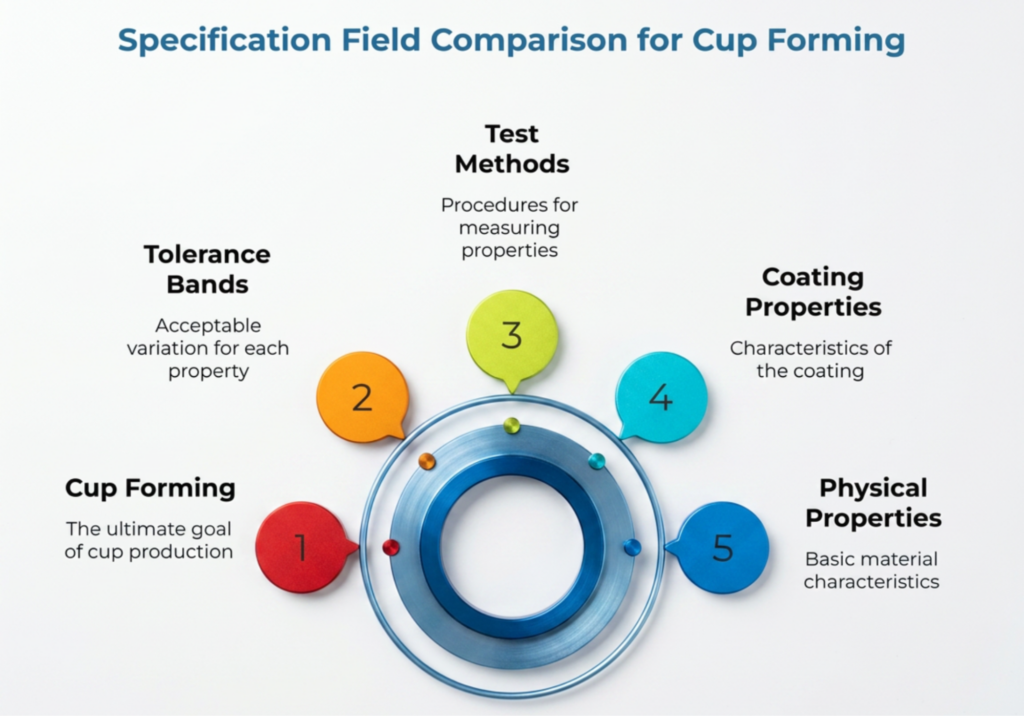
Before scheduling any line trial, procurement and QA should compare the incoming grade’s technical data sheet against the current grade’s specification, field by field.
Key fields to compare include basis weight (GSM), caliper, stiffness in machine and cross direction, moisture content range, coating type and coated side, coating weight or structure where disclosed, surface treatment, sheet or roll dimensions, grain direction for cup forming, lot traceability method, and the tolerance bands for each property.
Two grades may share the same nominal GSM yet differ in caliper enough to affect blanking, in stiffness enough to change cup-wall rigidity, or in moisture range enough to influence curl behavior on the line. Coating weight and surface uniformity can shift heat-seal performance even when the coating chemistry is nominally identical.
Tolerance bands deserve particular attention. A grade with wider tolerances introduces more lot-to-lot variation, which may be acceptable for some cup formats but not others. A supplier data sheet that lists one target value without the allowed variation gives procurement and QA less control than a specification that defines the acceptable range and test method. Where the supplier’s data sheet references specific test methods, confirm those methods match the ones used for the current grade. Differences in test methods — for example, between ISO and TAPPI protocols for stiffness or moisture — can make two values appear comparable when the underlying measurement differs. When teams need formal test-method references, official sources such as ISO 536:2019 for grammage or ISO 287:2017 for moisture content serve as starting points for method alignment. Do not convert these references into universal pass/fail limits unless the buyer’s internal specification, supplier documentation, or applicable standard supports that specific limit.
A specification comparison narrows the field. It does not prove that the new grade will run, seal, and perform like the current one. Do not approve a cupstock switch based only on:
- The same grade name
- Similar GSM
- A clean desk sample
- A supplier’s “equivalent grade” statement
- A lower quoted unit price
Cupstock Grade Switch Verification Matrix
The matrix below provides a starting framework. Adapt the check items and acceptance signals to the specific quality system, equipment, and customer requirements in place.
| Verification Area | What to Check | Owner | Evidence Needed | Pass / Hold / Reject Signal |
| Specification match | GSM, caliper, stiffness, moisture, coating type, tolerance bands, test methods | Procurement + QA | Supplier TDS vs. current internal spec, buyer requirements | Pass if key fields are comparable; hold if required fields are missing or test methods differ |
| Coating and barrier compatibility | Coating type, coated side, coating weight, PE/PLA/barrier structure, intended cup use | QA + Production | Supplier TDS, coating declaration, intended-use requirements | Pass if coating details support trial review; reject if coating type conflicts with sealing method or end-use requirement |
| Cup-forming and blanking | Feed consistency, blank dimensions, curl, forming stability, bottom-punch placement | Production | Trial run records, operator feedback, comparison with known-good grade | Pass if trial behavior meets defined criteria; hold if jam rate or waste rate exceeds the defined threshold; reject if recurring forming issues remain |
| Side-seam and bottom-seal performance | Seal strength, seal appearance, heat-seal window, scorch, delamination, leakage checks | Production + QA | Trial cups, seal-strength test data, inspection records | Reject if seal failures exceed trial acceptance limit; hold if sealing window is unstable |
| Finished-cup quality | Rigidity, print surface, appearance, leak resistance, stacking, customer-specific checks | QA | Finished-cup inspection records | Hold if visual or functional defects appear; pass if cups meet defined QA criteria |
| Compliance documentation | Food-contact declaration, migration data, certification claims, destination-market fit | QA + Compliance | Declarations matched to product, coating, supplier entity, and market | Reject if documentation is missing, mismatched, or unverifiable |
| Supplier consistency and traceability | Lot identification, batch variation, COA availability, change notification process | Procurement + QA | COA samples, lot history, supplier documentation | Pass if traceability supports future issue investigation; hold if lot control is unclear or variation undocumented |
| Trial approval record | Written sign-off with scope, conditions, responsible owner, and next review point | Cross-functional owner | Signed trial report and change record | Reject if no formal record exists before commercial use |
Verify Runnability on the Actual Cup Line
Specification review filters obvious mismatches. A controlled line trial reveals the ones that only surface under real operating conditions.
During the trial, production should monitor feeding and blanking behavior, curl or dimensional changes during forming, side-wall shaping, bottom-punch placement, line speed sensitivity, jam frequency compared to the known-good grade, waste rate, and direct operator feedback. Each variable depends on the specific machine, tooling condition, ambient environment, and operating parameters.
The trial should not be judged only by whether the material “ran.” That phrase is too broad to support a controlled grade change. Teams should define what acceptable means before the trial begins — stable feeding, manageable adjustments, acceptable finished-cup appearance, no recurring jam pattern, and no defect trend that would affect downstream use. A comparison with the known-good grade gives the team a practical baseline.
A grade that runs cleanly on one line may not behave the same way on a different line — even in the same plant. Trial results from another site or a different cup format should not substitute for verification on the target line.
Machine settings may need adjustment during a trial, and those changes should be recorded. If the grade works only after unusual intervention, reduced speed, or frequent operator correction, the decision should reflect that limitation. The grade may still be useful for a limited application, but it may not be ready for full commercial approval.
Record conditions and results with enough detail that the decision can be reviewed later. Informal notes — “it ran okay” — are hard to defend when a quality issue surfaces weeks after commercial production begins.
Check Sealing Behavior Before Judging Finished Cup Quality
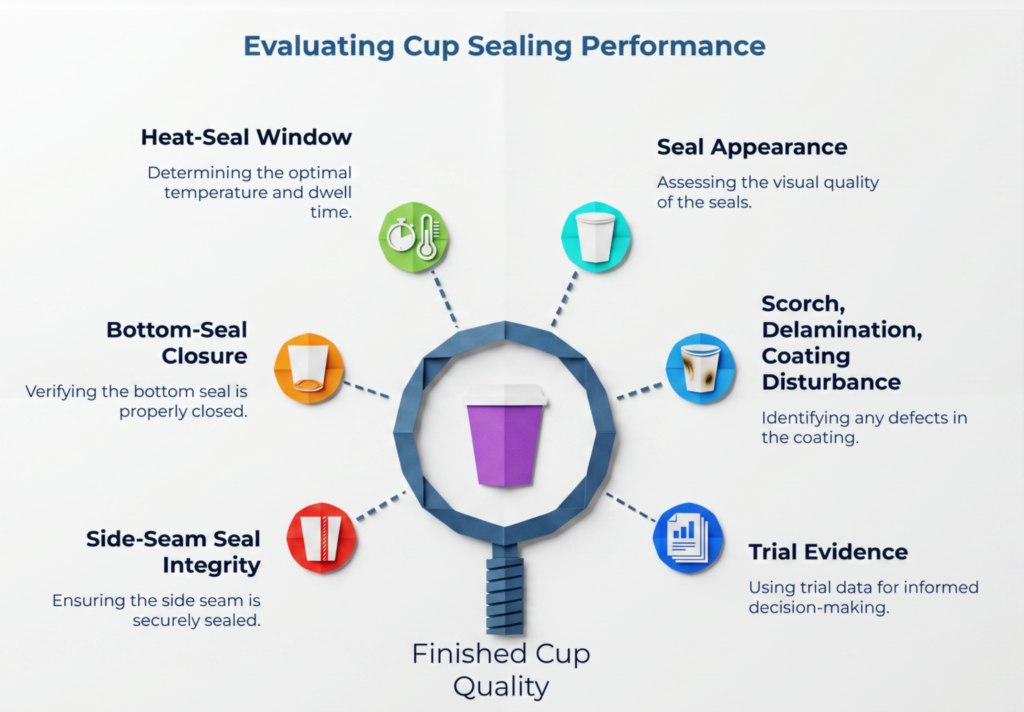
Sealing is where coating differences become visible. A grade that forms well may still produce inconsistent or weak seals.
During the trial, evaluate side-seam seal integrity, bottom-seal closure and strength, the heat-seal window (the temperature and dwell-time range producing acceptable seals), seal appearance under steady-state and edge-case conditions, and any signs of scorch, delamination, or coating disturbance.
Short stoppages, speed changes, and warm-up periods deserve specific attention. Some coating and caliper combinations hold up at steady state but produce inconsistent seals when conditions shift. The checks required will depend on machine design, sealing method, coating chemistry, cup format, and the end customer’s performance expectations. A cup intended for hot beverages, for instance, may need a wider heat-seal window and higher seal strength than one designed for cold drinks.
One coating type should not be treated as universally better than another without application-specific evidence. PE-coated, double PE-coated, uncoated, or alternative barrier cupstock may each require different checks depending on the equipment and intended cup use. A small number of visually acceptable cups should not be the only basis for bulk approval. Use trial evidence before commercial sign-off, and keep the seal checks connected to the actual cup size, line, and customer requirement.
Review QA, Compliance, and Documentation Before Commercial Approval
Production fitness alone is not sufficient. Before the new grade enters commercial use, QA and compliance teams should verify the documentation behind it.
Key documents to request include the supplier’s technical data sheet (confirmed current for the specific product and production site), a certificate of analysis or batch-quality report for the trial lot, lot and batch traceability records, and a food-contact declaration matching the specific product, coating, supplier legal entity, and intended destination market. Where the destination market or end-use application requires it, migration testing, extractives data, and explicit declarations confirming the absence of intentionally added PFAS (per- and polyfluoroalkyl substances) or other restricted chemicals should also be requested.
Compliance documents should match the specific product, coating, supplier entity, destination market, and intended use. A generic food-contact statement may not be enough if the buyer needs documentation tied to a particular grade, coating structure, or customer application. For market-specific food-contact review, teams should consult the relevant official source — such as the European Commission’s food contact materials guidance for the EU market or the FDA’s packaging and food contact substances information for the U.S. market. Other destination markets may require different official or customer-specified documentation. Even if the supplier treats two grades as commercially equivalent, compliance documents must match what is actually being purchased and converted. Requirements vary by destination market, so a declaration valid in one jurisdiction may not satisfy another. Confirm coverage for every market the finished cups will enter.
If the buyer intends to make FSC or PEFC certification claims, the new grade must carry valid chain-of-custody documentation tied to the actual supplier entity and product. For cups entering the European market, compliance with the EU Deforestation Regulation (EUDR) is mandatory for large and medium operators as of December 30, 2025, with the final enforcement phase for micro and small enterprises taking effect June 30, 2026, requiring strict geolocation traceability of raw materials. Because this enforcement phase is now active, verified compliance documentation must be secured prior to raw material validation. Verify that any recycled-content, compostability, or recyclability claims are supported by evidence specific to the exact product, market, and communication channel. Certification documents are relevant only when the buyer intends to make those claims or the customer requires them, but when they are relevant, incomplete documentation creates real exposure.
QA should also confirm whether incoming inspection criteria need revision. If the current receiving checklist was built around the old grade, the new grade may require updated checks, trial records, or supplier change-notification rules.
Use a Controlled Approval Decision
After verification, the decision should follow a structured outcome — not an informal agreement.
Approve when specifications align, trial results meet defined acceptance criteria across the target lines and cup formats, sealing performance is consistent, finished-cup quality passes inspection, compliance documentation is current and properly matched, and supplier traceability is confirmed.
Trial further when initial results look promising but the sample size is too small, the trial covered only one line or cup format, or edge-case conditions — speed changes, stoppages, seasonal humidity shifts — have not been tested.
Limit use when the grade performs well for specific lines or cup sizes but the evidence base is insufficient for broader deployment. Document which configurations are approved and which remain restricted.
Reject when sealing failures, forming defects, documentation gaps, or lot-to-lot consistency concerns remain unresolved after a reasonable trial period.
This framework helps teams avoid two opposite mistakes. Approving too quickly because the quote looks attractive is one. Rejecting a workable grade because the review process is unclear is the other. A controlled decision lets the team approve where evidence is strong, hold where evidence is incomplete, and limit use where the grade has a narrow but valid application.
Whichever outcome applies, document it in writing. Record who approved or rejected the change, under what conditions, based on what evidence, and for which lines, cup formats, and markets. Written approval ownership protects procurement, production, and QA alike if questions arise later.
Make the Grade Change Defensible Before Production Depends on It
Switching cupstock grades is manageable when teams verify the right evidence before the new grade enters commercial use. The process does not need to be slow — it needs to be structured, cross-functional, and documented.
Start by building a verification checklist adapted from the matrix above, fitted to the organization’s own equipment, quality system, and customer requirements. Use that checklist to align procurement, production, and QA before trials begin — not after problems surface.
When the team is ready to compare cupstock exporters and suppliers or review cupstock producing mills, bring the completed checklist to that conversation. When the requirement is ready for supplier comparison, teams can also prepare the details and submit a cupstock RFQ.
Frequently Asked Questions
Can two cupstock grades with the same GSM perform differently?
Yes. GSM measures weight per unit area, but it does not capture caliper, stiffness, moisture behavior, coating weight, surface properties, or tolerance ranges. Two grades at the same GSM can differ enough in these properties to produce noticeably different forming, sealing, and finished-cup results on the same line.
Should procurement approve a cupstock switch before production trials?
Procurement can shortlist candidates based on specification review, pricing, and supplier documentation. Final approval should not rest on a quote, supplier assurance, or desk sample alone. Production and QA need to validate runnability, sealing, and finished-cup quality through a controlled line trial before the grade moves to commercial use.
What documents should a supplier provide before a cupstock grade change?
At minimum: a current technical data sheet for the specific product and production site, lot or batch traceability information, and food-contact documentation matched to the product, coating, supplier entity, and intended destination market. Where applicable, certification documentation (such as FSC or PEFC chain-of-custody records) and migration or extractives testing data should also be requested. The exact document set may vary by buyer requirements, customer specifications, and destination market.
When should a new cupstock grade be limited to one line or cup size first?
When trial results show acceptable performance on one configuration but evidence is not yet sufficient for broader use — for example, when only one line has been trialed, when the grade has not been tested across all target cup sizes, or when variable conditions like seasonal humidity have not been covered. Limiting initial deployment reduces risk while the evidence base grows.
Disclaimer:
This article is for general informational purposes only and does not constitute compliance, safety, technical, or professional advice. Requirements, risks, and best practices may vary by context, jurisdiction, equipment, supplier, product specification, and end use. Confirm important decisions with the appropriate qualified professional, authority, supplier, or technical expert.
Our Editorial Process:
Our expert team uses AI tools to help organize and structure our initial drafts. Every piece is then extensively rewritten, fact-checked, and enriched with first-hand insights and experiences by expert humans on our Insights Team to ensure accuracy and clarity.
About the PaperIndex Insights Team:
The PaperIndex Insights Team is our dedicated engine for synthesizing complex topics into clear, helpful guides. While our content is thoroughly reviewed for clarity and accuracy, it is for informational purposes and should not replace professional advice.