

📌 Key Takeaways
Growth-stage paper cup teams should review cupstock specs when recurring problems show the original buying document no longer fits the actual order mix.
- Patterns Matter More Than One-Off Problems: Repeated issues across lots, suppliers, or SKUs signal a spec gap worth investigating—single bad runs usually do not.
- Reviewing Isn’t Rewriting: A spec review might just add missing fields or document unwritten assumptions, not start from scratch.
- SKU Growth Quietly Outpaces Buying Documents: Adding cup sizes, coatings, or print variants can make a single “standard” spec carry too many hidden assumptions.
- Passing Incoming Checks Can Still Miss Real Problems: Quality criteria built for a simpler product range may not catch what actually causes trouble on the forming line.
- Normalize Supplier Data Before Comparing Prices: Matching GSM on two data sheets does not guarantee matching performance—align all relevant fields before issuing RFQs.
Better specs start with reviewing what you already buy, not rushing to find a new supplier.
Procurement, production, and quality teams at growth-stage paper cup converters will gain a clear framework for deciding when and how to revisit cupstock specifications, preparing them for the detailed overview that follows.
~ ~ ~ ~ ~ ~ ~ ~ ~ ~ ~ ~ ~ ~ ~ ~ ~ ~
Growth-stage paper cup teams often begin with cupstock buying habits that work for a limited order mix. A familiar supplier, a narrow cup range, a known coating type, and repeat production runs can make informal specifications feel sufficient.
This stability changes as the business introduces additional cup sizes, novel coatings, and varied print variants. Managing multiple suppliers and specialized customer requirements creates operational complexity that informal agreements can no longer support. As this variety accumulates, the informal specifications that once kept procurement, production, and quality aligned may no longer reflect what the business actually buys, converts, and ships.
The practical question is not whether cupstock specifications will ever need review. They almost certainly will. The question is when the evidence is strong enough to justify a structured look—and how to tell the difference between normal variation and a pattern that signals a genuine specification gap.
Cupstock Specification Review Trigger Matrix
| Signal Area | Example Trigger | What It May Indicate | First Review Step |
| SKU variety | More sizes, coatings, print variants, or wall constructions | The existing specification may be too generic for the current order mix | Map active variants to current specification fields |
| Supplier change | New mill, grade, source, coating description, or roll format | Supplier sheets may not be directly comparable | Compare equivalent data-sheet fields and tolerances |
| Production feedback | Recurring curl, forming, sealing, or runnability issues | A material, storage, equipment, or process mismatch may need review | Compare issue logs by lot, supplier, SKU, and run |
| Quality checks | Repeated incoming deviations or passed lots that still run poorly | Incoming checks may not reflect real cup-forming performance | Review acceptance criteria, traceability, and feedback loops |
| Customer requirements | New foodservice, branding, storage, or documentation needs | Existing specs may miss end-use or approval requirements | Confirm requirements before revising the RFQ |
A Specification Review Is Not the Same as Rewriting Everything
A specification review does not mean starting over. Teams sometimes delay a review because they assume it requires a full rewrite. That assumption can be costly.
A review might confirm that the current specification still works, or it might mean adding a few missing fields, tightening an acceptance criterion, separating two product families that have outgrown a single spec, or simply documenting supplier assumptions that were never written down.
The key distinction is between reviewing and changing. Reviewing means checking whether the existing specification still fits the order mix, supplier base, production behavior, and quality requirements. Changing means updating specific fields, tolerances, or requirements after evidence and cross-functional alignment support the update. Not every review leads to a change—and not every production hiccup warrants a review.
This distinction protects teams from two common mistakes. One is ignoring repeated signals because the old buying note ‘has always worked’; the other is changing specifications too quickly after a single unusual run.
A review-worthy pattern is usually broader than one incident. It may show up across related SKUs, repeat with a certain supplier source, appear after a grade or coating change, or recur when production conditions are otherwise stable.
SKU and Order Variety Outgrow the Original Specification
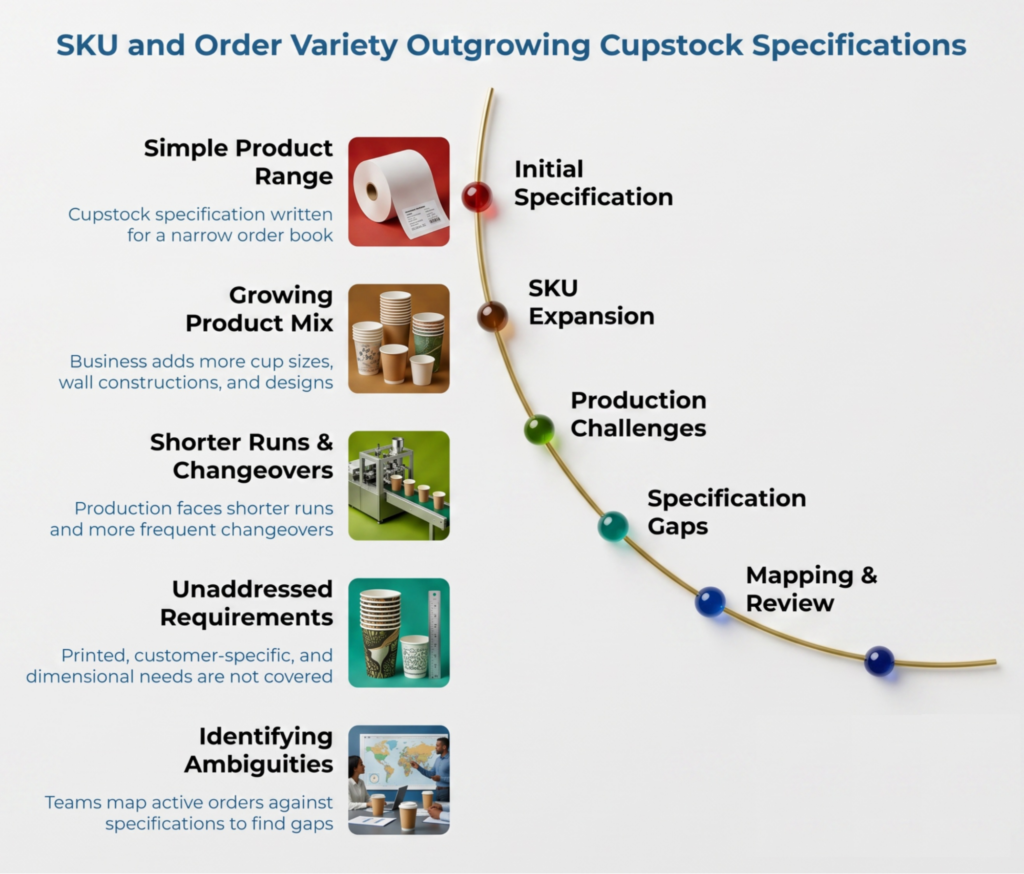
SKU growth places pressure on specifications that were originally written for a simpler product range. Many converters write their first cupstock specification around a narrow order book, and the mix often expands faster than the purchasing documentation behind it.
A paper cup business may add more cup sizes, different wall constructions, printed designs, hot and cold beverage formats, or customer-specific packaging requirements. At the same time, production may face shorter runs and more frequent changeovers. The original cupstock description may still contain useful information, but it can also hide assumptions that were never formally documented.
Signals that SKU variety may be outpacing the specification include printed and unprinted variants sharing a single spec that does not account for print-surface requirements, customer-specific orders introducing performance expectations—such as rigidity for vending applications or moisture resistance for cold beverages—that the original spec does not address, and more cup sizes or wall constructions running on the same line with different material demands.
One “standard” cupstock specification may be used for plain cups, printed cups, and customer-branded cups. That does not automatically mean every product needs a separate specification. It does mean the team should check whether those products truly share the same performance, coating, surface, roll, storage, and documentation expectations.
A practical first step is to map active order families against the existing specification. The teams closest to buying, converting, and inspecting can then identify where one requirement is carrying too much responsibility.
Useful review questions include: Which SKUs are materially similar? Which ones have different end-use or production needs? Where are supplier descriptions vague? Which fields are missing from the current buying document? Where one “standard” spec is carrying assumptions for cup families with different GSM needs, coating types, or dimensional requirements, the mapping often reveals where ambiguity has quietly built up.
Production Feedback Starts Repeating Across Runs
Production teams often detect material-related friction before procurement sees it in a data sheet. Recurring curl, dimensional stability concerns, inconsistent forming, sealing problems, line-speed adjustments, higher-than-usual rejects, stoppages, or operator workarounds can all signal that the specification deserves review. Line speed reductions that correlate with specific material batches are another signal worth tracking.
These signals deserve investigation, not automatic escalation. Curl on the production floor alone does not by itself prove the cupstock specification is wrong. Sealing issues are not always caused by the board. Runnability problems may involve material properties, storage conditions, ambient humidity, machine calibration, coating behavior, machine settings, tooling, operator setup, or the order itself. What matters is whether the pattern recurs across enough runs, lots, or suppliers to suggest the specification may be missing a relevant variable.
The value of production feedback is strongest when it is recorded consistently. A comment such as “this roll ran badly” is difficult to use. A record tied to supplier, lot, SKU, line, run date, storage condition, and observed symptom is much more useful.
For example, a growth-stage paper cup converter originally buys one standard PE-coated cupstock grade for a limited cup range. As it adds printed cups, new sizes, and a second supplier, production starts recording recurring curl or forming issues on certain SKUs. The team does not immediately blame the supplier. It maps issues by SKU, supplier lot, coating, storage, and production run before deciding whether the house specification needs refinement. The comparison reveals that the house specification does not distinguish between single-wall and double-wall material requirements—a gap that became visible only after the order mix expanded.
Quality Checks No Longer Explain Actual Performance
Incoming quality checks may pass while production still experiences problems. This disconnect can develop when acceptance criteria were defined for a narrower product range, when the checked parameters do not fully reflect how the material behaves during cup forming, sealing, printing, or storage, or when lot traceability is insufficient to connect quality records to specific production outcomes.
This does not mean the quality process failed. It may mean the quality process was calibrated for an order mix the business has since outgrown.
As cupstock requirements become more varied, quality teams may need to review whether incoming checks cover the right parameters, whether lot traceability is strong enough, whether supplier documentation is complete, and whether production feedback is being routed back into the approval process. The goal is alignment between incoming approval and production behavior—not added complexity for its own sake.
Specific test methods and pass/fail thresholds should be selected by qualified quality or technical teams. If a team needs to name formal methods for paper and board properties, official standards bodies such as ISO (e.g., ISO 536 for grammage) or TAPPI (e.g., the T 400 series for paper testing) are the appropriate authoritative sources to verify current standards before adding them to internal documents or RFQs.
For the article’s purpose, the key point is simpler: if incoming approval and production behavior no longer align, the specification may need review.
Supplier or Grade Changes Make Comparisons Harder

Growth-stage teams may add suppliers to improve availability, reduce single-source exposure, support larger volumes, or manage lead-time risk. That can be useful, but it can also make cupstock comparison harder.
Two supplier offers may appear similar while using different terminology. One may describe GSM or basis weight clearly but provide limited detail on coating type, caliper, stiffness, moisture, reel or roll format, tolerances, or test references. Another may provide a more complete data sheet but use terms that do not match the buyer’s internal language. A cupstock grade described as “230 GSM, PE-coated” by one supplier may not perform identically to a similarly described grade from another, depending on fiber composition, coating weight, caliper, moisture content, and stiffness.
Procurement should avoid treating quotes as equivalent until the underlying fields have been compared side by side. Matching GSM on two data sheets does not guarantee matching behavior on the forming line. Coating description, stiffness, dimensional stability, roll condition, documentation scope, and tolerances may all affect how confidently teams can compare grades. Teams evaluating new suppliers may find it useful to review approaches for verifying supplier capability before treating quotes as interchangeable.
This is where specification normalization helps. Before comparing price, procurement can align supplier documents against buyer-owned fields: grade description, coating type, basis weight or GSM, caliper, moisture-related handling expectations, roll format, tolerances, test references, packaging, lot traceability, and customer documentation requirements. This alignment should happen before issuing RFQs—not after material arrives on the production floor.
After internal requirements are clearer, teams can compare cupstock suppliers and exporters or cupstock manufacturers with a more disciplined understanding of what needs to match.
Customer, Compliance, or End-Use Requirements Become More Specific
Customer requirements often become more detailed as a paper cup business grows. New orders may involve foodservice use, hot or cold beverages, branded printing, storage expectations, surface presentation, or sustainability documentation.
The risk at the growth stage is that these requirements accumulate informally—through emails, verbal instructions, or sales notes—without being reflected in the purchasing specification. Over time, a gap develops between what procurement buys and what the customer actually needs.
These requirements can affect what the cupstock specification needs to capture. A plain cup and a customer-branded printed cup may not need the same level of surface or documentation review. A foodservice application may require additional confirmation of the coating, intended use, supplier declarations, and destination-market requirements.
Compliance-sensitive claims need caution. Food-contact suitability, recyclability, compostability, and coating compliance should not be assumed from a generic certificate or broad supplier statement. Requirements can vary by product design, material construction, end use, and jurisdiction.
For food-contact or packaging compliance questions, teams should refer to applicable official statutory sources in the target market, such as the FDA’s food-contact substance regulations (specifically 21 CFR Part 176 for paper and paperboard), or the European Commission’s framework Regulation (EC) No 1935/2004 on food contact materials, depending on where the product will be used or sold.
If procurement cannot translate a customer requirement into clear supplier-facing language, that is often a review trigger on its own.
A Practical Review Sequence Before Changing the Spec
The following sequence helps move from evidence gathering to specification updates without overreacting or skipping steps.
Collect evidence. Gather relevant order records, supplier lot data, production issue logs, incoming QC records, complaint notes, storage observations, and customer-specific documentation requests. The goal is a factual picture of where the current specification is—and is not—working.
Separate one-off issues from recurring patterns. A single difficult run may justify monitoring. A repeated issue linked to a SKU family, supplier lot, coating description, storage condition, or production line may justify deeper review. Recurring patterns across lots, suppliers, SKUs, or time periods carry more diagnostic weight than isolated incidents.
Compare the current specification against the new order mix. Identify where the existing specification covers the active product range and where it relies on assumptions that no longer hold. Look for missing fields, broad assumptions, unclear terminology, undocumented exceptions, and areas where procurement, production, and quality use different language for the same requirement.
Identify missing or ambiguous fields. Common areas include coating weight, moisture range, stiffness direction, caliper tolerance, and reel or sheet format requirements—fields that may have been unnecessary for a simpler order book but matter as variety increases.
Review cross-functionally before finalizing. Specification changes that reflect only one function’s perspective can create new blind spots. Buying teams see supplier comparability and RFQ clarity. The converting floor sees runnability, machine behavior, and workarounds. Inspection teams see incoming checks, traceability, and complaint patterns. Compliance or customer-facing teams may need to join when food-contact, sustainability, or labeling issues are involved. The review should confirm that updates serve purchasing clarity, line performance, and incoming quality control together.
Update supplier-facing requirements only after internal alignment. A clearer RFQ helps only when the internal requirement is clear enough to quote against. Once the team agrees on what needs to change, update the specification document and communicate revised requirements to current and prospective suppliers before the next purchasing cycle.
Review Specs When Growth Changes the Assumptions Behind Them
Cupstock specifications deserve review when the assumptions behind buying, converting, inspecting, or comparing suppliers no longer match the business’s actual operating footprint.
The strongest triggers are recurring patterns—production feedback that repeats across runs, quality checks that no longer explain actual performance, supplier documents that resist direct comparison, or customer requirements that outpace what the buying document captures.
The most useful reviews are evidence-led, include every function that touches the material, and focus on patterns rather than isolated events. They treat the specification as a living document that should reflect the business’s current operating reality, not a static artifact from a simpler order book.
The right next step is not always a new grade or a new supplier. Often, it is a better internal review of what the business is already buying, producing, checking, and promising customers.
After clarifying cupstock requirements, teams can compare suppliers more effectively or use a clearer RFQ. Teams ready to source can submit an RFQ with clearer specifications to help ensure supplier responses are comparable and relevant. Technical grade fit should still be confirmed through the buyer’s own procurement, quality, production, compliance, and supplier technical review.
Frequently Asked Questions
Does every new paper cup SKU need a separate cupstock specification?
Not necessarily. Some SKUs may share a specification if their performance requirements, coating needs, production conditions, and customer expectations are similar enough. A review helps decide whether the grouping still makes sense or whether certain product families have diverged enough to warrant separate specs.
What is the difference between reviewing and changing a cupstock specification?
Reviewing means checking whether the current specification still fits the order mix, supplier base, and production behavior. Changing means updating specific fields or tolerances after evidence has been collected and the relevant teams agree on what needs to change. A review may confirm that no change is needed.
Who should be involved in a cupstock specification review?
Procurement, production, and quality should usually be involved. Procurement manages supplier communication and quote comparison. Production sees runnability and line behavior. Quality manages incoming checks, traceability, deviations, and complaints. Depending on the triggers involved, compliance or customer-facing teams may also need to participate—particularly when food-contact suitability, sustainability documentation, or customer-specific performance requirements are part of the review.
Should production issues automatically trigger a supplier change?
No. Production issues should first be compared against material records, machine settings, storage conditions, order type, supplier lot, and documentation. A supplier change may be considered later, but recurring production feedback is first a signal to investigate the pattern and determine whether the root cause is material-related, process-related, or specification-related.
Disclaimer:
This article is for general informational purposes only and does not constitute compliance, safety, technical, or professional advice. Cupstock requirements, material performance, testing needs, and regulatory obligations may vary by product design, production process, supplier documentation, destination market, and end use. Confirm important decisions with qualified quality, compliance, production, or supplier technical professionals.
Our Editorial Process:
Our expert team uses AI tools to help organize and structure our initial drafts. Every piece is then extensively rewritten, fact-checked, and enriched with first-hand insights and experiences by expert humans on our Insights Team to ensure accuracy and clarity.
About the PaperIndex Insights Team:
The PaperIndex Insights Team is our dedicated engine for synthesizing complex topics into clear, helpful guides. While our content is thoroughly reviewed for clarity and accuracy, it is for informational purposes and should not replace professional advice.