

📌 Key Takeaways
Single-source procurement concentrates operational risk into one external dependency, turning supplier disruptions into fulfillment stoppages that cost more than procurement savings.
- Concentration Creates Vulnerability: Relying on one packaging supplier eliminates backup options when machinery failures, material shortages, or logistics delays halt production.
- Hidden Costs Exceed Visible Savings: Emergency expediting, premium freight, short-run printing, overtime, and repacking expenses scatter across departments and erase unit-price discounts.
- The Risk Calculator Reveals Exposure: An 8-factor assessment table scoring supplier concentration, lead time buffers, spec complexity, and geographic risks identifies where single-source arrangements threaten continuity.
- Qualify Backups Before Crisis: Proactive supplier qualification—validating specs, documenting lead times, establishing commercial terms—takes weeks in normal conditions but becomes impossible during disruption.
- Normalize Specs to Enable Switching: Standardizing dimensions, GSM weights, and kraft grades to industry norms reduces qualification friction and expands the pool of capable alternatives.
Resilience means qualifying alternatives before you need them, not scrambling when supply stops.
E-commerce operations managers and procurement teams responsible for packaging supply will gain a practical framework for assessing concentration risk, preparing them for the detailed risk calculator and resilience playbook that follows.
The warehouse is quiet. Too quiet. Your packaging supplier just called—production is halted for three weeks. Meanwhile, 2,000 orders sit ready to ship, and your single source of mailer bags has become a single point of failure.
Single-source procurement means relying on one supplier for a critical input. For e-commerce operations, packaging isn’t a commodity you can substitute overnight. Its operational infrastructure—cartons, mailers, labels, tape, void fill, and branded inserts that connect your product to your customer’s doorstep. The arrangement feels efficient: one vendor relationship to manage, consistent quality, streamlined ordering. Until something breaks.
This guide unpacks the hidden risks lurking beneath that operational simplicity and provides a practical framework—including a Supply Chain Risk Calculator—to help you assess your exposure and build resilience before disruption forces your hand.
Why Single-Source Procurement Feels Efficient (Until It Fails)
The appeal is genuine. Working with a single paper bag supplier means fewer vendor relationships consuming your procurement team’s bandwidth. Purchase orders become routine. Quality stays consistent because you’re drawing from one production line. Invoicing simplifies. The cognitive load of managing multiple SKUs, specs, and contacts drops considerably.
For growing e-commerce brands, this simplicity creates breathing room to focus on marketing, product development, and customer acquisition rather than supply chain complexity.
But here’s the tradeoff procurement teams often underestimate: every efficiency gain concentrates risk. What risk managers call “concentration risk” means that a single relationship becomes a single thread holding your fulfillment operation together. When the thread snaps—and eventually, something always snaps—there’s no backup catching the fall.
The 3 Hidden Risks of Single-Source Procurement
What makes these risks “hidden” is that they don’t appear on a purchase order or show up in quarterly cost analyses. They materialize suddenly, often at the worst possible moment.
Operational Risk: Fulfillment Paralysis. When your sole packaging supplier experiences a disruption—machinery failure, raw material shortage, labor dispute, logistics bottleneck—your ability to ship orders stops with them. Before full stoppage, warehouses try workarounds: reallocating packaging across SKUs, splitting orders into partial shipments, delaying lower-priority fulfillments. These actions consume labor and increase error rates while disguising how close the operation is to grinding to a halt. E-commerce fulfillment tolerates zero gaps in packaging supply. You can’t ship a fragile product in an improvised box without risking damage claims, returns, and customer complaints. The operational risk isn’t theoretical; it’s the difference between orders moving and orders stacking up in your warehouse.
Financial Risk: The Scramble Premium. Disruption triggers expensive firefighting scattered across departments. Moving from panic buying to strategic sourcing requires advance planning and qualified backup suppliers. Expedited shipping from alternative suppliers (if you can find them quickly) costs multiples of standard rates. Emergency purchasing often means accepting premium pricing without negotiation leverage. Short-run printing for substitute packaging materials carries setup fees that dwarf per-unit costs. Teams spend on overtime, repacking labor, and customer service handling. Substituting different packaging materials may require rework, reprinting, or accepting quality compromises. Internal teams shift from productive work to crisis management. These costs rarely appear in procurement’s budget because they’re scattered across operations, logistics, and customer service—similar to how unverified suppliers create hidden budget impacts beyond the unit price. Supply chain studies, including data from the Business Continuity Institute, indicate that disruption costs frequently exceed initial estimates due to emergency premiums. For affected product lines, companies often face temporary cost spikes of 15–30% driven by expedited freight, overtime labor, and spot-market purchasing rates.
Brand Risk: Customer Experience Degradation. Packaging is a brand touchpoint, particularly for direct-to-consumer e-commerce. When disruption forces you into substitute materials—generic boxes instead of branded kraft paper bags, mismatched colors, inconsistent unboxing experiences—customers notice. Delayed shipments erode trust. Inconsistency signals operational immaturity. For brands competing on experience rather than price alone, packaging inconsistency undermines positioning that took years to build. In regulated or premium categories, packaging changes can also create compliance and perception issues around label durability or scannability.
“Efficiency is great, but resilience is survival.”
The Domino Effect: How One Disruption Becomes Missed Deliveries
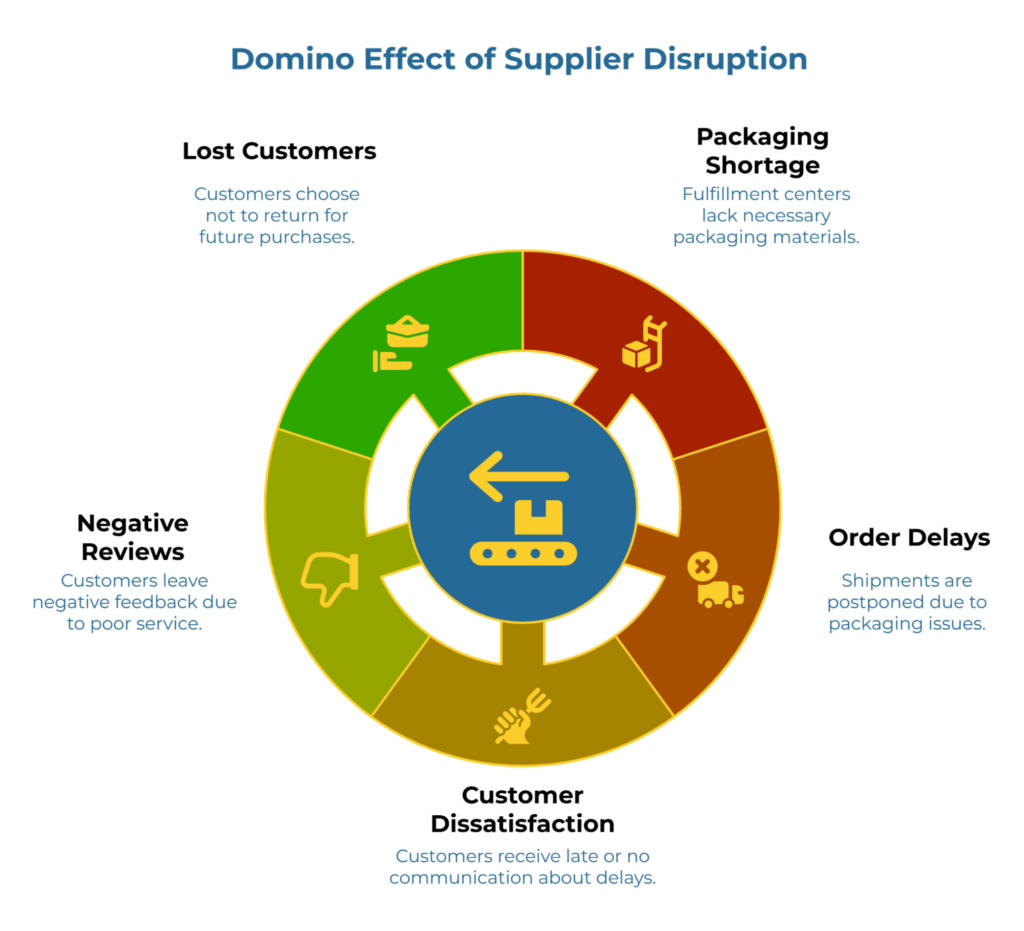
Understanding the cascade helps clarify why single-source exposure demands attention before a crisis hits.
The sequence typically unfolds like this: A supplier disruption occurs—perhaps equipment failure, a quality issue requiring production halt, or upstream raw material constraints. This triggers a packaging shortage at your fulfillment center. Without packaging, fulfillment slows or stops entirely. Orders that should ship today queue for tomorrow, then next week.
Customers waiting for shipments receive delay notifications—or worse, no communication at all. Delivery windows slip. Some customers cancel. Others receive orders late and leave negative reviews. A portion won’t return for their next purchase. Each lost customer represents not just one transaction but lifetime value walking away.
The domino effect explains why procurement decisions that seem purely operational carry strategic weight. A $0.03 per-unit savings on packaging means nothing if one disruption costs you a month of customer goodwill.
Use the Supply Chain Risk Calculator
Assessing your single-source exposure doesn’t require sophisticated software. The following framework helps procurement and operations teams evaluate risk quickly and identify where intervention matters most.
Risk Factor Assessment Table
| Risk Factor | What to Check (Buyer-Side) | What to Prepare (Supplier-Side) | Likely Impact if Single-Sourced |
| Supplier concentration | % of packaging volume from top supplier | Capacity headroom documentation; surge capability evidence | >80% = Critical exposure; one disruption halts all fulfillment |
| Capacity constraint | Peak season headroom; confirmed production slotting; documented surge plan | Subcontracting relationships; overflow capacity agreements | Stockouts during demand spikes; extended lead times; missed carrier cutoffs |
| Geographic concentration | Supplier location relative to disruption risks (weather, port congestion, political instability) | Multi-site production options; alternate shipping routes | Single-region events (hurricanes, strikes, lockdowns) become total supply failures |
| Lead time buffer | Days of safety stock vs. standard lead time | Early warning trigger system; buffer stock strategy | Buffer < Supplier Production Cycle = High stockout risk; inventory insufficient to cover reproduction lead time |
| Quality drift | Defect trend analysis; audit cadence; corrective action tracking | Statistical process control; root-cause analysis discipline | Returns spike; damage claims; brand erosion without early detection |
| Spec complexity | How easily can another supplier match specs? Custom vs. standard dimensions, materials, print requirements | Changeover flexibility; ability to match precise specifications | Custom specs = Longer qualification time; months to activate backup |
| Single-point components | Dependencies on specific labels, inks, adhesives, specialty papers that only one supplier provides | Approved alternate materials; secondary source relationships | One missing input blocks all output; complete production stoppage |
| Communication latency | Escalation path clarity; update frequency expectations | Named escalation contacts; defined update SLA | Delayed problem notification; bigger operational surprise when issues surface |
Risk Level Matrix
This simplified 2×2 matrix helps visualize where your current sourcing position falls:
| Lead Time Delay: Low | Lead Time Delay: High | |
| Supplier Reliability: High | Moderate Risk — Monitor quarterly | Elevated Risk — Build backup options |
| Supplier Reliability: Low | Elevated Risk — Accelerate diversification | HIGH RISK — Immediate action required |
How to interpret: Operating in the high-risk quadrant—characterized by historically low reliability and extended lead times—means your single-source procurement lacks the agility to recover from inevitable variations, posing a quantifiable threat to fulfillment continuity. The red zone demands immediate attention: either improve current supplier performance or qualify alternatives before disruption forces reactive decision-making.
Note that “reliability” encompasses more than on-time delivery. Consider quality consistency, communication responsiveness, financial stability, and capacity headroom during demand spikes.
Resilience Playbook: Reduce Single-Source Exposure
Moving from concentrated risk to distributed resilience doesn’t require rebuilding your entire supply chain. Four practical steps create meaningful protection.
Qualify a Backup Supplier Before Crisis Hits
The worst time to find a new supplier is when you desperately need one. Proactive qualification—requesting samples, validating specs, establishing commercial terms—takes weeks under normal circumstances. During a supply crisis, that timeline stretches while your leverage evaporates.
Effective qualification means verifying the supplier can meet your functional requirements: dimensions, strength specifications such as GSM and burst factor, print and branding tolerances. Production and logistics lead times need documentation for both normal and peak conditions. Commercial terms should be defined clearly enough that activation doesn’t stall in approval cycles.
Begin the qualification process with at least one alternative supplier now, even if you don’t intend to place volume immediately. Verify international suppliers systematically to ensure they meet your quality and reliability standards. Digital sourcing platforms and industry directories allow procurement teams to identify verified suppliers across multiple geographies, enabling capability comparison without immediate volume commitments.
For suppliers, backup readiness is a competitive advantage. Buyers evaluate responsiveness, transparency, and reliability evidence—especially during periods of market volatility.
Normalize Specifications to Enable Switching
Proprietary specs create switching friction. If your current supplier uses unique dimensions, custom print setups, or non-standard materials, qualifying an alternative becomes a mini-development project. Where possible, align specifications with industry-standard options—common paper bag dimensions, standard GSM weights, widely available kraft grades.
Practical normalization methods include:
- Define must-have versus nice-to-have requirements (critical dimensions and closure performance versus optional finishes)
- Standardize to a smaller set of sizes and SKUs where possible
- Maintain version control for print files and packaging drawings so alternates can be onboarded quickly
This normalization reduces qualification time and expands your pool of capable backup suppliers. (For detailed methodology, see our guide on spec-true mindset.)
Establish Clear Activation Triggers
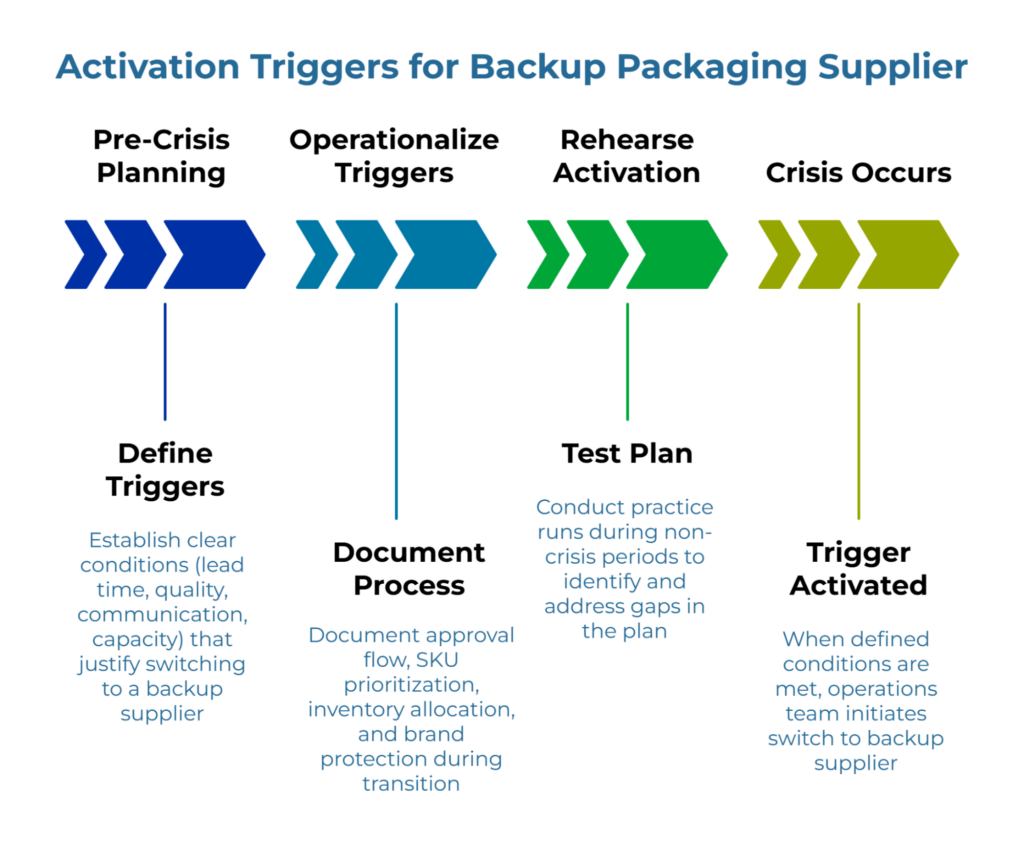
Resilience fails when activation is ad hoc. Define in advance what conditions justify activating your backup supplier. Useful triggers include:
- Lead time slipping beyond a defined threshold (e.g., 5+ days beyond quoted)
- Quality defect rate exceeding agreed tolerance levels
- Supplier communication becoming unresponsive for specified periods
- Capacity constraints preventing order fulfillment during peak periods
Then operationalize the trigger by documenting:
- Who approves the switch?
- Which SKUs switch first?
- How is inventory allocated during the transition?
- How are customer-facing brand elements protected (print consistency, inserts, messaging)?
Written triggers prevent debate during crisis and empower operations teams to act decisively. Rehearse the activation process during non-crisis periods to identify gaps in the plan before they matter.
Align with Risk-Management Standards (Optional for Governance)
For organizations requiring formal risk-management frameworks, recognized standards provide structure without requiring certification. Additionally, remote supplier verification methods enable systematic qualification without the expense of site visits.
ISO 31000:2018 offers general risk-management guidance for identifying, assessing, and treating risk across any operational context. The standard’s logic applies directly to supplier concentration issues: identify the dependency, assess likelihood and impact, implement controls, monitor effectiveness.
ISO 22301 provides a business continuity management framework that translates supplier disruption into continuity planning. The standard helps organizations prepare for, respond to, and recover from disruptive incidents.
For teams operating in security-sensitive supply chains, NIST guidance on supply chain risk management offers additional structure for managing supplier-related risk, especially where assurance and monitoring matter.
These frameworks are optional. Their value lies in providing governance-friendly language when procurement decisions require board-level or compliance-team approval.
Building Supply Chain Resilience as a Strategic Asset
Single-source procurement isn’t inherently wrong—it’s a calculated bet that simplicity outweighs fragility. For early-stage e-commerce operations with limited volume, concentrating with one reliable supplier may represent the right tradeoff.
But as order volumes grow, customer expectations rise, and fulfillment becomes a competitive differentiator, that calculus shifts. Developing a mature sourcing strategy transforms packaging from operational vulnerability to competitive advantage. The hidden costs of single-source exposure—operational paralysis, scramble premiums, brand erosion—compound faster than the visible savings from consolidated purchasing.
Resilience isn’t about maintaining expensive redundancy for its own sake. It’s about qualifying alternatives before you need them, normalizing specs to enable flexibility, and establishing clear triggers so transitions happen smoothly rather than chaotically.
Ready to assess your options? Submit an RFQ to receive quotes from multiple paper bag suppliers, or explore the supplier directory to identify potential backup partners aligned with your specifications.
Disclaimer: This article provides general educational guidance on procurement strategy. Specific risk assessments and sourcing decisions should account for your organization’s unique circumstances, supplier relationships, and operational requirements
Our Editorial Process:
Our expert team uses AI tools to help organize and structure our initial drafts. Every piece is then extensively rewritten, fact-checked, and enriched with first-hand insights and experiences by expert humans on our Insights Team to ensure accuracy and clarity.
About the PaperIndex Insights Team:
The PaperIndex Insights Team is our dedicated engine for synthesizing complex topics into clear, helpful guides. While our content is thoroughly reviewed for clarity and accuracy, it is for informational purposes and should not replace professional advice.