

📌 Key Takeaways
Certification claims count only when they appear on the final invoice, not just in supplier promises or certificate PDFs.
- Invoice Issuer Identity Determines Proof: Verify which legal entity issues the invoice and confirm they hold valid certification covering your product before approving the purchase order.
- Four Questions Reveal Baton Drops: Ask suppliers to specify exact claim wording, certificate codes, document placement, and timing—vague answers signal likely proof failures.
- Purchase Order Clauses Lock Requirements: Written PO language requiring specific claim wording on invoices creates enforceable documentation standards and prevents “we’ll add it later” excuses.
- Traders Add Handoff Risk: Each intermediary between mill and buyer creates another drop point where claims can disappear through entity mismatches or documentation gaps.
- Pre-Approval Testing Beats Post-Delivery Chasing: Ten minutes of verification questions before ordering prevents weeks of scrambling for missing proof after goods arrive.
Claims survive supply chains when status, scope, and document continuity align from quote through invoice.
Procurement teams managing certified paper sourcing through international traders will gain rapid verification protocols here, preparing them for the implementation scripts and PO templates that follow.
The quote said “FSC certified.” The supplier confirmed it twice. But when the invoice arrived, the certification claim had vanished.
Now a customer is asking for proof of certified paper—and there’s nothing to show them. This scenario is especially common when sourcing through international supply chains. Finding suppliers who can maintain certification continuity requires verification before commitment, not after delivery.
This happens constantly when traders enter supply chains. The mill holds a valid certificate. The trader sounds confident. Yet somewhere between quote and invoice, the claim disappears. Chain-of-custody certification works like a relay baton: every runner must receive it properly and pass it forward correctly. Drop it once, and the team is disqualified at the finish line—regardless of how fast everyone ran.
Treat the claim like a relay baton: drop it at a handoff, and it does not count at the finish line. A certificate PDF sitting in a filing cabinet means nothing if the claim never reaches the invoice. The good news? A simple four-question test reveals whether the baton will survive the handoffs or hit the ground.
What the “Relay Baton” Test Checks (In Plain English)
The claim is a document trail, not a logo
A certificate PDF helps, but proof usually lives in the documents that travel with the order—especially the invoice.
Three checks:
- Status: certificate active/valid in the public registry
- Scope: relevant to the seller’s role/activity and product group for this transaction
- Document continuity: exact claim wording survives quote → PO → delivery docs/labels → invoice
Where the baton gets dropped: handoffs between companies
Trader-added chains are higher risk because taking legal ownership requires the trader to hold their own valid Chain of Custody certificate to pass the claim; common breaks occur when uncertified traders attempt to ‘pass through’ paperwork, or when there is wording drift, missing claim fields, or an invoice issued by a different entity than the one that was checked.
Step 1: Map the Supply Chain for This Order (Who Touches the Paper?)
Manufacturer vs trader vs converter vs distributor (keep it simple)
Name the entities in one line: mill/manufacturer → trader/distributor → converter (if any) → buyer. Then confirm: who will issue the final invoice (legal entity name)?
If the invoice issuer is unclear, status and scope checks are unreliable. If roles are unclear, see FSC certified paper supplier vs trader (what buyers need to know).
Why adding one step increases proof risk
Each added party is another handoff where the claim can drop—so do not approve the PO until the claim is tied to the invoicing entity and the wording is locked.
Step 2: The 4-Question Baton Handoff Script
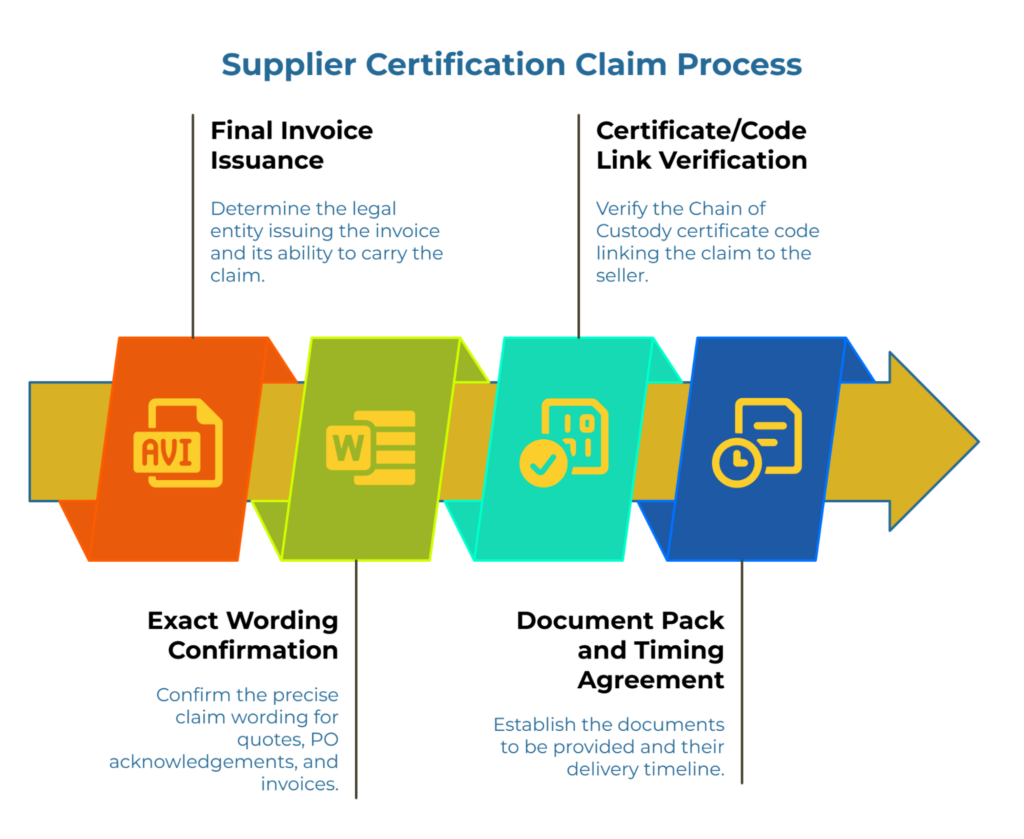
- Q1 — Final invoice: Who will issue the final invoice (legal entity name), and can they carry the certified claim on sales documents? Pass: “Invoice issuer is ____. Invoice will carry claim ____.” Fail: “We’ll figure it out later,” or “the mill is certified so it’s fine.”
- Q2 — Exact wording: What exact claim wording will appear on the quote, PO acknowledgement, and invoice—including specific categories like FSC 100%, FSC Mix Credit, or PEFC Certified? Pass: Exact wording pasted + placement named. Fail: “Certified paper” with no document commitment.
- Q3 — Certificate/code link: What specific Chain of Custody (CoC) certificate code ties the claim to the seller on transaction documents? Pass: The seller’s unique certificate code (e.g., XX-COC-123456) is confirmed for paperwork. Fail: Providing only a trademark license code (e.g., FSC-Cxxxxxx) or forwarded PDF without the specific CoC code.
- Q4 — Document pack + timing: What documents will be provided (invoice + packing list/delivery note + label details if relevant), and when? Pass: Documents and timing are named (before shipment / with shipment docs / with invoice). Fail: “Only if asked,” or “after delivery.”
Question 1: Who will issue the final invoice and can they carry the claim?
If the invoice issuer is unclear, status and scope checks are unreliable.
Question 2: What exact claim wording will appear on quote/PO/invoice?
If wording cannot be pasted in writing, document continuity is not locked.
Question 3: What certificate/code(s) tie the claim to the seller?
The linkage must be clear enough that the invoice issuer can be checked in the registry.
Question 4: What document pack will be received at shipment/invoice time?
Get documents and timing confirmed up front to avoid “proof after delivery” delays.
Step 3: Spot the “Fail” Signals Before You Approve the PO
Common red flags include vague ‘certified’ language and missing commitments—practices that enable greenwashing through unverifiable sustainability claims. Legitimate certified transactions require upfront documentation, not post-delivery proof.
- “Don’t worry, it’s certified.”
- “The mill is certified.” (no invoice-issuer commitment)
- “We’ll add the wording later.”
- “We can send the certificate.” (no invoice wording commitment)
Vague “certified” or “sustainable” language suggests the seller is not configured to carry proper claims—a common myth that certified suppliers automatically deliver certified transactions. Legitimate claims have specific wording—FSC 100%, FSC Mix Credit, PEFC Certified—not generic descriptions.
No certificate code provided prevents verification. Without a code, confirming active status or relevant scope becomes impossible.
Scope confusion emerges when sellers describe companies as “certified” but cannot confirm coverage of the specific product group. A certificate for trading uncoated paper may exclude coated grades entirely.
Document timing excuses create problems when customers need verification quickly. Proof arriving weeks after delivery—or only upon request—fails practical purposes.
Scope and status mismatches (keep to practical checks)
- Check certificate status for the invoicing entity in the FSC/PEFC registries using the public databases.
- Confirm certificate scope at a high level: role/activity + product group fit to ensure the seller’s certificate covers your specific product and transaction type.
- Re-check document continuity: agreed wording on quote and committed for invoice.
Certificate status can be verified directly through the public registries. However, active certificates only confirm capability. Transaction documents must still carry the claim correctly. Acceptance criteria can vary by customer and certifier.
Step 4: Write the Minimum Paperwork Requirements Into the PO
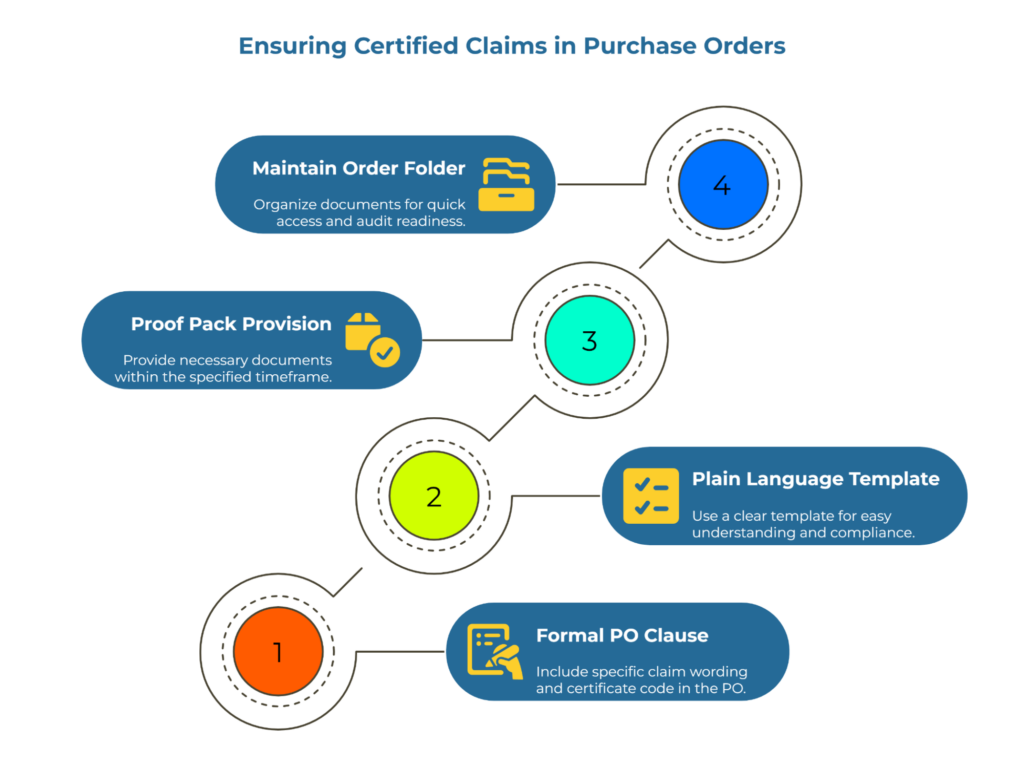
Formal PO Clause:
“Seller shall include on the commercial invoice: [specific claim wording, e.g., ‘FSC Mix Credit’], along with seller’s certificate code. Seller shall provide invoice and applicable delivery documentation showing this claim within [X business days] of shipment. Goods invoiced without specified claim wording will be treated as non-certified for acceptance purposes.”
Plain Language PO Template:
Final invoice will include the agreed certified claim wording exactly as stated in the quote/PO acknowledgement, and the seller’s specific Chain of Custody certificate code (not just a license number) used for transaction paperwork. Proof pack (invoice + packing list/delivery note, and label details if applicable) will be provided at: ____ (before shipment / with shipment docs / with invoice). If the invoice does not carry the agreed claim wording, treat the order as non-certified for acceptance purposes until corrected documents are received.
Maintain a folder for each order containing the quote with claim commitment, purchase order with the clause, and invoice with delivery documents upon arrival. This creates a fast proof package for customer or auditor requests.
Handoff point vs required proof fields (quick table)
| Handoff point | Who issues it? | Claim wording | Certificate/code reference |
| Quote | Seller quoting | Committed | Stated |
| PO acknowledgement | Invoice issuer (or named party) | Confirmed | Confirmed |
| Delivery docs/labels (if used) | Shipping/warehouse party | Consistent | Consistent |
| Final invoice | Invoice issuer | Appears | Appears |
What to store for fast proof replies (a simple folder rule)
Folder per order: Supplier → Order # → Certification Proof. Save quote, PO, PO acknowledgement, invoice, packing list/delivery note, and the wording confirmation.
If You’re the Supplier/Trader: How to Pass the Baton Cleanly
Prepare a consistent wording template across quote → invoice
One internal wording template across documents prevents drift. The same claim language should appear across quote, order acknowledgment, and invoice. Inconsistency triggers doubt even when everything is legitimate.
Know what you can and cannot claim on documents
A “certified company” is not the same as a proof-ready transaction; it fails when status, scope, or continuity breaks. Understand which product groups and activities the certificate covers—and which it excludes. Promising claims outside scope creates problems for everyone. Consult the FSC Product Classification (FSC-STD-40-004) or the relevant PEFC product categories to confirm eligibility.
Verify before quoting
When sourcing from mills or other traders, confirm their certificate status and scope before making buyer commitments.
Lead with documentation
Proactively offering certificate codes and explaining document placement builds trust. Buyers receiving clear answers upfront become easier long-term partners.
For a comprehensive approach to verifying FSC/PEFC claims beyond the relay baton test, use the buyer workflow that covers certificate status, scope, and invoice documentation.
Quick Recap: The Baton Test in 60 Seconds
A claim survives a trader step when:
- Status is valid
- Scope fits the transaction
- Document continuity keeps the exact wording intact from quote to invoice
Before approving orders with traders in the chain: map who touches the paper, run the four questions, watch for fail signals, lock requirements into the purchase order, and store the document trail for fast retrieval.
The test takes ten minutes before approval. Chasing missing documentation after delivery takes far longer—and sometimes proof simply cannot be recovered.
For a broader verification workflow: How to check paper supplier credentials.
FAQ
Can a trader sell “certified” paper without breaking the claim?
Yes—if the invoice issuer can carry the claim and the wording stays continuous.
What must appear on the invoice for a certified claim to count?
Typically, agreed claim wording + a link to the invoice issuer’s certificate/license reference; requirements can vary.
What’s the difference between a supplier being certified and a shipment being certified?
Supplier certification is capability; shipment proof is the claim carried on that order’s paperwork.
What to do when paperwork arrives without the claim?
Request corrected documents promptly; treat as non-certified for acceptance purposes until the invoice is corrected.
Disclaimer:
This guide is provided for educational and informational purposes. Certification requirements and acceptance criteria can vary by customer and certifier; confirm transaction-specific wording and documentation needs.
Our Editorial Process:
Our expert team uses AI tools to help organize and structure our initial drafts. Every piece is then extensively rewritten, fact-checked, and enriched with first-hand insights and experiences by expert humans on our Insights Team to ensure accuracy and clarity.
About the PaperIndex Insights Team:
The PaperIndex Insights Team is our dedicated engine for synthesizing complex topics into clear, helpful guides. While our content is thoroughly reviewed for clarity and accuracy, it is for informational purposes and should not replace professional advice.