

📌 Key Takeaways
Chain-of-custody integrity lives in sales documentation—invoices, quotes, purchase orders, and delivery notes—not in logos or marketing materials.
- Three Fields Prevent Audit Failures: Every certified transaction requires the specific claim type (FSC Mix 70%, not “FSC certified”), verifiable certificate identifier, and line-item mapping on commercial documents.
- Quote-to-Invoice Gaps Break Claims: Certification details appearing during bidding but missing on invoices create the most common downstream substantiation failure for buyers.
- Copy-Ready Clauses Force Compliance: Embedding claim requirements into RFQ responses, PO terms, and invoice approval gates prevents documentation rework and payment holds.
- Registry Checks Take Minutes: Verifying certificate validity, scope coverage, and entity name match through FSC Search or PEFC Find Certified databases creates defensible audit evidence.
- Supplementary Letters Need Controls: FSC allows certification letters only with certification body approval and unambiguous cross-references—buyers should treat them as exceptions, not standard practice.
Documentation discipline converts certification from marketing promise to legally defensible chain of custody.
Procurement managers and accounts payable teams sourcing FSC or PEFC certified paper will gain immediately usable verification workflows here, preparing them for the copy-ready clause templates and registry check protocols that follow.
The logo looks right. The supplier says “certified.” But when the auditor asks for documentation, your accounts payable folder contains an invoice that simply reads “FSC certified paper” with no claim type, no percentage, and no certificate code.That vague wording just broke your chain of custody—a gap that could derail your entire sustainable sourcing program.
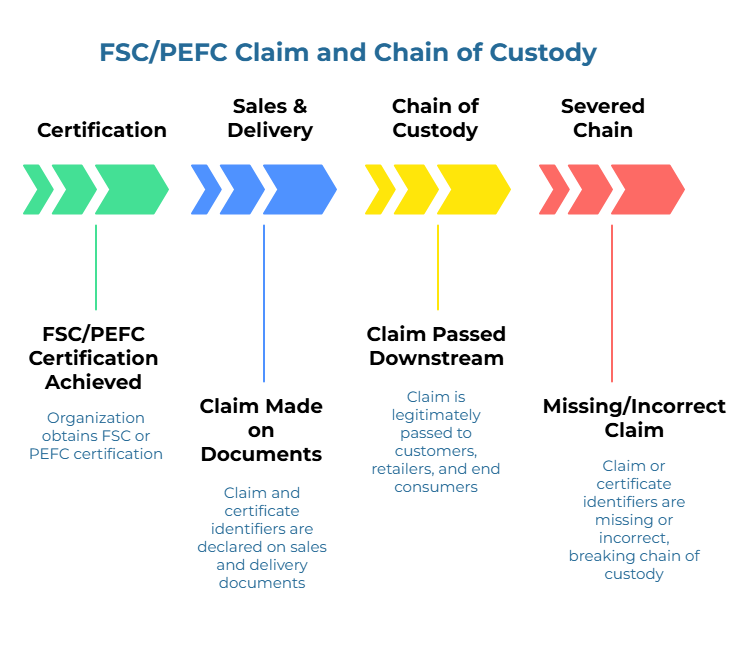
Most procurement teams treat certification as a badge problem—something for packaging artwork and marketing collateral. The standards themselves treat it differently. FSC explicitly defines an “FSC claim” as a declaration made on sales and delivery documents. PEFC uses identical language—a claim is an organization’s declaration stated in sales and delivery documentation. For both schemes, certification is fundamentally a sales-document problem. If the claim and certificate identifiers are missing or incorrect on the documents that transfer ownership, the chain of custody is effectively severed. The buyer cannot legitimately pass that claim downstream to customers, retailers, or end consumers.
This guide provides the exact wording requirements, copy-ready clauses, and a document-flow checklist that forces valid FSC/PEFC claims onto quotes, purchase orders, delivery documents, and invoices—the four control points where chain-of-custody most commonly breaks.
The Real Control Is the Paperwork Trail, Not the Logo
Logos can be printed by anyone with a graphics file. Invoices cannot be wished into compliance.
The enforceable control for certified sourcing sits in three elements that must appear together on commercial documents:
- The specific claim type (not just “FSC” or “PEFC,” but the exact claim format the standards define)
- The certificate identifier linking that claim to a verifiable, valid certification
- Line-item specificity so mixed orders clearly distinguish certified from non-certified products
When these elements are present and accurate, the documentation trail supports the claim—following the same verification principles outlined in the trust protocol for moving from signals to documented proof. When they are absent, vague, or mismatched, the claim becomes indefensible—regardless of what logo appears on the product itself.
Understanding this distinction matters because downstream stakeholders—including auditors and retail compliance teams—now prioritize the ‘paper trail’ over physical labels during chain-of-custody verifications. A buyer who accepts incomplete documentation inherits that gap.
Buyer Checklist: Required Fields for FSC Claims on Sales Documents
FSC’s Chain of Custody standard (FSC-STD-40-004) specifies what must appear on sales documents issued for products sold with FSC claims.
Must-have fields on invoices and sales documents:
| Field | What It Means for Buyers |
| Supplier name and contact information | Confirms the selling entity |
| Customer identification | Your company details for traceability |
| Date of issue | Establishes the transaction timeline |
| Product description | Identifies exactly what carries the claim |
| Quantity | Volume covered by the certification claim |
| FSC certificate code or FSC Controlled Wood code | The verifiable identifier that links to the public registry |
| FSC claim per line item or for the total products | The specific claim type: FSC 100%, FSC Mix x%, FSC Recycled x%, FSC Mix Credit, FSC Recycled Credit, or FSC Controlled Wood |
When delivery documents travel separately from invoices:
If the sales document is not included with the physical shipment, the delivery documentation must carry the same required information plus a reference that links it back to the sales document. This ensures the certification claim accompanies the goods throughout the logistics chain.
The exception path—supplementary documentation:
FSC allows supplementary documentation (such as a separate certification letter) only under controlled conditions with clear linking, no ambiguity, and explicit cross-references. The standard requires certification body permission for this approach.
Understanding certificate identifiers:
FSC distinguishes between two types of codes, and understanding this difference prevents confusion:
- License codes (format often FSC® C######) are used with labels and promotional materials
- Certificate codes (assigned by the Certification Body, typically in the format XXX-COC-###### or XXX-CW-######) appear on invoices and sales documents. Note: The FSC-C###### format is the License Code. The Certificate Code (e.g., ABC-COC-000000) is the required identifier for invoices
Your procurement requirement should focus on the concept, not the format: request “the certificate identifier that can be verified in FSC’s public registry.” This wording accommodates format variations while ensuring you receive information you can actually verify.
The practical test: If your accounts payable team cannot see both the specific claim type and the certificate code on the commercial document itself, you cannot reliably pass that claim to your own customers.
Buyer Checklist: Required Fields for PEFC Claims on Output Documentation
PEFC’s Chain of Custody standard (PEFC ST 2002:2020) establishes parallel requirements for output documentation covering products sold with PEFC claims.
Must-have fields on PEFC output documentation:
| Field | What It Means for Buyers |
| Customer identification | Your company details |
| Supplier name | The certified selling entity |
| Product identification | Description of claimed products |
| Quantity | Volume covered |
| Date or reference period | Transaction timing |
| Applicable PEFC claim | Must use defined wording (see below) |
| Supplier’s PEFC-recognised certificate number | The verifiable identifier |
Allowable PEFC claim wording:
PEFC defines specific claim formats—suppliers cannot invent their own marketing variations:
- “x% PEFC certified” (where x represents the certified percentage calculated according to the standard)
- “PEFC controlled sources”
- “100% PEFC Origin” (used under specific conditions as an alternative to “100% PEFC certified” for material from PEFC-certified forests)
The PEFC standard notes that it does not itself define a minimum threshold for communicating certified content percentage, though trademark rules may introduce thresholds for on-product trademark use. This is why buyers need to require the exact claim phrase—including the percentage—rather than accepting generic “PEFC certified” wording. The calculated percentage is part of the defined claim structure.
While PEFC trademarks may use ‘Mix’ labels, the mandatory claim wording for sales documentation is ‘x% PEFC certified’ or ‘PEFC controlled sources.’ Reject documentation using only ‘PEFC Mix’ as a claim.
Supplier verification requirement:
PEFC explicitly requires that buyers verify suppliers delivering inputs with a PEFC claim are covered by a PEFC-recognised certificate. This verification should be conducted through the PEFC Find Certified database and documented with your procurement records.
FSC vs PEFC: Side-by-Side Documentation Requirements
| Required Field (per shipment/invoice) | FSC Sales Documents | PEFC Output Documentation |
| Supplier name and contact details | Required | Supplier name required |
| Customer identification | Required (except end consumers) | Required |
| Document date or delivery period | Issue date required | Delivery date/period/accounting period required |
| Product identification and quantity | Required | Required |
| Claim wording tied to each line item | Required (“FSC claim for each product item”) | Required (“claim specifically for each claimed product”) |
| Certificate identifier on the document | FSC certificate code (or CW code) required | PEFC certificate number required |
| If delivery note replaces invoice info | Delivery doc must mirror requirements and link to sales doc | Standard requires claims provided “for each delivery” via documentation |
| Supplementary claim letters | Allowed only with linking, anti-ambiguity controls, and certification body permission | Keep claims on primary delivery docs where possible |
Approved Versus Risky Wording: What to Accept and What to Reject
The difference between defensible and problematic documentation often comes down to specificity. The following examples illustrate wording patterns across quotes, purchase orders, and invoices.
Wording that supports chain of custody:
| Document | Approved Example | Why It Works |
| Quote | “FSC Mix 70% – FSC® Certificate Code: FSC-C123456 – applies to SKU ABC-1234” | Specific claim type, percentage, certificate code, line-item reference |
| Quote | “54% PEFC certified – PEFC CoC certificate: PEFC/XX-XXX-XXXXX – Item: Kraft liner 150gsm” | Defined PEFC claim format with certificate number and product identification |
| PO | “Supplier shall include FSC claim type and FSC certificate code on invoice line items for all certified products” | Explicit documentation requirement built into commercial terms |
| Invoice | “FSC Recycled 85% – FSC-C789012 – Line 3: Corrugated sheets, 500 units” | Complete claim with certificate code at line-item level |
| Invoice | “70% PEFC certified – PEFC/XX-XXX-XXXXX – Tissue parent rolls, 12 tonnes” | Standard PEFC claim format with certificate number |
Wording that creates audit exposure:
| Document | Risky Example | The Problem |
| Quote | “FSC certified paper” | No claim type, no percentage, no certificate code |
| Quote | “PEFC Mix” or “PEFC Recycled” | Non-standard claim terminology not defined by PEFC |
| PO | “All products must be FSC” | No specification of required documentation fields |
| Invoice | “Sustainably sourced – certificate available on request” | Claim and code must appear on the document, not be available separately |
| Invoice | “FSC – see attached letter” | Supplementary documentation without proper cross-referencing and CB permission |
| Delivery note | “Certified material” | No scheme identified, no claim type, no certificate reference |
Each risky example creates the same downstream consequence: inability to pass the claim to customers, potential audit findings, and rework delays while requesting corrected documentation.
Where Buyers Get Burned: Seven Documentation Failure Modes
Procurement teams encounter the same documentation gaps repeatedly. Recognizing these patterns helps prevent them.
1. Claim appears on quote but disappears on invoice. The supplier’s sales team includes certification details during bidding, but the finance system generates invoices without those fields. The buyer discovers the gap only when compiling audit documentation or responding to a customer inquiry.
2. Entity mismatch between certificate holder and invoicing party. The certificate is registered to the manufacturing subsidiary, but invoices come from a trading entity or different legal name—a common issue when sourcing through exporters vs. manufacturers. The chain of custody requires that the certificate holder be the entity on the sales documentation.
3. Scope mismatch between certificate and product. The supplier holds a valid certificate, but it does not cover the specific product category, activity, or site involved in your order. A packaging converter’s certificate may not extend to the grade of paper they are sourcing for your job.
4. Mixed cart invoices without line-item separation. Orders containing both certified and non-certified products appear on a single invoice without clear distinction—the same line-item specificity problem that causes incomparable quotes in RFQ responses. The certified claim cannot be applied to the entire invoice, and without line-item specificity, the claim becomes unusable.
5. Percentage or credit detail lost at the retail stage. FSC allows some end-of-chain sellers to omit percentage and credit details from consumer-facing claims. However, this simplification prevents downstream reinstatement of the full claim. If your business needs to pass the complete claim forward, you need the complete documentation—including the percentage for PEFC claims, where the calculated percentage is part of the defined claim structure.
6. Over-broad PO language without documentation requirements. Purchase orders state “must be FSC certified” without specifying what fields are required on invoices. Suppliers interpret this loosely, and buyers receive documentation that technically mentions certification but lacks the elements needed for chain-of-custody compliance.
7. Supplementary letters used without linking discipline. Suppliers issue separate certification letters that are not clearly linked to specific invoices, shipments, or time periods—and often without the certification body approval FSC requires for this approach. When auditors request documentation, buyers cannot demonstrate which letter corresponds to which transaction.
For a broader framework on building verification into your sourcing workflow, see from claims to certificates: why verifiable evidence should replace supplier promises.
Copy-Ready Clauses for RFQ, PO, and Invoice Requirements
The following clause templates can be adapted to your organization’s commercial documents. Each includes the operative language followed by an annotation explaining its purpose.
Clause A: RFQ and Quote-Response Documentation Requirement
Clause text:
Supplier shall state in their quote response: (a) the exact FSC or PEFC claim wording that will appear on invoices for quoted products; (b) the unique FSC or PEFC certificate number as it appears in the official database; (c) verification that the certificate’s ‘Product Groups’ or ‘Scope’ explicitly includes the materials ordered and that the invoicing legal entity is a registered member of the certificate. Supplier shall provide current certificate documentation and scope evidence with the quote submission, following the evidence pack methodology that names exact test methods and documentation requirements.
Annotation: This clause surfaces documentation issues before order placement. It requires suppliers to commit to specific claim wording at the bidding stage and demonstrate that their certification actually covers what they are quoting. Scope evidence and legal entity confirmation prevent the mismatch problems that typically emerge only at invoice stage. Note that the “certificate identifier” language accommodates format variations (license codes vs certificate codes) while ensuring verifiability.
This approach aligns with building a minimum viable evidence pack during supplier qualification. For a template that integrates documentation requirements into broader RFQ discipline, see the spec-driven RFQ template.
Clause B: Purchase Order Certification Documentation Requirement
Clause text:
Supplier shall include on all invoices and delivery documents for certified products: (a) the applicable FSC or PEFC claim type and percentage where relevant; (b) the supplier’s certificate identifier verifiable in the applicable public registry; (c) clear identification at the line-item level distinguishing certified from non-certified products. Buyer reserves the right to withhold payment approval and artwork or label approval for future production runs until compliant documentation is received.
Annotation: This clause establishes documentation as a commercial gate, similar to the pre-qualification gates that prevent unverified suppliers from advancing through the sourcing process. The explicit list of required fields removes ambiguity about what “certified” means on the invoice. The approval-withholding language creates a consequence for non-compliance without making legal claims—it positions documentation as a procurement control that affects payment processing and production authorization workflows.
Clause C: Invoice and Delivery Note Verification Checklist
Clause text:
Prior to invoice approval, Buyer’s accounts payable or quality assurance team shall verify: (a) FSC or PEFC claim type appears on the document; (b) certificate identifier appears on the document and is verifiable in the public registry; (c) claim and identifier correspond to the products and quantities invoiced; (d) invoicing entity name matches the certificate holder name in the relevant public registry.
Annotation: This clause translates requirements into a 30-second verification step. Accounts payable staff do not need certification expertise—they need a checklist. The four-point verification catches the most common documentation failures before payment approval.
Clause D: Nonconformance and Remedy
Clause text:
If certification claim or certificate identifier is missing, incorrect, or mismatched on invoices or delivery documentation, Supplier shall issue corrected documentation within five (5) business days of Buyer’s notification. Until corrected documentation is received, Buyer may: (a) treat the affected goods as non-certified for internal records and downstream claims; (b) withhold approval of artwork, labels, or marketing materials referencing certification for current and future production runs.
Annotation: This clause establishes a clear remedy path without escalating to legal dispute. The five-day correction window is practical for administrative fixes. The consequences—treating goods as non-certified and withholding artwork approval—create a meaningful incentive for suppliers to get documentation right the first time, while remaining within procurement’s operational authority.
If You’re a Supplier: How to Avoid Buyer Holds in One Page
Buyers increasingly reject or hold invoices that lack proper certification documentation. Meeting their requirements upfront reduces back-and-forth and speeds payment approvals.
Quick compliance checklist:
- Put the specific claim type (FSC 100%, FSC Mix x%, x% PEFC certified, etc.) on every invoice line item for certified products
- Include your certificate identifier verifiable in the public registry on the invoice—not just on a separate letter
- Ensure the invoicing entity name exactly matches the name on your certificate
- Use only standard claim terminology defined by FSC or PEFC—avoid marketing variations
- Separate certified and non-certified products clearly on mixed orders
- Be prepared to provide scope evidence showing your certificate covers the product category
- If using supplementary documentation for FSC claims, obtain certification body approval and ensure unambiguous cross-references
- Expect buyers to run registry checks; ensure your certificate status is current and visible in official databases
This approach positions your company as audit-ready and reduces the documentation rework that delays payments and strains buyer relationships.
For suppliers seeking to connect with global buyers, listing your company on PaperIndex provides visibility to over 50,000 registered buyers across 195 countries.
Quick Registry Check Workflow and Recordkeeping
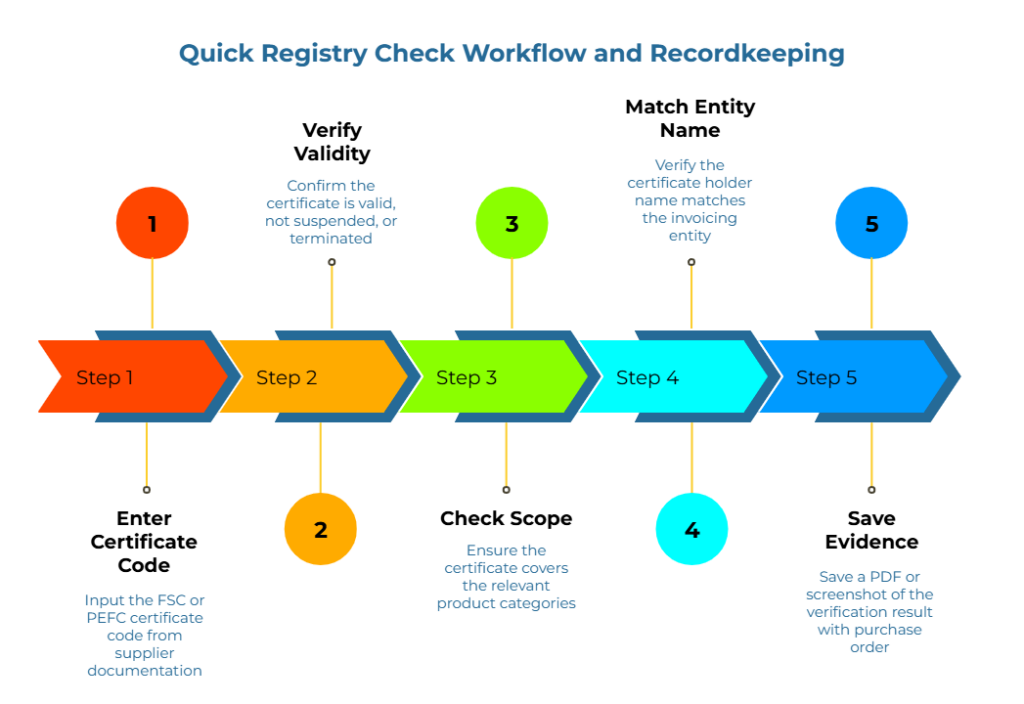
Verifying certificate validity takes minutes and should become routine procurement hygiene.
For FSC certificates:
FSC’s certificate search tools have undergone system updates. While the FSC Public Search is the primary verification tool, users may occasionally encounter links to legacy interfaces during the transition period. Enter the certificate code from the supplier’s documentation and confirm: the certificate is valid (not suspended or terminated), the scope covers the relevant product categories, and the certificate holder name matches the invoicing entity. Enter the certificate code from the supplier’s documentation and confirm: the certificate is valid (not suspended or terminated), the scope covers the relevant product categories, and the certificate holder name matches the invoicing entity.
Because registry tools are evolving, save a PDF or screenshot of the verification result with your purchase order file. This documented evidence becomes especially important during tooling transitions and creates an audit trail if questions arise later.
For PEFC certificates:
Use the PEFC Find Certified database to verify the supplier’s certificate number. Confirm validity, scope coverage, and entity name match. Save verification evidence with your records.
Suggested verification cadence:
For ongoing suppliers, re-verify certificate status every six to twelve months or whenever certificate expiry dates approach. Certificates can be suspended or scopes can change between orders. Treating verification as recurring procurement hygiene—rather than a one-time onboarding task—prevents surprises.
For a detailed walkthrough of the registry verification process, see greenwashing alert: how to verify FSC claims on paper bag orders, which covers the ten-minute verification process including scope matching and document consistency checks.
Frequently Asked Questions
Can buyers accept “FSC certified” without a claim type on the invoice?
No. “FSC certified” alone is insufficient. FSC requires a clear claim for each product item on sales documents, and that claim must follow defined formats: FSC 100%, FSC Mix x%, FSC Recycled x%, FSC Mix Credit, FSC Recycled Credit, or FSC Controlled Wood. The invoice should also include the certificate code. Without these elements, the buyer cannot substantiate the claim for downstream use or audit purposes.
What is the difference between FSC license code and certificate code?
FSC distinguishes between license codes used with labels and promotional materials (often formatted as FSC® C######) and certificate codes used on invoices and sales documents (formats vary by certification body, such as XXX-COC-###### or XXX-CW-######). When requesting documentation from suppliers, specify that you need “the certificate identifier that can be verified in FSC’s public registry.” This concept-based language accommodates format variations while ensuring you receive verifiable information.
What PEFC claims are allowed on invoices?
PEFC defines three claim formats: “x% PEFC certified” (with the calculated percentage), “PEFC controlled sources,” and “100% PEFC Origin” (used under specific conditions as an alternative to “100% PEFC certified”). The percentage is part of the defined claim structure—PEFC’s standard does not define a minimum threshold for communicating certified content, though trademark rules may introduce thresholds for on-product use. Variations like “PEFC Mix” or “PEFC Recycled” are not standard PEFC terminology and should prompt clarification from the supplier.
What if the claim is on the quote but missing on the invoice?
Hold invoice approval and request corrected documentation. The claim appearing on the quote indicates the supplier can provide certified material, but the chain of custody requires the claim to appear on the actual sales documentation. Accept only invoices that include both the claim type and certificate identifier.
Do retailers need the percentage on sales documentation?
FSC allows some end-of-chain sellers to simplify consumer-facing claims by omitting percentage and credit details. For PEFC, the calculated percentage is part of the defined claim format (“x% PEFC certified”), and output documentation must include the applicable claim. If your business needs to pass the complete claim to customers or use it in B2B contexts, you need complete documentation including percentages—a requirement explored in the retailer’s guide to sustainable packaging compliance. Simplified retail claims prevent downstream reinstatement of the full percentage claim.
Can suppliers send a supplementary letter instead of putting claims on invoices?
Supplementary documentation is an exception path. FSC allows it only with controlled conditions: clear linking, no ambiguity, explicit cross-references, and certification body approval. PEFC’s implementation varies, but the safest practice is keeping claims on primary delivery documents. Buyers should not accept supplementary letters as standard practice. If a supplier proposes this approach for FSC claims, request written confirmation that their certification body has approved the arrangement and ensure unambiguous linkage between the letter and specific invoices or shipments.
Building Documentation Controls into Your Sourcing Program
Certification claims are only as strong as the paperwork trail supporting them. By requiring specific claim wording, certificate identifiers, and line-item detail on quotes, purchase orders, and invoices, buyers create the documentation foundation that makes claims defensible in audits and passable to downstream customers.
The clauses and checklists in this guide provide a starting point. Adapt them to your organization’s commercial templates, train accounts payable and quality teams on the verification steps, and treat registry checks as routine procurement hygiene rather than one-time tasks. Document your verification results—especially important during periods when registry tools are transitioning—to substantiate the claim during your next chain-of-custody audit.
For a broader framework on building evidence-chain workflows for sustainability claims, including supplier verification beyond certification documentation, develop systematic controls that apply at every sourcing stage.
Ready to source certified paper and packaging?
Find verified suppliers and request quotes free through PaperIndex’s global supplier directory featuring over 6,900 suppliers across 195 countries.
Disclaimer:
This guide is provided for educational and informational purposes.
Our Editorial Process:
Our expert team uses AI tools to help organize and structure our initial drafts. Every piece is then extensively rewritten, fact-checked, and enriched with first-hand insights and experiences by expert humans on our Insights Team to ensure accuracy and clarity.
About the PaperIndex Insights Team:
The PaperIndex Insights Team is our dedicated engine for synthesizing complex topics into clear, helpful guides. While our content is thoroughly reviewed for clarity and accuracy, it is for informational purposes and should not replace professional advice.