

📌 Key Takeaways
Badge ≠ proof: FSC/PEFC certification claims protect buyers only when verified through three checks—status, scope, and document continuity.
- Registry Checks Prevent Invoice Failures: Verify certificate status in official directories (FSC Search, PEFC Find Certified) before quoting, saving time-stamped proof to prevent audit scrambles.
- Scope Limits Matter More Than Badges: A valid certificate doesn’t certify everything a supplier sells—request written confirmation that your specific product falls within certified scope.
- Document Continuity Stops Greenwashing Risk: Require suppliers to include exact claim wording and certificate codes on quotes, purchase orders, and invoices before releasing orders.
- PDF Certificates Go Stale Quickly: Certificate PDFs represent snapshots, not live status—suspended or expired certificates create liability even when paperwork looks complete.
- Fix Documentation at Quote Stage: Adding one RFQ clause requiring claim language on all documents takes thirty seconds and prevents weeks of post-shipment chasing.
Three checks, fifteen minutes per supplier, proof folder ready before audits ask.
Procurement managers sourcing certified paper will gain immediately actionable verification workflows here, preparing them for the copy-ready RFQ clause and internal SOP templates that follow.
Badge ≠ proof.
If your organization needs to defend an “FSC/PEFC certified” claim internally—or to a customer—you need more than a badge. You need proof that survives the document trail.
Organizations frequently encounter ’emergency audits’ when retail customers request retroactive FSC/PEFC documentation that was never secured during the procurement phase—a verification gap that mirrors broader supplier verification challenges across paper supply chains. The supplier said they were certified. The quote mentioned it. But the invoice? Silent. The certificate PDF in the shared drive is fourteen months old. And the audit deadline is in six days.
This scenario plays out constantly across paper supply chains. Buyers assume “FSC/PEFC certified” means the product is certified, the documentation is handled, and the claim will hold up under scrutiny. These assumptions create rejected submissions, emergency supplier calls, and the kind of greenwashing exposure that damages customer relationships and brand reputation.
The fix is straightforward. Three checks—taking fifteen minutes or less—separate defensible proof from a marketing statement that might not survive its first challenge.
The 3-Check Method: Status, Scope, and Document Continuity
Every FSC/PEFC verification reduces to three questions. Get clear answers to all three, and the claim holds. Skip one, and problems surface—usually at the worst possible moment. Exact procedures can vary by certification scheme and certifying body, but the three-check structure remains consistent.
Check 1: Status
Is the certificate valid right now? Not last quarter. Not when the supplier onboarded. Right now.
Certificates get suspended for non-compliance. They lapse when companies miss renewal deadlines. They terminate when ownership changes. A PDF saved to a shared folder has no awareness of these events.
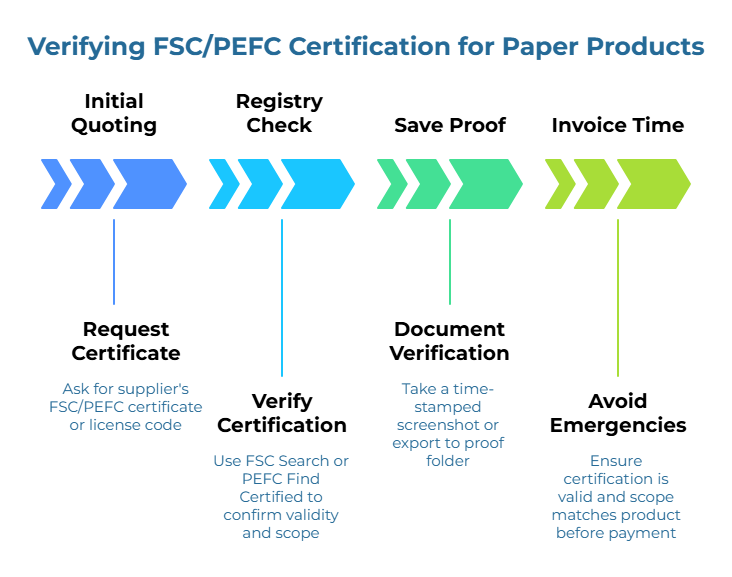
The action: Request the certificate or license code from the supplier. Enter it into the FSC Certificate Database (accessible through FSC Search tools) or the PEFC “Find Certified” directory. Confirm the status displays as valid or active. Save a time-stamped screenshot or PDF export of the registry result. Store it in the proof folder for this order.
Check 2: Scope
Does the certificate cover what you are actually buying?
A valid certificate does not mean everything the supplier sells is certified. Scopes define specific product categories, specific activities (trading versus manufacturing versus converting), and sometimes specific sites. A supplier certified to trade packaging papers may hold no certification for kraft linerboard. A mill certified to manufacture tissue may not be certified for the specialty board produced on a different line.
The action: Read the scope description on the registry record. Does it explicitly include your product type? Does it cover the activity the supplier performs for your order? If ambiguity exists, request written confirmation that your specific product falls within the certified scope.
Check 3: Document Continuity
Does the claim survive from quote to purchase order to invoice?
This is where most failures occur. Chain-of-custody systems require that certified claims pass correctly through transaction documents so downstream buyers can verify and use those claims. The supplier holds a valid certificate. The scope matches. But the commercial documents—the ones that actually prove a transaction—contain no claim wording, no certificate code, nothing an auditor or customer can verify.
The action: Add one clause to the RFQ or purchase order template requiring the supplier to include the exact FSC/PEFC claim statement (such as “FSC Mix Credit” or “PEFC Certified”) plus the FSC Certificate Code (e.g., XXX-COC-000000) on all quotes, order confirmations, and invoices. Note that the FSC License Code (FSC-C######) is typically for on-product labeling; the Certificate Code is required for chain-of-custody transfer documents. Reject quotes that omit this information. Verify invoices against the original claim before filing.
If you can’t verify the chain and the claim, you don’t have a certification—you have a marketing statement.
The False Equivalence of Supplier Certification and Product Certification
The Myth
A supplier mentions certification in an email or on their website. The buyer assumes the product being quoted is therefore certified and documentation will follow.
The Reality
The statement “we’re FSC certified” is incomplete. It reveals nothing about whether the certificate remains valid today, whether the scope covers the specific product under discussion, or whether the supplier will carry the claim through to commercial documents.
Suppliers frequently hold certification for some products while selling others outside their certified scope. A company can maintain chain-of-custody certification and simultaneously offer non-certified inventory—sometimes without clearly distinguishing between the two in sales conversations.
What to Do Instead
Request the certificate or license code during initial quoting—before investing time in negotiation. Run a registry check using FSC Search tools or the PEFC Find Certified directory. The check takes approximately two minutes. Save a time-stamped screenshot or export to a proof folder labeled by supplier and order reference.
This discipline catches scope mismatches and expired certificates before they become invoice-time emergencies. For additional guidance on protecting against false claims, the PaperIndex Academy article on verifying FSC claims on paper bag orders outlines verification protocols based on official FSC and PEFC standards.
The Temporal Risk of Static PDF Certificates
The Myth
The supplier provided a certificate PDF during onboarding. The file sits in a shared folder. The buyer considers certification verified.
The Reality
Certificate documents represent a snapshot in time. They do not update themselves when status changes. A certificate valid when received may be suspended, terminated, or expired by the time an order ships—and the PDF offers no indication, creating the same supplier opacity risks that undermine kraft paper procurement decisions.
Equally problematic: the PDF shows what the supplier is certified to do, not whether a specific transaction falls within that scope. A certificate for “manufacturing of corrugated packaging” provides no coverage for a trade transaction involving uncoated printing paper.
What to Do Instead
Treat the PDF as a reference document, not final proof. Before significant orders—or at minimum quarterly for ongoing suppliers—verify current status in the live registry. Match the scope language to the actual product and activity. When the registry confirms validity and scope alignment, save that confirmation alongside the PDF.
This verification step is brief but serves as a critical safeguard against lapsed credentials. Discovering an invalid certificate after shipping requires considerably more time to resolve.
Scope Boundaries within Certified Facilities
The Myth
The mill holds FSC or PEFC certification. The buyer assumes all products from that mill are therefore certified.
The Reality
Certification scopes have boundaries. A paper mill might hold chain-of-custody certification for specific grades—uncoated woodfree, for instance—while producing other grades entirely outside that scope. A trading company might be certified for certain product categories but not others.
The distinction between activities also matters. Certification for trading does not automatically extend to converting or repackaging. If a transaction involves any processing beyond straight resale, the scope must explicitly cover that activity.
What to Do Instead
Never assume a certified company equals a certified product. The certificate scope is the only relevant document.
In RFQs or quote requests—whether you’re sourcing kraft paper, packaging grades, or finished products such as paper bags—ask suppliers to confirm in writing that the specific product being quoted falls within their certified scope. One sentence mapping scope to product—”This quotation covers FSC Mix Credit kraft paper per our certificate scope”—provides documentation that a verbal assurance cannot.
Keep that written confirmation in the proof folder alongside the registry screenshot.
The Distinction Between Artwork Approval and Chain-of-Custody Verification
The Myth
The product mockup or printed packaging displays an FSC or PEFC logo. The buyer considers this sufficient proof that certified material was used.
The Reality
Logos on artwork represent outputs of a process, not verification of that process. A certification mark on packaging assumes—but does not prove—that the underlying supply chain maintained proper chain-of-custody controls for that specific production run.
From a procurement standpoint, artwork approval should follow supply chain verification, not replace it. Approving packaging artwork before confirming the claim creates risk: printed materials making statements that purchase documentation cannot support.
What to Do Instead
Treat artwork approval as downstream from procurement verification. Complete the 3-check method—status, scope, document continuity—before authorizing any artwork containing certification marks. Lock the verified claim in commercial documents before releasing the purchase order.
This sequence prevents the situation where thousands of printed bags display a certification logo while the corresponding invoices contain no claim language whatsoever.
The Irreversibility of Post-Shipment Documentation Gaps
The Myth
The quote mentioned certification. Details can be sorted out when the invoice arrives. Paperwork is administrative; it can be corrected after the fact.
The Reality
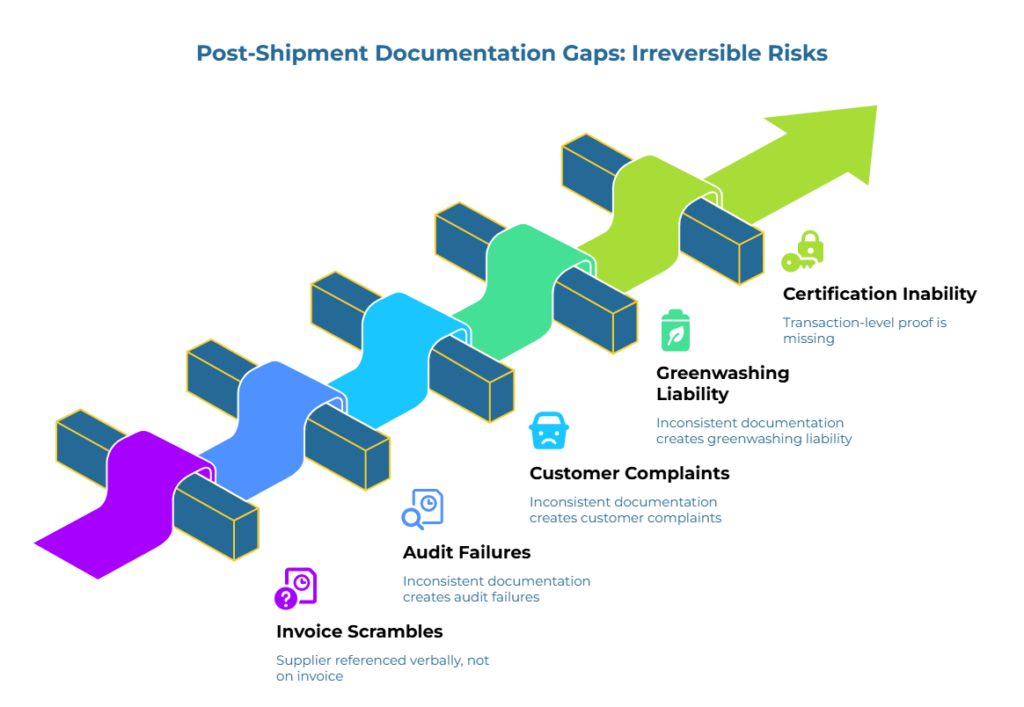
If the certification claim does not appear on commercial documents, defensible proof does not exist. Invoice-time scrambles are common: the supplier referenced “FSC certified” verbally, but the invoice shows nothing. Now the buyer chases corrected documentation while an audit deadline approaches.
Inconsistent documentation creates audit failures, customer complaints, and potential greenwashing liability—risks that extend beyond FSC/PEFC to all sustainability claims in paper sourcing. In some cases, it means the certification claim cannot be used at all—even if the material was genuinely certified—because transaction-level proof is missing.
What to Do Instead
Require documentation upfront rather than hoping to fix it later. Add a single clause to the standard RFQ or purchase order template. Reject quotes that omit this information. Fixing documentation at the quote stage takes minutes; fixing it after shipment takes days and sometimes proves impossible.
Standard RFQ/PO Clause:
“If any FSC/PEFC claim is quoted, the supplier must (a) hold an active, in-scope FSC/PEFC chain-of-custody certificate at the time of shipment, and (b) print the exact agreed claim wording and certificate/license identifier on the invoice and dispatch documents for the shipped goods.”
For further technical guidance, procurement teams should consult the official FSC ‘Chain of Custody’ training modules or PEFC’s ‘Supply Chain’ compliance standards.
The One-Page Playbook: A Reference for Procurement Teams
The following table consolidates the five myths into a format suitable for team training, supplier onboarding documentation, or posting in a shared workspace.
| Myth | Reality | What to Do Instead |
| “Supplier says certified = product is certified” | Claims require verification; scope may not cover the product | Request certificate code at quoting; run registry check; save time-stamped screenshot |
| “Certificate PDF is enough” | PDFs go stale; status and scope can change without notice | Verify in live registry before orders; confirm scope matches product |
| “Certified mill = everything is certified” | Scopes have limits by product type and activity | Get written scope confirmation for specific products—the same discipline needed when sourcing kraft linerboard or testliner for converting operations |
| “Logo on packaging = certified material” | Logos are outputs, not procurement proof | Complete verification before artwork approval; lock claim before PO release |
| “Fix paperwork later” | Missing invoice claims cause audit failures | Require claim and code on all documents via RFQ/PO clause |
Evidence Ladder: The strength of proof increases as you move through this sequence:
Website badge → Registry record (time-stamped) → Scope evidence mapped to SKU → Quote/PO claim text → Invoice and dispatch documents showing the claim.
The closer evidence sits to execute transaction documents, the easier it is to defend.
Quick Checklist: What to Request, Archive, and Reject
Request at quoting stage:
- Certificate or license code
- Written confirmation that the product falls within scope
- Agreement to include claim and code on all commercial documents
Archive in the proof folder:
- Time-stamped registry screenshot or export
- Scope confirmation correspondence
- Quote, purchase order, and invoice showing consistent claim language
Reject or escalate:
- Quotes without certificate codes
- Invoices missing claim wording
- Scope mismatches between certificate and ordered product
Buyers sourcing from international paper suppliers should extend this verification discipline across all documentation categories—certifications, quality specs, and commercial terms—to build defensible audit trails before orders ship.
Building an Internal Standard That Survives Staff Changes
The 3-check method works for individual transactions. Scaling it across a team—and maintaining it when people leave—requires minimal infrastructure.
Create a shared proof folder with a consistent naming convention—a documentation discipline that applies equally to kraft paper supplier qualification, audit trails, and certification records. Use a format such as YYYY-MM-DD_SupplierName_Scheme_CertID_StatusScope.pdf for registry records and YYYY-MM-DD_PO12345_Invoice_Claim.pdf for commercial documents. This structure allows anyone to locate current documentation without asking colleagues where files were saved.
Add one clause to the standard RFQ and purchase order templates. The clause requiring claim wording and certificate codes on all documents takes thirty seconds to add and prevents weeks of downstream chasing. Use the copy-ready clause provided in Myth 5.
Assign verification ownership. Someone—whether in procurement, quality, or operations—should confirm that the 3-check method completes before purchase orders are released. The same person or role should spot-check incoming invoices against the proof folder.
When new staff onboard or suppliers change, the system holds. The folder contains the proof. The template enforces the standard. The owner maintains the discipline.
Closing Perspective
“FSC/PEFC certified” protects an organization only when the claim can be verified, the scope matches what is actually being purchased, and the documentation carries through from quote to invoice—the same evidence-based approach that prevents supplier capability failures across all paper procurement categories. Most costly failures trace back to skipping one of these steps.
Three checks. Fifteen minutes per supplier. A proof folder that answers customer audits without scrambling.
The difference between a defensible certification claim and a marketing statement someone might challenge comes down to evidence—evidence that exists before the order ships, not evidence that gets assembled after someone asks for it.
Frequently Asked Questions
1. What does “FSC/PEFC certified” actually mean for a buyer?
It signals that the seller participates in a chain-of-custody system and can make specific certified claims—when the certificate is active, the scope covers the product and activity, and the claim is correctly carried on transaction documents.
2. How can certificate status be verified quickly?
Use the official scheme directory (FSC Search tools for FSC certificates; PEFC Find Certified for PEFC certificates) and save a time-stamped screenshot or export in the order’s proof folder. Basic registry checks typically complete within minutes when certificate identifiers and seller legal name are available.
3. What is “certificate scope,” and why does it matter?
Scope describes what activities and product categories the certificate covers. A valid certificate can still be out-of-scope for a specific paper grade, product category, or business activity. Buyers must confirm the scope explicitly includes what they are purchasing.
4. If a mill is certified, does that cover everything it sells?
Not necessarily. Scope limitations are common. Mills may hold certification for certain grades while producing other grades outside that scope. Request a one-sentence scope-to-SKU confirmation in the quote to verify coverage.
5. Does an FSC/PEFC logo on packaging prove the material is certified?
Logos support a claim but do not replace verified status, scope matching, and correctly stated transaction documents. Artwork approval should follow procurement verification, not precede it.
6. What must appear on invoices and dispatch documents?
As a chain-of-custody principle, sales documents need the correct claim language and relevant identifiers so the claim can be passed downstream. Exact formatting varies by scheme and certification body, but the claim must be present and consistent with what was agreed at quoting.
7. Can certification paperwork be fixed after the order ships?
Fixing documentation after shipment is difficult and sometimes impossible—a lesson that applies equally to RFQ evidence packs, commercial terms, and certification claims. Missing or inconsistent invoice language breaks the claim trail and may prevent the buyer from using the certification claim—even if the material was genuinely certified. Require complete documentation at the quote stage.
Disclaimer:
This article is for educational purposes only and does not constitute legal advice, certification advice, or an audit opinion. Certification requirements and trademark/labeling rules can vary by scheme and context; always verify against current official guidance and your organization’s compliance requirements.
Our Editorial Process:
Our expert team uses AI tools to help organize and structure our initial drafts. Every piece is then extensively rewritten, fact-checked, and enriched with first-hand insights and experiences by expert humans on our Insights Team to ensure accuracy and clarity.
About the PaperIndex Insights Team:
The PaperIndex Insights Team is our dedicated engine for synthesizing complex topics into clear, helpful guides. While our content is thoroughly reviewed for clarity and accuracy, it is for informational purposes and should not replace professional advice.