

📌 Key Takeaways
Container failures trace to format-load mismatch, not material weakness—match the container to how the load behaves and how it gets unloaded.
- Format First, Then Spec: “Triple-wall” describes board construction while “Gaylord” describes a bulk-bin format—most Gaylords are triple-wall, so the real decision is shape plus strength requirements.
- Load Behavior Drives Choice: Discrete heavy parts need cartons for puncture resistance and controlled stacking; loose bulk materials need bins designed for tip/dump discharge workflows.
- Thickness Alone Won’t Save You: A triple-wall Gaylord still bulges under dense lateral loads if wall height and reinforcement aren’t specified for that pressure profile.
- Spec for the Dock, Not the Lab: Forklift tine punctures, clamp pressure, and operators working at speed are the norm—specify burst, ECT, and handling limits for real conditions.
- Pilot Before You Scale: A 25–50 container validation run through actual receiving and production exposes fit, handling, and failure-mode issues that paper specs cannot catch.
The container that survives your supply chain is the one specified for your load, your handling, and your dock.
Operations directors and procurement managers sourcing heavy-duty corrugated packaging will gain a clear decision framework here, preparing them for the detailed specification guidance that follows.
~ ~ ~ ~ ~ ~ ~ ~ ~ ~ ~ ~ ~ ~ ~ ~ ~ ~
When the Truck Doors Open to a Mess
8:18 AM. Receiving dock.
The back doors of the trailer swing open, and instead of neatly stacked pallets, the operations director sees buckled boxes leaking oily transmission housings across the concrete. The driver shrugs. Production needs those parts in 40 minutes.
That scene almost always traces to a single upstream failure: a mismatch between container format and load behavior—precisely the kind of governance gap that structured sourcing frameworks are designed to prevent. You specified “heavy-duty corrugated boxes,” but the RFQ didn’t define how those parts actually move, stack, and get unloaded at the dock. Triple-wall cartons and Gaylord bulk bins both handle heavy industrial loads, yet they solve fundamentally different problems. Pick the format that matches your load and handling, then lock the spec before you source.
| Decision Factor | Triple-Wall Cartons | Gaylord Bulk Bins |
| Strongest for load type | Discrete, heavy items (castings, machined parts) | Loose parts, bulk materials, high-volume components |
| Strongest for handling | Piece-picked / manual extraction + palletized unit loads | Forklift bin movement + tip/dump discharge |
| Typical unloading | Remove items individually or in layers | Tip, dump, or gravity-feed in bulk |
| Common failure risk | Puncture from point loads, bottom blowout | Side bulging, collapse from over-stacking |
| Procurement focus | Strength specs (ECT, burst), puncture resistance, edge durability | Bin geometry, stacking limits, liner compatibility, discharge design |
What “Triple-Wall” and “Gaylord” Actually Mean
These two terms describe different things—and the overlap between them is exactly where procurement errors start.
Triple-wall refers to a corrugated board construction: three layers of fluting sandwiched between four liners, producing a board thickness typically ranging from 14 mm to 16 mm for standard industrial grades (e.g., A/A/C or A/A/B), though lighter combinations can be thinner. It is a material specification, not a container format. Triple-wall boards can be fabricated into standard cartons, die-cut trays, or large bulk bins. For a closer look at how flute profiles and wall types interact with load protection, explore understanding corrugated box flute & wall types: a plain English guide for food & beverage owners. The Fibre Box Association, the North American trade body for corrugated box packaging manufacturers, provides additional technical guidance on board constructions, flute designations, and container styles.
Gaylord refers to a bulk-container format: a large, open-top bin—typically sized to a standard pallet footprint (standardized to 1,016 mm×1,219 mm for US GMA pallets or 1,000 mm×1,200 mm for ISO Euro-pallets)—designed to hold high volumes of loose or semi-loose material. Here is the nuance many buyers miss: heavy-duty industrial Gaylords are frequently manufactured from triple-wall boards, though lighter-duty agricultural bins often utilize double-wall construction. The real procurement decision is not ‘triple-wall or Gaylord.’ It is format plus specification. Define how the load behaves and how it will be moved, then lock the board construction and strength specs accordingly.
Six Factors That Determine the Right Bulk Container
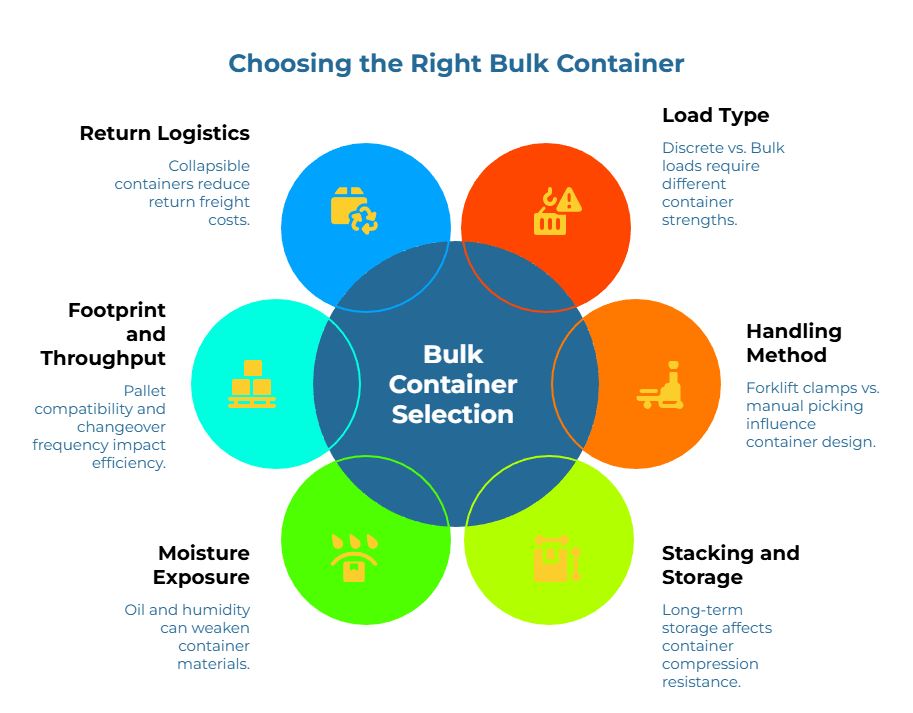
Load Type: Discrete vs. Bulk
A 45 kg machined casting concentrates force on a small contact area. A bin of 2,000 loose fasteners distributes weight across the entire base. The first scenario demands puncture resistance and controlled unit loads; the second demands volume capacity and wall rigidity under distributed lateral pressure.
Handling and Discharge Method
If a dock team picks items out one at a time—or uses a hoist to lift layers—a carton format with defined internal dimensions keeps parts organized and accessible. If the process relies on forklift clamps, bin tippers, or gravity discharge into hoppers, Gaylord’s open-top geometry and reinforced corners are designed for that workflow.
Forklift tine puncture is a leading cause of field failure for both formats. The morning rush at 6:45 AM doesn’t leave room for gentle handling. Specify minimum burst and puncture resistance based on the actual equipment and pace at your facility, not idealized lab conditions.
Stacking and Storage Time
Triple-wall cartons in standard sizes stack predictably when palletized, but edge crush performance (ECT) degrades measurably over extended storage—with significant strength loss often occurring within the first 3 to 10 days in uncontrolled humidity. Gaylords tolerate less stacking height before side bulging begins. If parts sit in a staging yard for days before use, specify compression resistance and stacking limits explicitly. Standards such as ASTM D642, which measures the compressive resistance of shipping containers and unit loads, and TAPPI T 804, which tests fiberboard container compression, provide recognized test methods for validating these specifications. TAPPI T 402 offers conditioning guidance that accounts for how temperature and humidity affect board performance in real supply chains.
Oil and Moisture Exposure
Oily automotive parts, greased bearings, and machining residues weaken corrugated box fibers rapidly. Specify Cobb values and, where contamination is expected, require wax-treated or polyethylene-lined interiors. Humidity conditioning matters too: a container tested at 23 °C and 50% relative humidity per ISO 187 may perform very differently in an unconditioned warehouse running at 35 °C and 80% RH.
Footprint and Throughput
Gaylords typically match standard pallet footprints, maximizing cube efficiency per truck. Triple-wall cartons offer more flexibility in dimensions but may require mixed pallet configurations that reduce load density. Consider how many container touches a line requires per shift—fewer changeovers often favor the Gaylord format.
Return Logistics
If containers cycle back to a supplier for refilling, collapsible Gaylord variants reduce return freight volume significantly. Standard triple-wall cartons are typically single-use. Factor disposal or return costs into the total per-unit container cost—not just the purchase price. For operations sourcing across multiple regions, multi-regional corrugated box sourcing strategies can reduce exposure to single-supplier disruptions while managing return logistics complexity.
When Triple-Wall Cartons Fit the Application
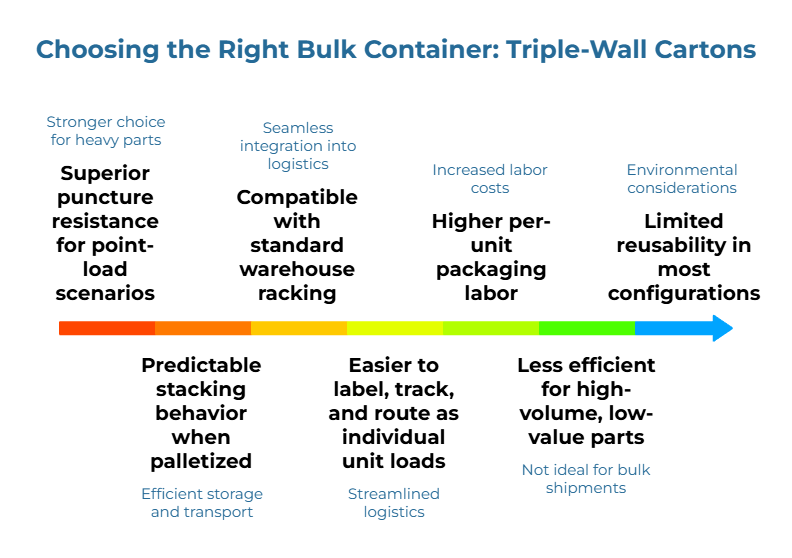
Triple-wall cartons reduce risk from puncture and edge damage on discrete, heavy parts. They are the stronger choice when shipping engine blocks, industrial valves, or machined housings where each item exerts concentrated point loads. The carton format allows defined internal packing arrangements, dividers, and cushioning layers that keep parts separated and stationary during transit.
Advantages: Superior puncture resistance for point-load scenarios. Predictable stacking behavior when palletized. Compatible with standard warehouse racking. Easier to label, track, and route as individual unit loads.
Trade-offs: Higher per-unit packaging labor (loading individual items). Less efficient for high-volume, low-value parts. Limited reusability in most configurations.
Failure modes to spec against: Bottom blowout from concentrated weight—specify minimum burst strength using a recognized test method such as Mullen burst testing. Edge crush failure under stacking—require ECT values matched to actual stacking height and storage duration, with verification per TAPPI T 811. Forklift tine puncture—define fork entry points and specify minimum puncture resistance on the container.
When a Gaylord Bulk Bin Fits the Application
Gaylord bulk bins reduce handling steps for high-volume loose parts and bulk materials. They fit when moving stampings, fasteners, plastic fittings, or granulated material, and the receiving process uses bin tippers, dump stations, or gravity-feed systems. The open-top format eliminates individual packing steps and reduces container touches per shift.
Advantages: Fewer handling steps for bulk loads. Pallet-footprint geometry maximizes truck cube. Compatible with tip/dump discharge workflows. Collapsible versions cut return freight costs.
Trade-offs: Limited stacking capability—typically two-high without intermediate frames. Side bulging risk under lateral pressure from dense loads. Requires liners for oily or fine-particle contents. Less practical for items that need individual identification or layer-by-layer retrieval.
Failure modes to spec against: Side-wall bulging from lateral load pressure—specify minimum ring crush or ECT for the bin walls. Collapse from over-stacking—define a hard stacking limit and require it printed on the container. Base failure during forklift clamp handling—require reinforced bottom panels and specify clamp-pressure tolerances. For general fabrication and performance considerations, ASTM D5118 provides recognized guidance for fiberboard shipping boxes.
The Decision Matrix: Load Type × Handling Method
Use this 2×2 grid to route the format decision before writing an RFQ. Match the container to how the load behaves and how it will be moved and unloaded.
| Piece-Picked / Manual Handling | Forklift-Binned / Tipped | |
| Discrete, Heavy Parts | Triple-wall carton. Controlled unit loads, internal dividers, defined fork entry. Specify ECT + puncture resistance. | Triple-wall carton or reinforced Gaylord. Depends on whether items are individually retrieved after transport. Specify clamp-pressure limits. |
| Bulk, Loose Materials | Small Gaylord or partitioned carton. Manual scooping or partial tip; consider liner for fines. | Gaylord bulk bin. Full tip/dump discharge. Specify stacking limit, liner type, bin geometry for tipper clearance. |
Matric Application:
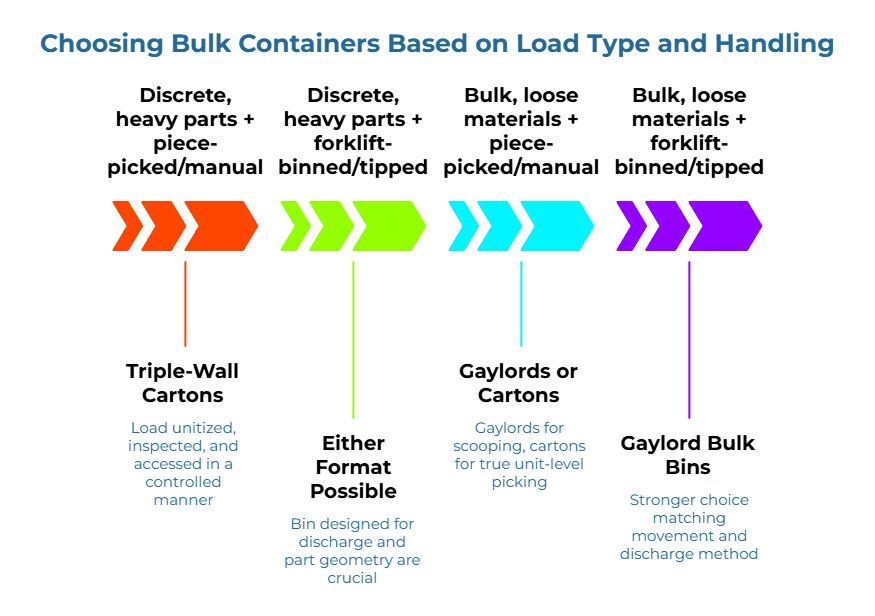
- Discrete, heavy parts + piece-picked/manual: Triple-wall cartons are typically the better fit because the load can be unitized, inspected, and accessed in a controlled manner.
- Discrete, heavy parts + forklift-binned/tipped: Either format can work, but only if the bin is designed for the discharge method and part geometry will not puncture or abrade panels.
- Bulk, loose materials + piece-picked/manual: Gaylords often fit if “picking” is actually scooping or portioning; cartons work better for true unit-level picking.
- Bulk, loose materials + forklift-binned/tipped: Gaylord bulk bins are typically the stronger choice because the format matches the movement and discharge method.
This framework is stable, but outcomes depend on implementation details—equipment capabilities, operator consistency, storage duration, and exposure conditions all shape real-world performance. For a cost-impact analysis of these variables, review the total cost of ownership framework for corrugated boxes.
Once the format is clear, lock the specifications. Select a vendor capable of maintaining these tolerances across high-volume runs, ensuring their testing facilities align with the ASTM and TAPPI standards cited above. Browse corrugated box suppliers on PaperIndex to compare options that match your required format, or find suppliers across broader packaging categories.
Procurement Checklist: Questions to Ask Suppliers Before Committing
Clear procurement specs prevent supplier variability that leads to line-stopping failures. Before sending an RFQ for either format, pin down the following.
Format and footprint:
- What finished dimensions are required?
- How does the container integrate with pallet footprint and warehouse racking?
Board construction and performance intent:
- What wall type is proposed (including triple-wall where needed)?
- What performance measures are being used for stacking versus puncture risk?
- Moisture and oil resistance requirements (Cobb value, liner or coating type)
Verification approach:
- What test methods will verify compression and stacking performance (e.g., ASTM D642 for compression, TAPPI T 811 for ECT)?
- What conditioning protocol applies, and is it consistent with actual storage and transit conditions?
Handling constraints and stacking limits:
- Maximum stacking height (number of layers, with and without intermediate frames)
- Fork entry specifications and clamp-pressure limits
- Discharge method compatibility (tip/dump clearances, liner removal sequence)
Quality controls:
- Inbound inspection protocol: what gets checked at the dock, and against what threshold?
- Sampling frequency and acceptance criteria (AQL levels for critical, functional, and cosmetic defects)
- Documentation expectations: certificates of analysis, lot traceability
- How is run-to-run consistency controlled and documented?
Pilot run:
- What small validation run will check inbound condition, handling damage, stacking stability, and discharge behavior before scaling?
Run a pilot. A small validation run—even 25 to 50 containers through the actual receiving and production workflow—exposes fit, handling, and failure-mode issues that paper specs alone cannot catch. ISTA test procedures provide a recognized framework for simulating distribution hazards during transit testing.
For applications involving shock-sensitive components during handling or transit, define G-force protection requirements and drop-test protocols as part of your container specification.
Common Mistakes Buyers Make
Assuming a thicker board is automatically safer. Triple-wall construction does not help if the container format doesn’t match the load’s behavior—a lesson reinforced by strategic corrugated box sourcing frameworks that prioritize specification discipline over material thickness alone. A triple-wall Gaylord will still bulge under dense lateral loads if wall height and reinforcement are not specified for that pressure profile.
Treating Gaylord as a material spec instead of a format choice. A Gaylord can be a triple-wall. The bin format solves a workflow problem; the board spec solves a performance problem.
Ignoring forklift and stacking realities. Specs written in a conference room often assume gentle handling. The dock is not gentle—tine impacts, clamp pressure, uneven floor surfaces, and operators working at speed are the norm. Specify for the environment that actually exists, and establish evidence-based protocols for handling non-compliance disputes before problems arise.
Skipping the pilot run. Approving a container based on a sample and a data sheet, then ordering 3,000 units, is a common and expensive shortcut. The pilot is where problems surface: the container’s internal height doesn’t clear the conveyor infeed, or the liner snags during discharge.
Sourcing and Validation: Your Next Steps
With format and spec decisions locked, the next step is finding suppliers who can hold those specs consistently across production runs.
- To compare corrugated box suppliers for your required format and specification, use PaperIndex’s verified supplier directory.
- For broader supplier discovery across categories, use the PaperIndex supplier directory.
- To view corrugated box product listings and typical offerings, explore the corrugated boxes category.
The container that survives the supply chain is the one precisely engineered for the specific interaction between load behavior, environmental variables, and dock handling protocols.
Submit a formal Request for Quotation (RFQ) to validate vendor capacity against these ASTM/TAPPI requirements.
Disclaimer:
This article is for educational and informational purposes only. All specifications, test methods, and container selections should be validated through your own engineering and quality assurance processes.
Our Editorial Process:
Our expert team uses AI tools to help organize and structure our initial drafts. Every piece is then extensively rewritten, fact-checked, and enriched with first-hand insights and experiences by expert humans on our Insights Team to ensure accuracy and clarity.
About the PaperIndex Insights Team:
The PaperIndex Insights Team is our dedicated engine for synthesizing complex topics into clear, helpful guides. While our content is thoroughly reviewed for clarity and accuracy, it is for informational purposes and should not replace professional advice.