
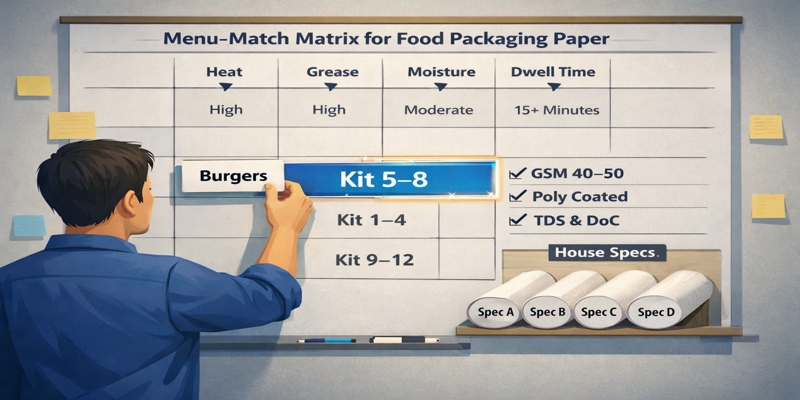
📌 Key Takeaways
Matching paper specifications (specs) to your actual menu—not grabbing “food safe” labels—prevents grease stains, soggy wraps, and wasted money.
- Menu Conditions Drive Specs: Heat, grease, moisture, and hold time determine which paper works—not what the label says or what costs least.
- Kit Level Handles Grease Only: Higher Kit numbers block more oil, but they won’t fix steam sogginess or heat-softened coatings—check the full spec sheet.
- Two to Four House Specs Cover Most Menus: Grouping similar items into a few standard papers cuts SKU chaos and ends kitchen-versus-procurement arguments.
- Supplier Documents Prove Performance: A Technical Data Sheet with test results and compliance statements beats marketing claims every time.
- Under-Specifying Shows, Over-Specifying Hides: Weak paper fails visibly in customer hands; slightly stronger paper just costs a bit more per unit.
Spec the paper to the food, and the packaging argument ends before it starts.
Food service operators, restaurant procurement managers, and multi-location franchise buyers will gain a shared decision method here, preparing them for the detailed spec-building framework that follows.
~ ~ ~ ~ ~ ~ ~ ~ ~ ~ ~ ~ ~ ~ ~ ~ ~ ~
The customer pulls out their sandwich. A dark grease stain spreads across the wrapper and onto their sleeve.
That moment costs more than one lost sale. It costs trust. And somewhere in the back office, the argument starts again: kitchen blames the paper, procurement blames the vendor, and nobody can agree on what went wrong because nobody agreed on what “right” looked like in the first place.
Most food operators buy food packaging paper by feel—grabbing whatever says ‘food safe’ on the label—instead of matching actual menu conditions to measurable specifications. The result is mismatched performance, wasted reorders, and a procurement process where kitchen staff and buyers speak entirely different languages.
This guide provides a shared framework. You’ll learn to classify menu items by their real-world demands, translate those demands into defensible specifications, and consolidate purchasing into a small set of “house specifications” that everyone can agree on.
The Decision Table: Common Menu Categories and What to Look For
If you read only one section, read this table. A manager should be able to scan it and understand what to ask a supplier without reading every paragraph.
| Item Classification | Heat | Grease | Moisture | Dwell Time | Kit Band | Specification Checklist | Supplier Ask |
| Dry pastries, cookies, bread | Low | Low–Med | Low | Short–Med | 3–6 | GSM 30–45; treated uncoated or light barrier; sheet/bag | TDS; dry-food compliance statement |
| Cold sandwiches, deli wraps | Low | Low–Med | Medium | Medium | 3–6 | GSM 35–50; moisture-resistant coating; wrap | TDS with grease/moisture specifications; food-contact declaration |
| Hot sandwiches, paninis | Medium | Medium | Med–High | Medium | 5–8 | GSM 40–60; heat-stable barrier; wrap/sheet | TDS confirming heat tolerance; Kit test documentation |
| Standard burgers | Med–High | Med–High | Medium | Medium | 6–9 | GSM 45–65; greaseproof barrier; wrap format | TDS with Kit results; compliance certificate |
| Fried items (fries, nuggets) | High | High | Low–Med | Short–Med | 7–10 | GSM 40–55; high-performance barrier; liner/basket | TDS with Kit verification; traceability docs |
| Heavy-grease items (fried chicken, bacon, wings) | High | Very High | Medium | Med–Long | 9–12 | GSM 50–70; premium barrier coating; structured wrap/liner | TDS with Kit 9+ verification; batch traceability |
| Steamy hot-held items (buns, wraps in clamshells) | High | Low–Med | High | Med–Long | 1–4 or 5–8 | Moisture management focus; venting strategy; GSM for stiffness | TDS with moisture-related properties; compliance statement |
| Short-contact basket liners, tray liners | Medium | Medium | Medium | Short | 5–8 | Liner format; balanced GSM; light barrier; printable options | TDS; compliance statement; traceability basics |
| Long-hold delivery items | Med–High | Med–High | Med–High | Long | 5–8 or 9–12 | Specification for hold time and temperature range; consider multi-layer system | TDS aligned to hold time; lot traceability; consistency evidence |
This table provides a decision framework. Your specific menu items, portion sizes, and hold times may shift requirements within these bands. Always validate final selections with supplier documentation.
The Operational Translation Gap
The hidden cost of “generic food-safe” buying shows up in three places: inconsistent performance on the line, emergency reorders that blow your budget, and endless finger-pointing between departments.
Kitchen managers see failures firsthand. Greasy fingerprints. Soggy wraps. Customers complaining. But when they escalate the issue, they describe symptoms: “The burger paper doesn’t work.” Procurement teams need something different—a specification sheet, a TDS, a measurable standard they can put into an RFQ and use to compare quotes.
This translation gap is where teams get stuck. Without shared vocabulary, every purchasing decision becomes a guess. When that guess fails, nobody knows whether the problem was the paper, the supplier, or the original specification. The phrase “food safe” on a label proves nothing without named standards and lot-linked documentation behind it.
The fix isn’t better. It’s building a matrix that maps what you actually serve to the specifications that can handle it. A good matrix makes the conversation boring—in the best way. It replaces opinion with a repeatable classification method.
Two Knobs That Decide Most Outcomes: Material Variables
Two variables control most food packaging paper performance. Get these right, and most failures disappear.
Food-Grade Paper Specifications as the Packaging “DNA”
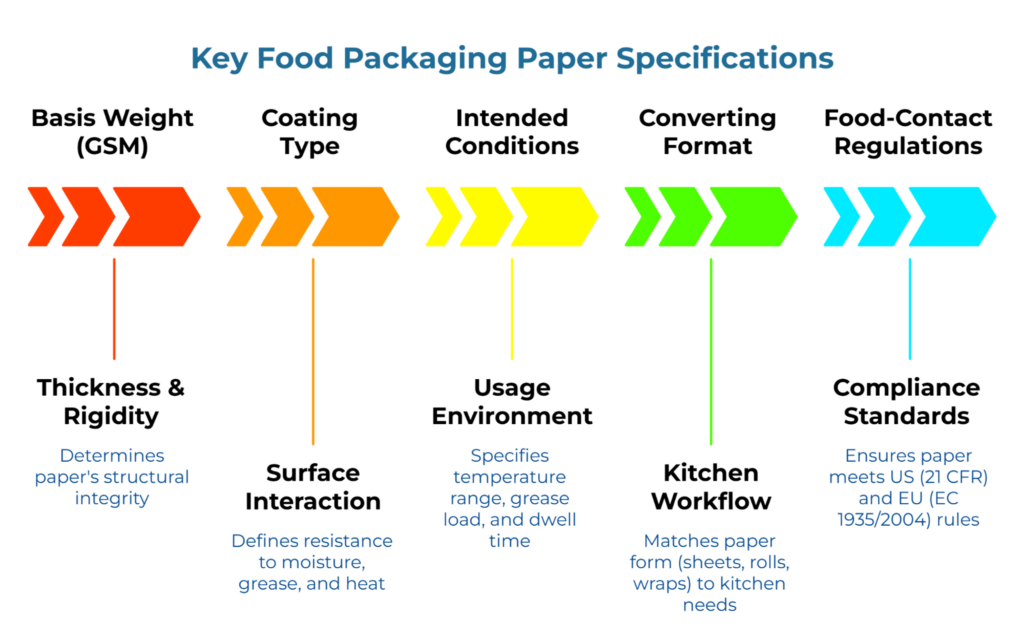
Every sheet of food packaging paper carries a specification profile—think of it as the paper’s genetic code. The key parameters include:
Basis Weight (GSM) determines the paper’s thickness and rigidity. Heavier paper generally offers more structural integrity, but weight alone doesn’t guarantee grease resistance. A 70 GSM sheet with no barrier coating will soak through faster than a 40 GSM sheet with proper treatment.
Coating Type defines how the surface interacts with moisture, grease, and heat. Options include uncoated (for dry items only), wax-coated (limited heat tolerance), aqueous barriers, and fluorochemical-free grease barriers. Understanding the difference between poly-coated and uncoated barriers is critical for hot, steamy foods. Wax coatings soften at higher temperatures, making them unsuitable for hot, greasy foods.
Intended Conditions describe the temperature range, grease load, and dwell time the paper was designed to handle. While premium suppliers list this on the Technical Data Sheet (TDS), many basic specification sheets omit dwell time and max temperature. In such cases, request a separate ‘Declaration of Compliance’ (DoC) or specific usage guidelines to confirm thermal limits.
Converting Format—sheets, rolls, or pre-cut wraps—must match your kitchen workflow.
These specifications must align with food-contact regulations. In the US, 21 CFR 176.170 covers paper intended for aqueous and fatty foods, while21 CFR 176.180 addresses dry food contact. The EU Food Contact Materials framework applies similar principles under EC 1935/2004.
A good specification doesn’t need to be long. It needs to be unambiguous.
Grease Holdout (TAPPI T 559)
While historically the primary metric, Kit Level (standardized per TAPPI T 559) remains a common measure of grease resistance, particularly for traditional fluorochemical-treated papers. The test applies increasingly aggressive oil/solvent mixtures to the paper surface; the highest-numbered solution the paper resists determines its Kit Level. Note, however, that many modern PFAS-free (fluorine-free) barrier coatings may score lower on Kit tests yet still provide effective functional grease resistance in real-world applications. Always cross-reference Kit scores with practical usage tests for newer eco-friendly papers.
Think of Kit Levels like SPF ratings for sunscreen—higher numbers handle more intense exposure. Three practical bands:
- Kit 1–4 (Low): Dry or minimally greasy items—bread, pastries, cookies
- Kit 5–8 (Medium): Moderate grease—sandwiches, light fried items, deli wraps
- Kit 9–12 (High): Aggressive grease and heat—fried chicken, bacon cheeseburgers, hot wings
A common mistake is assuming Kit Level tells the whole story. It doesn’t. A high Kit Level won’t save paper that softens under steam or loses rigidity at serving temperature. Kit addresses grease holdout; the broader specifications sheet defines the full suitability envelope. For a deeper breakdown, see the guide on GSM and Kit Levels in food packaging paper.
60-Second Kit Band Flowchart
Before working through the full matrix, this quick decision path gets you to a starting Kit band in under a minute.
Initial Temperature Assessment
- Cold or room temperature → go to Question 2
- Hot → go to Question 3
Cold-State Analysis
- Mostly dry or low oil → Kit band 1–4, then confirm GSM and format
- Noticeable oils from spreads, dressings, or cheese → Kit band 5–8, then confirm coating and format
Hot-State Analysis
- Low grease but high steam → Kit band 1–4 or 5–8 (Kit may be secondary to moisture strategy)
- Medium grease → Kit band 5–8, then confirm heat tolerance and GSM
- High grease from frying, oily sauces, or rendered fat → Kit band 9–12, then confirm anti-wicking properties and format
Final step: Confirm your selection against the specification checklist and supplier documentation. Cross-reference this flowchart against specific Technical Data Sheets (TDS) to verify that barrier chemistry matches the anticipated thermal load.
Implementation Framework
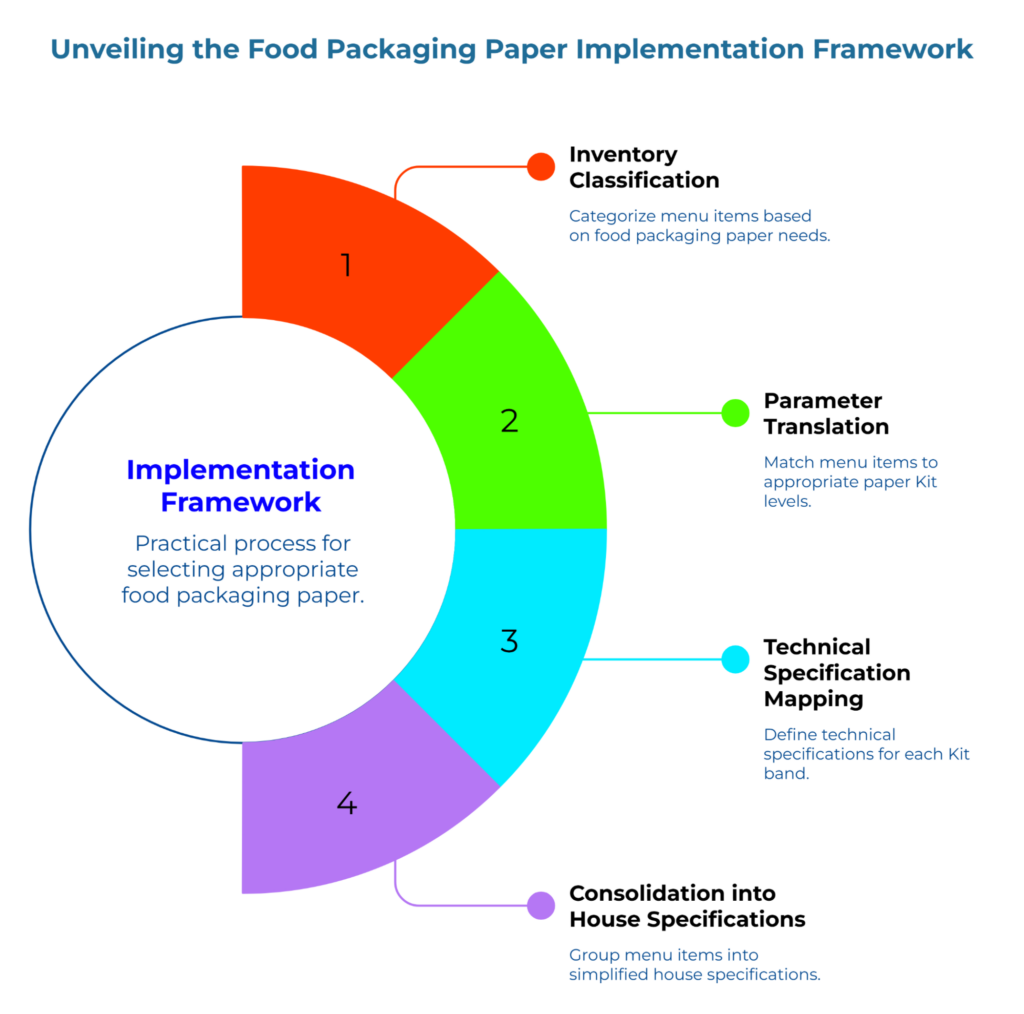
Here’s the practical process. Grab your menu and work through four steps.
Inventory Classification
Create a simple spreadsheet listing every menu item that touches food packaging paper. Tag four variables for each:
- Heat exposure: Low (room temp/cold), Medium (warm/hot), High (straight from fryer/grill)
- Grease load: Low (dry), Medium (moderate oil/butter), High (fried or cheese-heavy)
- Moisture/steam: Low (dry), Medium (some condensation), High (steaming)
- Dwell time: Short (under 5 min), Medium (5–15 min), Long (15+ min or delivery)
Don’t overthink this. You’re building a rough classification, not a laboratory analysis. This step is where the kitchen’s reality becomes procurement input.
Parameter Translation
Use the flowchart above as a first-pass filter. Then apply a conservative decision rule:
Mostly “Low” tags across all variables point to Kit 1–4. A mix of “Low” and “Medium” suggests Kit 3–6. Mostly “Medium” tags indicate Kit 5–8. Any “High” grease or heat tag pushes toward Kit 7–10. Multiple “High” tags or long dwell times with grease require Kit 9–12.
When moisture or steam dominates the failure mode rather than grease, the right answer often comes from barrier strategy and format choices, not simply a higher Kit band.
When uncertain, round up. Under-specifying causes visible failures; over-specifying just costs a bit more.
Technical Specification Mapping
For each Kit band, note the accompanying specifications:
- GSM range (not a single point) matched to structural needs
- Coating type appropriate for heat and moisture conditions
- Format based on kitchen workflow
- Compliance documentation including food-contact declarations and relevant certifications
This step is where kitchen needs meet procurement language. The specification checklist translates “the paper that works for our burgers” into “45–65 GSM, Kit 6–9, greaseproof barrier coating, wrap format.” Now procurement has something concrete that suppliers can quote against.
Consolidation into House Specifications
Most operations don’t need unique paper for every menu item. Look across your matrix for natural groupings. The food packaging paper sourcing matrix framework helps balance safety certification requirements with performance specifications..
Can fried items and heavy burgers share the same high-performance paper? Can cold sandwiches and hot paninis share a medium-grade wrap with a buffer built in? The goal is reducing complexity to two to four “house specifications” covering 90%+ of your menu.
A practical naming pattern:
- House Specification A (Dry/Low Grease): Kit band 1–4, GSM tuned for stiffness, sheets or liners
- House Specification B (Warm/Moderate Grease): Kit band 5–8, wrap or liner format
- House Specification C (Hot/High Grease/Fried): Kit band 9–12, strong anti-wicking focus
- House Specification D (Exceptions): Reserved for outliers with long hold times, high moisture, and oil combined
Exceptions are allowed. They just need to be documented as exceptions—to prevent SKU proliferation. Consolidating specifications stabilizes inventory costs and minimizes procurement variance.
Document your house specifications with clear names and the associated requirements. This becomes your purchasing standard and the document that ends kitchen-versus-procurement arguments.
Procurement-Ready: How to Ask Suppliers for Apples-to-Apples Quotes
With house specifications defined, you can request quotes that actually compare. Defining your specifications sheet first prevents the mismatched quotes that make supplier evaluation impossible.
RFQ Requirements:
- Environmental Load (Heat/Grease/Moisture/Dwell)
- Performance Band (Kit 1-12)
- Structural Specification (GSM/Format)
- Logistics (Volume/Cadence)
Supplier Quote Requirements:
- Technical Data Sheet confirming the specifications profile
- Kit Level test documentation with test methods and results
- Food-contact compliance statement referencing applicable regulations
- Basic traceability information (manufacturing source, lot tracking)
This approach eliminates comparing apples to oranges. When every supplier quotes against the same checklist, you evaluate on price, lead time, and reliability—not guesswork about whether their paper will perform. For a complete verification workflow, see the compliance audit checklist.
Common Failure Modes (and Quick Fixes)
When food packaging paper fails, the symptom usually points to a specific mismatch.
Grease Strike-Through
Symptom: Oil soaks through the paper, leaving customers with greasy fingers.
Likely mismatch: Kit Level too low for the grease load, or dwell time longer than the paper handles.
Fix: Move up one Kit band. If using Kit 5–8, test Kit 7–10. Confirm the coating type suits your specific fat profile. A 5-minute grease spot test at receiving can catch problems before they reach customers.
Heat + Grease Failures
Symptom: Paper works initially but softens, wrinkles, or loses barrier integrity as hot food sits.
Likely mismatch: Coating not heat-stable, or GSM too light for structural demands. Even paper that performs well on cold foods can fail when heat causes the barrier formulation to break down.
Fix: Check coating type in the TDS. Wax coatings soften above certain temperatures, making them unsuitable for hot applications. Switch to heat-stable barrier coatings, add “heat tolerance” as an explicit condition in your spec checklist, and validate with TDS documentation plus a kitchen trial.
Over-Specifying
Symptom: Using premium high-Kit paper for items that don’t need it, or managing more SKUs than the operation can handle.
Likely mismatch: Specifications were created per item instead of per condition cluster. No consolidation step—every item has its own paper grade.
Fix: Revisit Step 4. Rebuild around two to four house specifications, then document exceptions. The matrix becomes the governance tool. Identify condition clusters where high-performance specification can subsume lower requirements. This ‘over-specification’ strategy reduces total SKU count, capturing volume-pricing tiers that offset the higher per-unit material cost.
Master Menu-Specifications Matrix (Template + Example)
The template includes:
- Menu classification worksheet with columns for heat, grease, moisture, and dwell time
- Kit band lookup table for translating tags to recommended bands
- Specifications checklist builder with fields for GSM, coating, format, and documentation
- House specifications consolidation tracker to define and name purchasing standards
- Supplier comparison grid for side-by-side quote tracking
- Documentation tracker with fields for TDS, compliance statements, and traceability notes
Using it across locations: If you operate multiple sites, build location-specific matrices then compare them. Most operators find 80%+ overlap, which means consolidated purchasing across locations, volume pricing, and fewer total SKUs.
Start with the top sellers across all stores. Standardize primary specifications based on the highest-demand condition clusters. Allow exceptions only when a location’s conditions are genuinely different due to hold time, equipment, or delivery profile.
Remember to validate final selections with supplier documentation and testing. The matrix gives you a decision framework; supplier TDS and compliance documents confirm the paper meets your requirements.
Frequently Asked Questions
What does a Kit Level actually tell me?
Kit Level measures grease resistance—how well a paper surface repels oil penetration over time. It’s tested using standardized solutions per TAPPI T 559. Higher numbers handle more aggressive grease without staining or soaking through. Kit Level doesn’t measure heat tolerance, moisture resistance, or structural strength. Those require separate specifications.
Is a higher Kit Level always better?
No. Higher Kit Levels cost more and may use coating technologies unnecessary for low-grease items. Higher grease resistance can also add complexity without solving steam or moisture failures. Matching the Kit band to actual menu conditions is more cost-effective than blanket over-specifying. A dry pastry doesn’t need Kit 10 paper.
How should GSM and Kit Level work together?
GSM determines thickness, rigidity, and structural durability. Kit Level determines grease resistance. They’re independent variables. Heavy paper with low Kit Level will be sturdy but grease-permeable. Light paper with high Kit Level resists grease but may lack structural integrity for large items. Match both to your use case.
What supplier documents should I request?
At minimum: TDS confirming the specifications profile, Kit Level test documentation, and food-contact compliance statement referencing applicable regulations. Verified food packaging paper suppliers can provide these documents as standard practice. For the US, this typically means alignment with 21 CFR 176.170 for fatty foods or 21 CFR 176.180 for dry foods. For EU markets, reference the Food Contact Materials framework. For higher-risk applications, request batch traceability and manufacturing source information. When importing food packaging paper, additional verification of international safety certifications becomes essential.
How do I consolidate specifications without hurting performance for a difficult menu item?
Cluster by conditions, not by SKU. Identify the highest-demand item in each Kit band and build your house specifications around it. If fried chicken requires Kit 9–12 and fried shrimp requires Kit 7–10, your “High-Grease” house specifications should target Kit 9–12 to cover both. The shrimp will be slightly over-specified, but you manage one SKU instead of two. Document a small number of exceptions—often one “extreme grease/hot” specification and one “steam/moisture” specification—rather than creating separate specifications for every edge case.
What’s the fastest way to sanity-check a new wrap before a full rollout?
Run a short kitchen trial that mirrors actual dwell time and heat/grease exposure. Pair that with TDS review and a basic receiving/spot-check plan so performance doesn’t drift between lots.
Ready to source food packaging paper that matches your menu specifications? Find verified suppliers on PaperIndex to request quotes against your house specifications.
For additional educational resources on food packaging paper specifications and supplier verification, visit the PaperIndex Academy.
Disclaimer:
This article is provided for educational purposes and does not constitute legal or regulatory advice. Final food packaging paper decisions should be validated with supplier documentation and applicable food-contact requirements.
Our Editorial Process:
Our expert team uses AI tools to help organize and structure our initial drafts. Every piece is then extensively rewritten, fact-checked, and enriched with first-hand insights and experiences by expert humans on our Insights Team to ensure accuracy and clarity.
About the PaperIndex Insights Team:
The PaperIndex Insights Team is our dedicated engine for synthesizing complex topics into clear, helpful guides. While our content is thoroughly reviewed for clarity and accuracy, it is for informational purposes and should not replace professional advice.