
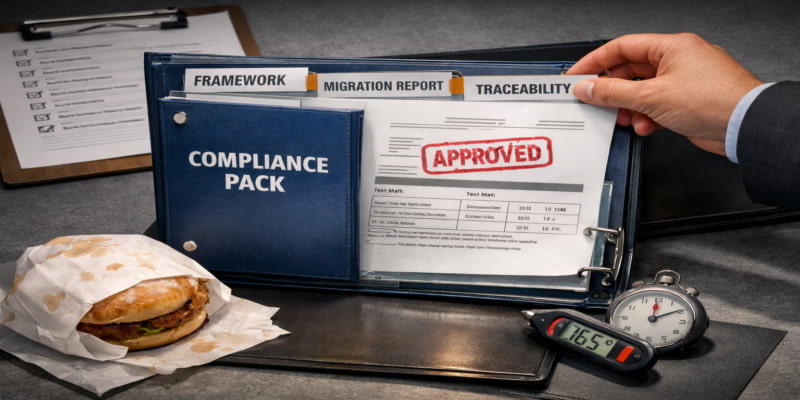
📌 Key Takeaways
“Food grade” describes the raw material; “food safe” proves the finished product works for your specific food, temperature, and contact time.
- Material Isn’t Application: A kraft paper labeled “food grade” can still fail when wrapping hot, greasy fried chicken because the actual use conditions were never tested.
- Inspectors Want Proof, Not Labels: Health inspectors look for documents that match your menu—migration test reports showing your food type, temperature, and contact duration—not generic certificates.
- Ask for Specific Test Conditions: Before ordering packaging, request a compliance letter naming the regulatory framework and a migration test report that matches your real-world use.
- Thickness Doesn’t Block Grease: Heavier paper feels sturdier but GSM measures weight, not grease resistance—only a Kit level rating (1–12) shows how well paper stops oil from soaking through.
- Run a Same-Day Shelf Audit: Pull 5–10 food-contact packaging items, check if each names a framework and test conditions, then request missing proof from suppliers.
Proof beats labels—document your packaging the way an inspector would check it.
Food service operators and procurement managers preparing for health inspections will gain immediate clarity here, setting up the documentation checklist that follows.
~ ~ ~ ~ ~ ~ ~ ~ ~ ~ ~ ~ ~ ~ ~ ~ ~ ~
When a health inspector requests documentation for your packaging, a ‘food safe’ label on the box is insufficient. Success in an audit depends on the distinction between ‘food grade’ and ‘food safe’ becoming operational.
These terms appear on packaging specifications and supplier data sheets—often used interchangeably. They are not the same. Understanding the distinction helps you move from trusting claims to requesting proof, which is precisely what a health inspection demands.
Food Grade vs Food Safe: The Difference in One Sentence Each
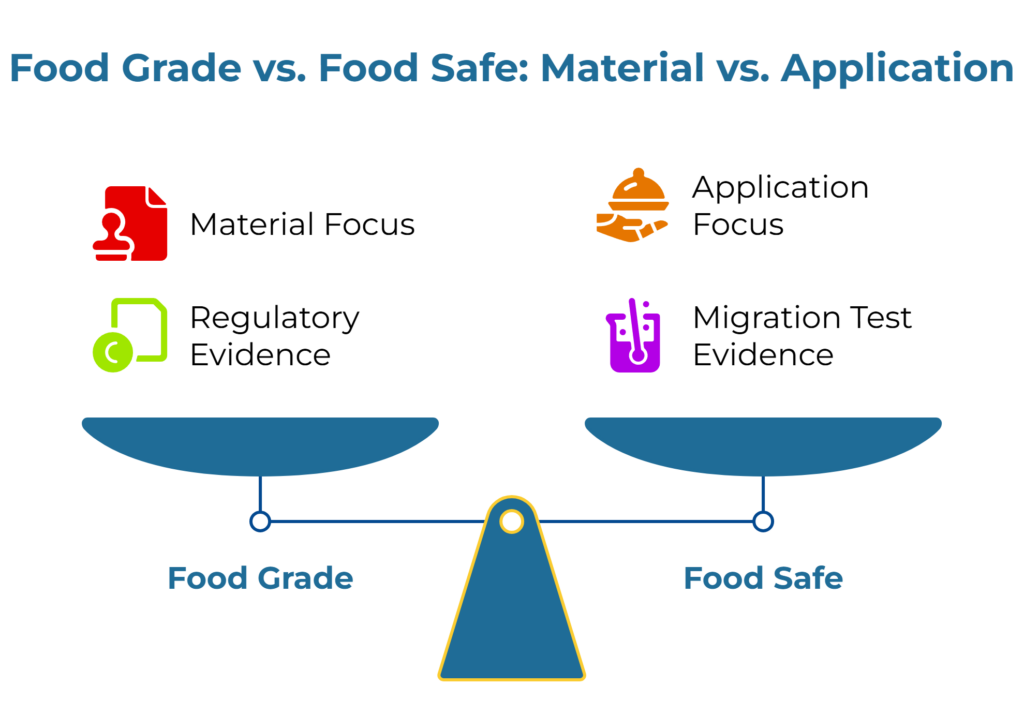
Food grade means the material can be used for food contact under a defined regulatory framework.
Food safe means the finished product is safe for its specific intended use—considering the food type, temperature, and contact duration.
The terms get conflated because both sound compliant. “Food grade” sounds definitive, even when it only describes a base paper type—not the inks, coatings, adhesives, or converting steps that can change real-world suitability. A kraft paper may be manufactured from food-grade materials yet fail as food-safe packaging when wrapping hot, greasy fried chicken for fifteen minutes. This is why sourcing from qualified food grade kraft paper suppliers who understand application-specific testing is essential. The material met a standard. The application was never tested.
The safest mental model: food grade starts a conversation; food safe for intended use closes it.
Core Distinctions: Material vs. Application
| Aspect | Food Grade | Food Safe |
| What it refers to | The raw material or component | The finished product in its intended application |
| What it proves | Material can contact food under defined conditions | Product performs safely under your specific conditions |
| Evidence to request | Letter of Guarantee citing relevant 21 CFR sections (e.g., part 176.170 for fatty/aqueous, part 176.180 for dry foods) (US), or a Declaration of Compliance for EC 1935/2004 (EU) | Migration test reports matching your food type, temperature, and contact time |
| Common red flag | Claim with no regulatory framework reference | Claim with no test conditions specified |
What the Difference Means for Your Health Inspection
The distinction determines whether a packaging choice is defensible with documentation when an inspector asks, “How do you know this is appropriate for food contact?”
Inspectors look for documented risk control—not labels. A certificate proves something was tested. It does not prove that your paper, for your menu items, passed under conditions reflecting actual service.
The bridge between these terms is intended for use. A packaging paper’s safety depends on three variables:
Contact type. Is the food dry, moist, fatty, or acidic? Fatty foods stress grease barriers differently than dry goods.
Temperature. Cold storage, ambient display, or hot holding above 160°F (~70°C) each create different demands.
Duration. Seconds of contact during wrapping differ from twenty minutes in a delivery bag.
A bakery liner that touches a dry pastry briefly is not the same as a wrap in direct contact with a hot, oily sandwich. When sourcing wrapping paper for food service applications, always match specifications to your specific use case. Even if both are “food grade” materials, the conditions of use change what’s reasonable to claim and what evidence should be on file. A paper tested for dry bakery items cannot be assumed safe for hot, oily fried food. When staff start double-wrapping items to prevent grease bleed-through, the problem is often a mismatch between the paper’s rating and the food’s demands. Understanding grease resistance ratings (Kit levels 1–12) helps address this.
For teams operating across regions, keeping official reference links available supports supplier conversations. In the U.S., packaging discussions often reference the FDA’s Inventory of Effective Food Contact Substance Notifications. In the EU context, the European Commission’s Food Contact Materials overview provides a practical starting point.
For what inspectors typically expect in documentation, see Food Packaging Paper Trail: 3 documents you need to pass a health inspection.
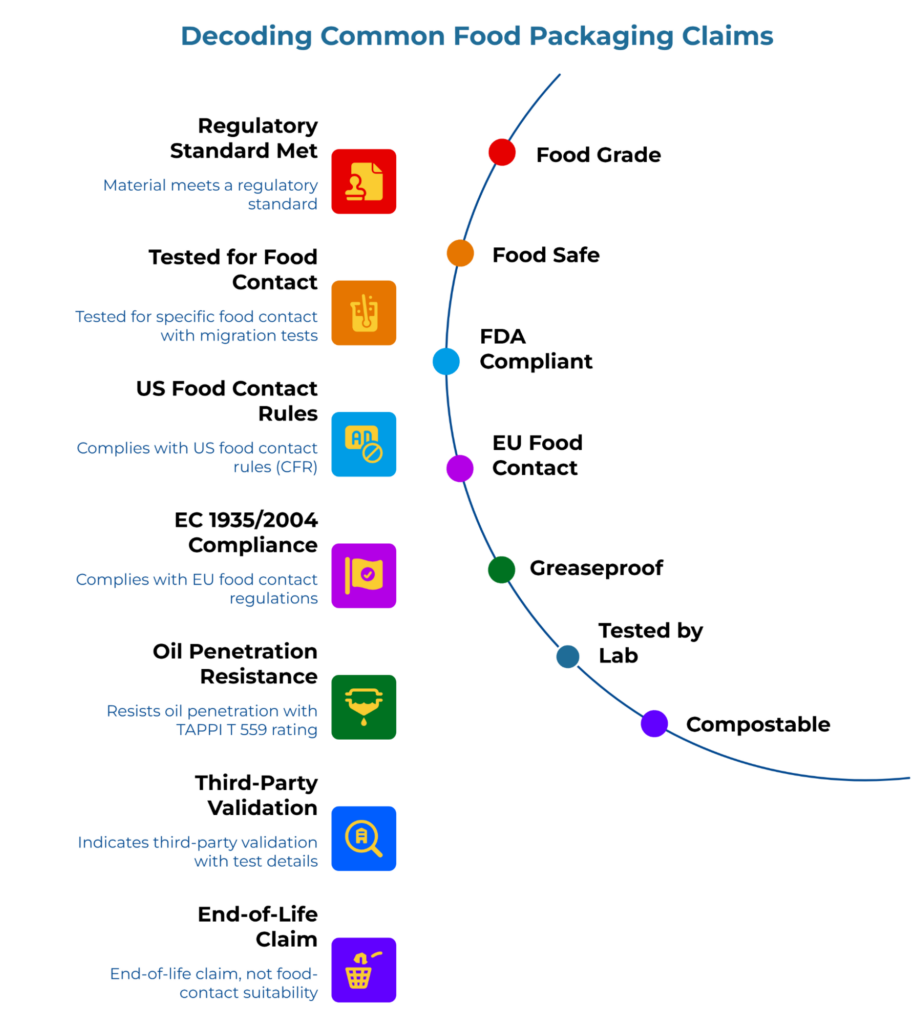
How to Decode Common Packaging Claims
| Claim | What It Implies | Proof to Request | Red Flag |
| “Food Grade” | Material meets a regulatory standard | Declaration of Compliance naming the framework | No framework cited |
| “Food Safe” | Tested for specific food contact | Migration test report with conditions | No test conditions listed |
| “FDA Compliant” | Meets US food contact rules | CFR section; check FDA FCS Inventory | Generic claim without citation |
| “EU Food Contact” | Complies with EC 1935/2004 | Declaration of Compliance per EU regulation; accredited lab report | Logo without certificate |
| “Greaseproof” | Resists oil penetration | Kit level rating (1–12) per TAPPI T 559 | Omission of Kit level or a rating insufficient for the grease-load of the application |
| “Tested by lab” | Indicates third-party validation, but scope may not align with specific use-cases | Test name, conditions, and product identification | Lab logo with no report or SKU match |
| “Compostable” | End-of-life claim, not food-contact suitability | Separate food-contact documentation | Compostable treated as proof of food contact |
The goal is knowing what question each term should trigger: What proof supports this claim for my use case?
What to Ask Your Packaging Supplier: a Documentation Mini-Checklist
Before your next order—whether working with domestic vendors or evaluating food packaging paper suppliers internationally—request these six items:
- Compliance Guarantee or Declaration. Look for a Letter of Guarantee for US frameworks (FDA 21 CFR) or a formal Declaration of Compliance for European frameworks (EU 1935/2004). This must confirm coverage for the base paper, coatings, and inks.
- Migration test report. Should specify food simulant, test temperature, and contact duration. Match these to your actual menu conditions.
- Scope verification. Confirm the certificate covers your specific product. Whether sourcing from food packaging paper mills or distributors, ask: “Does this cover coated kraft for hot fatty foods above 160°F (~70°C)?”
- Accreditation check. If a lab name appears, verify accreditation via directories like DAkkS.
- Traceability link. Request lot numbers connecting the certificate to your shipment.
- Change-notification commitment. A simple supplier agreement to notify you if materials or processes change.
A supplier who provides these promptly demonstrates compliance infrastructure. One who cannot is worth reconsidering — find suppliers who can meet your compliance documentation requirements through verified marketplaces.
Common Traps and How to Avoid Them
Trap 1: Equating thickness or colour with compliance. A heavier kraft paper feels substantial. Neither weight nor natural brown colour proves food contact safety. GSM measures weight—not grease resistance or regulatory compliance. The false diagnosis is believing thicker paper stops grease, when what matters is an appropriate Kit level. See GSM explained: matching paper weight to menu items.
Trap 2: Equating laboratory logos with comprehensive coverage. A reputable testing body’s certificate proves something was evaluated—not that your specific paper grade, coating, and use conditions were tested. Always check the scope section and match reports to the exact SKU.
Trap 3: Misinterpreting ‘food grade’ as universal certification. Food-grade status applies to materials, not assembled products. All components—paper, coatings, adhesives, inks—must be compliant for the intended use. See Beyond the fine: reputation risk of non-compliant food packaging paper.
Trap 4: Treating compostable claims as compliance proof. Compostable certifications address end-of-life disposal, not food-contact suitability. A paper can be industrially compostable yet lack any food-contact documentation. Keep these claims separate in your evaluation.
Quick Next Step
A same-day shelf audit can reduce inspection anxiety by identifying which items have documentation gaps.
- Pull 5–10 packaging SKUs from current inventory that directly touch ready-to-eat food. Prioritize hot and greasy items.
- Photograph the label claims (“food grade,” “food safe,” “FDA compliant,” “EU compliant”).
- Create a one-page tracker: SKU → claim(s) → documents on file → missing items.
- For each item, answer three questions:
- Does it name a specific regulatory framework?
- Does it specify test conditions matching actual use?
- Can the certificate be traced to the lot in storage?
- Request evidence using the mini-checklist above for any item with uncertain answers. File by SKU name and revision date.
That conversation shifts purchasing from label-based assumptions to proof-based confidence—exactly what a health inspection rewards.
Establish a procurement mandate: every food-contact SKU must be accompanied by a specification sheet, compliance statement, and defined intended-use parameters prior to inventory entry. When ready to source from verified suppliers, you can submit your buying requirements to receive quotes directly.
Disclaimer:
This article is provided for general educational purposes and does not constitute legal advice. Requirements and enforcement practices vary by jurisdiction; consult local authorities or a qualified compliance professional for situation-specific guidance.
Our Editorial Process:
Our expert team uses AI tools to help organize and structure our initial drafts. Every piece is then extensively rewritten, fact-checked, and enriched with first-hand insights and experiences by expert humans on our Insights Team to ensure accuracy and clarity.
About the PaperIndex Insights Team:
The PaperIndex Insights Team is our dedicated engine for synthesizing complex topics into clear, helpful guides. While our content is thoroughly reviewed for clarity and accuracy, it is for informational purposes and should not replace professional advice.