

📌 Key Takeaways
Two toilet tissue rolls can show the same GSM and still run differently. Moisture content explains why.
- GSM Measures Weight, Not Quality: GSM tells you how heavy the paper is, but not whether that weight comes from fiber or absorbed water.
- Moisture Changes How Rolls Run: Extra moisture weakens the paper and causes snapping, uneven tension, and wasted material on converting lines.
- Water Weight Hides Value Loss: A roll with higher moisture contains less usable fiber—you’re paying for water disguised as paper.
- Mill Tests Don’t Match Arrival Reality: Rolls tested at the factory may absorb moisture during shipping and storage, changing how they perform at your plant.
- Lock Test Methods Before You Buy: Specify ISO standards for both GSM and moisture in your RFQ so all supplier quotes measure the same thing.
Same paperwork, different performance. Control moisture to control runnability.
Procurement managers, QA teams, and converting operations staff sourcing toilet tissue parent rolls will gain practical clarity here, preparing them for the specification-building guidance that follows.
~ ~ ~ ~ ~ ~ ~ ~ ~ ~ ~ ~ ~ ~ ~ ~ ~ ~
GSM tells you the paper’s mass per square meter, but it does not tell you whether excess moisture is inflating that weight or changing how the toilet tissue parent roll behaves on the converting line. Two rolls can show similar GSM and still run very differently if moisture is not controlled. Therefore, GSM and moisture content must be read together when judging whether a toilet tissue parent roll is likely to deliver stable runnability and fair raw-material value.
The line snaps again.
The unwind stand is loaded, the web is moving, and a parent roll that appeared within specification is now throwing off waste, instability, and causing stop-start frustration. The certificate of analysis is in hand. The GSM reading sits well within range. Yet the converting line tells a different story. Snaps. Tension inconsistencies. Unexplained waste piling up by mid-shift.
You have seen this before. The paperwork looks fine. The supplier delivered what was promised. So why does the material behave as though something is wrong?
The answer often comes down to what a GSM number cannot reveal on its own: moisture content.
Why Toilet Tissue Rolls That “Meet GSM” Can Still Run Badly
A common mistake is treating GSM as the whole story. It is not.
Grammage (g/m2) represents the mass of the substrate per unit area and serves as the baseline specification for toilet tissue parent rolls under ISO 536.
This metric allows for direct comparison against procurement specifications. For Quality Assurance, it establishes the baseline mass; for Procurement, it serves as the primary benchmark for material yield.
While grammage quantifies total mass, it fails to differentiate between fiber density and moisture weight. Because tissue fibers are hygroscopic, their mass fluctuates as they adapt to environmental humidity. A roll tested at the mill may contain a very different moisture level by the time it reaches your facility.
Your converting line does not run on a single number. It runs on how the toilet tissue parent roll behaves under tension, speed, handling, and changing plant conditions. Converting lines respond to tensile behavior, dimensional stability, and processing characteristics—all of which shift when moisture levels change. Two tissue rolls showing identical GSM can run very differently if one absorbs moisture during transit.
That is the contradiction you need to keep in view. Same apparent compliance. Different line behavior.
What Moisture Content Means in Toilet Tissue Parent Rolls
Moisture content refers to the amount of water present in a toilet tissue parent roll, expressed as a percentage of total weight. Testing methods are defined by standards such as ISO 287, which uses an oven-drying method.
Moisture is not a side note in toilet tissue sourcing. It changes how you interpret the roll—and how you interpret value.
If two parent rolls show the same GSM, but one contains more moisture, then more of that measured mass is water and less of it is usable fiber. That is where the “water weight” problem starts. A roll can look acceptable by grammage while delivering weaker real material value than you assumed. For converters evaluating tissue paper raw material suppliers, this distinction separates specification compliance from actual yield. The grammage figure on the certificate stays the same, yet the usable fiber value has decreased.
Moisture drift also changes how the material handles. Excess moisture can weaken tensile strength, making the web prone to snapping under tension. Uneven moisture distribution across the roll width causes tracking problems and web breaks.
How GSM and Moisture Interact to Affect Runnability
Here is the key mechanism: the same GSM can hide very different conditions if moisture is not controlled.
Imagine two toilet tissue parent rolls entering the plant with the same stated GSM. One has stable moisture. The other has elevated or drifting moisture. On paper, they appear comparable. On the line, they may not behave the same way at all.
The mechanism of failure follows a clear cause-and-effect chain:
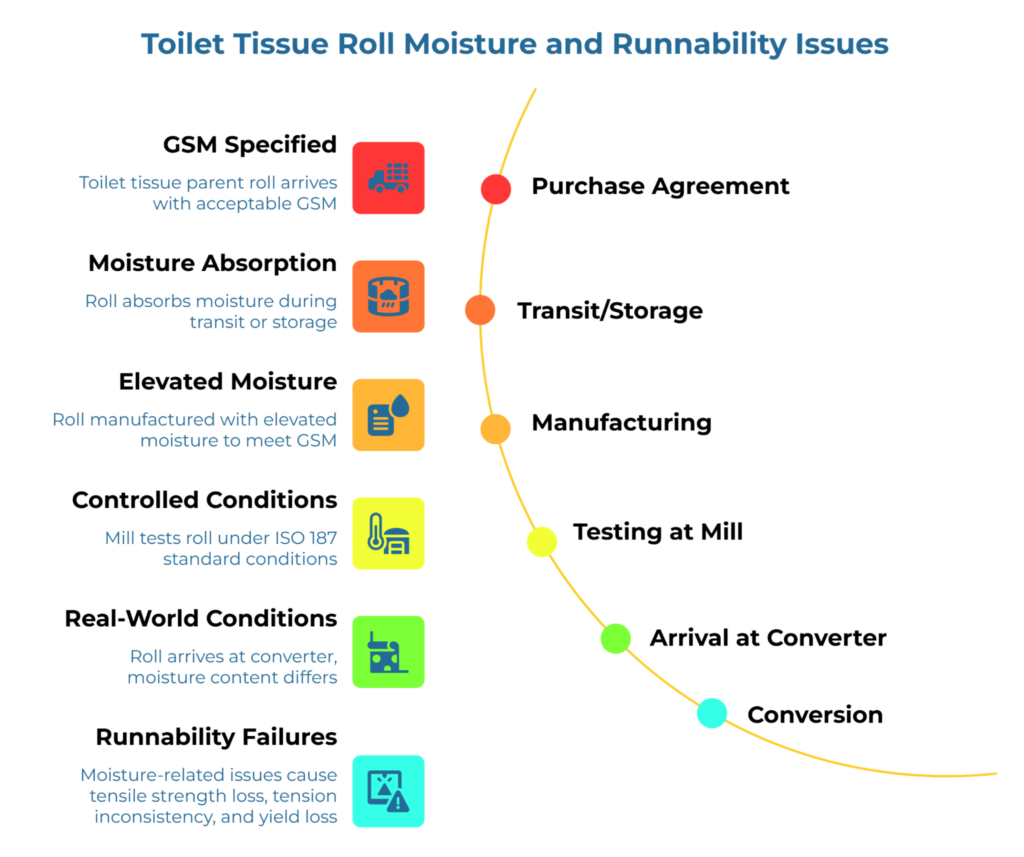
A toilet tissue parent roll arrives with a GSM value that appears acceptable. Moisture content was not specified or controlled in the purchase agreement. The roll typically absorbed additional moisture during transit or storage, or it was manufactured with elevated moisture to reach the target GSM. If the latter, the real usable fiber value is generally lower than expected—part of the measured weight is water. Regardless of origin, moisture elevation alters the web’s physical properties. This manifests as compromised tensile strength, inconsistent tension, and higher yield loss during conversion.
The more stable roll is more likely to deliver predictable handling and more consistent converting behavior. Excessive moisture content inversely correlates with net fiber yield; as moisture increases, the structural integrity of the hydrogen bonds between fibers may weaken, leading to the observed web breaks.
Testing context matters too. Mills typically test under controlled conditions specified by ISO 187, which defines standard conditioning atmospheres. Toilet tissue paper mills establish these baselines before shipment, but transit conditions rarely replicate laboratory environments. The delta between mill-tested values and arrival-state reality is where runnability failures originate. Absent standardized reporting, identical specifications can mask disparate performance profiles.
What Procurement, Operations, and QA Should Lock Before the Next Toilet Tissue RFQ
Before the next RFQ goes out, three teams need to lock the same language. Once specifications are aligned, buyers can submit an RFQ and receive quotes from verified suppliers. Otherwise, quote comparison stays messy and line surprises keep coming back.
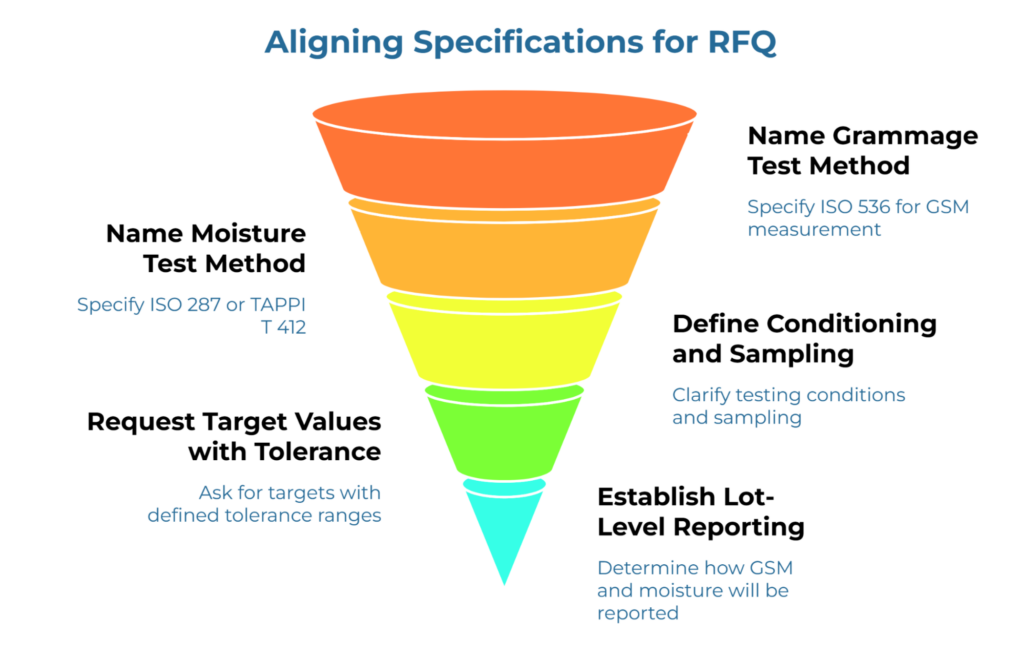
Name the grammage test method. Specify which standard the supplier should use for GSM measurement. ISO 536 is widely recognized. Naming the test method ensures reported values are comparable across suppliers and shipments. If GSM is part of the requirement, the test method should be named, not assumed.
Name the moisture test method. Specify the standard for moisture content measurement. ISO 287 provides an oven-drying method; TAPPI T 412 is another recognized approach. Without a named test method, suppliers may report moisture using different procedures, making comparisons unreliable.
Define conditioning and sampling expectations. Clarify whether measurements should reflect mill conditions, arrival conditions, or both. A number without testing context is weaker than it looks.
Request target values with tolerance language. Ask for targets with defined tolerance ranges for both GSM and moisture content. A target without tolerance language leaves room for different interpretations. Tolerance language creates clear boundaries for acceptable delivery.
Establish lot-level reporting expectations. Determine how suppliers will document GSM and moisture content for each lot. One broad product claim is not enough when incoming runnability depends on lot behavior.
This is where specification discipline starts. Quietly. Early. Before the line has to pay for the ambiguity.
A Simple First-Step Checklist for Toilet Tissue Roll Runnability
Use these questions the next time two tissue rolls look similar on paper.
Before comparing two rolls:
- Were both rolls tested using the same grammage test method?
- Were both rolls tested using the same moisture content test method?
- Were both rolls conditioned under comparable atmospheres before testing?
When a roll looks fine but runs badly:
Is the grammage acceptable only because extra moisture is inflating the total mass? Has the roll’s moisture content been checked since it arrived at the facility? Did storage conditions differ from the conditioning atmosphere used at the mill? Is moisture variation showing up as instability, snaps, or waste at the converting line? Are QA and Operations looking at the same lot-level data, or different assumptions?
QA-to-Procurement Requirements:
The named grammage test method. The named moisture test method. The exact lot-level reporting format needed for future quote comparison and receiving checks. Confirmation that QA has the information needed to verify supplier claims upon receipt. Establish a feedback loop to communicate performance variances to Procurement for vendor negotiations.
Conclusion
A toilet tissue parent roll does not become runnable because one number looked acceptable. It becomes runnable when grammage, moisture, testing context, and discipline all point in the same direction. That is the foundation.
Understanding that GSM and moisture content must be read together is a foundational step toward better toilet tissue parent roll decisions. The next stage involves specification discipline: setting moisture baselines in contracts, defining tolerance ranges, and building QA processes that verify more than the grammage figure on a certificate.
For converters sourcing toilet tissue parent rolls, getting these fundamentals right protects both raw-material value and converting-line stability.
Resources
The PaperIndex Academy provides comprehensive educational resources for converters navigating toilet tissue parent roll procurement. For readers exploring the GSM-plus-moisture issue for the first time, the following articles build the rest of the runnability baseline:
The Blueprint for Runnability: Standardizing Your Toilet Tissue Parent Roll Specifications covers the broader specification structure.
3 Ways Moisture Content Ruins Toilet Tissue Parent Rolls in Transit provides the moisture-specific follow-up.
How to Set Baseline GSM and Bulk Specifications for Toilet Tissue Paper Contracts addresses the next layer of baseline setting.
Stop Guessing: Why Visual Samples Fail High-Speed Toilet Tissue Converting Lines explores the limits of visual approval.
Once internal specification baselines are clearly defined, toilet tissue parent roll suppliers can be explored through PaperIndex’s supplier directory.
Disclaimer:
This article provides general educational information on how GSM and moisture content interact in toilet tissue parent rolls. It is not a substitute for professional quality assurance, engineering, or procurement advice. Actual runnability depends on equipment, environmental conditions, and supplier execution. References to ISO and TAPPI standards are summarized for context; consult official documents for precise procedures.
Our Editorial Process:
Our expert team uses AI tools to help organize and structure our initial drafts. Every piece is then extensively rewritten, fact-checked, and enriched with first-hand insights and experiences by expert humans on our Insights Team to ensure accuracy and clarity.
About the PaperIndex Insights Team:
The PaperIndex Insights Team is our dedicated engine for synthesizing complex topics into clear, helpful guides. While our content is thoroughly reviewed for clarity and accuracy, it is for informational purposes and should not replace professional advice.