

📌 Key Takeaways
A toilet tissue parent roll that looks perfect can still jam your converting line—because machines test properties your eyes can’t see.
- Visual Checks Miss What Matters: Moisture content, bulk consistency, and basis weight uniformity exist below what human senses can detect—but they control how rolls behave at speed.
- Speed Amplifies Hidden Problems: Minor moisture differences that work fine at slow speeds create tension swings and stoppages when lines run fast.
- Similar Samples ≠ Equal Performance: Two rolls that look identical may have different tolerance windows, creating different runnability profiles and different operational costs.
- Specifications Replace Guesswork: Defining named test methods (like ISO 287 for moisture) and tolerance windows forces suppliers to quote against the same baseline.
- Alignment Prevents Finger-Pointing: When procurement, operations, and product development share the same specification language, “met requirements but caused problems” disputes disappear.
Visual confidence is not operational control—specifications are.
Private-label converters and procurement managers sourcing toilet tissue parent rolls will find a clear path from sample-room habits to specification discipline here, preparing them for the methodology-first sourcing guidance that follows.
~ ~ ~ ~ ~ ~ ~ ~ ~ ~ ~ ~ ~ ~ ~ ~ ~ ~
Why a Toilet Tissue Roll That Looks Right Can Still Fail on the Line
The parent roll looked fine. Smooth surface. Clean edges. The weight felt about right.
Then came the sound every converting plant manager dreads—the loud crunch and sudden stop of the line. An inconsistent toilet tissue parent roll had jammed under speed and tension. Maintenance found nothing wrong with the equipment. The machine was not the problem. The roll was.
This failure mode is endemic to private-label operations. A parent reel that passes aesthetic muster during sample-room inspection can create unpredictable stoppages once it meets the mechanical demands of high-speed converting. The line reads the roll differently than a buyer does. It responds to tension behavior, internal structure, and measured consistency—not surface appearance.
Visual inspection cannot detect the tolerance-level differences that determine whether a toilet paper parent roll will run cleanly. The variables that matter—moisture content, bulk consistency, basis weight uniformity—exist below the threshold of what human senses can perceive.
Myth: Visual Sampling as a Viable Proxy for Technical Validation
Visual sampling persists because it provides immediate, tactile feedback. Procurement teams favor the speed of a physical ‘hand-feel’ over the latency of laboratory analysis. Samples feel familiar—the kind of practical shortcut experienced buyers rely on.
For low-stakes purchases, visual inspection may be sufficient. For toilet tissue parent rolls feeding high-speed converting lines, it creates false confidence.
What feels efficient in the sample room becomes unreliable at line speed. A roll that seems acceptable during static inspection may behave unpredictably under the dynamic stresses of unwinding, tension control, and continuous feed. The sample room rewards appearance. The converting line responds to something else entirely. Procurement here is engineering, not shopping.
Reality: High-Speed Toilet Tissue Converting Amplifies Invisible Variation
Converting equipment does not evaluate a toilet tissue parent roll the way a buyer does.
While procurement observes aesthetic finish, the converting line is sensitive to structural integrity. Where a buyer estimates weight by hand, the high-speed unwinder detects grammage fluctuations across the web width. The buyer senses general softness. The line responds to bulk and caliper consistency that determine how material feeds through nips and rollers.
High-speed lines amplify small variations. A roll with minor moisture inconsistency might run acceptably at lower speeds. At higher speeds, that same inconsistency creates tension fluctuations, tracking problems, and machine stoppages. The faster the line, the less tolerance it has for incoming variation. Furthermore, the variables that drive runnability risk are precisely the ones visual inspection cannot detect.
What the Eye Misses in Toilet Tissue Parent Rolls
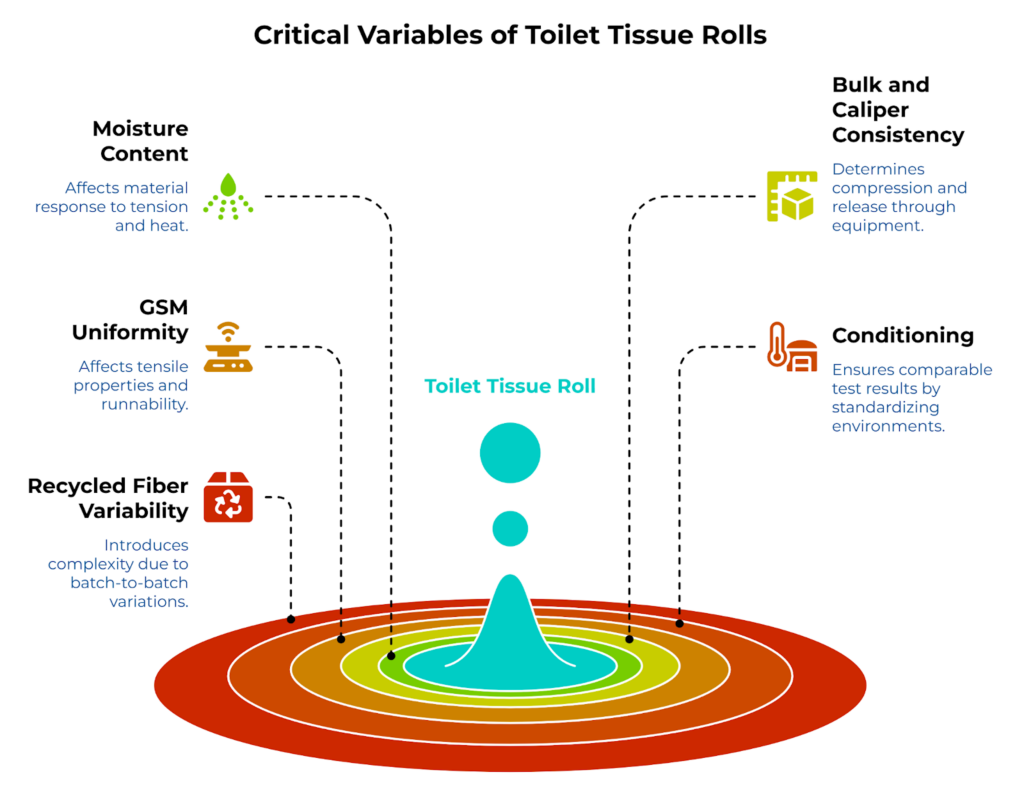
Several critical variables determine whether a toilet tissue parent roll will run smoothly. None are visible.
Moisture content affects how material responds to tension and heat. A roll that absorbs moisture during transit will behave differently than one within its optimal range. ISO 287 provides standardized methods for moisture determination.
Bulk and caliper consistency determine how material compresses and releases through converting equipment. Variation across the roll width or from outside to core creates unpredictable feed behavior—differences measured in fractions of a millimeter that the eye cannot detect.
Grams per square meter (GSM) uniformity—also known as basis weight—affects tensile properties and runnability. ISO 12625-1 addresses tissue paper terminology, while TAPPI T 410 covers grammage measurement. Without standardized testing, two rolls that feel similar may have meaningfully different basis weight profiles.
Conditioning before measurement matters because paper properties change with ambient conditions. TAPPI T 402 establishes standard conditioning atmospheres. When suppliers test under different conditions, reported specifications are not directly comparable.
Recycled fiber variability introduces additional complexity. Toilet tissue parent rolls with higher recycled content may show greater batch-to-batch variation—requiring tighter specification discipline, particularly when rolls travel through humid trade corridors.
Why Visual Samples Create False Comparability Across Toilet Tissue Suppliers
When procurement evaluates suppliers based on visual samples, the comparison seems straightforward. The samples look similar. The prices differ. The logical choice appears to be the lower-cost option.
This reasoning assumes visual similarity means performance equivalence. It does not.
Two toilet tissue parent roll samples that look identical may have different tolerance windows for moisture, bulk, and GSM. Different tolerances create different runnability profiles. Different runnability profiles create different operational costs—costs that surface later as line jams, rejected shipments, and unplanned maintenance.
The supplier offering a lower price may be providing material with wider tolerance bands, meaning more batch-to-batch variation. Visual approval is a weak control method when it stands in for named tolerances, named test methods, and conditioning discipline. This cycle institutionalizes sample-room bias, allowing false comparability to undermine supplier evaluation. Procurement thus defaults to the ‘lowest-bidder trap,’ prioritizing surface aesthetics over quantifiable runnability.
The Specification-First Alternative for High-Speed Toilet Tissue Lines
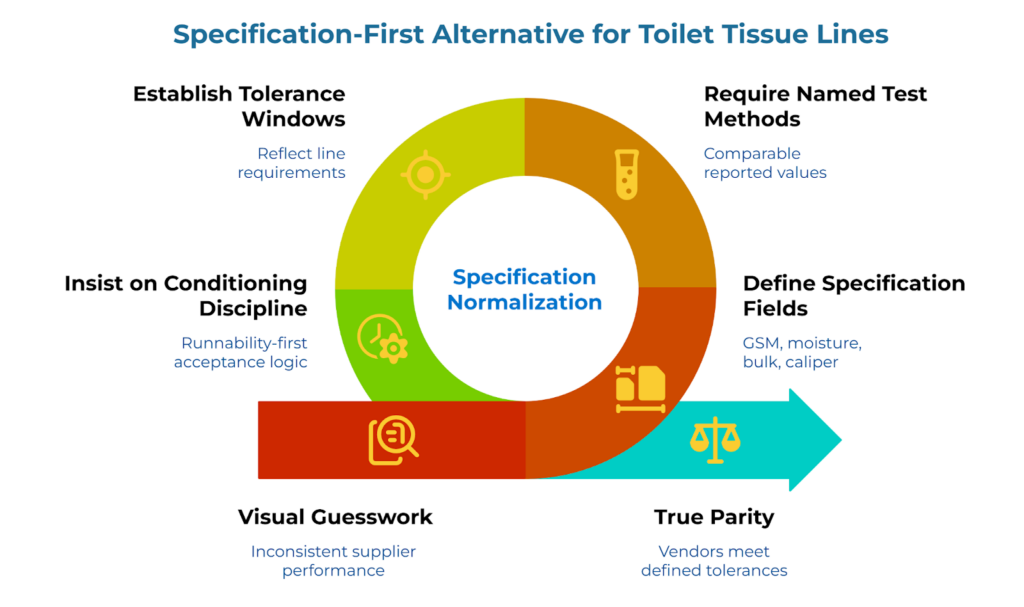
The alternative to visual guesswork is specification normalization—aligning all suppliers around the same technical baseline before comparing prices or reviewing samples. A specification is a blueprint, not paperwork.
This means defining named specification fields for variables that determine runnability: GSM, moisture content, bulk, caliper. It means requiring named test methods so reported values are comparable. It means establishing named tolerance windows reflecting what the toilet tissue converting line actually requires. It means insisting on conditioning discipline and adopting runnability-first acceptance logic.
With standardized technical mandates, vendor quotes achieve true parity. A supplier who cannot meet defined tolerances will adjust pricing, acknowledge limitations, or decline to quote—making it essential to submit your buying requirements with specification fields clearly defined from the outset. Each outcome is more useful than a visual sample hiding non-equivalent performance behind surface similarity.
For readers seeking a deeper methodology on this approach, why visual samples cause toilet tissue line jams (and what to do instead) explores the operational mechanics in greater detail.
What Changes When Procurement, Converting, and Product Development Use the Same Specification Language
Specification discipline improves more than supplier evaluation. It improves internal alignment.
When procurement, converting operations, and product development work from the same specification document, the production floor no longer receives toilet tissue parent rolls that “met procurement’s requirements” but create operational problems. Sample-room subjectivity decreases as approval decisions shift from “this looks acceptable” to “this meets the documented specification.”
Supplier accountability strengthens. When a shipment creates line problems, the conversation becomes factual: did the material meet the agreed specification? Cross-functional confidence grows as each department trusts the others are working from the same understanding of acceptable toilet tissue parent roll quality.
From Guesswork to Runnability: The Better Next Step
If this pattern sounds familiar, the path forward is methodological.
It begins with documenting what the converting line actually requires—not what suppliers typically offer, but what specific equipment running at target speeds needs to perform reliably. From there, the work is alignment: getting procurement, operations, and product development to agree on specification language; getting suppliers to quote against that language; building a comparison process that evaluates performance equivalence before price.
Visual confidence is not operational control. Specifications are. Visual approval returns to its proper place: a secondary impression, not the primary control system.
Explore more methodology-first sourcing guidance in the PaperIndex Academy.
Once specification language is aligned, browse toilet tissue parent roll suppliers or explore toilet tissue mills on PaperIndex.
Disclaimer:
This article is for informational purposes only and does not constitute professional engineering, procurement, or quality assurance advice. Toilet tissue converting operations vary by equipment, materials, and conditions; outcomes from applying these concepts will differ. Consult qualified professionals before making operational or sourcing decisions.
Our Editorial Process:
Our expert team uses AI tools to help organize and structure our initial drafts. Every piece is then extensively rewritten, fact-checked, and enriched with first-hand insights and experiences by expert humans on our Insights Team to ensure accuracy and clarity.
About the PaperIndex Insights Team:
The PaperIndex Insights Team is our dedicated engine for synthesizing complex topics into clear, helpful guides. While our content is thoroughly reviewed for clarity and accuracy, it is for informational purposes and should not replace professional advice.