
📌 Key Takeaways
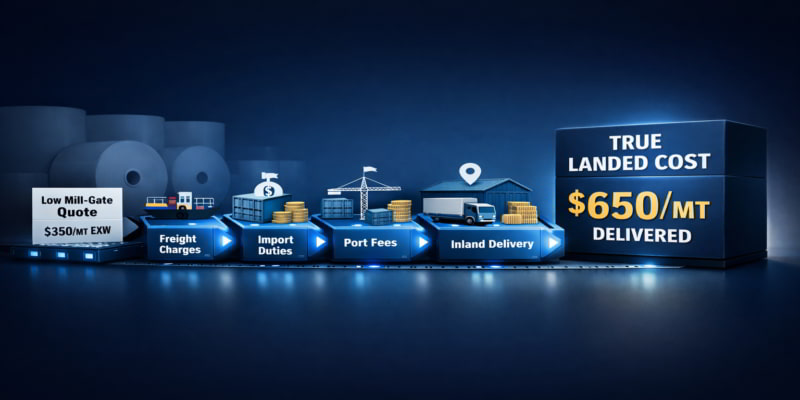
The cheapest toilet tissue parent roll quote often becomes the most expensive purchase once freight, duties, and port fees appear.
- Quotes Hide Real Costs: Mill-gate prices exclude freight, insurance, customs duties, port handling, and delivery—costs that can flip the economics of a “cheap” order.
- EXW Looks Cheap for a Reason: Ex Works terms push all logistics costs and risks onto the buyer, making the quote look low while hiding what happens next.
- Volume Locks Up Cash Fast: A single container ties up significant working capital, and any surprise charge multiplies across the entire shipment.
- Tight Margins Leave No Buffer: Private-label converting runs on thin margins, so a small cost overrun can erase the savings that made the low quote attractive.
- Normalize Before You Compare: Translate every quote to the same delivered basis—your door, cleared, ready to use—before ranking suppliers.
Compare quotes on landed cost, not mill price.
SME toilet tissue converters managing working capital and supplier decisions will find a practical framework for avoiding hidden-cost surprises, preparing them for the standardization guide that follows.
~ ~ ~ ~ ~ ~ ~ ~ ~ ~ ~ ~ ~ ~ ~ ~ ~ ~
A low bathroom tissue parent roll quote can feel like a win—until the hidden charges arrive. Initial quotes often present an optimized unit price that fails to account for downstream logistics and regulatory overhead. But somewhere between the mill gate and your converting floor, that “cheap” shipment quietly becomes the most expensive purchase of the quarter.
This pricing discrepancy exists because mill-gate quotes frequently exclude freight, insurance, duties, port handling, and inland delivery.
For toilet tissue parent rolls, those hidden costs can materially change the economics of the shipment. The only fair comparison is a normalized to-door total.
Cost Transparency: The Mill-Gate Fallacy
Most procurement decisions start with a spreadsheet. Quotes arrive from three or four mills, and the instinct is to sort by unit price. The lowest number floats to the top. The decision is made.
This preference for low unit-cost is understandable under immediate budgetary constraints. When operating under thin margins, a lower quoted price appears to mitigate risk. However, this initial saving is often illusory when isolated from the broader supply chain.
The quoted mill price is a starting point, not a finish line. It tells you what the bathroom tissue parent roll supplier wants for the raw material at a specific location under a specific set of trade terms. It fails to account for the total cost of ownership (TCO) once the goods are cleared and staged for production.
For SME toilet tissue converters operating under working-capital pressure, the gap between “quoted price” and “delivered cost” is where surprises live. And surprises, in international procurement, rarely work in the buyer’s favor.
The Reality: A Quote Is Only the Visible Tip of the Cost
Think of a toilet tissue parent roll quote like a budget airline ticket. The fare looks unbeatable—until you add baggage fees, seat selection, priority boarding, and airport transfers. By the time you land, the “cheap” flight costs more than the full-service option you dismissed.
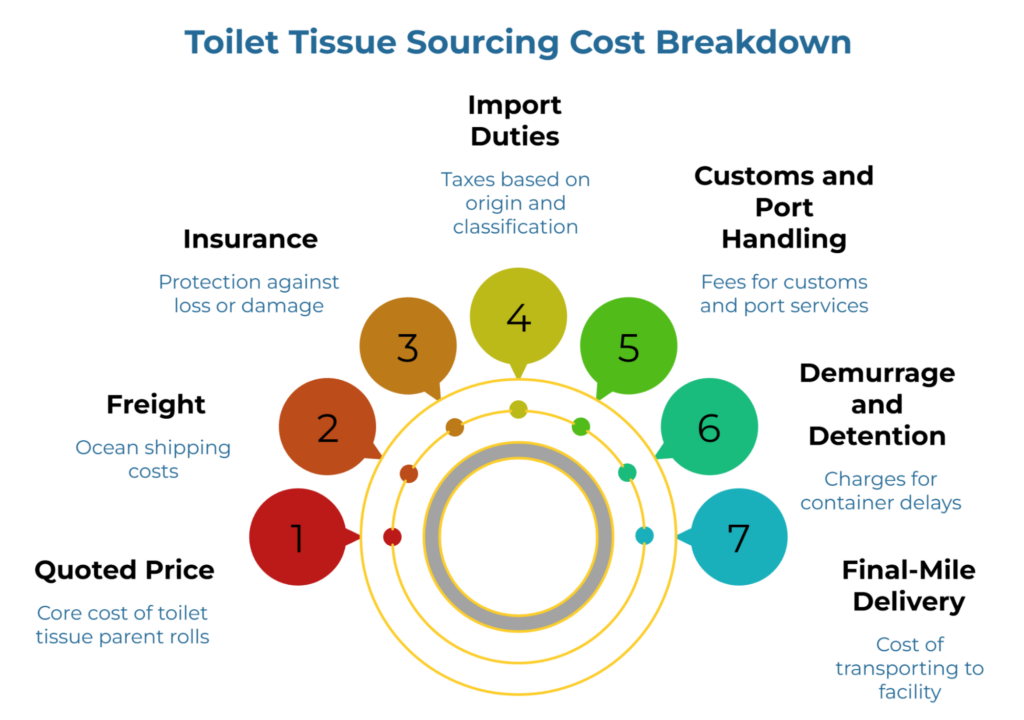
The same logic applies to international toilet tissue sourcing. A quoted price typically covers the parent rolls themselves and, depending on the Incoterms rules, some portion of the logistics chain. What it often excludes:
Freight: Ocean shipping rates fluctuate based on fuel surcharges, carrier capacity, and seasonal demand. According to UNCTAD’s Review of Maritime Transport, freight-rate volatility remains a significant factor in global trade costs. A quote issued in January may not reflect the freight reality in March.
Insurance: Marine cargo insurance protects against loss or damage in transit. If the quote doesn’t include it, you’re either self-insuring or paying separately.
Import duties: The duty rate on toilet tissue parent rolls varies by origin country and product classification. A low mill price from a high-duty origin can flip the economics entirely.
Customs and port handling: Terminal handling charges, documentation fees, and customs brokerage add up. These costs don’t appear on the mill’s invoice—they appear on yours. The U.S. Customs and Border Protection guidance on customs value outlines how these elements factor into total import cost.
Demurrage and detention: If your container sits at port because paperwork is incomplete or the warehouse isn’t ready, daily charges accumulate fast.
Final-mile delivery: The cost of moving a container from the port to your facility depends on distance, trucking rates, and local logistics infrastructure.
Each of these cost layers sits below the waterline of the quoted price. Under EXW (Ex Works) terms, the buyer assumes all liability and costs the moment the product is made available at the supplier’s premises. That low number looks attractive precisely because it excludes the loading process and everything that happens next.
Why Toilet Tissue Parent Rolls Magnify the Risk
Not all commodities carry equal exposure to landed-cost surprises. Toilet tissue parent rolls amplify the risk for two specific reasons.
Volume commits capital fast. A single container of parent rolls represents a significant working-capital commitment for an SME converter. Most mill MOQs are strict, as minimums are tied to continuous machine runs or standard container volumes. These orders sequester significant liquidity; any subsequent logistical friction functions as an additional carry cost on that capital.
Margins leave no room for error. Private-label toilet tissue converting operates on tight margins. A landed-cost overrun that seems minor in isolation can erase the savings that made the “cheap” quote attractive in the first place when spread across a full production run—a dynamic explored further in the cost of inaction: quantifying the impact of out-of-specification toilet tissue parent rolls on converting lines.
The financial pressure that makes a low quote appealing is the same pressure that makes hidden landed costs dangerous. This is both a procurement problem and a working-capital problem. One unexpected charge—a port storage fee, an underestimated duty rate, a freight surcharge—can turn a procurement win into a cash flow shock that destroys yield.
Myth vs. Reality: Cheapest Quote vs. Lowest Landed Cost
| Unit Price Focus | Total Landed Cost (TLC) Reality |
| The lowest quoted price is the best deal. | The cheapest quote may become the most expensive shipment once hidden landed costs appear. |
| EXW looks cheaper, so it usually is cheaper. | EXW can look artificially low because key delivery costs sit outside the quote. |
| Quote comparison is a purchasing task. | Quote comparison is also a working-capital defense task for toilet tissue converters. |
| Unit price decides the winner. | Normalized to-door landed cost decides the winner. |
The Better Buying Habit: Compare Every Toilet Tissue Quote on the Same To-Door Basis
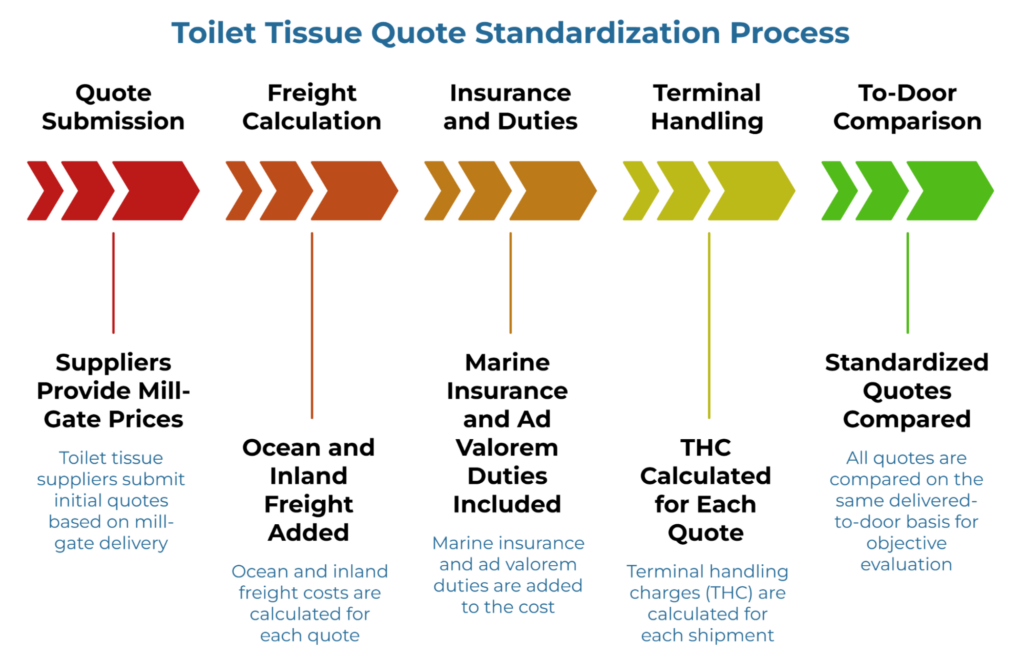
The fix isn’t complicated in principle. Before ranking suppliers by price, translate every quote to the same delivered basis—your door, cleared, and ready to use.
Your calculations must incorporate freight (ocean/inland), marine insurance, ad valorem duties, and terminal handling charges (THC). Standardizing these variables ensures the comparison is objective. This reveals whether the lowest mill-gate quote retains its competitive advantage after all variables are internalized.
Never compare toilet tissue parent roll quotes until they are translated to the same delivered basis. That single discipline eliminates the most common source of procurement surprise: assuming that “cheap at the mill” means “cheap at your warehouse.”
For procurement teams juggling multiple suppliers across different Incoterms, this normalization step is where quote standardization becomes essential. Without it, you’re comparing numbers that don’t mean the same thing.
Next Step
Breaking the “cheapest quote wins” habit is the first step. The next step is building a repeatable process for normalizing quotes so the comparison happens automatically, not as an afterthought.
If supplier quote variance is creating confusion in your RFQ process, start with a framework for standardizing global toilet tissue parent roll quotes. For a deeper dive into translating EXW and CIF offers onto a common footing, explore the practical framework for comparing quotes across Incoterms. For tighter specification discipline that prevents downstream quality surprises, review how to reference ISO 287 testing standards in your RFQ language.
For broader educational guidance, continue exploring PaperIndex Academy.
Browse bathroom tissue parent roll suppliers
Disclaimer
This content is for informational purposes only and does not constitute financial, trade, or professional procurement advice. Freight rates, import duties, port charges, and landed costs vary by origin, route, and market conditions. Consult qualified trade and logistics professionals before making sourcing commitments. Individual outcomes depend on specific supplier terms and operational circumstances.
Our Editorial Process:
Our expert team uses AI tools to help organize and structure our initial drafts. Every piece is then extensively rewritten, fact-checked, and enriched with first-hand insights and experiences by expert humans on our Insights Team to ensure accuracy and clarity.
About the PaperIndex Insights Team:
The PaperIndex Insights Team is our dedicated engine for synthesizing complex topics into clear, helpful guides. While our content is thoroughly reviewed for clarity and accuracy, it is for informational purposes and should not replace professional advice.