
📌 Key Takeaways
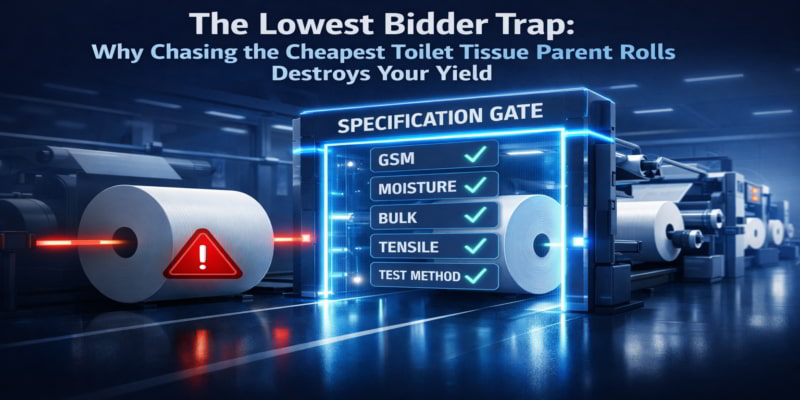
The cheapest quote on toilet tissue parent rolls often costs more once hidden specification gaps cause jams, waste, and unstable yield on the converting line.
- Quotes Aren’t Comparable by Default: Two suppliers quoting “18.5 GSM” may have tested under different test methods—so the numbers match but the material behaves differently on your line.
- Cheap Rolls Fail at Moisture First: Rolls absorb or lose moisture in transit; without a locked test method and tolerance range, disputes become unresolvable and web breaks multiply.
- Visual Samples Miss What Matters: Eyes cannot detect GSM drift, moisture shifts, or tensile weakness—only specification-first checks catch problems before they reach the floor.
- Lock Specifications Before Comparing Price: Define your target GSM, bulk, moisture, strength, and test methods in a buyer-owned baseline, then disqualify any quote that cannot meet it.
- Commercial Terms Hide Cost Gaps Too: Different Incoterms bases (EXW vs CIF) can make one supplier look cheaper when the real price difference is freight and risk allocation.
Specification control is cost control—price comparisons without it are just guesswork.
Procurement managers and converting operations leads sourcing toilet tissue parent rolls will find a clear framework for locking specifications and filtering suppliers, preparing them for the detailed normalization guide that follows.
~ ~ ~ ~ ~ ~ ~ ~ ~ ~ ~ ~ ~ ~ ~ ~ ~ ~
The cheapest quote on toilet tissue parent rolls rarely delivers the lowest cost. Once that roll reaches your converting line, hidden specification gaps surface as machine jams, wasted material, and unstable yield, and the apparent savings disappear before the first pallet ships.
You did not buy the cheapest toilet tissue parent roll. You bought the cheapest-looking quote. Those are not the same thing.
The Myth: The Lowest Quote on Toilet Tissue Parent Rolls Saves Money
Procurement teams face relentless pressure to reduce input costs. When three suppliers submit quotes for toilet tissue parent rolls and one comes in noticeably lower, the math seems straightforward: lower price per ton means lower raw material cost, which means better margins. The challenge is ensuring those suppliers have been properly vetted before quotes are compared—a step that begins with how you find suppliers in the first place.
This logic holds only if every roll performs identically on the converting line. They rarely do.
Why Low Unit Price Feels Like the Safest Decision
A lower quote creates immediate, visible proof of cost control. The savings appear on purchase orders, vendor scorecards, and quarterly reports. Procurement can point to the number and demonstrate value.
However, converting yield, machine uptime, and waste rates are tracked in disparate silos—often owned by different departments. The connection between a low-cost toilet tissue parent roll and a spike in line stoppages takes time to surface. By then, the contract is signed.
Where This Thinking Breaks on High-Speed Converting Lines
High-speed toilet tissue converting equipment operates within narrow tolerance windows. Deviations in moisture, grammage (GSM), bulk, or tensile strength trigger web breaks, dusting, and winding instability.
Each stoppage triggers restart cycles, operator intervention, and discarded material. A toilet tissue parent roll priced lower per ton can cost significantly more per usable output if it causes even modest increases in downtime and waste. The savings in procurement’s column become losses in operations’ column—and the net position is often worse than paying more for a verified, specification-aligned roll.
Reality: Unverified Toilet Tissue Parent Rolls Create Hidden Yield Loss
The real risk in toilet tissue parent roll sourcing is not price. It is unverified runnability.
What “Unverified” Actually Means in Parent Roll Sourcing
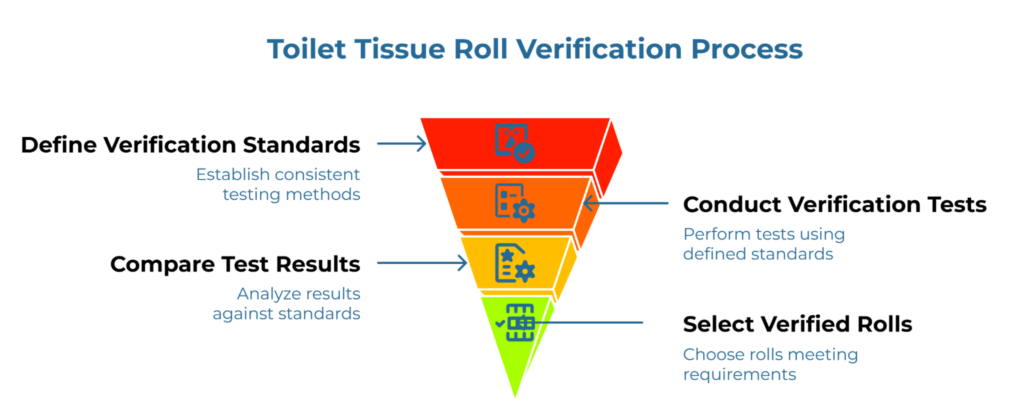
An unverified toilet tissue parent roll is one where the buyer has not confirmed that the supplier’s specifications match the buyer’s operational requirements—using the same test methods, tolerance bands, and measurement conditions.
Two suppliers can both quote “18.5 GSM” toilet tissue parent rolls. If one tested under ISO 287 conditioning and the other used a different protocol, those two rolls may perform very differently at unwind. The number looks the same. The material is not.
When sourcing across diverse toilet tissue paper mills, different testing standards and wide tolerance bands can mean the buyer is effectively purchasing water or weak paper—not a true equivalent roll. Verification means locking the test method, the acceptable tolerance range, and the reporting format before comparing any quotes. Without this step, quote comparison is assumption comparison.
Why a Quote Can Look Cheaper and Still Be Operationally Worse
A supplier quoting aggressively may be working from different assumptions about acceptable moisture range, GSM tolerance, or strength thresholds. They may test under conditions that flatter their product. They may quote a grade optimized for legacy equipment that fails under the dynamic tension of high-speed lines—a discrepancy absent from the face of the quote. It appears on the converting floor—as snapped webs, tears, dusting, jams, restarts, reruns, and unstable yield that erode the margin the low quote promised. Visual inspection alone cannot catch these specification misalignments. Read more on why visual samples fail high-speed converting lines.
Where Cheap Toilet Tissue Parent Rolls Fail First on the Line
Specification mismatches translate into specific, predictable failure modes on toilet tissue converting equipment.
Moisture Content Mismatches
Toilet tissue parent rolls absorb and release moisture during storage and transit. A roll that left the mill within specification can arrive outside your acceptable window if transit conditions were humid or storage was prolonged.
Excess moisture softens the web, causing stretch and mis-tracking. Insufficient moisture creates brittleness, leading to edge cracks and breaks during unwind. ISO 287 specifies an oven-drying method for determining the moisture content of paper and board lots, while TAPPI T 412 focuses on moisture’s economic significance and relevant to physical properties. Without a defined moisture tolerance and a named test method, disputes become unresolvable and line performance suffers. Implementing ISO 287 moisture testing within the RFQ framework addresses this technical gap directly.
Grammage (GSM) and Bulk Volatility
GSM (grams per square meter) determines how much material is on the roll. Bulk determines how thick and soft that material feels. Both affect converting behavior.
A toilet tissue parent roll with GSM variation outside your tolerance band will produce inconsistent finished rolls—some underweight, some overweight, all potentially non-compliant with retailer or end-customer specifications. Setting baseline GSM and bulk specifications for toilet tissue contracts prevents this variability from reaching the line.
Strength and Tolerance-Band Gaps
Tensile strength determines whether the web survives high-speed converting without tearing. If a supplier’s tolerance band is wider than your equipment can handle, some rolls will run and some will not. The ones that fail cause stoppages, restarts, and wasted leader material.
Test-Method Mismatch: TAPPI vs ISO
Different test methods yield different numbers from the same physical roll. A supplier reporting moisture under TAPPI T 412 and a buyer expecting ISO 287 results will misalign on what “within specification” means. This is not fraud—it is a documentation gap that becomes an operational gap. Named test methods reduce ambiguity before a bid is awarded. They do not eliminate every future problem, but they make quote comparison far more defensible.
Myth vs Reality: What Procurement Thinks It Bought vs What Operations Actually Runs
| Procurement Assumption | Operational Reality |
| Lowest quote means lowest cost | Unverified specifications create waste and downtime that exceed unit-price savings |
| Mill data sheets prove equivalence | Wide tolerance bands allow variation that breaks high-speed consistency |
| Visual samples confirm quality | Visual inspection cannot detect GSM, moisture, or strength variation |
| Specifications are specifications | Different test methods produce different numbers from identical material |
The gap between what procurement believes it purchased and what operations actually runs is where yield destruction happens. Every assumption that was not verified becomes a variable that can fail.
Why Comparability Must Come Before Price
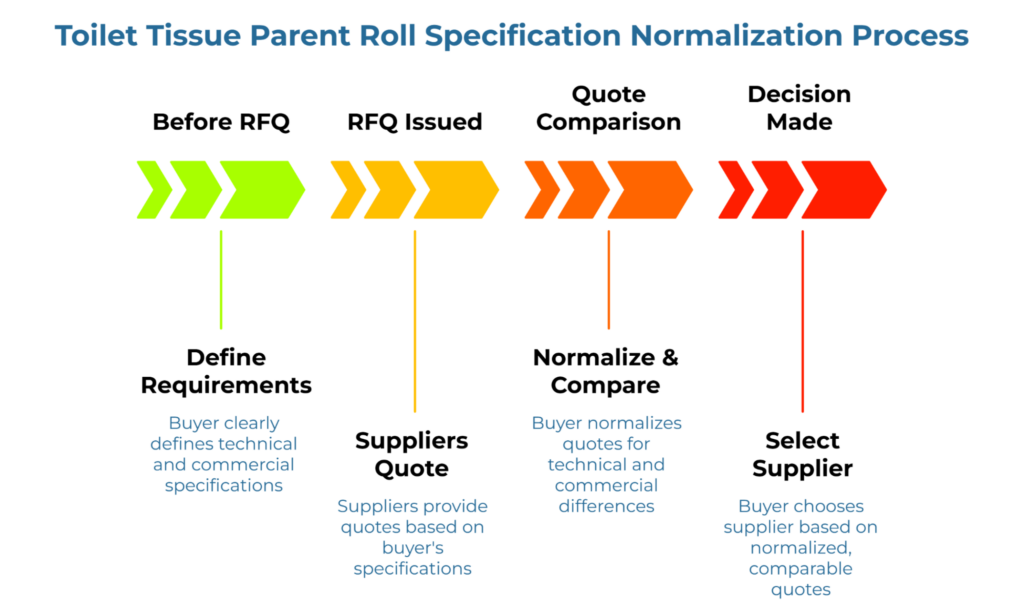
Quote gaps often reflect assumption gaps, not true pricing advantages.
When one supplier quotes lower, the first question is not “How do we get the others to match?” The first question is “Are these quotes describing the same material?” If the answer is uncertain, the price comparison is meaningless.
Commercial terms can create false price gaps just as easily as technical specification differences. Incoterms® 2020 rules define who bears which costs and risks in international trade. When suppliers quote on different bases—one EXW, another CIF—the apparent price gap may partly reflect freight, insurance, or risk-transfer differences rather than material value alone. Normalization belongs on both the technical and the commercial side of the RFQ.
A full framework fortoilet tissue parent roll specification normalization walks through this process in detail. The principle is simple: define what you need, how you will measure it, and what tolerance you will accept—before any supplier sees your RFQ. Then every quote describes the same material, and price comparison becomes valid. Buyers ready to apply this framework can submit an RFQ with specification-aligned requirements.
The Safer First Step: Define a Buyer-Owned Baseline Before Comparing Any Quote
The fix for the lowest bidder trap is not to avoid low prices. It is to verify that every quote describes a roll your line can actually run.
The Baseline Fields That Matter Most
Before requesting quotes, define your house specification for toilet tissue parent rolls. At minimum, lock these fields with target values, tolerance bands, and named test methods:
- GSM with ± tolerance range
- Bulk target and acceptable variance
- Moisture content window with named test method (ISO 287 or TAPPI T 412)
- Tensile strength in both machine direction and cross direction
- Water absorption capacity and rate (e.g., via ISO 12625-8)
This buyer-owned baseline becomes the reference point for every supplier response. Quotes that cannot meet it are disqualified before price enters the conversation.
Where to Go Next
For the complete framework covering specification normalization, test-method alignment, and supplier verification, read the full guide to normalizing toilet tissue parent roll quotes before RFQ chaos starts.
When your specification baseline is ready, explore verified toilet tissue parent roll suppliers to begin sourcing with confidence.
For broader guidance on procurement, verification, and international trade in the pulp and paper industry, explore the PaperIndex Academy.
Disclaimer
This article is provided for educational purposes only. It explains sourcing methodology and specification concepts to help readers evaluate toilet tissue parent roll offers more carefully.
Our Editorial Process:
Our expert team uses AI tools to help organize and structure our initial drafts. Every piece is then extensively rewritten, fact-checked, and enriched with first-hand insights and experiences by expert humans on our Insights Team to ensure accuracy and clarity.
About the PaperIndex Insights Team:
The PaperIndex Insights Team is our dedicated engine for synthesizing complex topics into clear, helpful guides. While our content is thoroughly reviewed for clarity and accuracy, it is for informational purposes and should not replace professional advice.