
📌 Key Takeaways
Matching a toilet tissue parent roll blend to a private-label softness target starts with your own specifications, not the supplier’s grade label.
- Your Specification Beats the Label: Two mills selling the same grade name can deliver rolls with very different softness, bulk, and strength profiles.
- Softness Is a Team Outcome: Bulk, tensile strength, moisture, and converting conditions all shape the final feel — no single fiber type guarantees softness alone.
- Trial the Roll on Your Line: Test at full operating speed and record feel, bulk, and break frequency together — a soft sample that jams the rewinder has not passed.
- Three Teams Must Agree: Procurement, QA, and converting each need to confirm the blend fits before approval is complete.
- Reject Early, Save More: A blend showing widening batch-to-batch variance is a liability even if each shipment technically falls within tolerance.
Own the specification, own the outcome.
Private-label bath tissue converters evaluating new parent roll blends will gain a structured decision method here, preparing them for the detailed overview that follows.
~ ~ ~ ~ ~ ~ ~ ~ ~ ~ ~ ~ ~ ~ ~ ~ ~ ~
Softness is not a fiber argument. It is a precision alignment challenge.
In private-label toilet paper, the real decision is rarely “virgin or recycled?” in isolation. The real decision is whether a toilet tissue parent roll can deliver the shelf feel a SKU promises without creating GSM drift, roll break frequency, or rewinder tension problems on the converting line. Therefore, the better analogy is not ethics or sustainability, but performance fit—matching the right tire to the road it will actually run on. A converter trying to upgrade shelf feel on a mid-tier bathroom tissue SKU faces exactly this kind of matching problem: the next parent roll option has to deliver a noticeably softer hand and stay stable on a high-speed rewinder without spiking roll break frequency. Evaluating bath tissue parent roll suppliers against those constraints — rather than against grade labels — is where the process begins.
By the end of this guide, you will have a buyer-owned method — a blend-to-bulk matrix and a structured trial workflow — to evaluate whether a virgin-heavy, balanced, or recycled-heavy bathroom tissue parent roll blend fits your specific private-label softness target. The core thesis is direct: match the fiber blend to the finished SKU’s softness promise through your own specification system, rather than relying on supplier grade labels, which are often insufficient for technical precision.
What “Softness” Really Means in Private-Label Toilet Paper
Softness in toilet paper is a multi-variable outcome. It is shaped by hand feel, bulk impression, surface character, finished-SKU promise, and converting behavior. A sheet can feel softer because it has a more apparent body, a cleaner surface impression, or a combination of structure and finishing that improves perceived quality. A parent roll contributes to the softness outcome. It does not guarantee it.
That is the first distinction that matters — and it is where specification control either holds or falls apart.
Shelf Feel vs. Converting Reality
What a retailer evaluates at product review is a consumer perception: the squeeze, the first touch, the visual plushness. What your converting floor needs is a toilet tissue substrate that unwinds consistently, holds rewinder tension without breaks, and delivers stable bulk across a full production run. A parent roll may look promising in a sample check yet become harder to control at speed. When those two realities diverge, the result is either rejected finished goods or unplanned downtime — and frequently both.
In practice, softness must sit beside bulk, tensile stability, and runnability. Grammage and GSM for tissue products describe mass under ISO 12625-6, while bulk and thickness are captured differently under ISO 12625-3. One number does not explain the full sensory result.
Why Softness Claims Fail When the House Specification Is Incomplete
A supplier quoting a “premium soft” grade is describing a marketing position, not a converting outcome. If your internal specification does not define softness in measurable terms — a target bulk range, a minimum dry tensile value, a documented surface-feel evaluation method — then the supplier’s label is doing the decision-making for you. That is where specification misalignment causes retailer rejections.
A house specification that says “soft” without a bulk floor and a tensile minimum is not a specification. It is a wish list. For a structured method to set baseline GSM and bulk specifications for toilet tissue paper contracts, the starting point is locking both values with tolerance bands before the next RFQ.
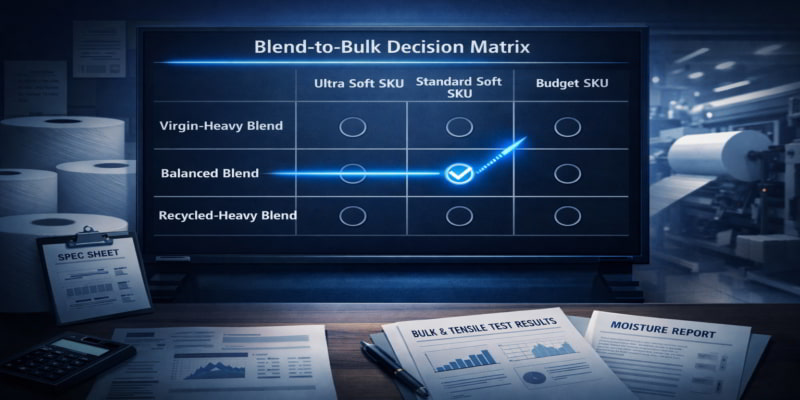
Use the Blend-to-Bulk Matrix Before You Compare Parent-Roll Offers
This is the practical center of the decision. Use it before supplier comparisons begin.
The matrix below connects the blend direction to the downstream reality your line and your retail buyer will face. It stays qualitative on purpose — universal percentages for the virgin-recycled split do not exist, because fiber sourcing, pulping method, and mill-specific furnish all change the outcome.
| Finished Private-Label Toilet Paper Target | Likely Blend Direction | Expected Bulk / Hand-Feel Implication | Runnability Watch-Outs | What to Validate in Trial |
| Premium-feel bathroom tissue (high shelf softness, plush hand) | Virgin-heavy | Higher bulk potential; smoother surface feel | Lower tensile may require adjusted rewinder tension; dust generation at high speeds | Uniform bulk retention; post-embossing tactile evaluation; tensile performance at peak line velocity |
| Mid-tier private-label toilet paper (balanced softness and durability) | Balanced blend | Moderate bulk; hand feel balances softness and perceived strength | Blend variability between shipments can shift feel and line behavior; GSM drift more likely | Batch-to-batch bulk and feel consistency; roll break frequency across two or more runs |
| Standard-value toilet paper (functional, cost-positioned) | Recycled-heavy | Lower initial bulk; firmer hand feel; potentially rougher surface without compensating converting technique | Higher stiffness can affect sheet separation; moisture sensitivity may increase | Bulk vs. target minimum; tensile at operating speed; surface feel with and without embossing |
Virgin-Heavy Blends: Where They Usually Fit
Virgin-heavy toilet tissue jumbo/parent rolls tend to deliver higher bulk-to-weight ratios and smoother initial surface feel, making them a natural starting point for SKUs where the retailer’s brief explicitly calls for a premium hand. They are not automatically the right choice — virgin-heavy rolls can run lower on tensile, which means your rewinder settings and line speed may need adjustment to avoid increased break frequency. A softer perception can disappear quickly if the sheet structure is dense, if the roll loses bulk in conversion, or if the line becomes harder to control.
Balanced Virgin-Recycled Blends: Where They Usually Fit
A balanced blend is a controlled middle path, not a compromise by default. Many mid-tier private-label toilet paper products sit here, where the finished roll needs to feel noticeably soft without requiring the cost structure or converting sensitivity of a virgin-heavy parent roll. In many converting environments, this is the most practical way to move toward better hand feel without giving away too much structural control. The key risk is variability: balanced blends are more sensitive to shifts in the recycled-fiber component between shipments.
Recycled-Heavy Blends: Where They Can Work and Where They Need Tighter Validation
Recycled-heavy parent rolls can meet a softness brief when the specification is tight enough to manage the fiber’s natural starting conditions — lower bulk, higher stiffness, rougher surface texture. The validation burden is simply higher. If your GSM and bulk baselines are locked and your trial process is disciplined, recycled-heavy blends can serve value-tier and some mid-tier toilet paper SKUs reliably.
Match the Fiber Blend to the Toilet Paper SKU, Not the Mill’s Generic Grade Label
A mill’s grade name tells you what the mill wants to sell. Two mills quoting “Premium Soft Grade A” can deliver toilet tissue parent rolls with meaningfully different bulk, tensile, and surface-feel profiles, because grade labels are not standardized across the industry. This is why technical specification matching remains the only objective safeguard for global procurement. Your internal benchmarks serve as the primary diagnostic tool.
Standard-Value SKUs
For cost-positioned toilet paper, the primary specification concern is functional adequacy: does the parent roll clear a minimum softness floor while remaining stable enough to convert without recurring interruptions? The blend direction here is typically recycled-heavy, but the to-door specification verification must still confirm that the delivered roll matches the agreed tolerance bands — not just the quoted grade name.
Mid-Tier Softness Targets
Mid-tier SKUs carry a noticeable softness expectation at the shelf, which typically requires a balanced blend or a virgin-leaning mix. The finished private-label toilet paper must feel clearly improved, but not at the cost of unstable running conditions or inconsistent bulk. The critical discipline here is defining what “soft enough” means in your own measurable terms before engaging suppliers — a target bulk range, a minimum tensile, and a surface-feel evaluation score that your QA team can repeat.
Premium-Feel Bathroom Tissue Targets
Premium private-label toilet paper demands the highest alignment between parent roll properties and finished-product promise. Virgin-heavy blends are the common starting point, but even here, the grade label alone is insufficient. The specification must account for bulk consistency across the full run, post-embossing surface feel, and the tensile behavior that your specific line speed and rewinder configuration require. The tolerance for mismatch gets smaller, and the hand feel has to land correctly at shelf level while the line still holds.
Where Softness, Bulk, Tensile Stability, and Runnability Push Against Each Other
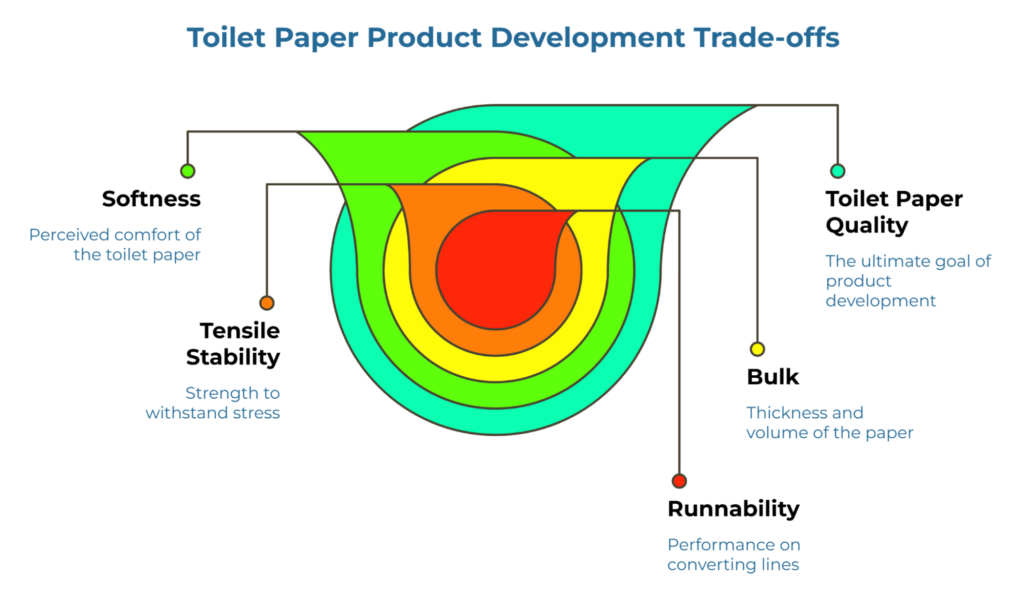
This is where the decision earns its technical weight.
Why a Softer Target Can Create Downstream Instability
Every move toward a softer finished toilet paper product creates a trade-off. Higher bulk typically improves perceived softness, but it can reduce tensile strength. Lower tensile means more roll breaks on a high-speed rewinder. A parent roll with elevated moisture may feel softer at first touch, but it can create feeding problems and runnability issues on the converting line. Softness cannot be evaluated in isolation from the variables that determine whether the roll actually runs.
If tensile stability falls away, the converting line will usually show it quickly — and that is why tensile discussion should be tied to named test methods such as TAPPI T 581 when the conversation turns to structure and runnability. If absorbency enters the approval logic, ISO 12625-8 provides the correct reference point—and normalizing absorbency and moisture tolerances before evaluating suppliers prevents misaligned comparisons.
Why Recycled Content Can Still Fit the Brief When the Specification Is Controlled
When recycled content is controlled to a tight specification — with named test methods, defined tolerance bands, and a buyer-owned evaluation sequence — it can still meet the softness target. The fiber source does not disqualify a blend. A loose specification does. The distinction matters because it shifts the decision from ideology to engineering, which is where it belongs.
A Trial Workflow for Approving a New Toilet Tissue Parent-Roll Blend
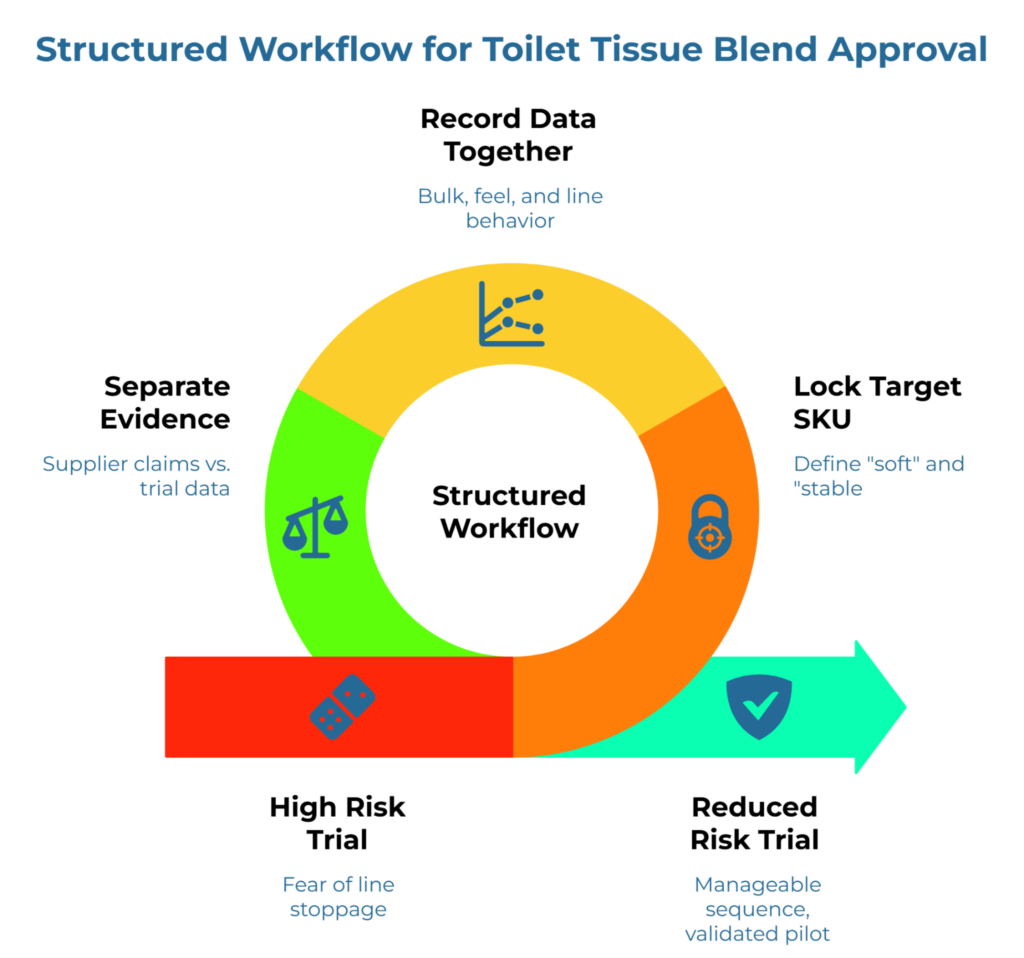
Trialing a new blend carries real risk — the fear of line stoppage during a new mill trial is one of the most common reasons converters delay the decision, and quantifying the impact of out-of-specification rolls on converting lines makes the cost of inaction visible enough to justify a structured pilot. A structured workflow reduces that risk to a manageable sequence.
Lock the Target SKU Outcome First
Start with the finished toilet paper product, not the parent roll. Define what “soft enough” and “stable enough” mean for that specific SKU: target bulk range, minimum tensile at operating speed, acceptable surface-feel score. If the target is not written down in terms your QA team can repeat, the trial has nothing to validate against.
Record Bulk, Feel, and Line Behavior Together
Run the trial parent roll on your actual converting line at operating speed. Record bulk, hand feel, and line behavior — roll break frequency, rewinder tension adjustments, waste percentage — as a single data set. A roll that feels right in the hand but breaks every few minutes on the rewinder has not passed.
Separate Supplier Storytelling from Plant-Floor Evidence
Supplier data sheets describe what the mill intended. Your trial data describes what the toilet tissue raw material actually did under your conditions. When the supplier’s claimed bulk does not match measured bulk, the disconnect often traces to specification misalignment — the biggest hidden risk in global sourcing. Generic claims about premium fiber, softness, or suitability do not replace a converter-validated pilot run.
This same discipline also reduces retailer risk. This alignment is critical because softness and bulk specifications established upstream directly dictate the quality of the finished private-label pack, preventing downstream retailer rejections.
What Procurement, QA, and Converting Each Need to Confirm Before Approval
No single team owns this decision.
Procurement Questions
Does the blend’s cost structure fit the SKU’s margin target without sacrificing the specification? Can the supplier commit to consistent blend composition across repeat orders? Are tolerance bands and test methods named in the purchase agreement? A structured approach to standardizing toilet tissue parent roll specifications ensures these fields survive from quote through delivery.
QA Questions
Do the incoming parent roll’s measured properties — bulk, tensile, moisture — fall within the tolerance bands defined for the trial? Are absorbency and moisture tolerances normalized before comparing results across suppliers? Is the evaluation method documented and repeatable?
Converting-Floor Questions
Did the roll run at target speed with acceptable break frequency and waste levels? Was sheet quality consistent across the full run? Did rewinder tension settings require adjustment beyond normal operating range?
If any one of those three confirmations is missing, the approval is incomplete.
When to Reject a Blend That Looks Good on Paper
Reject it when the softness gain exists only in the sample room. Reject it when the line must be nursed through the run. Reject it when the supplier explanation is stronger than the plant-floor evidence.
A parent roll blend that tests well in a single controlled trial but cannot deliver batch-to-batch consistency is a liability. If the first three shipments show widening variance in bulk or tensile — even if each individual shipment technically falls within tolerance — the trend is telling you something the specification sheet will not.
The cost of accepting that blend is not limited to one bad production run. It is the accumulating waste, the unplanned line stoppages, the retailer rejections caused by misaligned specifications, and the QA hours spent chasing a moving target. Rejecting early costs less than correcting late. That is the cost of inaction made visible — and it is the strongest argument for owning the specification rather than trusting the label.
Frequently Asked Questions
Does virgin fiber always make toilet paper softer?
Not automatically. Virgin fiber offers higher bulk potential and smoother surface feel, but softness in the finished product also depends on refining, converting conditions, embossing, and ply bonding. A poorly converted virgin-heavy roll can underperform a well-converted balanced blend.
Can recycled fiber still meet private-label toilet paper softness targets?
Yes, when the specification is tight enough. Recycled fiber starts with lower bulk and rougher texture, but disciplined refining, converting technique, and locked tolerance bands can deliver softness targets for value-tier and some mid-tier SKUs.
Why can two bath tissue parent rolls with similar GSM feel very different in the finished product?
GSM measures mass per unit area, not fiber structure or bulk. Two rolls at the same GSM can differ in fiber composition, refining level, moisture content, and caliper — all of which affect the sheet after converting. Testing bulk and thickness alongside GSM is essential.
Which matters more for softness targeting: bulk, tensile, moisture, or absorbency?
They interact. Bulk is the closest proxy for perceived softness. Tensile determines whether the roll survives the converting line. Moisture affects both hand feel and runnability. Absorbency influences end-use performance. Evaluating any single variable in isolation produces an incomplete picture.
How should a converter trial a new parent-roll blend before approving it for a private-label bathroom tissue SKU?
Lock the finished-SKU target first — bulk range, tensile minimum, surface-feel score. Run the trial roll on your production line at operating speed. Record bulk, feel, and line behavior as a single data set. Compare against your internal target, not the supplier’s data sheet.
Converters who start this process struggling to bridge the gap between mill-offered grades and private-label retail specifications now have a repeatable methodology: a blend-to-bulk matrix to sort options by SKU target, a trial workflow to validate on the plant floor, and a cross-functional approval structure to close the loop. The validation of converter-defined benchmarks provides the ultimate safeguard for SKU integrity.
For a deeper look at the specification fundamentals behind these decisions, explore the PaperIndex Academy. To evaluate supplier options against your locked targets, browse bath tissue parent roll suppliers.
Disclaimer:
This content is for informational purposes only and does not constitute engineering, quality assurance, or professional procurement advice. Fiber blend performance, softness outcomes, and converting behavior vary by supplier, equipment, and SKU requirements. Consult qualified technical professionals before adjusting blend specifications or approving new suppliers.
Our Editorial Process:
Our expert team uses AI tools to help organize and structure our initial drafts. Every piece is then extensively rewritten, fact-checked, and enriched with first-hand insights and experiences by expert humans on our Insights Team to ensure accuracy and clarity.
About the PaperIndex Insights Team:
The PaperIndex Insights Team is our dedicated engine for synthesizing complex topics into clear, helpful guides. While our content is thoroughly reviewed for clarity and accuracy, it is for informational purposes and should not replace professional advice.