

📌 Key Takeaways
A toilet tissue parent roll that passes inspection can still fail on a high-speed converting line if the GSM tolerance is too wide.
- “Within Spec” Can Still Break Your Line: Standard ±5% GSM tolerances may trigger web breaks as speeds approach 600+ m/min, where high-velocity tension demands outpace typical variance limits.
- Variance Costs More Than Price Savings: One roll break can waste 5–15% of the roll’s value before counting downtime and missed shipments.
- Watch for Patterns, Not Just Failures: Breaks that cluster around certain shipments or lots point to incoming material, not your equipment or team.
- Set Your Own Tolerance, Not the Mill’s: Tighter GSM bands like ±3% may cost more per tonne but less per finished case when fewer breaks and less waste are counted.
- Name the Test Method on Every Quote: A GSM number without a named standard and conditioning test method makes supplier comparisons meaningless.
Tighter specifications cost more per roll but less per shift.
Toilet tissue converters running high-speed lines will gain a clear framework for tightening GSM tolerances before their next sourcing round, preparing them for the detailed overview that follows.
~ ~ ~ ~ ~ ~ ~ ~ ~ ~ ~ ~ ~ ~ ~ ~ ~ ~
Why “standard tolerance” is a risky assumption.
The certificate reads 18.5 GSM ±5%. The bath tissue raw material supplier confirms this range is “industry normal.” Three weeks later, your high-speed toilet tissue converting line jams for the fourth time this shift—and every parent roll technically met specification.
Why does this keep happening?
You have compared quotes, checked fiber content, and confirmed delivery timelines. Yet your rewinder tension keeps spiking. Roll breaks keep piling up. Your finished toilet tissue output swings between acceptable and unsellable. Notably, these shipments pass standard QC inspections.
Here is the reality most toilet tissue converters discover only after the waste bins fill up. A GSM tolerance that works at 400 m/min becomes a production hazard at 600 m/min. Standard variance is not a paper-property footnote. It is an operational risk multiplier—with costs compounding per shift.
Small GSM drift is a production risk multiplier, not a rounding error.
Once you understand where standard GSM tolerance fails on fast toilet tissue lines, you can lock the tighter specification windows that actually protect runnability. Fewer “acceptable-on-paper, unstable-on-line” surprises. More confidence when comparing toilet tissue parent roll options.
The Myth: “Standard GSM Tolerance Is Good Enough for Toilet Tissue Converting”
This belief sounds reasonable because it comes from reasonable sources.
Mill sales teams quote standard tolerances because those tolerances reflect what large-scale tissue-making equipment can reliably hold. A ±5% window on an 18.5 GSM toilet tissue parent roll represents a genuine manufacturing achievement at the tissue machine level. Procurement teams accept it because the number appears on every quote they receive. For converters running moderate line speeds, that tolerance window often works well enough to avoid obvious disasters.
The assumption becomes dangerous when it travels from the mill’s production reality into the converter’s production reality.
A tissue machine forming parent rolls at relatively consistent output conditions operates in a different environment than a high-speed rewinder applying aggressive tension to that same roll at 650 m/min. Standard tolerance reflects what the mill can make. It does not reflect what your toilet tissue converting line can run.
Why High-Speed Bath Tissue Converting Lines Magnify Small GSM Shifts
Line speed is the tipping point.
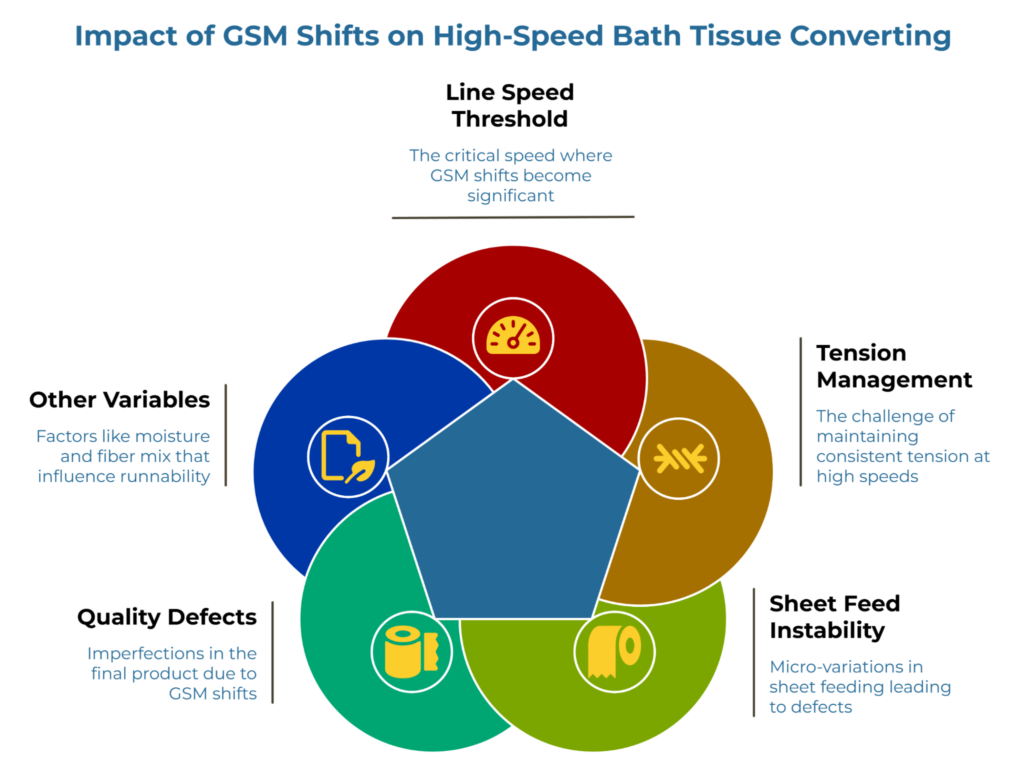
Below roughly 600 m/min, most converting operations absorb minor GSM variation through tension adjustments, operator intervention, and acceptable waste rates. Above that threshold, the physics change. Rewinder tension rises. The parent roll must unwind under increasing stress without tearing, without stretching unevenly, and without creating the micro-variations in sheet feed that trigger downstream quality defects.
A toilet tissue parent roll sitting at the low end of a ±5% GSM window—say, 17.6 GSM instead of 18.5 GSM—contains slightly less fiber mass per unit area. Under high tension, that lighter sheet behaves differently than the heavier sheet your line parameters were set for.
GSM is not the only variable involved. Moisture, tensile, bulk, and fiber mix can all influence runnability. But GSM drift alone is often enough to create instability on automated rewinder systems, even before those other weaknesses compound the problem.
The roll does not fail dramatically every time. It fails intermittently.
A break here. A jam there. Runnability that looked stable at 550 m/min becomes unstable at 620 m/min. The problem stays invisible on paper because the parent roll never actually left the certified specification range. What passes inspection can still fail production. And the failure often looks like operator error or equipment issues rather than incoming material variance—until the pattern repeats across multiple shipments.
The line does not consume the supplier’s description. It consumes the actual roll, under real tension, in real time.
This is why visual samples alone fail high-speed toilet tissue converting lines. The variance that causes line stoppages is measurable, not visible.
Myth vs. Reality: What GSM Drift Actually Costs on a Toilet Tissue Line
The myth: A 1% price save on parent roll procurement improves margins.
The reality: A single roll-break event at high speed typically generates a highly variable waste exposure—often ranging anywhere from 5% to 15% of the roll’s value depending on line geometry and remaining roll mass—before counting downtime, rescheduling, and downstream quality ripple.
The arithmetic is often overlooked during procurement-level analysis.
A roll break stops the line. Operators clear the jam. Tension settings get rechecked. The next roll gets threaded. Minutes pass. Finished toilet tissue that was on schedule for shipping now misses the window. The waste material from the break itself—along with the compromised product on either side of the event—is downgraded or scrapped.
Price-first sourcing hides these costs. The purchase order shows a favorable unit price. The production log shows lost minutes and wasted tonnage. Finance rarely connects the two. When the specification baseline is missing, the buyer is not comparing equivalent offers—the buyer is comparing supplier assumptions. For a deeper framework on quantifying these hidden losses, see The cost of inaction: quantifying the impact of out-of-specification bath tissue parent rolls on converting lines.
The cheapest toilet tissue parent roll quote is not the lowest-cost parent roll if it increases your roll-break frequency by even a small margin. Specification drift does not announce itself on the invoice. It announces itself on the converting floor.
The Operational Signals That Your Toilet Tissue Parent Roll Specification Is Too Loose
You do not need a laboratory to spot GSM-related runnability problems. You need pattern recognition.
- Rising roll break frequency. If breaks cluster around specific shipments or supplier lots rather than distributing randomly across all production, the incoming material is the variable—not your equipment or your team.
- Unstable runnability at target speed. Your line runs smoothly at 580 m/min but struggles at 640 m/min with certain rolls. The parent roll specification may technically allow that variance, but your line parameters do not.
- Inconsistent bulk and softness in finished toilet tissue. GSM variance in the parent roll translates into bulk variance in the converted product. If your private-label customer’s QA team flags inconsistency—or worse, if retailer rejections start appearing — the upstream tolerance window is likely too wide for the downstream specification you are trying to hit. This is the grade-to-SKU misalignment problem that erodes margins quietly over time.
- Procurement confusion disguised as comparability. Multiple bath tissue parent roll suppliers appear to quote the same GSM, but the line behaves differently from one lot or source to another. That usually means the specification was not locked tightly enough for meaningful comparison.
These signals do not prove GSM drift is the root cause. They prove the question is worth investigating before you accept the next quote at face value.
What to Lock Before Comparing Toilet Tissue Parent Roll Quotes
The fix is not complicated. It is specific.
Without a buyer-owned baseline, quote comparisons become exercises in false comparability—numbers that look equivalent on paper but perform differently on the line.
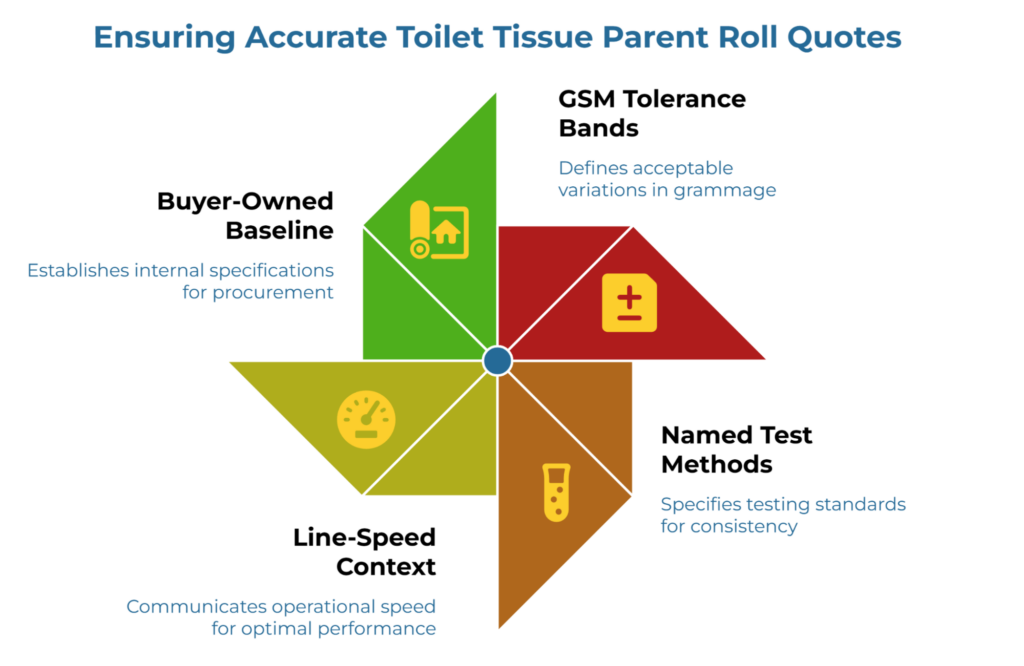
- Tighter GSM tolerance bands. If your converting line runs above 600 m/min, evaluate whether ±5% is actually acceptable or whether ±3% would eliminate the runnability variance you absorb today. The tighter window costs more per tonne. It may cost less per finished case.
- Named test methods. GSM measurement depends on conditioning and sampling. A parent roll tested under ISO 536 for grammage determination with proper conditioning per ISO 187 produces a different number than a roll tested under looser protocols. If your quote does not name the test method, you are comparing numbers that may not mean the same thing. For tensile properties that affect runnability under tension, ISO 1924-2 provides the relevant standard. North American operations may also reference TAPPI/ANSI T 410 for grammage measurement.
- Line-speed context. Tell suppliers what speed you are running. A mill optimizing for a customer at 450 m/min may deliver parent rolls that perform poorly at 650 m/min—not because of bad intent, but because the specification did not communicate the end-use reality.
- Buyer-owned baseline. Stop accepting the supplier’s tolerance as your tolerance. Define your house specification based on what your converting line actually requires, then evaluate quotes against that baseline. This is specification-true procurement: buying what you need, not what someone else decided was “standard.” Verification begins with establishing an internal baseline prior to procurement.
For a step-by-step framework on building this baseline, see the first 48 hours: establishing a buyer-owned GSM accuracy baseline for toilet tissue parent rolls. For the broader specification framework beyond GSM alone, toilet tissue parent roll technical specifications: the essential baselines for high-yield converting covers the full picture.
Bottom Line
On high-speed toilet tissue converting lines, it is a risk exposure you have agreed to absorb.
The myth says variance is normal. The reality says variance has a price—and that price scales with line speed, rewinder tension, and production volume. A parent roll that appears acceptable on a certificate can still underperform on a converting line. Specification drift is an operational cost source. Tighter, buyer-owned GSM tolerance windows are the safeguard.
The next time you compare toilet tissue parent roll quotes, ask a different question. Not “which roll is cheapest?” but “which roll will actually run?”
The answer changes the math. Technical specification compliance yields higher ROI than baseline price optimization.
For more on toilet tissue parent roll specifications and converting-line runnability, explore PaperIndex Academy. When you are ready to apply tighter specifications to real sourcing decisions, browse verified bathroom tissue parent roll suppliers.
Disclaimer:
This content is for informational purposes only and does not constitute engineering, quality assurance, or professional procurement advice. GSM tolerances, runnability outcomes, and converting line performance vary by equipment, line speed, and supplier. Consult qualified technical and operations professionals before adjusting specifications or sourcing decisions.
Our Editorial Process:
Our expert team uses AI tools to help organize and structure our initial drafts. Every piece is then extensively rewritten, fact-checked, and enriched with first-hand insights and experiences by expert humans on our Insights Team to ensure accuracy and clarity.
About the PaperIndex Insights Team:
The PaperIndex Insights Team is our dedicated engine for synthesizing complex topics into clear, helpful guides. While our content is thoroughly reviewed for clarity and accuracy, it is for informational purposes and should not replace professional advice.