
📌 Key Takeaways
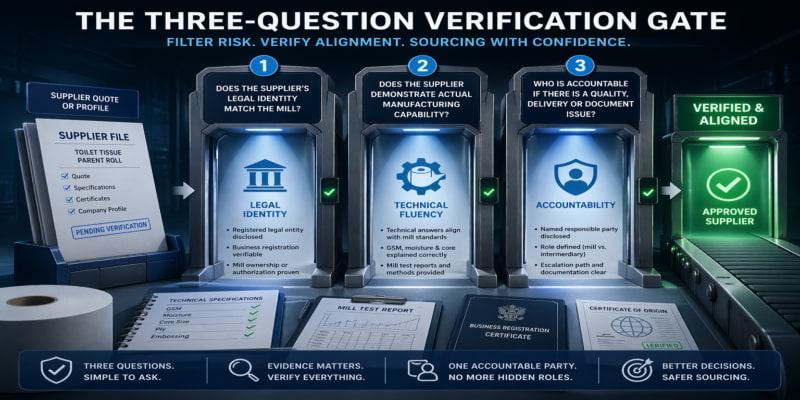
The fastest way to spot a fake “factory-direct” toilet tissue supplier is to ask three simple questions about who actually makes the product.
- Ask Who Actually Makes It: Three direct questions about legal identity, technical capability, and accountability expose hidden brokers before any sample ships.
- Polished Profiles Prove Nothing: Websites, certificates, and fast replies can all be borrowed or relayed — they don’t confirm who runs the mill.
- Transparent Traders Can Work: The real danger is not using a middleman — it’s when a middleman pretends to be the factory and hides who’s responsible.
- Test Technical Fluency: A real mill talks comfortably about GSM tolerances, moisture ranges, and production windows — brokers tend to relay generic answers with delays.
- Use Approve, Pause, or Reject: Sort every supplier into one of three buckets based on whether identity, technical answers, and accountability all point to the same entity.
Three questions before any quote moves forward — that’s where reliable sourcing starts.
Procurement managers and toilet tissue converters vetting overseas parent roll suppliers will gain a ready-to-use screening method here, preparing them for the detailed verification workflow that follows.
~ ~ ~ ~ ~ ~ ~ ~ ~ ~ ~ ~ ~ ~ ~ ~ ~ ~
Seven quotes in the inbox. Three claim factory-direct pricing on toilet tissue parent rolls.
The spreadsheet is open; the tabs are multiplying. Which of these suppliers actually runs a mill — and which is forwarding someone else’s price list?
This uncertainty is not a minor inconvenience for a growing toilet tissue converter. It is the gap where production downtime, specification failures, and supply disruptions hide. Accurate supplier vetting depends on rigorous authentication, not quote volume or surface-level digital signals. Before comparing prices or requesting samples, the first question should be simpler: Is the entity behind this quote actually capable of manufacturing what it claims?
Neutral supplier verification functions as a technical pre-flight audit: a systematic verification of manufacturing credentials and operational capacity before any capital is committed. And that audit starts with three questions.
The 3 Questions to Ask Before You Trust a Toilet Tissue Supplier Quote
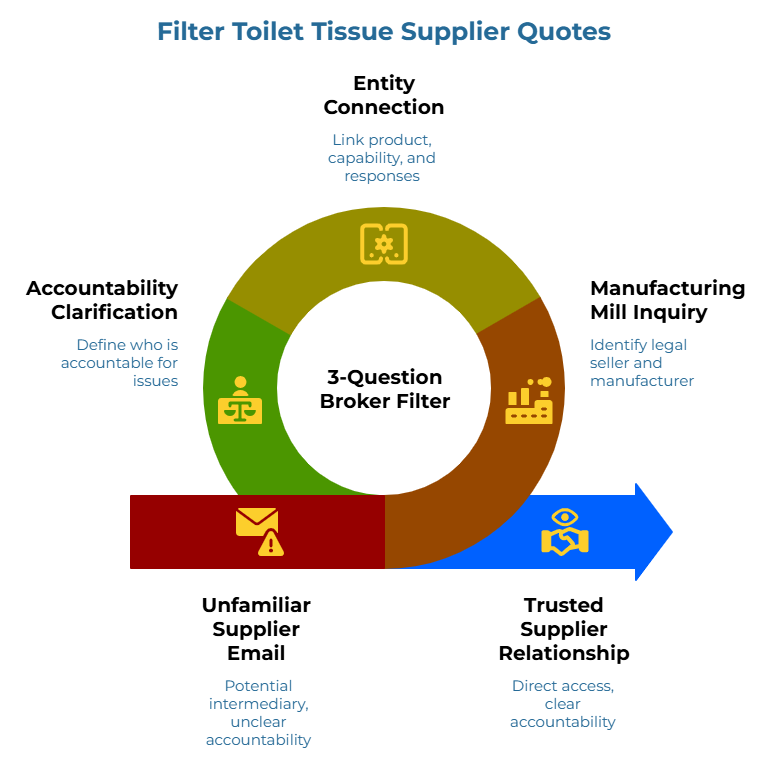
Before a single sample ships, every overseas toilet tissue quote should pass through three direct questions. These are designed to be used immediately — the next time a lean procurement team opens an unfamiliar supplier email.
The 3-Question Broker Filter
- Are you the manufacturing mill for this toilet tissue product, or are you representing another company? Name both the legal seller and the manufacturing entity if they differ.
- Can you connect the quoted toilet tissue product, production capability, and technical responses to the same entity that will stand behind the supply relationship?
- Who remains accountable if a specification, timing, or documentation issue arises between the initial quote and final delivery?
A genuine mill generally demonstrates direct access to technical data, though response times may naturally vary due to global time zones, translation needs, or internal routing. Conversely, an undisclosed intermediary often deflects, generalizes, or shifts accountability to vague “partner” language. The substantive detail of the response matters just as much as the communication pattern.
Factory-Direct vs. Intermediary: What Actually Changes in Supplier Vetting
“Factory-direct” should mean something operationally specific: the entity quoting a toilet tissue parent roll is the same entity manufacturing it, with verifiable legal identity, production capability, and technical fluency tied to a single source. If those pieces do not line up, “factory-direct” is just language.
A transparent trader — one who openly declares the role and names the manufacturing source — can serve a legitimate function in cross-border toilet tissue procurement. Many growing converters rely on traders for market access or consolidated logistics.
The real problem is undisclosed role-blurring: when a trader communicates or documents itself as if it were the mill. That ambiguity corrodes every downstream decision, from specification trust to lead-time assumptions. For a deeper look at this dynamic, the guide on direct toilet tissue supplier authentication maps the distinction in practical terms.
Why Digital Profiles and Basic Certificates Often Fail in Global Toilet Tissue Trade
A polished website with factory photos does not prove manufacturing capability. Neither does an ISO 9001 certificate. While these confirm quality management systems exist, verifying the certificate’s scope and ensuring the registrant matches the quoting entity is a separate step entirely.
Documents still matter. They just need context. In broker-dense international environments, surface signals fail more often than expected. A supplier can display certifications belonging to a partner mill, post third-party production images, or generate fluent quotes by relaying information from the actual manufacturer. A reply within 14 minutes doesn’t indicate mill-level knowledge. It may simply indicate an efficient trading desk.
A Neutral Authentication Workflow for Toilet Tissue Parent Roll Suppliers
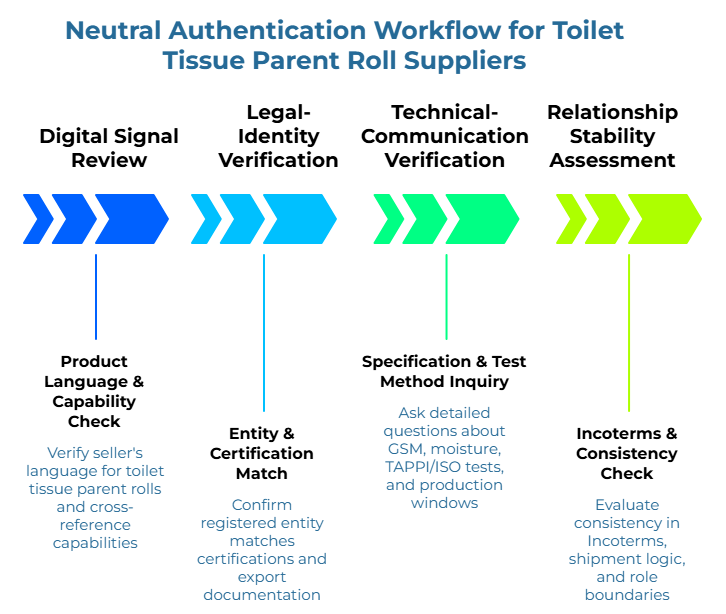
A multi-layer verification process generally follows a clear sequence: begin with a digital signal review. Check whether the seller’s product language is specifically about toilet tissue parent rolls, mill capability, and manufacturing scope, or whether it stays broad and trade-heavy. Cross-reference claimed capabilities against publicly verifiable records.
Move to legal-identity verification. Confirm the registered entity matches the name on certifications and export documentation — a process structured in detail within the multi-layer verification blueprint for toilet tissue parent roll procurement. If those names differ, the relationship may still be workable — what matters is whether the difference is declared cleanly and documented.
Technical-communication verification comes next. Ask specification-level questions about the toilet tissue grades quoted: GSM tolerances, moisture content ranges, relevant TAPPI or ISO test methods, and realistic production windows. A genuine mill answers with operational specificity. Technical fluency should sound specific, not borrowed. Disjointed communication loops or generic phrasing often signal an undisclosed broker attempting to relay technical data from a secondary source.
Finally, assess relationship stability. Does the supplier show consistency in Incoterms® usage, shipment logic, and role boundaries across conversations? Incoterms provide useful context for structuring cross-border delivery obligations, but they are not proof of factory origins on their own. When signals conflict — say, the legal entity on the quote doesn’t match the entity on the certificate — escalate rather than proceed.
Toilet Tissue-Specific Signals That Improve Vetting Accuracy
Certain signals carry extra weight in toilet tissue procurement because generic paper language hides weak vetting. A credible toilet tissue parent roll supplier should discuss grades and mill capabilities in the operational vocabulary of the converting floor, not marketing language.
Comfort with specification details is a strong differentiator — GSM, moisture ranges, and the test methods behind reported values. A supplier redirecting specification questions or responding only with generic data sheets may be operating at a distance from the mill. Clarity around Incoterms, shipment responsibility, and supplier role boundaries is equally telling, because a factory-direct supplier controls these variables directly — a principle explored further in standardizing toilet tissue parent roll specifications from quote to delivery. The WTO Trade Facilitation Agreement database reinforces why cross-border documentation discipline matters — it tracks implementation commitments aimed at expediting the movement, release, and clearance of goods across borders.
When an Intermediary Is Acceptable and When It Becomes Dangerous
A transparent trader who declares the role, names the manufacturing source, and maintains documented accountability can be a practical partner. The danger begins when a supplier implies a manufacturing claim it cannot substantiate.
A declared role and an implied manufacturing claim are fundamentally different, and the gap between them is where specification misalignment risk hides. Hidden intermediaries blur who made the product, who answered the technical questions, and who will own the issue if the shipment fails expectations. Documentation and accountability matter more than labels alone.
A Simple Approve-Pause-Reject Matrix for Lean Procurement Teams
After running a supplier through the filter and authentication workflow, the decision distills into three outcomes:
- Approve — Legal identity, technical communication, and production capability trace back to a single verifiable entity. Role is clear, accountability documented.
- Pause — Evidence is incomplete or contradictory. Missing entity clarity, weak specification answers, or inconsistent responsibility language are all reasons to slow down. The supplier may be legitimate but hasn’t provided enough verification to justify moving forward. Request clarification.
- Reject — Undisclosed role confusion or unverifiable claims that the supplier cannot resolve. If the seller will not clearly state whether it is the manufacturing mill or a representative, the risk is no longer hidden. It is visible.
Frequently Asked Questions
Is factory-direct always better than buying through a trader?
Not necessarily. A transparent trader provides value in logistics and market access. The primary risk is not the intermediary structure, but ‘shadow brokering’—where role ambiguity obscures technical accountability.
What documents matter most before trusting a toilet tissue supplier?
Verify that the legal entity on the quote matches the entity on quality certifications, export documentation, and business registration. A practical 72-hour audit process can structure this check for lean teams.
Can a good sample still come from a risky supplier setup?
Yes. A sample represents product quality at a single point in time, not the reliability of the supply relationship behind it. An undisclosed broker can forward an excellent sample and still lack the specification control or production-window consistency needed for ongoing procurement. Verification should happen before sample enthusiasm starts driving decisions — a principle underscored in the framework for how visual samples fail high-speed toilet tissue converting lines.
Build a Stronger Verification Filter
Verification is not a one-time event — it is the safety check that must happen before every commitment. Start with the 3-question filter on the next overseas quote. Explore the PaperIndex Academy for deeper frameworks on neutral supplier verification, including the multi-layer verification blueprint, beyond the broker, the first 72 hours, and beyond the brokerage. To see how structured verification looks in practice, browse verified toilet tissue mills and toilet tissue parent roll suppliers.
Disclaimer:
This content is for informational purposes only and does not constitute legal, due diligence, or professional procurement advice. Supplier legitimacy, entity structures, and verification outcomes vary by jurisdiction and market conditions. Consult qualified legal and trade compliance professionals before making supplier commitments. This framework supports vetting discipline, not legal certification.
Our Editorial Process:
Our expert team uses AI tools to help organize and structure our initial drafts. Every piece is then extensively rewritten, fact-checked, and enriched with first-hand insights and experiences by expert humans on our Insights Team to ensure accuracy and clarity.
About the PaperIndex Insights Team:
The PaperIndex Insights Team is our dedicated engine for synthesizing complex topics into clear, helpful guides. While our content is thoroughly reviewed for clarity and accuracy, it is for informational purposes and should not replace professional advice.