
📌 Key Takeaways
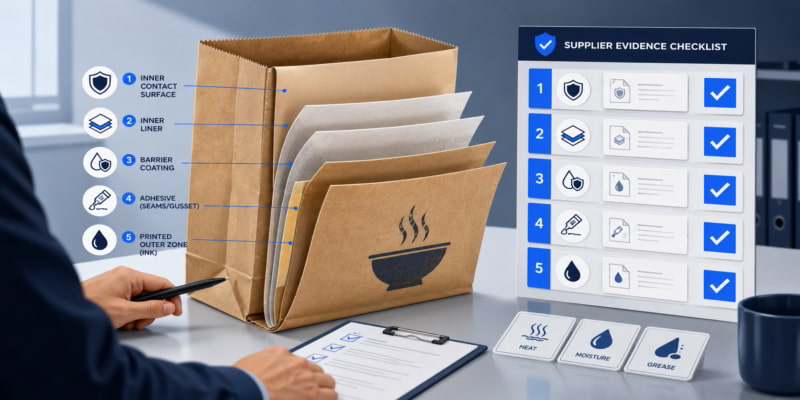
A food-service paper bag is not one material — it is several layers, and each layer needs its own food-contact proof.
- Check What Actually Touches Food: The inner surface, seam adhesives, gusset folds, and printed zones can all reach food through direct contact, heat, grease, or moisture.
- Each Layer Needs Separate Proof: Base paper, liner, coating, adhesive, and ink serve different jobs and need different documentation — one certificate rarely covers them all.
- Match Proof to Real Conditions: A bag safe for dry bread rolls may fail with hot, greasy fried chicken — always confirm temperature, grease level, and hold time are covered.
- Vague Claims Need Follow-Up Questions: Phrases like “food safe,” “greaseproof,” or “natural kraft” are too broad to approve without asking which standard, food type, and conditions they cover.
- Tie Documents to the Exact Product: Certificates, test reports, and data sheets only count when they match the specific material, batch, and use scenario being supplied.
One bag, many layers — approve the evidence for each one, not just the label on the outside.
Food-service buyers, procurement teams, and QA managers evaluating paper bag suppliers will gain a structured layer-by-layer review framework here, preparing them for the detailed supplier-question checklist that follows.
~ ~ ~ ~ ~ ~ ~ ~ ~ ~ ~ ~ ~ ~ ~ ~ ~ ~
Two food-service paper bags can sit side by side on a sample table and look almost identical — same color, similar weight, comparable feel. Yet one may carry a barrier coating rated for hot, greasy takeaway items, while the other is uncoated structural kraft with no documented food-contact suitability at all.
That difference lies in the material layers: the direct food-contact surface, the inner liner, the barrier coating, the adhesive at the seams, and the ink on printed areas. When any of those layers can reach the food — through direct placement, heat, moisture migration, or grease absorption — the buyer needs to know what that layer is, what conditions it handles, and what documentation supports the claim.
Buyers should check four things before requesting samples or documentation: what actually touches the food, what the liner or coating is designed to do, whether the bag matches the food’s heat, grease, moisture, and hold-time conditions, and what evidence ties those claims to the specific product.
Food-contact requirements vary by jurisdiction and application. Nothing here replaces verification with the relevant authority, testing body, or qualified professional.
Start by Identifying the Actual Food-Contact Path
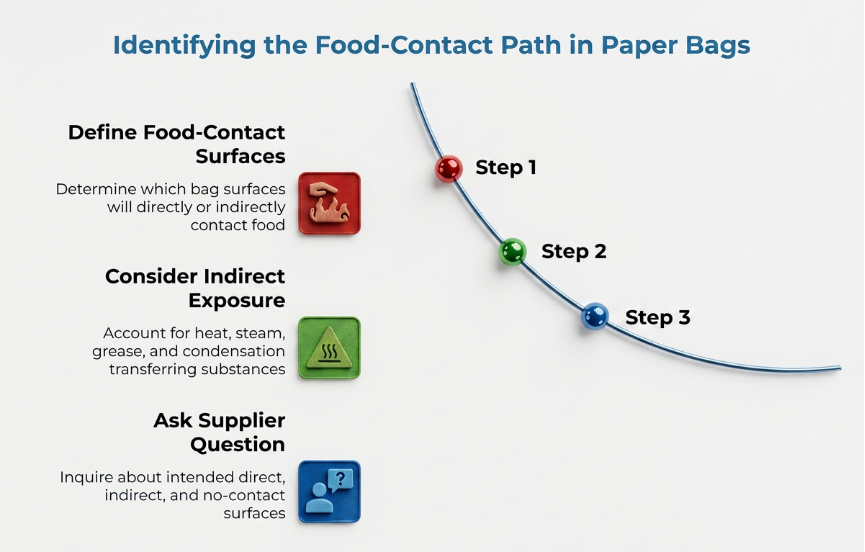
The first question is not “What is the bag made of?” but “Which surface can contact the food under real use?”
For most food-service paper bags, the inner surface is the primary contact zone. But “inner surface” is not a single, fixed answer. Food placed directly into a bag touches bottom panels, side walls, and gusset folds. A wrapped sandwich may contact fewer surfaces — yet grease or moisture can still reach the paper through the wrapping. A bag holding a hot container transfers heat through several layers even when food never touches the paper.
Areas buyers often overlook include bottom seams where adhesive is exposed, gusset folds where a different paper layer may face the food, liner edges where material transitions occur, and printed zones where ink set-off could reach food under pressure or heat.
Direct contact is the most obvious concern. Indirect exposure matters too — heat, steam, grease migration, and condensation can carry substances from outer layers toward the food, especially during longer hold times.
A useful early supplier question captures the full picture: “Please identify which finished-bag surfaces and components are intended for direct food contact, indirect food contact, or no food contact under the intended use.” That question helps prevent a common review error — treating a general paper grade, color, or bag description as proof of food-contact suitability.
Separate Paper Grade, Liner, Coating, Adhesive, and Ink Questions
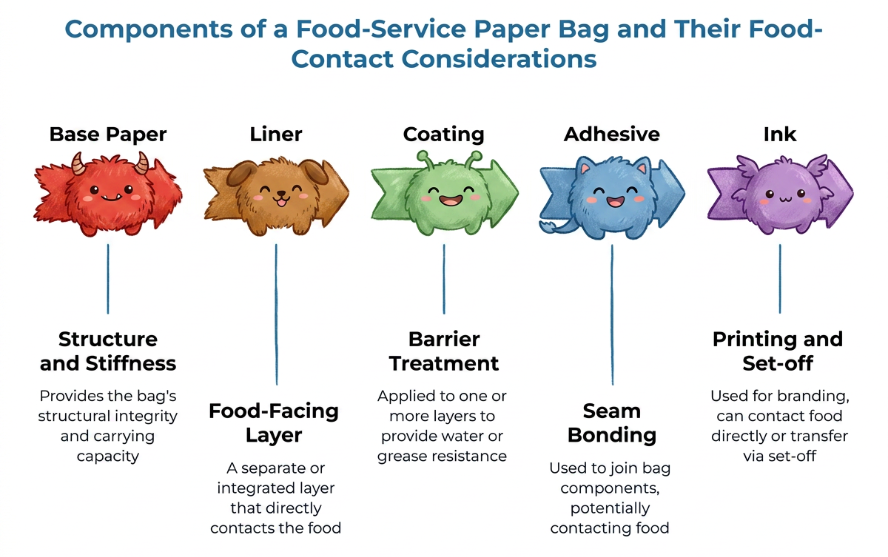
A food-service paper bag is not a single material. It is a construction of several components, each raising different questions.
Base paper provides structure — stiffness, tear resistance, carrying weight. But paper grade alone does not determine food-contact suitability. A 70 GSM bleached kraft and a 70 GSM unbleached kraft may carry the same load while differing completely in contact-surface treatment.
Liner refers to a separate layer or internal material that changes what faces the food. Some bags use a distinct liner sheet bonded to the base paper; others incorporate the liner into the paper structure. The key question: is a liner present, where does it sit, and has it been evaluated for the intended food type?
Coating is a surface treatment or barrier — water-based, wax-based, polymer-based, or another chemistry — applied to one or more layers. A coating’s presence does not confirm food-contact suitability by itself; the type, scope, and documented performance all need clarification. For a closer comparison of grease-barrier approaches, see this guide on poly-coated vs. kit-treated paper.
Adhesive bonds seams, gussets, handles, or reinforcements. If adhesive areas can contact food or if substances can migrate through the paper to reach adhesive, its suitability may need to fall within the supplier’s documentation scope.
Ink on printed bags raises questions when printed areas face the food directly or when ink set-off — the transfer of ink from an outer surface to an inner contact surface during stacking or storage — is possible. The goal is not to assume a problem with every printed bag. The goal is to confirm whether ink falls within the scope of the supplier’s food-contact evidence.
Buyers reviewing paper bags, Kraft bags, or food packaging paper should still verify the actual material construction. Category labels are useful for navigation, but they do not replace layer-level review.
Match Material Questions to the Food-Service Use Condition
No material question exists in isolation. The same bag may perform acceptably for one food application and fail under different service conditions.
Hot vs. room-temperature food. Heat can accelerate migration, soften coatings, and weaken adhesive bonds. Ask whether documentation covers the temperature range relevant to the intended use.
Dry vs. moist food. Moisture from steam, condensation, or wet ingredients can compromise paper strength and degrade certain coatings. A bag that works for dry baked goods may soften or lose its barrier function with steamed or sauced items.
Low-grease vs. high-grease food. Grease penetration is one of the most common visible failures in food-service bags. A bag for a bread roll faces different demands than one for fried chicken. Understanding how grease resistance is measured — including the role of food packaging paper Kit Levels — helps frame more precise supplier questions.
Short carry-out vs. longer delivery or holding time. Longer contact gives grease, moisture, and heat more time to act on every material layer.
Direct food placement vs. wrapped food inside the bag. When food is wrapped first, the primary barrier shifts to the wrapper — but the bag’s inner surface may still face grease, moisture, and heat. Confirm which scenario the documentation covers.
To illustrate: a café buyer comparing two similar-looking bags for hot sandwiches and fried sides needs to confirm that each bag’s contact surface, barrier, liner scope, and documentation match the actual food temperature, grease level, and hold time.
The Material-Layer Clarification Matrix
The table below converts material-layer questions into a practical buyer reference.
| Bag Layer | What to Clarify | Why It Matters | Evidence to Request | Red-Flag Wording | Verification Need |
| Direct contact surface | What material faces the food — base paper, liner, or coated surface? | Determines which material is evaluated for food contact. | TDS identifying the contact-surface material. | “Food safe” with no material or use-condition scope. | Confirm against exact material and application. |
| Inner liner | Is a liner present? Where does it sit? What is it made of? | A liner changes which material contacts food. | Liner specification and food-contact documentation for the liner material. | “Lined” with no liner identity or documentation. | Verify suitability for intended food-contact use. |
| Barrier coating | What coating type? What does it resist? Under what conditions? | Suitability depends on food type, temperature, grease, and moisture. | Coating type, barrier performance data, and documentation tied to use conditions. | “Greaseproof” with no test method or rating. | Verify test scope, food type, and conditions. |
| Adhesive / seams | Can adhesive contact food directly or indirectly? | Adhesive may be a food-contact concern if not evaluated. | Confirmation that adhesive falls within the food-contact documentation scope. | No mention of adhesive in documentation. | Confirm documentation scope covers finished bag. |
| Printed areas / ink | Can ink contact food? Is set-off possible during stacking? | Ink migration may introduce substances to the contact surface. | Ink system documentation or scope-inclusion confirmation. | “Food-safe ink” with no documentation. | Verify if print is within the contact or transfer path. |
| Outer paper | What is the outer grade? Does it affect the contact evaluation? | Outer layers may transfer substances under heat, moisture, or prolonged contact. | Grade specification; confirmation of whether outer layers affect the evaluation. | “Kraft,” “natural,” or “brown” used as proof of suitability. | Do not treat color or grade name as proof. |
This matrix also helps align procurement, packaging engineering, quality assurance (QA), and operations around a common framework. Procurement may receive a commercial description. Operations may notice softening, tearing, or grease staining. QA requires precise data to match these observations. The matrix gives each team a way to connect the issue back to a specific material layer.
Supplier Phrases Requiring Clarification
Certain supplier phrases are not automatically wrong — they are simply too broad to approve without scope. Pause and ask for clarification when wording includes:
- “Food safe” with no standard, jurisdiction, material, or use-condition scope
- “Suitable for all foods”
- “Greaseproof” with no test method, rating, or application detail
- “Compostable” used as proof of food-contact suitability
- “FDA compliant” or “EU compliant” with no material, batch, grade, or condition linkage
- “Natural kraft” or “brown paper” presented as evidence of food-contact suitability
- “Certificate available” without clarity on whether it covers raw paper, liner, coating, ink, adhesive, or the finished bag
Any of these should prompt follow-up questions, not automatic rejection. The goal is to convert broad language into reviewable supplier evidence.
What Supplier Documentation Should Clarify Before Approval
Once material-layer questions are mapped, match them to supplier documentation. A bag that “comes with a certificate” may still leave critical gaps if that certificate does not cover the actual material, food type, and use conditions.
A technical data sheet (TDS) should identify specific layers, coatings, and substrates. A TDS naming only “paper” without specifying the contact surface, liner, or coating offers limited evaluation value.
A declaration of compliance (DoC) or certificate should be tied to the exact material, intended food type, and contact conditions — not issued as a blanket statement. For a broader evaluation framework, see this guide on verifying food contact compliance beyond certificates.
A migration or barrier test report shows whether substances transfer from the material to food simulants under conditions that match the actual service scenario.
A letter of guarantee provides a supplier’s formal statement about material suitability. A statement of intended food-contact use conditions should specify food types, temperatures, durations, and contact scenarios the documentation covers.
Batch, grade, coating, or SKU linkage confirms that documentation applies to the exact product being supplied — not a different specification or older production run.
For regulatory background, the U.S. Food and Drug Administration provides resources on packaging and food contact substances, and the FDA also maintains Food Ingredient & Packaging Inventories. The European Commission covers food contact materials under the foundational framework of Regulation (EC) No 1935/2004, alongside material-specific legislation. Additionally, Regulation (EC) No 2023/2006 provides the mandatory EU Good Manufacturing Practice (GMP) context for materials intended to come into contact with food. These are for background only. For more on food-grade certification standards for delivery packaging bags, the Academy offers a separate guide.
When to Pause and Ask Follow-Up Questions
Certain supplier responses should prompt additional questions rather than immediate acceptance:
- A generic “food safe” or “food grade” label with no standard, food type, or use-condition scope
- A certificate not tied to the exact material, batch, or SKU being quoted
- Documentation that omits food type, temperature range, or contact duration
- A missing coating or liner identity
- A sustainability claim presented as food-contact evidence, when these evaluations follow different paths
- A supplier who cannot clarify whether ink, adhesive, or outer-layer substances fall within scope
These are not automatic disqualifiers. They signal that more information is needed before the bag reaches a food-service line.
Supplier Questions Checklist
Before approving a food-service paper bag, confirm the supplier can answer clearly:
- What material forms the direct food-contact surface?
- Is a liner or internal layer present, and what is it made of?
- What coating provides the grease or moisture barrier, and under what conditions was it tested?
- Are adhesives and inks within the scope of the food-contact documentation?
- What food types, temperatures, and hold times does the documentation cover?
- Is the declaration, certificate, or test report tied to this specific material, batch, or SKU?
- Can the supplier provide a TDS, DoC, and any relevant test reports for the exact product being quoted?
- Which jurisdiction or review framework is the documentation intended to support?
Use the Bag’s Material Layers as the Supplier-Question Map
The visible paper bag is only the starting point. What matters lies underneath: the contact surface, the liner, the coating, the adhesive, the ink, and the documentation tying each layer to the intended food use.
Before approving a supplier sample, document the food-contact surface, liner or coating function, use condition, and evidence requested. That turns a visual inspection into a structured evaluation.
Explore related paper packaging guides in the Academy.
Frequently Asked Questions
Does brown kraft paper mean a food-service paper bag is food safe?
No. Paper color or type alone does not prove food-contact suitability. Ask for documentation tied to the actual material and use condition. For more context, see why brown kraft paper is not automatically food safe.
Are liners and coatings the same thing?
No. A liner is generally a separate layer or inner surface material, while a coating is a barrier treatment applied to a surface. Both affect the food-contact path but serve different structural and barrier functions. Confirm exact construction with the supplier.
Should buyers ask about inks and adhesives?
Yes, when printed or glued areas could contact food directly or indirectly, or when the supplier’s documentation claims to cover the full finished bag. The purpose is not to assume risk but to confirm whether those components fall within the supplier’s evidence scope.
Is a food-contact certificate enough to approve a paper bag?
Not by itself. The certificate scope, material identity, intended food type, contact conditions, and jurisdictional relevance all matter. A certificate is more useful when it clearly connects to the exact bag and intended application.
Do recyclable or compostable claims prove food-contact suitability?
No. Environmental certifications and food-contact evaluations follow different evidence paths with different criteria. A recyclable, compostable, plastic-free, or PFAS-free claim should not be treated as proof of food-contact suitability unless it is separately verified for the intended application.
Disclaimer:
This article is for general informational purposes only and does not constitute compliance, safety, technical, or professional advice. Requirements, risks, and best practices may vary by context, jurisdiction, material, supplier, and use case. Confirm important decisions with the appropriate qualified professional, authority, testing body, or supplier documentation.
Our Editorial Process:
Our expert team uses AI tools to help organize and structure our initial drafts. Every piece is then extensively rewritten, fact-checked, and enriched with first-hand insights and experiences by expert humans on our Insights Team to ensure accuracy and clarity.
About the PaperIndex Insights Team:
The PaperIndex Insights Team is our dedicated engine for synthesizing complex topics into clear, helpful guides. While our content is thoroughly reviewed for clarity and accuracy, it is for informational purposes and should not replace professional advice.