

📌 Key Takeaways
Paper bag quotes vary because of specification gaps, not just pricing — so define the bag before comparing the price.
- Same Size ≠ Same Bag: Paper grade, handle type, coating, print detail, and order mix all change the price, so two quotes for the “same” bag often describe different products.
- Spell Out Every Detail: List the paper weight, handle style, coating needs, print colors, and order quantities upfront so every supplier quotes the exact same bag.
- Heavier Isn’t Always Better: A higher paper weight with weaker fibers can perform worse than a lighter, stronger option — define what the bag must survive, not just what it should weigh.
- “Food-Safe” Needs Proof: Verbal promises of food-grade status may not meet your market’s rules — ask for specific test results, certificates, and the exact regulations they cover.
- Fewer Variations Save Money: Grouping bags into families with shared specifications before quoting cuts setup costs and makes supplier prices easier to compare.
Specification clarity before price comparison — that’s where better sourcing starts.
Procurement teams and category buyers sourcing custom paper bags will sharpen their quote process here, preparing them for the detailed specification guidance that follows.
~ ~ ~ ~ ~ ~ ~ ~ ~ ~ ~ ~ ~ ~ ~ ~ ~ ~
Two suppliers receive what appears to be the same paper bag request — same dimensions, same end use. Yet the quotes come back at noticeably different levels, and neither supplier has made an error.
This discrepancy is one of the most common sources of confusion in B2B paper bag procurement. This variation typically stems from specification gaps rather than supplier pricing strategies. When a bag request leaves paper grade, handle construction, coating scope, print complexity, or order mix partially undefined, each supplier fills in assumptions differently — resulting in quotes that look comparable but describe entirely different bags. The more useful question is not, “What does this paper bag cost?” but “Are all suppliers quoting the same bag?”
The five specification areas below most commonly shape paper bag quotes. Understanding them helps procurement teams and category buyers recognize where gaps create quote variation — and what to clarify before comparing suppliers.
Start with Comparability, Not the Lowest Unit Quote
Before asking which supplier is cheaper, confirm whether the quotes describe the same bag construction.
A lower unit price may simply reflect a lighter paper grade, a simpler handle, no barrier coating, or fewer print colors. That is not necessarily a better deal — it may be a different bag. Procurement teams sometimes face internal pressure to select the lowest visible unit quote, but comparing quotes on mismatched specifications can lead to problems downstream when operations teams encounter bag failures that trace back to gaps in the original specification.
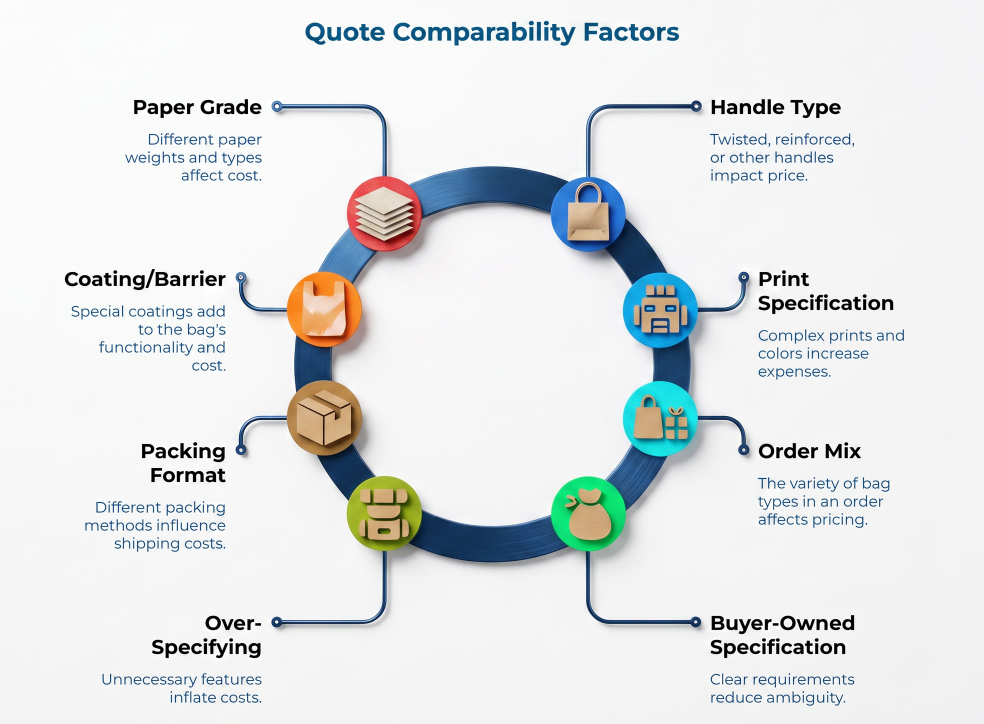
Quote comparability depends on whether every supplier received the same inputs: paper grade, handle type, coating or barrier scope, print specification, packing format, and order mix. When any of these fields remain open, the resulting quotes are not directly comparable. If procurement asks for “paper bags with handles,” one supplier may quote a standard twisted-handle kraft bag while another assumes reinforced handles, heavier paper, or a different finish. If marketing asks for a “premium-looking” bag, suppliers may interpret that as bleached paper, higher print coverage, tighter color control, or a special finish.
Equally importantly, over-specifying — requesting a heavier grade or tighter tolerance than the use case demands — inflates quotes unnecessarily. The goal is to define what the bag needs to do, no more and no less. A buyer-owned specification reduces ambiguity by separating must-have requirements from preferences so that suppliers can quote the same baseline. For buyers building a repeatable process, an internal paper bag specification sheet can help keep procurement, quality, operations, and marketing aligned before quote comparison begins.
Paper Grade and Strength Requirements
Paper grade is typically the single largest specification variable in bag quoting, encompassing kraft type, fiber composition (virgin, recycled, or blended), grammage, and strength properties including burst strength, tear resistance, and stiffness.
Grammage — measured in grams per square meter (GSM) — describes the mass of paper per unit area, as defined by ISO 536. It is a starting point for comparison but not a complete picture. Burst strength, measured according to ISO 2758, indicates how much pressure paper can withstand before rupturing. For bags carrying heavy or sharp-edged items, burst strength and tear resistance may matter more than grammage alone. Strength-related properties may also include fold behavior, moisture sensitivity, and handle-area performance — each of which can affect how the bag holds up in actual use. Test results can vary depending on the conditioning environment; ISO 187 specifies the standard atmosphere for conditioning and testing paper, which helps ensure comparability across supplier test reports. Results are more useful when suppliers report not only the value but also the test method and test context.
To illustrate: two kraft paper bags may share the same dimensions but differ in paper grade, GSM, recycled content, or strength expectations. One supplier may quote a lighter recycled-content kraft paper while another assumes a higher-strength grade with defined GSM and burst-strength requirements. Those are not equivalent quotes, even if both bags are described as kraft paper bags.
When specifying paper grade, define what the bag needs to do rather than just what it should weigh. Ask for material type, GSM, relevant strength properties, tolerances, and test methods where those properties affect the buying decision. For a detailed explanation of how GSM and burst factor interact, see the technical specifications for paper bag raw material grades.
Handle Type and Attachment Method
The handle design directly dictates the bag’s maximum load-bearing capacity during transit. Handle construction affects material input, converting steps, attachment strength, and quality-inspection expectations.
Twisted paper handles, flat paper handles, rope handles, and die-cut handles each involve different materials and processes. A twisted paper handle is typically integrated during converting with standard automation. A rope handle may require manual or semi-automatic attachment plus reinforcement — adding labor, material, and inspection time. A die-cut handle removes material from the bag body, which can reduce structural integrity and may require a heavier grade to compensate.
Reinforcement adds another variable. Cardboard inserts, adhesive patches, or fold-over reinforcement at the bag top improve durability but also add material and processing steps. A request for a “stronger handle” may mean stronger paper, wider adhesive area, top-fold reinforcement, a different handle material, or tighter inspection requirements — and if the buyer does not define the requirement, suppliers may make different assumptions about what “stronger” means.
Two bags of identical dimensions can produce different quotes simply because one specifies a twisted paper handle and the other a rope handle with reinforced attachment. Defining the handle type, attachment method, and reinforcement expectations upfront removes one of the most common hidden sources of quote variation. Buyers should not assume any single handle type is universally the best or cheapest; a retail carry bag, a food-service takeaway bag, and a promotional event bag may each need a different balance of appearance, comfort, strength, and production simplicity.
Coatings, Barriers, and Food-Contact Requirements
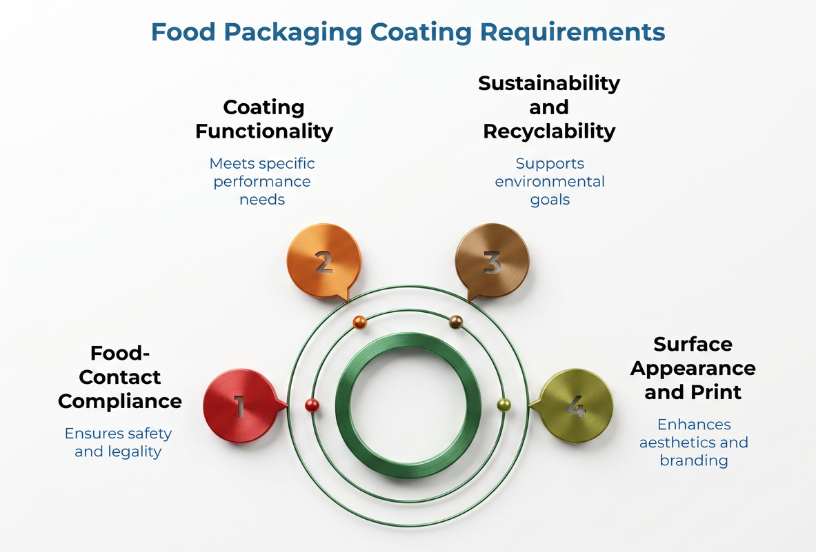
Coatings and barrier treatments introduce specification complexity because they are driven by end use rather than bag construction alone. The important question is not simply whether the bag is coated — it is what the coating or barrier must do. A bag for dry retail goods may need no coating. A bag used for takeout food service may require grease resistance, moisture protection, or a barrier layer that meets food-contact documentation requirements. Other coating drivers include surface appearance and print behavior, and a single bag may involve a combination of these factors.
Aqueous coatings, polyethylene lamination, wax treatments, and bio-based barriers each affect material selection, converting compatibility, and recyclability. For grease resistance, suppliers often reference the TAPPI T 559 kit test, though it was originally designed for fluorochemical treatments; newer aqueous or bio-based barriers may require alternative testing standards such as TAPPI T 507 or ISO 16532-1 to accurately document performance.
Food-contact requirements deserve particular care. In the United States, federal compliance is governed by FDA 21 CFR Part 176 for paper and paperboard components, and 21 CFR Part 177 for relevant polymers and coatings. However, buyers must also verify compliance with state-level regulations, as numerous states have enacted strict bans on PFAS (per- and polyfluoroalkyl substances) and other targeted chemicals in food packaging that supersede federal allowances. In the European Union, EU Regulation 1935/2004 provides the framework for food-contact materials. These references do not make a specific finished bag compliant in every market. Requirements vary by jurisdiction — a supplier’s verbal assurance of “food-safe” status may not align with the documentation a buyer’s market actually requires.
Sustainability and recyclability claims related to coatings require verification through official certification documentation. If a bag carries food-grade kraft paper or certified-fiber claims, buyers should request relevant chain-of-custody certificates — such as those from FSC or PEFC — rather than relying on general supplier statements. When a supplier uses terms such as grease-resistant, moisture-resistant, food grade, recyclable, compostable, FSC, or PEFC, ask what the claim applies to: paper, coating, adhesive, ink, finished bag, facility, chain of custody, or shipment.
To illustrate: one supplier may assume uncoated kraft for a food-service bag, while another assumes a grease-resistant, food-contact documented material. Same end use, different barrier assumptions — and a meaningful gap in quoted scope. For a deeper look at documentation requirements, see this overview of food-grade paper bag certification standards.
Printing, Branding, Inks, and Finish Complexity
Printing specifications are a frequent source of hidden quote variation, partly because print requirements often originate from a marketing team while cost accountability sits with procurement. That gap can create friction when visual expectations are not converted into quote-ready fields.
Consider an illustrative contrast: one quote may assume a single-color line print on natural kraft, while another reflects higher ink coverage, tighter color matching using Pantone references, or a different finish. Both respond to the same bag request, but the print scope differs substantially.
Each additional element adds to the scope. Metallic inks, spot UV finish, full-bleed coverage, multi-panel registration, proofing steps, and registration tolerance can each affect setup time, waste tolerance, and quality-approval steps. A print-ready specification should define artwork expectations, color references, surface finish, logo placement, proofing requirements, and the acceptable range of variation.
When these details remain undefined, suppliers estimate differently — and the resulting quote gaps reflect different production assumptions, not pricing strategy. A universal claim that “printed paper bags are always expensive” is too broad. A simple one-color line logo adds relatively modest complexity. Cost tends to increase with the number of ink colors, surface coverage, color-matching precision, and finishing steps. The cost effect depends on the full print specification, not simply on whether the bag is printed.
Order Mix, SKU Count, and Production Setup
Order architecture and production sequencing frequently drive margin variance, independent of the physical bag construction.
A buyer ordering one bag size in one print design at a consistent volume gives the supplier a straightforward production run. A buyer ordering eight sizes across three handle types with five print variations creates a fundamentally different setup — each change may require separate tooling, material staging, and verification.
SKU fragmentation affects quote comparability in ways not immediately visible in unit pricing. Internal teams sometimes request “stronger,” “more sustainable,” or “premium-looking” variations without defining measurable requirements — each of which can multiply SKU count and add setup complexity. Packing format, minimum order quantities per SKU, and delivery schedule also influence the final price.
Where possible, standardize bag families before requesting quotes. A practical approach is to group bags into categories — retail carry bags, takeaway bags, delivery bags, promotional bags, and specialty-use bags — then define what stays common across each family and what changes by SKU. Separate must-have variations from preferences to improve quote clarity and make supplier comparisons more meaningful.
A Buyer’s Quote-Comparability Checklist
| Cost Driver | What to Define | Why It Can Affect Quote Comparability |
| Paper grade | Kraft type, recycled/virgin content, GSM, strength metrics, tolerances | Different grade assumptions create different material and performance scope |
| Handles | Handle type, attachment method, reinforcement, inspection expectations | Handle construction changes converting steps and failure-risk assumptions |
| Coating / barrier | Grease exposure, moisture exposure, food-contact scope, coating type, required documentation | Barrier requirements may require specific materials, testing, or proof |
| Printing | Number of colors, ink coverage, artwork, logo placement, finish, acceptable variation | Print complexity affects setup, waste tolerance, and approval steps |
| Order mix | Sizes, SKU count, quantities per SKU, packing format, delivery schedule | A fragmented mix affects production planning, setup frequency, and comparability |
This checklist is qualitative. It does not replace a full internal paper bag specification sheet, but it identifies the fields most likely to cause quote variation when left undefined.
How to Use This Information Before Shortlisting Suppliers
Start with the bag’s actual use case and performance requirements. Define what it must carry, how it will be handled, whether it faces moisture or grease exposure, whether it needs customer-facing print quality, and whether it requires documentation for food-contact or certified-fiber claims.
Next, group similar bags into families sharing paper grade, handle type, and print scope. Separate common requirements from SKU-specific differences so that the quote request stays focused and helps suppliers avoid guessing.
Then define must-have specifications before preferences. Paper grade, GSM, handle type, coating requirement, print scope, packing format, and documentation are typically must-have fields. A special finish, alternate handle, or optional branding detail may be a preference unless the use case requires it.
Ask suppliers to quote against the same defined fields so that differences in pricing reflect real scope differences rather than hidden assumptions. Once quotes arrive on a comparable basis, evaluate supplier documentation, sample quality, and production fit rather than unit price alone. For buyers sourcing internationally, landed cost — including freight, duties, and destination charges — should also factor into the comparison. For a structured approach to supplier evaluation, see this guide on paper bag requirements and supplier selection.
Frequently Asked Questions
Why do two suppliers quote different prices for the same paper bag size?
Size is only one specification variable. Paper grade, GSM, handle construction, coating scope, print complexity, packing format, and order mix can all change the quoted scope. When those fields are undefined, each supplier fills in the gaps differently — and the quotes describe different bag constructions, not just different pricing. Before comparing unit quotes, confirm whether both suppliers quoted the same specifications.
Does higher GSM always mean a better paper bag?
Not necessarily. GSM describes mass per unit area as defined by ISO 536, but bag performance also depends on fiber quality, construction method, handle attachment, moisture exposure, converting quality, and actual handling conditions. A higher GSM with lower fiber quality may perform worse than a lower GSM with stronger fibers. Define the performance requirements first, then match the grade.
Do printed paper bags always cost more?
A universal claim would be too broad. A single-color print on natural kraft adds relatively modest complexity. Cost tends to increase with the number of ink colors, surface coverage, color-matching precision, registration tolerance, proofing steps, and finishing steps such as lamination or spot UV. The cost effect depends on the full print specification, not simply on whether the bag is printed.
What should buyers clarify before comparing paper bag quotes?
At minimum: paper grade, bag dimensions, handle type, coating or barrier requirements, printing scope, packing format, SKU mix, order quantity, delivery terms, and documentation requirements. The more fields defined upfront, the more directly comparable the resulting quotes will be.
Specification Clarity Before Price Comparison
Better quote comparison starts with better specification definition. When procurement teams define paper grade, handle construction, coating requirements, print scope, and order structure before approaching suppliers, quote differences become easier to interpret — and easier to explain to stakeholders focused on unit price.
Before comparing supplier quotes, turn paper bag requirements into a buyer-owned specification sheet. Then use the same fields across every supplier so that quote differences reflect real specification choices — not hidden assumptions. For a broader framework on evaluating suppliers once specification clarity is in place, see this guide to paper bag supplier shortlist criteria.
Disclaimer:
This article is for general informational purposes only and does not constitute compliance, safety, technical, or professional advice. Requirements, risks, and best practices may vary by context, jurisdiction, system, provider, or use case. Confirm important decisions with the appropriate qualified professional, authority, or technical expert.
Our Editorial Process:
Our expert team uses AI tools to help organize and structure our initial drafts. Every piece is then extensively rewritten, fact-checked, and enriched with first-hand insights and experiences by expert humans on our Insights Team to ensure accuracy and clarity.
About the PaperIndex Insights Team:
The PaperIndex Insights Team is our dedicated engine for synthesizing complex topics into clear, helpful guides. While our content is thoroughly reviewed for clarity and accuracy, it is for informational purposes and should not replace professional advice.