
📌 Key Takeaways
A new paper bag works on paper only if it also works on the packing counter, in the stock room, and across every reorder cycle.
- Approve in Three Stages, Not One: Confirm the specification, test it in real stores during busy periods, and then lock the details so reorders stay consistent.
- Pilot Where Conditions Differ: Test at locations with different storage, order volumes, and product mixes — one flagship store will not reveal everyday friction.
- Separate Bag Faults From Workflow Faults: Double-bagging at one site may mean a process or storage gap, not a weak bag — investigate the pattern before upgrading materials.
- Give Suppliers Evidence, Not Complaints: Document the product loaded, the batch, the location, photos, and conditions so the supplier can actually diagnose the problem.
- Lock the Specification for Every Reorder: “Same as last time” lets dimensions, handles, and materials drift quietly — use a documented specification sheet with change-notification rules instead.
A controlled rollout turns scattered complaints into clearer specifications with every order cycle.
Procurement leads, store managers, and packaging teams rolling out new paper bags across multiple locations will gain a practical feedback-to-reorder framework here, preparing them for the detailed overview that follows.
~ ~ ~ ~ ~ ~ ~ ~ ~ ~ ~ ~ ~ ~ ~ ~ ~ ~
A paper bag can pass a desk-side sample review and still cause problems once hundreds of units enter a real store, cafe, takeaway, or grocery packing workflow. Consider a common scenario: procurement approves a new kraft bag based on a clean sample and a competitive quote. Weeks later, staff at busy takeaway locations are double-bagging because the base softens under hot, moisture-heavy orders. The bag did not fail a test — it failed a workflow that was never tested.
This does not automatically mean the supplier failed. The root cause may be a size issue, a gusset choice, a handle type, a storage condition, or a mismatch between the approved bag family and the way locations actually pack orders. Bridging the gap between specification approval and operational reality requires a controlled process built on structured feedback, representative pilot testing, and documented repeat-order controls.
Treat Rollout as Three Approvals, Not One
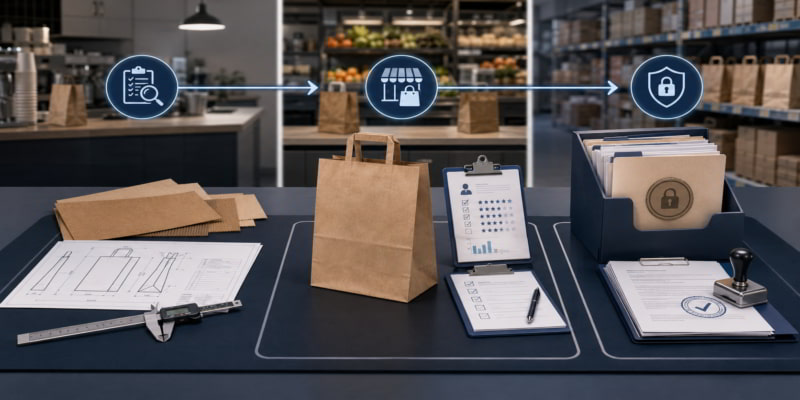
Most procurement teams treat bag selection as a single gate: the specification is confirmed, the sample is acceptable, and the order is placed. A more reliable approach separates rollout into three approvals.
Specification approval confirms the bag meets documented requirements — dimensions, paper grade, handle type, construction, print, and any relevant material or food-contact documentation. Procurement, packaging, brand, or quality teams confirm these details before field testing begins.
Operational approval — a term worth defining for teams new to it — confirms the bag performs under real conditions. That means actual pack-out with real products, at representative locations, during peak periods, with the storage constraints and staff routines that shape daily operations. Specification approval happens in a meeting room. Operational approval happens on a packing counter during a lunch rush.
Repeat-order control confirms the specification is documented clearly enough to reorder consistently. Without it, dimensions, handle attachment, paper feel, or carton format can shift gradually — particularly when a different team member places the next order or the supplier adjusts materials without notification.
Separating these gates prevents a familiar pattern: a sample is signed off, location-level problems surface weeks later, and complaints reach the supplier without structured evidence. This distinction matters because procurement and operations often see different risks. Procurement may approve what was quoted and sampled. Operators must use the bag under pressure, with real products, changing order patterns, and practical storage limits. A shared rollout plan should bridge that gap rather than treating paper bags as a simple replenishment item.
Teams already aligning procurement and operations priorities will find these gates give both functions a shared language for rollout decisions.
Run a Small Pilot Before Scaling Across Locations
A pilot rollout — a controlled test of the new specification in actual operating environments — is the primary tool for catching problems that sample reviews miss. Its value depends entirely on design.
Selecting a single flagship store with generous storage and experienced staff is unlikely to reveal friction that appears at a smaller, busier, or differently stocked outlet. Where product mix, order volume, storage layout, or packing speed varies across locations, the pilot should reflect that variation. A useful pilot might include a busy high-volume location, a lower-volume site, and one outlet with known storage constraints. The right mix will vary by business, but the principle is consistent: test the new paper bag specification where it will actually be used — including compact cafes, takeaway counters with moisture-prone food, and grocery environments with heavier basket mixes.
During the pilot, observe operational performance under load—specifically checking whether staff can open, fill, and close the units at the required speed. Key indicators include structural upright stability during packing, volumetric fit for standard order SKUs, handle tensile integrity under stress, and presentation quality at handoff. Check whether the carton format fits storage shelves. Test the bag with the heaviest and most awkward items in the real order mix.
Peak periods matter. A bag that works during a quiet morning shift may behave differently when staff pack under time pressure. Watch for workarounds: double-bagging, avoiding certain sizes, leaving bags open because the closure method slows the line. Sometimes the fix is a specification adjustment; sometimes the packing process needs to change alongside the new bag.
Storage should be part of the pilot as well. A carton format that looks efficient on a purchase order may be awkward in a back room. If teams must break cartons apart, store bags away from the packing station, or place stock in exposure-prone areas, the rollout issue may come from the storage process rather than the bag itself.
For teams unfamiliar with how physical bag dimensions affect pack-out speed, reviewing paper bag size, gusset, and handle specifications before the pilot can sharpen the observations that matter most.
Use a Feedback Loop That Separates Bag Problems From Process Problems
Vague feedback does not improve specifications. “The bags are weak” gives procurement nothing to act on and makes supplier diagnosis impossible. A structured feedback loop — a repeatable process for capturing what happened, where, and under what conditions — turns scattered complaints into actionable evidence.
Not every rollout problem is a bag problem. A handle that tears under load may indicate a specification gap. But staff double-bagging at one location while another reports no issues may point to a process gap, a storage problem, or a product mix difference. Separating these categories early prevents over-correction — such as switching to a heavier bag when the real issue is loading or storage.
Paper Bag Rollout Feedback Loop Matrix
| Rollout Checkpoint | What to Observe | Who Records It | Evidence to Collect | Possible Specification or Process Response |
| Sample review | Does the bag meet the documented specification for dimensions, material, handle, print, and construction? | Procurement, packaging, or quality lead | Photos, measurement notes, comparison against supplier data sheet, approved sample | Revise the specification sheet or request corrected samples before proceeding |
| Pilot pack-out | Does the bag open, stand, fill, carry, and close as needed during real packing at representative locations, including peak periods? | Store or outlet manager, packing team lead | Product and load type, packing speed observations, failure descriptions, order mix notes, photos | Adjust bag size, gusset, handle type, or base construction — or adjust the pack-out workflow |
| Location storage check | Does the carton size and format fit existing storage shelves, receiving areas, and daily restocking flow? Do loose bags and cartons fit actual storage and picking routines? | Store manager, warehouse lead, or stock team | Carton dimensions versus shelf dimensions, photos of storage fit, restocking friction notes, visible damage or exposure | Change carton pack count or format, adjust storage allocation or replenishment routine at the location |
| Staff handling feedback | Are staff using the bag as intended, or creating workarounds such as double-bagging, avoiding certain sizes, or selecting old stock? | Shift supervisors, packing team | Specific workaround description, which bag SKU is involved, which products trigger the issue, time of day, short comment log | Determine whether the fix is training, process change, bag selection rules, or specification change |
| Customer-facing condition | Does the bag hold up through the customer journey — carry weight, moisture, handle comfort, visual presentation? | Front-of-house staff, delivery team, or customer feedback channel | Failure type, product loaded, hold time, weather or moisture conditions, filled-bag photos | Adjust material weight, coating, handle reinforcement, or closure method |
| Repeat-order documentation | Is the specification documented clearly enough to reorder without interpretation? | Procurement lead or supplier manager | Completed specification sheet with all critical parameters, supplier written confirmation, change-notification agreement, batch or lot reference where available | Finalize the specification sheet, lock tolerances, confirm the reorder process with the supplier |
This matrix is a starting framework. Adapt the rows and evidence columns to match what each function can realistically capture. The core principle: record enough detail that procurement, operations, and the supplier can distinguish a bag problem from a storage, handling, or process problem.
A single complaint should not automatically trigger a heavier bag, a coated bag, or a supplier change. The better first step is to check the pattern. If staff double-bag only one product combination, the bag-family mapping may need adjustment. If complaints come from one location, storage or handling may need review. If the same issue appears across representative locations, the specification or supplier documentation may need closer attention. Teams that need to standardize bag choices across different product groups may benefit from mapping the product catalog to paper bag families before approving repeat orders.
Convert Field Feedback Into Supplier-Ready Documentation
After the pilot, feedback needs to reach the supplier in a form they can investigate. A general complaint — “the bags tore” — creates a dead end without detail on what was in the bag, how it was packed, how long it was held, and whether the failure recurred across batches.
For each issue, document the bag SKU or description, the location or location type, the product or load type, the packing or storage condition, visible evidence such as photos, the batch number or purchase order if available, and whether the issue was isolated or repeated. This allows the supplier to determine whether the root cause sits with the material, the construction, the storage environment, or the usage pattern.
“Handles failed” is too broad to support a fair technical discussion. A more useful record would describe the load type, the carrying path, whether the issue appeared across locations, whether the same batch was involved, and whether storage or moisture exposure may have affected the result. The solution may still be a specification change, but the evidence should come first.
Frame these conversations around evidence rather than blame. Teams working on multi-location consistency may find that supplier qualification questions for paper bag material consistency provide a useful structure for these discussions.
Where technical testing is relevant — for example, when a recurring failure suggests paper weight or burst strength may not meet the specification — procurement teams can reference relevant test methods from bodies such as ISO, TAPPI, or ASTM when requesting supplier clarification. Where food-contact compliance is part of the discussion, jurisdiction-specific resources such as the FDA’s packaging and food contact substances page may also be relevant. Specific standards should only be named after verifying the correct method for the paper type and application, and these references should support verification rather than serve as shortcuts for product-specific approval.
Lock the Specification for Repeat Orders
The first successful rollout is not the final step. Without documented controls, repeat orders drift. A different team member may use slightly different language. The supplier may substitute a comparable handle type or adjust carton dimensions. Over several cycles, the bag that was tested during the pilot may no longer match what arrives.
Repeat-order problems often appear when teams rely on informal language such as “same as last time,” “standard kraft bag,” or “the cafe bag.” Those phrases may be convenient, but they are not a controlled specification.
Before placing repeat orders, confirm and document: exact dimensions and tolerances, handle type and attachment, paper grade and weight, base construction, print specifications, pack count per carton, carton dimensions, supplier-provided material description, and acceptance criteria tied to pilot findings. If tolerances, technical test methods, food-contact documentation, or certification evidence are required for the intended use, those requirements should be verified through appropriate supplier documentation or qualified review before they are treated as mandatory fields. Agree with the supplier on a change-notification process — any element that changes should be documented before the next production run.
Change triggers should also be clear. If the supplier proposes a change in material source, handle construction, carton format, print method, dimensions, or supporting documents, the buyer should know whether that change requires internal review before the next order is accepted. The exact trigger list will vary by business and product use, but the principle is stable: repeat orders should be controlled by documented requirements, not memory.
A bag family — the set of related bag sizes and formats serving a product range — is easier to manage when each variant has its own specification sheet. Teams that have not yet built one will find practical guidance in creating internal paper bag specification sheets that both internal teams and suppliers can reference.
Common Rollout Mistakes to Avoid
- Skipping staff feedback during the pilot. Procurement may focus on material performance and miss the handling and storage friction packing teams experience daily.
- Testing only one location when conditions vary. If storage, order mix, or service speed differs across outlets, a single-site pilot may not reveal the friction that matters.
- Overreacting to a single complaint. One torn handle at one location does not prove the specification is wrong. Investigate load type, packing method, and batch before revising.
- Upgrading to a heavier bag before diagnosing the cause. A “stronger” bag may over-specify when the real issue is moisture, workflow, or storage. Diagnose first.
- Sending the supplier vague feedback. “Improve quality” is not actionable. Product type, load, photos, batch, and conditions give the supplier something to investigate.
- Escalating to the supplier before checking internal causes. Storage conditions, handling practices, pack-out routines, and bag-family mapping should be reviewed before assuming the supplier is at fault.
- Reordering from informal descriptions. Relying on “same as last time” instead of a controlled specification record allows gradual drift across order cycles.
- Treating the first rollout approval as permanent. Specifications need repeat-order controls and a change-notification agreement, not a one-time sign-off.
Make Rollout Feedback Part of the Specification
Rolling out new paper bag specifications across stores, cafes, and takeaway operations is not just a purchasing step. It is an operational handoff between procurement, store teams, packing staff, storage owners, and suppliers.
A paper bag specification becomes reliable when tested in real operations, refined through structured feedback, documented clearly enough to reorder without ambiguity, and protected against the gradual drift that multi-location procurement creates. A good rollout does not promise that every issue will disappear. It gives teams a practical way to catch friction early, understand what caused it, and convert field feedback into clearer repeat-order requirements.
The gap between procurement decisions and operational reality is where avoidable rollout friction originates. Closing it requires a shared process. When procurement and operations contribute to the same feedback loop, the specification improves with each order cycle instead of quietly degrading.
Next, build an internal paper bag specification sheet your team and suppliers can actually use.
Frequently Asked Questions
How many locations should test a new paper bag specification before rollout?
There is no universal number. The goal is representation, not volume. Include locations that reflect the range of real conditions the bag will face — different product mixes, order volumes, storage layouts, and staff routines. A practical pilot should cover high-volume packing, limited storage, and different customer handoff routines. Even two or three carefully selected sites that vary meaningfully can surface issues a uniform pilot would miss.
What feedback should store or cafe teams collect during a bag rollout?
Useful feedback is specific. Capture the product or load type involved, the packing conditions (speed, time of day, staffing), the visible failure or handling difficulty, the bag SKU or size, photos where possible, storage context, and the batch or purchase order number if available. General comments such as “bags are bad” do not give procurement or the supplier enough to act on. The feedback loop matrix above provides a starting framework.
Should procurement change suppliers if a rollout has problems?
Not as a first response. Rollout problems often involve specification gaps, storage or handling conditions, and process issues unrelated to supplier quality. Separate what is a bag problem from what is a workflow, storage, or documentation problem using structured evidence. If documented findings point to consistent material or construction failures the supplier cannot resolve, then a change may be warranted.
Disclaimer:
This article is for general informational purposes only. It is not a substitute for advice from a qualified professional, provider, or official source relevant to your situation. Always verify important decisions with the appropriate expert, authority, or service provider.
Our Editorial Process:
Our expert team uses AI tools to help organize and structure our initial drafts. Every piece is then extensively rewritten, fact-checked, and enriched with first-hand insights and experiences by expert humans on our Insights Team to ensure accuracy and clarity.
About the PaperIndex Insights Team:
The PaperIndex Insights Team is our dedicated engine for synthesizing complex topics into clear, helpful guides. While our content is thoroughly reviewed for clarity and accuracy, it is for informational purposes and should not replace professional advice.