
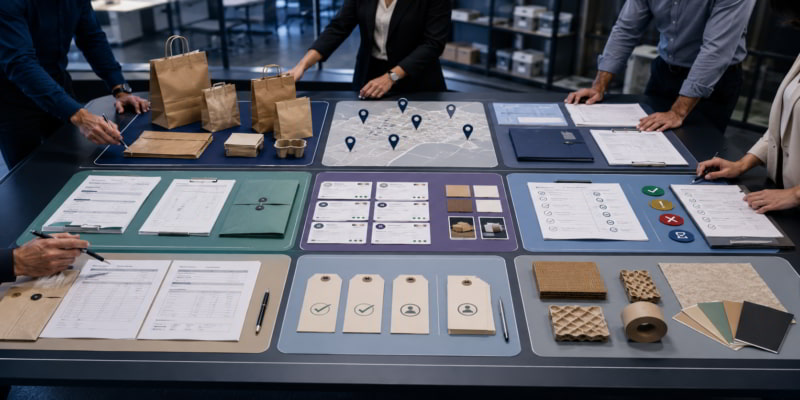
📌 Key Takeaways
Switching from plastic to paper bags across many locations is a cross-functional project, not a purchasing line item.
- Map Bags by Use Case: Group needs by what each bag must handle — heat, weight, moisture — not by store name or location.
- Assign Owners Before Sourcing: Specs drift when no one owns each decision area, so name owners before contacting suppliers.
- Pilot With Real Orders: Test paper bags under actual packing conditions — real food, real speed, real staff — not staged demos.
- Prepare Specific Supplier Questions: Vague specs produce vague quotes; align internal requirements first so you can compare responses fairly.
- Don’t Let Claims Outrun Proof: Verify sustainability and food-contact claims with supplier documentation before using them in any customer-facing materials.
Plan the changeover like a project, and the rollout takes care of itself.
Procurement, operations, and project managers overseeing multi-site packaging transitions will gain a clear readiness framework here, preparing them for the detailed overview that follows.
~ ~ ~ ~ ~ ~ ~ ~ ~ ~ ~ ~ ~ ~ ~ ~ ~ ~
The directive sounds simple enough: replace plastic bags with paper. But for teams managing dozens — or hundreds — of retail stores, QSR outlets, cafes, or grocery locations, the actual changeover is a cross-functional project, not a purchasing line item.
A paper bag that passes a sample review in a meeting room may fail when kitchen staff pack greasy takeout during a Friday rush, or when a checkout team loads mixed grocery baskets into a size that looked right on a spec sheet.
This checklist helps procurement, operations, and project teams define what needs to be mapped, assigned, and tested before suppliers are contacted or bulk orders placed.
Why a Plastic-to-Paper Changeover Is Not a Simple Product Swap
Plastic and paper bags differ in ways that are not always visible on a product data sheet. Paper stores differently, opens differently under pressure, reacts to moisture and heat, and takes up more shelf space. These differences affect packing speed, storage footprint, customer handling, and reorder frequency.
Take a hypothetical QSR chain that approves a paper bag for dine-in takeaway. The bag performs well in store. But when the same bag is used for delivery — where it sits sealed with hot food and trapped steam for 20 to 40 minutes — the base softens and the seams weaken.The bag did not fail because it was poorly made; it failed because the team tested one use case and deployed across all of them.
This failure mode compounds across multi-location networks. Procurement may evaluate bags on unit cost and MOQs (minimum order quantities), while operations care about whether the bag opens quickly, stands upright during packing, and survives the trip home. Marketing wants clean branding. QA needs food contact documentation. Finance may want to understand inventory runout and order-size implications.
Without a shared readiness framework, changeover projects often cycle through resampling, retraining, and supplier switching — sometimes reverting to plastic while the team regroups. For teams already navigating this complexity, a closer look at managing paper bag specification changes during supplier transitions can help avoid common approval-stage setbacks.
Plastic-to-Paper Packaging Changeover Readiness Checklist
This is the core planning asset. It outlines seven readiness areas to define before engaging suppliers. Not every organization will need every row — adapt based on your product types, location count, and operating conditions.
| Readiness Area | What to Map | Why It Matters |
| Current plastic usage | Bag types, sizes, order channels, store formats, volumes, and exceptions | Prevents replacing one plastic SKU with an oversimplified paper substitute |
| Use-case families | Carryout, delivery, grocery, bakery, retail display, branded shopping | Groups requirements into manageable paper bag families rather than forcing a single universal replacement |
| Operating conditions | Weight loads, grease exposure, moisture, steam, handling distance, storage environment | Identifies where stronger or specially treated paper bags may be needed |
| Site differences | High-volume stores, franchise locations, small storerooms, seasonal peaks | Prevents a single rollout plan from failing at edge locations with different constraints |
| Brand and print needs | Artwork, color expectations, logo placement, finish, and scuff resistance | Catches print or presentation issues before production, not after |
| Supplier documentation | Food-contact proof, sustainability claims, recycled content data, coating and ink details where relevant | Ensures teams do not repeat supplier claims that lack supporting documentation |
| Rollout governance | Pilot owners, feedback channels, approval gates, staff training, reorder timing | Keeps the changeover controlled and measurable across locations |
Treat this checklist as a working document. Assign an owner to each area. Track completion before moving to supplier evaluation. By the end of the exercise, the team should know which requirements are standard, which locations need exceptions, which claims require documentation, and which supplier questions are ready for RFQ use.
Map Paper Bag Requirements by Use Case and Location Type
The single most avoidable changeover mistake is assuming one paper bag can replace every plastic format currently in use.
A cafe serving pastries needs a different bag than a grocery store handling mixed baskets of canned goods and produce. An apparel retailer with branded gift bags has different print and handle requirements than a QSR chain packing fried food. A delivery-first food operation places demands on bag construction — heat retention, moisture resistance, base strength — that a retail display bag never faces. Grouping requirements by real use case, rather than by location name, keeps the specification process manageable.
Start by grouping requirements into practical families:
- Food takeout and delivery
- Grocery and mixed baskets
- Bakery or cafe orders
- Retail apparel and branded shopping
- Gift, display, or customer-facing presentation bags
- Bulky or heavier items
For each use-case family, map the relevant variables: load range, bag dimensions, handle style, gusset depth, moisture or grease exposure, storage conditions, and print requirements. Then separate the standard requirements that apply across most of your locations from the exceptions that only apply to specific sites, seasons, or order channels.
One caution worth noting early: general terms like “kraft,” “recycled,” “coated,” “food grade,” or “compostable” may mean different things depending on the supplier, construction, component, and destination market. The safer planning approach is to define what the bag must do in each use case, then request documentation tied to that exact bag and use case rather than relying on label assumptions.
A hypothetical example: a mid-size grocery chain standardizes on one kraft carry bag across 40 stores. But three downtown locations with limited back-of-house space need smaller case packs and more frequent deliveries. Those are not edge cases to solve later — they are specification inputs to capture now.
Teams working through this mapping stage may find it useful to review guidance on how to match paper bag specifications to basket size, food weight, and handling conditions.
Define Ownership Before Comparing Suppliers
Changeover projects stall most often not because of a technical problem, but because nobody defines who owns which decision. Specifications drift when multiple teams revise requirements without a shared document.
Clarify ownership before the first RFQ (request for quotation) goes out. A simple responsibility matrix is enough for many teams — the point is that each responsibility area has a named owner and a defined output before supplier conversations begin.
| Decision Area | Typical Owner | Output Before RFQ |
| Bag specification | Procurement with operations input | Comparable requirement sheet |
| Store usability | Operations | Pilot feedback criteria and packing workflow validation |
| Food-contact documentation | QA / food safety, where applicable | Required proof list |
| Branding and print | Marketing / brand | Artwork, presentation standards, and print expectations |
| Inventory transition | Procurement, operations, finance | Runout and reorder plan, write-off risk from existing plastic inventory, MOQ budget impact |
| Sustainability language | Sustainability / compliance stakeholders | Claims approved for use only after supplier documentation has been verified |
This is not intended as a rigid corporate template. Small teams may combine roles. Supplier comparison becomes more reliable when internal requirements are aligned first. Without that alignment, suppliers may quote different assumptions, making price comparison less meaningful.
Plan Inventory Runout, Sampling, and Pilot Timing
A changeover has a sequence. Skipping steps — or running them in the wrong order — creates gaps that are expensive to fix once the rollout is underway.
Map the depletion window. Estimate when existing plastic inventory will run out at each location. This varies by site, bag type, and usage volume. The depletion window sets the earliest realistic switch date, not the desired one.
Request production-representative samples. Appearance samples show how a bag looks. Production samples show how it performs. Ask suppliers for samples made on the actual production line, using the actual paper grade, coating, ink, and handle construction.
Pilot before full rollout. Select a small number of locations that represent your range of use cases, volumes, and operating conditions. A practical pilot group might include a high-volume site, a site with limited storage, a food-service location, a retail location, and a franchise or regional site where applicable. Run the pilot with real products and real orders — not staged demonstrations.
Collect structured feedback from store staff in categories that can be acted on:
- Bag selection errors (wrong bag chosen for the task)
- Packing speed or handling friction
- Storage problems (space, stacking, humidity)
- Customer presentation concerns
- Failures during handoff or transport
- Documentation gaps surfaced during use
- Reorder timing issues
Define go/no-go criteria before the pilot begins so the scale-up decision is based on evidence, not urgency or an approaching launch date.
Understanding how paper bag lead times interact with seasonal ordering windows can help teams avoid scheduling conflicts that compress pilot timelines or force premature commitments. For wider implementation planning, refer to our guide on rolling out new paper bag specifications across stores, cafes, and takeaway operations.
Prepare Supplier Questions Before RFQs
An RFQ produces useful, comparable responses only when the buyer’s requirements are specific enough to evaluate on a like-for-like basis. Vague specifications lead to vague quotes. Before reaching out, prepare a standard question list organized around five areas.
Specification and construction. Ask for dimensions, paper description, GSM (grams per square meter — a measure of paper weight and density), handle construction, gusset depth, base style, coating or finish, tolerance ranges, print method and color matching, packaging format, and carton or pallet details. GSM is one input in specification review, not a complete performance guarantee by itself — construction, coating, handle attachment, and base design all affect real-world bag performance.
Use-case fit. Ask which proposed bag fits each use case: takeaway, delivery, grocery, bakery, retail display, branded shopping, or heavier items. Request production-like samples where appearance samples are not enough.
Documentation. For food-service applications, ask suppliers to provide food-contact documentation specific to the bag, the components used (coatings, inks, adhesives), and the intended market. Food-contact requirements may vary by jurisdiction, type of food contact, and material composition — do not assume suitability without documentation. Review regulatory resources, such as the FDA’s Packaging & Food Contact Substances guidelines or the European Commission’s Food Contact Materials framework, to determine applicable market standards.
Sustainability and environmental claims. For sustainability-related language — recyclable, compostable, recycled content, biodegradable, or similar claims — ask suppliers to provide proof tied to the specific product and the destination market’s disposal infrastructure. Environmental marketing rules vary by market. For example, the U.S. Federal Trade Commission (FTC) publishes Green Guides to help marketers avoid misleading environmental claims. Verify claims before using them in customer-facing materials or packaging copy.
Standards and test methods. Where technical performance matters, ask suppliers which test methods, tolerances, or standards support the specification. Standards bodies such as ISO can be useful reference points, but the exact standard or test method should be selected according to the product, material, use case, and destination market.
For a more detailed framework on supplier evaluation across multi-store networks, see guidance on supplier qualification questions for paper bag material consistency. For documentation planning around sustainability claims specifically, our guide on paper bag sustainability specifications can help buyers organize supplier questions before claims are repeated internally or externally.
Common Changeover Mistakes to Avoid
Most changeover setbacks stem from skipped readiness steps, not from choosing the wrong bag. Six recurring failure patterns emerge:
- Treating the changeover as a single SKU swap instead of a multi-site operational project with different use cases, sites, and stakeholders.
- Approving desk samples without operational testing. A bag that looks and feels right in a meeting room may fail under real packing conditions — heat, weight, speed, moisture, or stacking.
- Letting sustainability language outrun documentation. Marketing teams sometimes adopt supplier language — “recyclable,” “compostable,” “eco-friendly” — before the supporting documentation has been reviewed and verified. Claims should be tied to the actual bag, component, and destination market.
- Leaving store teams out of the planning process. Procurement may buy the bag, but store associates, kitchen staff, packers, delivery handlers, and customers experience whether it works. Paper bags take up more space than plastic, open differently, and may require different packing techniques. Staff need clear, simple guidance on which bag to use in which scenario.
- Comparing supplier quotes before specifications are normalized. If procurement sends different specifications to different suppliers, the resulting quotes cannot be compared fairly.
- Running down plastic inventory without a timing buffer. If the paper bag samples, artwork approvals, or pilot feedback take longer than expected, a location with zero plastic stock and no paper alternative faces a packaging gap.
Frequently Asked Questions
What should be included in a plastic-to-paper packaging changeover checklist?
A thorough checklist covers current plastic usage by location, paper bag requirement families by use case, site-level operating conditions, specifications, supplier documentation needs, inventory runout timing, a pilot plan with feedback criteria, staff training, and rollout ownership across procurement, operations, and store teams.
Should every location use the same paper bag specification?
Not always. Standardization works where use cases and conditions are similar, but exceptions may be needed for locations with different product types, food handling conditions, storage capacity, order volumes, or seasonal patterns. Identifying those exceptions early prevents late-stage rework.
When should suppliers be contacted during a plastic-to-paper changeover?
After the internal team has mapped requirements clearly enough to ask specific questions — but before finalizing specifications, artwork, or rollout timing without supplier input on feasibility. The window between “we know what we need” and “we know what suppliers can deliver” is where the best alignment happens.
What claims should be verified before using paper bag sustainability language?
Any claim related to recyclability, compostability, recycled content, food-contact suitability, coating composition, ink safety, adhesive content, or market-specific disposal instructions should be verified with supplier documentation before appearing in customer-facing or marketing materials. Definitions and requirements may vary by market.
How should teams pilot paper bags before full rollout?
Choose representative locations that reflect your range of use cases, volumes, and operating conditions. Use real products and real orders. Collect structured feedback from staff — packing speed, bag performance, storage issues, and customer reactions. Set approval criteria before the pilot starts so that the decision to scale up is driven by data, not pressure.
Conclusion
A plastic-to-paper packaging changeover succeeds when the planning is as structured as the rollout itself. The teams that avoid rework and supplier churn are the ones that map specifications by use case, assign clear ownership, pilot under real conditions, and prepare specific supplier questions — all before the first bulk order.
Before requesting quotes, align procurement, operations, QA, and store teams around one shared changeover checklist and supplier question list. That shared foundation is what separates a controlled rollout from a reactive one.
Once internal readiness is in place and specifications are defined, teams can explore paper bag suppliers to begin sourcing conversations with clarity and confidence.
Disclaimer:
This article is for general informational purposes only. It is not a substitute for advice from a qualified professional, provider, or official source relevant to your situation. Always verify important packaging, food-contact, sustainability, regulatory, and supplier decisions with the appropriate expert, authority, or service provider.
Our Editorial Process:
Our expert team uses AI tools to help organize and structure our initial drafts. Every piece is then extensively rewritten, fact-checked, and enriched with first-hand insights and experiences by expert humans on our Insights Team to ensure accuracy and clarity.
About the PaperIndex Insights Team:
The PaperIndex Insights Team is our dedicated engine for synthesizing complex topics into clear, helpful guides. While our content is thoroughly reviewed for clarity and accuracy, it is for informational purposes and should not replace professional advice.