
📌 Key Takeaways
Every sustainability claim on a paper bag needs matching proof — or it becomes a greenwashing risk.
- Specifications Come Before Claims: Define what the bag must be (fiber, coating, grade) in your RFQ before evaluating any environmental statement a supplier makes.
- Certificates Don’t Cover Everything: A supplier’s certification may not match the specific product, site, or legal entity on your quote — always check scope, dates, and registry records.
- Match Each Claim to Documents: Broad terms like “eco-friendly” or “recyclable” need product-specific evidence; a brochure alone is not enough proof to repeat on your own materials.
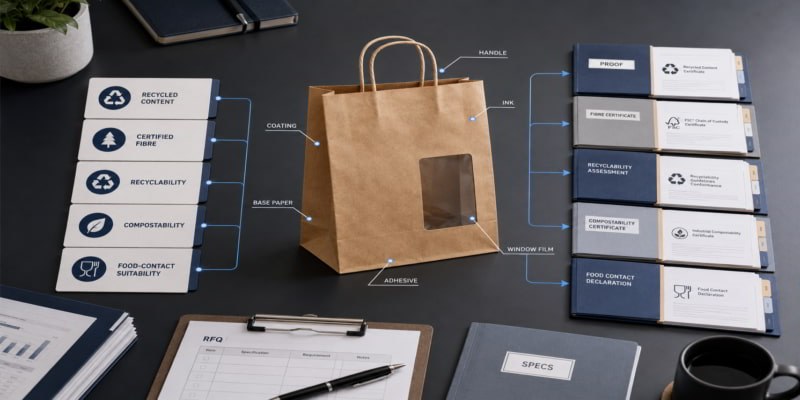
- Non-Paper Parts Break Claims: Coatings, inks, adhesives, handles, and window films can undermine recyclability or compostability claims that would hold for plain paper.
- Keep a Claim File: A simple shared tracker linking each sustainability statement to its supporting document, expiry date, and approved wording prevents drift between evidence and what gets published.
Documented proof turns supplier promises into defensible buyer claims.
Procurement, packaging, and QA professionals sourcing paper bags will gain a practical framework for requesting and verifying sustainability documentation, preparing them for the detailed guide that follows.
~ ~ ~ ~ ~ ~ ~ ~ ~ ~ ~ ~ ~ ~ ~ ~ ~ ~
Internal teams routinely ask procurement to source “sustainable paper bags.” The request rarely arrives with a clear definition, or with guidance on what evidence supports that language on a website, invoice, or package. Suppliers may respond with brochures, certificates, or broad environmental phrases, but none of these automatically give the buyer’s company a defensible claim to repeat.
This is a documentation problem, not a branding exercise. Buyers across procurement, packaging, operations, and QA need to know which sustainability-related documents they can request from paper bag suppliers, what those documents may support, and where common claims fall apart when evidence is missing. The goal is practical: ask better supplier questions, match every claim to proof, and avoid greenwashing risk, audit failures, or supplier disputes.
Start by Separating Specifications from Claims
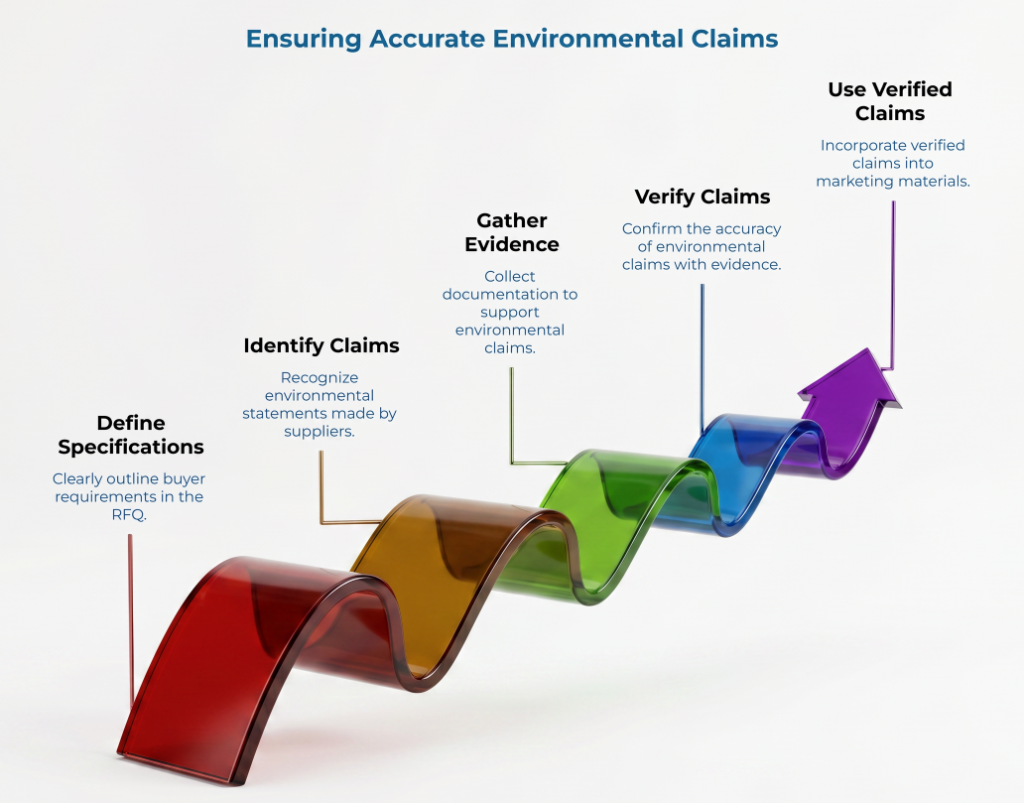
A specification defines what the buyer requires the supplier to provide. It belongs in the RFQ (request for quotation) and might include fiber source, recycled content percentage, paper grade, coating type, ink system, adhesive chemistry, handle material, dimensions, intended use, certification requirements, or documentation expectations. Specifications are buyer-owned. They help suppliers quote against the same requirement instead of responding with broad marketing language.
A claim states something about environmental performance, certification status, or end-of-life behavior — “recycled,” “recyclable,” “compostable,” “FSC-certified,” “PEFC-certified,” “PFAS-free,” or “plastic-free.” Claims carry risk because they assert something that needs evidence behind it. The support needed may vary depending on the product, supplier, transaction documents, destination market, and whether the wording appears in an internal RFQ, an invoice, packaging artwork, website copy, or customer-facing marketing material.
The risk increases when supplier marketing language obscures structural specifications. A brochure may describe a bag as “eco-friendly,” but that phrase is neither a specification nor a verified claim. Buyers should treat every environmental statement as something that maps to documentation before it gets repeated. The working principle: specification first, claim second, evidence always.
What Sustainability-Related Documents Buyers Can Ask Paper Bag Suppliers to Provide
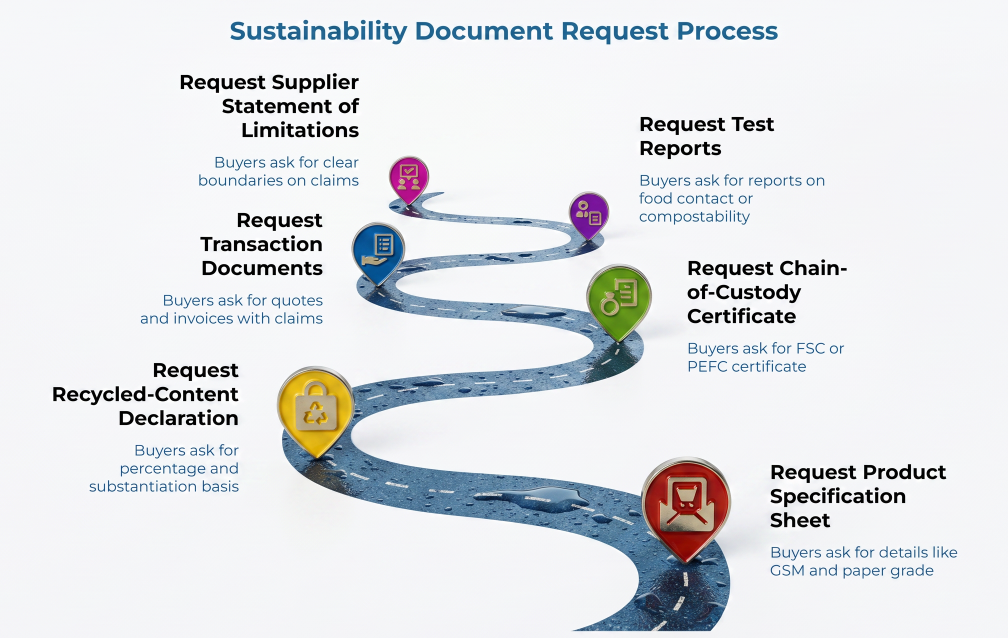
Buyers do not need to become certification specialists to improve documentation requests. The following categories cover the most common sustainability-related document types for paper bag sourcing. None guarantee legal compliance globally — they support informed evaluation.
Product specification sheet. Also called a technical data sheet (TDS), this should confirm GSM (grams per square meter), paper grade, fiber type, coating, ink system, adhesive, handle material, dimensions, and intended use. It establishes what the product actually is before any environmental claim gets evaluated. For kraft bags, buyers should separate the base paper specification from bag-conversion details such as handles, windows, coatings, inks, and adhesives.
Recycled-content declaration. Where recycled content is part of the requirement, buyers can ask for the percentage, whether pre-consumer or post-consumer, which SKUs the declaration covers, and the supplier’s substantiation basis. A declaration tied to ISO 14021 may add credibility, though it remains supplier-provided evidence rather than independent proof. ISO 14021 is a useful standards reference because it addresses requirements, common terms, and evaluation methods for self-declared environmental claims.
Chain-of-custody (CoC) certificate. Chain of custody means the documented system used to track certified or controlled material through the supply chain. For FSC (Forest Stewardship Council) or PEFC (Programme for the Endorsement of Forest Certification) claims, buyers should request the supplier’s valid CoC certificate. According to FSC chain-of-custody guidance, organizations labeling products with FSC claims must maintain a valid CoC certificate covering the sourcing, processing, labeling, and sale of the certified products, and ensure corresponding sales documentation supports the claim. PEFC chain-of-custody standards similarly set requirements for making claims about forest-based product origin, including certified, recycled, and controlled sources. Buyers should check the certificate holder’s legal name, scope, product coverage, site or entity match, and validity dates.
Transaction documents. Quotes, purchase orders, invoices, and delivery notes may carry claim wording. A supplier certificate may show capability, but the quote, purchase order, invoice, delivery note, batch reference, or packing list helps connect the claim to the actual product being supplied. Buyers can ask whether sustainability-related claims appear on these documents and whether invoice-level wording matches the certificate scope.
Test reports or declarations. Where claims involve food contact, compostability, recyclability, or PFAS-free status, buyers can ask for the relevant test report or certification tied to the actual product and use conditions — not just a general supplier capability statement.
Supplier statement of claim limitations. Asking the supplier to identify what the buyer may and may not say based on the supplied documents gives procurement a clear boundary to pass along downstream. Procurement often collects the evidence, but marketing, sustainability, QA, or legal teams end up writing the claims — so internal alignment becomes critical.
Why Certificates Do Not Automatically Support Every Sustainability Claim
A common misunderstanding is that a certificate proves everything. In practice, a certificate may show that a supplier participates in a certified system, but the buyer still needs to confirm whether the specific product, site, transaction, and claim wording are actually covered.
Buyers should check whether the certificate holder’s legal name matches the entity on the quote or invoice. The scope should cover the specific product category — a certificate for printing paper does not automatically extend to kraft bags. Validity dates matter; an expired certificate does not support a current claim. The production site should match the certified site, and the buyer should confirm whether claims can appear on sales documents and whether logo use requires separate certification-body approval.
Official registries can support this review. Buyers can use the FSC public certificate search and PEFC Find Certified to verify validity. A supplier PDF alone should not be the only reference point when the claim will appear on purchase orders, invoices, packaging, or marketing copy.
Illustrative example. A buyer sourcing kraft paper bags for takeaway food asks for “sustainable bags.” The supplier sends an FSC certificate and states the bags are recyclable. The buyer should not repeat both claims automatically. Instead, the buyer verifies whether the FSC certificate covers the specific product and legal entity, then requests material composition and coating details before making any recyclability statement.
The Buyer Sustainability Claim Documentation Matrix
The following matrix maps common sustainability-related claims to the documentation buyers can request, what each document may support, and where it falls short.
| Claim or Requirement | What to Ask the Supplier For | What It May Support | What It Does Not Prove by Itself | Internal Review Focus |
| Recycled content | Supplier declaration, percentage basis, SKU coverage, invoice wording | Product-specific recycled-content discussion | Overall sustainability or recyclability | Verify source, percentage basis, and claim wording |
| FSC/PEFC claim | Valid certificate, scope, legal entity match, product category, invoice claim | Chain-of-custody claim if scope matches | Universal sustainability | Registry, scope, and trademark review |
| Recyclability | Material composition, coatings/inks/adhesives disclosure, destination-market guidance | Internal evaluation of end-of-life claim | Recyclable everywhere | Jurisdiction, infrastructure, and technical review |
| Compostability | Relevant test or certification documentation, composting-condition scope | Specific compostability claim under stated conditions | Home compostability, landfill degradation, or universal compostability | Standards, facility, and legal review |
| PFAS-free or chemical claim | Supplier declaration, lab test report, coating chemistry disclosure | Restricted-chemical claim if verified | Broad safety claim | Technical and compliance review |
| Food-contact relevance | Declaration of compliance or test report tied to actual use conditions | Food-contact suitability for stated conditions | Sustainability or performance | Food-contact compliance review |
“May support” means the documentation can contribute to an internal evaluation — not that the claim is ready to publish. Non-paper components such as coatings, inks, adhesives, handles, and window films can undermine claims that would otherwise hold for uncoated paper, so requesting component-level disclosure helps buyers evaluate whether a claim applies to the whole product.
For compostability claims, standards may depend on the product and material composition. ASTM D6400, for example, addresses the labeling of plastics designed to be aerobically composted in municipal or industrial facilities (ASTM International), while ASTM D6868 specifically covers paper and other substrates incorporating plastic coatings or additives designed for those same industrial composting environments. If a paper bag includes plastic-containing coatings, binders, windows, adhesives, or other non-paper components, the exact product construction matters when evaluating which compostability standard applies.
Keep the wording narrower than the evidence. If the evidence supports only a product-specific recycled-content statement, do not turn it into a broad sustainability claim. If the evidence supports industrial compostability under defined conditions, do not imply home compostability or landfill degradation.
How to Ask Suppliers Without Overclaiming in the RFQ
Buyers can include documentation-led language in their RFQs without overstepping into legal territory. The point is to request evidence clearly and professionally. Practical request wording might include:
- “Please provide documentation supporting any recycled-content, chain-of-custody, recyclability, compostability, chemical, or food-contact claims made for this specific paper bag product.”
- “Please identify which claims may appear on quotes, invoices, delivery documents, packaging, or marketing materials.”
- “Please confirm whether the certificate scope covers the quoted product, production site, legal entity, and transaction documents.”
- “Please identify any claim limitations, conditions, or exclusions.”
These four lines signal that the buyer takes documentation seriously without implying the supplier bears sole responsibility for customer-facing claims. They give procurement something concrete to pass to internal teams. Buyers sourcing from kraft bags suppliers or food grade kraft paper suppliers may need additional food-contact documentation — request it explicitly.
Claims Buyers Should Avoid Until Evidence Is Reviewed
Certain terms carry high risk when used without product-specific, claim-specific, and jurisdiction-aware evidence. The FTC Green Guides provide principles for substantiating environmental marketing claims — including in B2B transactions. The underlying FTC guidance, codified at 16 CFR Part 260, addresses environmental marketing claims in labeling, advertising, promotional materials, and other media, emphasizing that claims should be interpreted and substantiated based on what they reasonably convey. ISO 14021 specifies requirements for self-declared environmental claims, reinforcing that vague or unqualified language creates risk regardless of the audience.
Terms to treat as evidence-dependent until documentation supports the exact wording:
- “Eco-friendly,” “green,” or “sustainable” — broad and typically unsubstantiable without extensive qualification
- “Fully recyclable” or “compostable” — depends on material composition, infrastructure, and applicable standards
- “Biodegradable” — may be misleading without defined conditions and timeframe
- “Plastic-free” — requires verification of coatings, adhesives, windows, handles, and inks
- “PFAS-free” — requires lab testing or a verifiable supplier declaration
- “Carbon-neutral” — faces strict regulatory scrutiny, including bans on offset-based consumer claims in jurisdictions like the EU (Directive (EU) 2024/825), and requires specialized lifecycle assessment beyond most procurement teams’ scope
- “FSC-certified” or “PEFC-certified” — valid only if certificate scope, entity, product, and transaction match
- “Made from recycled paper” — needs documented percentage and product-level coverage
- “Food-safe” — requires a formal regulatory compliance statement (such as a US FDA Letter of Guaranty) or a Declaration of Compliance (under EU Regulation (EC) No 1935/2004) tied to the actual product and use conditions
Each of these claims may be defensible in narrow, well-documented contexts. The absolute rule for procurement is to restrict public marketing assertions to match the precise limits of the technical documentation.
Keep a Claim File Before Repeating Supplier Language
Before any sustainability-related language moves from a supplier document into a buyer’s own materials, a simple internal claim file helps prevent drift between evidence and published claims. This does not need to be an enterprise ESG system — a shared spreadsheet works for most growth-stage procurement teams.
A practical claim file tracks: supplier name and legal entity, product or SKU, certificate title and reference number, expiration date, claim wording allowed, claim wording not approved for use, internal review owner, date last reviewed, and where the claim appears (RFQ, purchase order, invoice, packaging, website, or customer-facing copy).
The location of the claim matters. A statement used in an internal RFQ is different from wording printed on a bag, added to packaging artwork, placed on a website, repeated in customer sales materials, or shown on an invoice. The claim file should make that distinction visible.
This structure turns evidence handoff into a repeatable process and creates an audit trail if anyone questions a published statement. For a broader supplier verification methodology, this guide to verifying paper bag supplier capability covers related checks.
Frequently Asked Questions
Can buyers ask for FSC or PEFC documents before placing an order?
Yes. Requesting chain-of-custody certificates, scope details, and registry confirmation before committing to an order is standard practice. However, receiving a certificate does not end the review — scope, validity, legal entity match, product coverage, and sales-document claims all need verification before repeating any certification-related language.
Does recycled content make a paper bag sustainable?
Not by itself. Recycled content may support a specific recycled-content claim if the percentage, source basis, and product coverage are documented — but it does not prove overall sustainability. A bag with post-consumer recycled fiber may still have coatings or adhesives that affect recyclability. Treat recycled content as one attribute, not a blanket label. For a closer look at how fiber choice affects performance, see virgin vs. recycled kraft paper.
Can a supplier’s brochure be used as sustainability proof?
A brochure is a starting point, not proof. It may indicate what the supplier claims, but brochures typically lack the product-specific, scope-verified documentation needed to support a buyer’s own claims. Ask for the underlying certificates, declarations, test reports, or statements of claim limitations instead.
Should buyers avoid the term “eco-friendly” for paper bags?
Avoid it unless the claim can be substantiated and qualified for the specific product and use case. Environmental marketing guidance generally treats unqualified broad claims as high-risk. Narrower wording is usually safer — such as “contains documented recycled content” or “supplied with chain-of-custody documentation” — where the evidence supports that exact statement.
Match Every Claim to Evidence Before Comparing Suppliers
Buyers do not need to become sustainability auditors to improve sourcing discipline. The practical step: ask targeted documentation questions, match each claim to evidence, and avoid repeating broad environmental language until the proof supports the exact wording.
Use the documentation matrix above to prepare a clearer RFQ. Once those questions are ready, compare paper bag suppliers or submit an RFQ with specific evidence requests built in. For broader context on aligning sourcing with sustainability goals, sustainable sourcing of bag paper covers the wider framework.
Disclaimer:
This article is for general informational purposes only and does not constitute compliance, safety, technical, legal, or professional advice. Environmental claim requirements, packaging rules, and certification requirements may vary by jurisdiction, product, supplier, and use case. Confirm important decisions with the appropriate qualified professional, certification body, regulator, or technical expert.
Our Editorial Process:
Our expert team uses AI tools to help organize and structure our initial drafts. Every piece is then extensively rewritten, fact-checked, and enriched with first-hand insights and experiences by expert humans on our Insights Team to ensure accuracy and clarity.
About the PaperIndex Insights Team:
The PaperIndex Insights Team is our dedicated engine for synthesizing complex topics into clear, helpful guides. While our content is thoroughly reviewed for clarity and accuracy, it is for informational purposes and should not replace professional advice.