
📌 Key Takeaways
Comparing kraft paper parent rolls by grade name or GSM alone hides the differences that cause real problems on the converting floor.
- Grade Names Are Marketing, Not Standards: Two suppliers can use similar names while offering very different strength, moisture, and surface properties — always check the specifications behind the label.
- Cheap Rolls Often Cost More: A lower price per tonne means nothing if the roll causes web breaks, extra waste, slower speeds, and more operator time to fix problems.
- Match Specifications to Your Process First: Build an internal requirement sheet with input from procurement, production, and quality before requesting quotes — this turns vague comparisons into real ones.
- Numbers Need Context to Compare: Two datasheets showing the same GSM or moisture may use different test methods, conditions, or definitions of “guaranteed” versus “typical.”
- Trial Rolls Beat Datasheets: Sample rolls tested on your actual machines, with documented waste, speed, and defect data, are the only reliable proof that an offer will perform.
The best parent roll is the one with enough evidence to trust — not the lowest price or the most familiar name.
Kraft paper procurement teams and converting plant buyers will gain a structured method for screening offers before committing, preparing them for the detailed comparison framework that follows.
~ ~ ~ ~ ~ ~ ~ ~ ~ ~ ~ ~ ~ ~ ~ ~ ~ ~
Three offers hit the desk.
The spreadsheet columns line up — GSM, roll width, price per tonne. One supplier labels its product “high-strength kraft.” The second calls it “bag kraft.” The third offers “premium recycled kraft.” On paper, all three look close enough to choose on price. On the converting floor, the story changes: one causes web breaks, another creates edge trim waste, and the third runs smoothly enough to justify a higher price.
Why does this keep happening? Procurement compares offer sheets. Production lives with the consequences. The difficulty is not inexperience — kraft paper terminology is not standardised across suppliers, regions, or end-use categories. Domestic and international suppliers may use different test methods, units, and definitions of quality.
The comparison criteria that matter depend on the converting process, machine setup, end-use requirement, and customer acceptance standard — whether the roll feeds a slitting and rewinding line, a bag-making machine, a wrapping operation, a coating head, or a laminator. Buyers should verify claims using supplier technical datasheets, certificates of analysis, representative samples, agreed test methods, and controlled trial orders. With a structured method to compare kraft paper mother roll offers, procurement teams can screen out rolls that fail on the machine and present management with a defensible case for choosing converting performance over the lowest unit price.
The exact end application is not specified here, so this guidance applies broadly to kraft paper converting uses — slitting, rewinding, packaging conversion, wrapping, bag-making, sheet cutting, coating, printing, and lamination. Specific acceptance values vary by machine setup, customer requirement, end use, and agreed test method.
Why Kraft Paper Grade Names Alone Can Mislead Buyers
Supplier grade names are commercial labels that identify a broad product family, not a universal performance standard. Two mills may use similar-sounding names while offering different furnish blends, strength profiles, moisture levels, surface properties, and tolerance discipline.
“Same GSM” does not mean same runability. Supplier A’s 70 GSM kraft and Supplier B’s 70 GSM kraft may differ in tensile strength, moisture, Cobb value, surface roughness, and lot consistency. Until the buyer compares grammage, tensile, tear, burst, Cobb value (water absorptiveness), where relevant, surface properties, roll dimensions, tolerances, and trial performance, those grade names remain unverified descriptions. The sharper question: equivalent according to which properties, test methods, and tolerances?
Price comparison becomes unreliable when specifications, lanes, and test methods are not aligned — a principle explored further in comparability before price.
The Real Cost of a Poor Parent Roll Choice Shows Up in Converting
A cheaper parent roll can become the most expensive material on the floor. The cost appears as web breaks, excessive trim waste, wrinkles or baggy lanes, dusting, poor edge quality, inconsistent roll tension, difficulty maintaining machine speed, finished-product variation, operator intervention, customer complaints, and rejected rolls or converted products. Sometimes finished-product complaints trace to paper variability rather than machine settings.
TAPPI identifies common physical tests — grammage, moisture, caliper, density, smoothness, porosity, stiffness, tensile, burst, tear, and folding endurance — as measurable properties affecting converting outcomes. The honest comparison is cost per usable converted output, not cost per tonne purchased. Effective parent roll buying criteria start with these measurable properties, not with the grade name on the offer sheet.
Start With the Application, Not the Supplier’s Grade Name
Before requesting quotes, document specific performance requirements: end-use application, machine speeds, and critical tolerances for tension, surface friction, and moisture.
Build an internal ‘performance requirement sheet’ with input from procurement, production, and quality — a process detailed in Creating your mill specification sheet. This becomes the shared comparison template that many converting operations lack. Without that sheet, the buyer asks suppliers for “similar kraft paper.” With it, the buyer asks for a material that can survive a defined converting process. The kraft paper property–application match matrix provides a useful starting reference.
Build a Like-for-Like Kraft Paper Parent Roll Comparison Table
A side-by-side table should capture comparable fields that turn vague supplier claims into structured data. The following framework covers the core comparison:
| Comparison Field | Why It Matters |
| Supplier, mill or country, grade name, intended use | Shows whether the offer is being positioned for the same application. |
| Furnish type, verified by supplier documentation | Virgin, recycled, or blended furnish may perform differently depending on process control and end use. |
| GSM or grammage, plus tolerance | Helps compare weight per area, yield, and finished-product expectation. |
| Caliper or thickness | Affects stiffness, roll build, handling, and finished-product feel. |
| Moisture content | Can affect curl, dimensional stability, printability, shrinkage, and strength behaviour. |
| Tensile and tear strength, MD/CD | Separates machine-direction and cross-direction performance where web stress matters. |
| Burst strength or burst index | Relevant where pressure resistance or packaging performance matters. |
| Cobb value or water absorptiveness | Relevant for gluing, sizing, printability, coating, or moisture exposure. |
| Porosity, smoothness, surface side, edge quality | Helps predict print, coating, air permeability, dusting, and edge-trim behaviour. |
| Roll width, diameter, core, hardness, winding quality | Connects the offer to actual unwinding, slitting, and handling performance. |
| Splice policy, packaging, moisture protection | Reduces uncertainty in long-distance shipments and production planning. |
| Test method, unit, typical/minimum/guaranteed status | Determines whether numbers are truly comparable. |
| Certificate of analysis, trial notes, claim process | Shows how supplier claims will be verified and handled. |
Beyond these core fields, also capture roll hardness and winding quality, edge condition, core condition, minimum order quantity, lead time, storage recommendations, and any trial-roll performance notes relevant to the converting process.
This table should travel with the RFQ, supplier response, trial notes, and purchase approval. It should also inform the purchase order itself — agreed tolerances, test methods, certificate requirements, splice limits, packaging expectations, and claim procedure all belong in the PO, not just in the evaluation file. For buyers building a more formal RFQ, the anatomy of a perfect brown paper RFQ offers a related structure for reducing quote confusion.
For grammage, ISO 536 specifies the determination method. TAPPI T 410 clarifies that basis weight, ream weight, and substance are commercial terms for weight per unit area. For water absorptiveness, TAPPI T 441 provides the standard Cobb test method.
Check Whether the Numbers Were Measured the Same Way
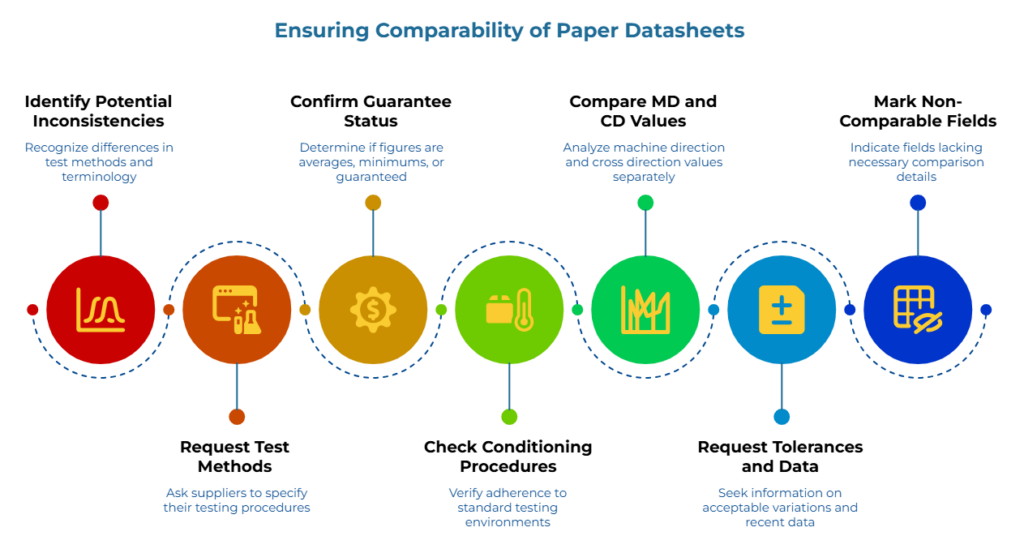
Two datasheets showing “80 GSM” and “7.5% moisture” may not be comparable if suppliers used different test methods, conditioning environments, or definitions of “typical” versus “guaranteed.” Regional terminology adds confusion — GSM versus basis weight in pounds per ream, for example.
Ask suppliers to state every test method. Confirm whether figures are averages, minimums, or guaranteed. Check conditioning procedures — ISO 187 specifies standard atmospheres for testing pulp, paper, and board, including procedures for monitoring temperature and relative humidity. That does not mean every buyer needs laboratory-level detail in every transaction, but it does mean moisture-sensitive values should not be compared casually across unclear conditions. TAPPI T 410 helps normalize grammage terms. ISO 536, generally remains the standard for determining grammage. Compare MD and CD values separately. Request tolerances and recent lot-level data. The TAPPI/ISO test method guide for kraft paper RFQs provides a ready reference.
Values without methods are claims. Values with methods are data. Mark any field as “not comparable” if the supplier does not provide the test method, unit, tolerance, or guarantee status — that is more useful than pretending the values line up.
Translate Each Specification Into a Converting Risk
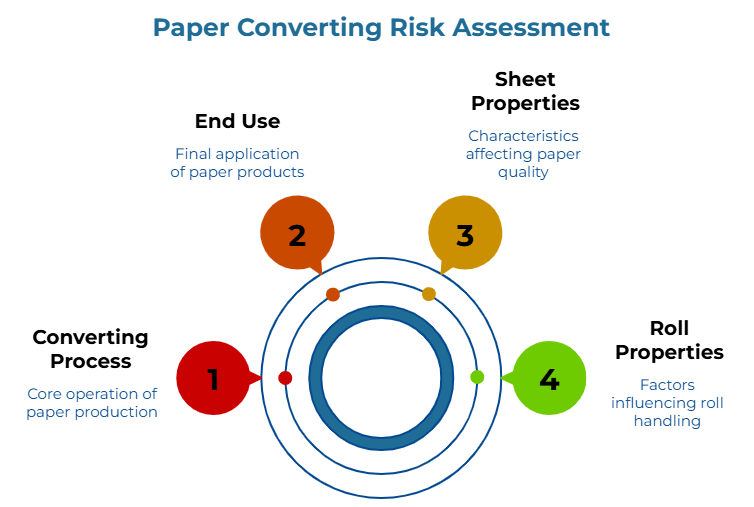
The goal is not the strongest paper on every measure, but the right property balance for the converting process and end use.
- Grammage affects yield, machine setup, and finished-product consistency — ask for tolerance, test method, and lot variation.
- Caliper variation changes nip pressure and coating uniformity.
- Moisture outside the moisture window causes curl, telescoping, or dimensional instability; TAPPI T 412 notes that moisture affects economic value and properties—including printability, shrinkage, dimensional stability, and physical strength. Therefore, ask whether values are recent, lot-specific, and measured under stated conditions.
- Tensile strength in the cross direction determines web-break risk.
- Tear strength governs edge integrity during slitting.
- Burst strength matters for bag-making and handling survival.
- Cobb value affects printability, gluing, and moisture barriers.
- Surface smoothness influences print and coating quality.
- Porosity affects vacuum feeding and coating processes.
Beyond sheet properties: roll build and winding quality determine tension consistency, edge quality problems create trim waste, splices interrupt production, and core condition and packaging affect storage and mounting. TAPPI notes that strength is critical for both end use and converting operations, with common tests including tensile, burst, stiffness, tear, internal bond, and ring crush.
Over-specifying can restrict the supplier pool and increase cost without improving the actual application outcome. The target is the right balance, not the highest number in every column.
Ask Suppliers for Evidence, Not Just Claims
Request: a full technical datasheet with test methods and units, typical and guaranteed values separated, tolerance ranges, a recent certificate of analysis, sample rolls, recommended applications, known converting limitations, storage recommendations, splice policy, roll packaging details, a claim procedure, and references from similar converting applications. The Specification-driven kraft paper RFQ template provides a fuller structure.
A practical RFQ line: “Please provide grade name, end use, grammage, caliper, moisture, tensile MD/CD, tear MD/CD, burst, Cobb if applicable, test methods, tolerances, roll build details, splice policy, and recent lot-level test data. Clarify which values are guaranteed and which are typical.”
For buyers who need a more complete documentation bundle, the RFQ evidence-pack guide explains how product identity, tolerances, roll specifications, moisture requirements, packaging standards, and certificate expectations can be bundled before supplier comparison.
Use Kraft Paper Sample Testing Before Comparing Full-Order Prices
Sheet samples reveal appearance and some physical properties. Lab tests verify claims. Sample rolls are more useful for assessing runnability and slitting and rewinding performance. However, a single sample represents a point-in-time snapshot and does not guarantee long-term lot consistency. TAPPI T 400 notes that a small sample may not represent the full lot. Test under ISO 187 conditioning standards where possible, following the protocol outlined in the reel and core fit checklist.
Keep retained samples with supplier name, grade, lot number, receipt date, storage condition, and test notes. If a bulk shipment performs differently later, retained samples give quality and production teams something concrete to compare.
Run a Controlled Paper Roll Trial Order Before Scaling Up
Document: supplier and grade, lot number, roll dimensions and roll profile, machine used, operator notes, setup changes, running speed, breaks, downtime minutes, trim waste, edge quality, dusting, wrinkles, splice performance, finished-product defects, customer or internal QC feedback, and comparison against the current approved grade.
If a new roll is 4% cheaper but requires slower speed, extra waste, and more operator intervention, the real cost may be higher — calculated using actual production data. Treat that 4% as an illustrative example rather than a universal threshold. The only metrics that matter are those derived from the buyer’s own converting floor. A trial without machine settings, waste figures, and QC results is difficult to use in paper roll quality inspection or supplier evaluation. Avoid over-specifying unnecessarily tight tolerances that increase cost without improving the actual application outcome.
Compare Total Converting Cost, Not Just Price per Tonne
Total Comparison Cost = Landed Price + (Waste % × Unit Price) + (Downtime Hours × Machine Rate) + Quality Failure Costs. This is a planning framework, not a universal formula.
Account for purchase price, freight, payment terms, minimum order quantity, yield loss, trim waste, production downtime, machine speed reduction, inspection, rejects, rework, customer complaints, claims handling, inventory risk, and supplier reliability.
Different roles will weigh these factors differently. A finance buyer may refine the framework with labour rates, machine-hour cost, claim history, or customer penalty exposure. An operations manager may focus on speed loss, downtime, and operator intervention. A quality manager may focus on rejects, complaint frequency, and lot-to-lot variation. The framework becomes easier to defend when it includes both procurement price and converting-floor evidence.
When documented, this gives procurement a way to explain to management why a higher-priced offer delivers lower total cost. The landed-cost framework requires normalizing Incoterms to ensure freight and insurance costs are captured.
Watch for Red Flags in Kraft Paper Parent Roll Offers
Be cautious when offers list only GSM and price, suppliers cannot provide test methods, values are described only as “standard” or “premium,” no tolerances are given, no trial option exists, lot data is unavailable, datasheet values are typical only with no guaranteed minimums, grade names change between quotation and shipment, packaging protection is vague, splice limits or roll defect policies are undefined, trial rolls perform differently from bulk shipments, or the lowest-price offer requires production compromises excluded from the cost comparison. Any of these signals increase the risk of roll defects, paper waste, and avoidable production disruption.
One red flag does not automatically disqualify a supplier. It tells the buyer where the approval should pause and where additional evidence is needed before proceeding.
Create an Approved Supplier and Grade Comparison Process
A repeatable process: define application and production pain points, build the specification sheet, request comparable data, normalise units and test methods, screen samples, run a controlled production trial, compare total converting cost, approve conditionally, monitor first bulk shipments through incoming inspection, and keep production feedback tied to supplier and lot records. Maintain a supplier performance log recording incoming roll quality, production issues, claims, and repeat-order performance. Over time, the log becomes evidence — not opinion.
From Grade-Name Buying to Converting Confidence
The next quote sheet may still show three offers that look similar. That part will not change.
What can change is the buying method. Translate each offer into measurable specifications. Check the test methods. Ask for supplier evidence. Run a controlled trial. Compare cost per usable converted output, not only price per tonne.
The best parent roll offer is not the lowest price or the most familiar grade name. It is the one backed by enough technical evidence, reliable converting performance, acceptable finished output, and fewer avoidable surprises.
Before approving the next supplier, build a comparison table, request test-method-backed kraft paper specifications, run a controlled trial, and review results with production and quality — not procurement alone. Verified kraft paper mother roll suppliers and kraft paper jumbo roll listings on PaperIndex can serve as a starting point for sourcing candidates to evaluate through this process.
Frequently Asked Questions
Why can’t kraft paper parent rolls be compared by grade name alone?
Grade names are supplier-specific commercial descriptions. Two similar-sounding grades may differ in grammage tolerance, strength, moisture, surface properties, roll build, or converting performance.
Is GSM the most important specification?
GSM is important but insufficient alone. Also compare caliper, moisture, tensile, tear, burst, water absorptiveness where relevant, roll dimensions, winding quality, and tolerances.
How can two offers be confirmed as equivalent?
Only when key specifications, test methods, tolerances, end-use suitability, and trial performance align. Matching grade names or GSM alone is not sufficient.
How do you compare a cheaper offer with a more reliable roll?
Compare total converting cost. Include waste, downtime, speed loss, rejects, rework, claims, operator intervention, and inventory risk. The lowest unit price can still be lost once production costs are included.
What should a trial order prove?
A trial should show whether the roll runs acceptably on the buyer’s actual machine under normal production conditions. It should produce usable data — machine settings, waste figures, QC results — not just a general impression.
Are virgin and recycled kraft papers directly comparable?
Not automatically. They may perform differently depending on furnish, strength profile, and process control. Compare measurable specifications and trial performance rather than assuming one category is better.
Disclaimer:
This article is published for educational and informational purposes only. The comparison criteria and recommendations discussed are general guidance. Buyers should verify all claims using their own procedures, datasheets, certificates of analysis, samples, and trials. The correct criteria depend on the converting process, machine setup, end-use requirement, and customer acceptance standard.
Our Editorial Process:
Our expert team uses AI tools to help organize and structure our initial drafts. Every piece is then extensively rewritten, fact-checked, and enriched with first-hand insights and experiences by expert humans on our Insights Team to ensure accuracy and clarity.
About the PaperIndex Insights Team:
The PaperIndex Insights Team is our dedicated engine for synthesizing complex topics into clear, helpful guides. While our content is thoroughly reviewed for clarity and accuracy, it is for informational purposes and should not replace professional advice.