
📌 Key Takeaways
The best kraft paper isn’t the strongest; it’s the lightest grade that still passes the job’s real-world tests.
- Match Paper to the Actual Risk: Pick the grade based on what could go wrong — tearing, puncture, moisture — not just by choosing the heaviest option available.
- Heavier Doesn’t Mean Better: Higher weight means more fiber per sheet, but it says nothing about whether the paper handles your specific stress, like sharp product edges or damp storage.
- Turn Vague Requests Into Tests: When a customer says “strong” or “moisture resistant,” figure out which measurable property they actually need and test for that one thing.
- Trial Before You Switch: Specification sheets show lab results, not how paper runs on your machine — a controlled production trial is the only reliable proof a new grade works.
- Hold Specifications That Protect You: Cost-cutting should never override safety, compliance, or jobs where failures are expensive — challenge specifications only on low-risk, short-life, or hidden-use applications.
Buy the grade the job needs, not the grade that feels safest.
Small-scale converters and packaging buyers looking to cut material costs without adding production risk will find a ready-to-use decision framework here, guiding them into the detailed grade-matching guidance that follows.
~ ~ ~ ~ ~ ~ ~ ~ ~ ~ ~ ~ ~ ~ ~ ~ ~ ~
A 90 GSM sack kraft on a job that only needed 70 GSM natural kraft. Wet-strength paper wrapping a product that never touches water. Premium brightness on an interleaving sheet no customer will ever see.
Small converters make these calls every week — not because the specifications are wrong on paper, but because “go stronger” feels safer than “go right.” That instinct raises material cost, reduces converting yield, complicates inventory, and pressures margins on jobs that should be profitable.
The “best” kraft paper grade is not the strongest, heaviest, whitest, or most premium option available. It is the lowest-risk grade that reliably passes the job’s real converting, handling, storage, and customer-use requirements.
Three levels of certainty shape that match. Official standards define how paper properties are measured. Established converting practice links those properties to likely failure modes. Actual pass/fail targets vary by product, machine, customer requirement, storage condition, and compliance exposure. A grade decision grounded in all three levels is defensible. One based on only the first — or on none — is a guess.
What Over-Specifying Kraft Paper Looks Like in Everyday Jobs
Over-specification is not simply buying expensive paper. It is paying for paper properties that do not reduce the actual risk the application faces. In practice, it shows up in six recognizable patterns.
Choosing a higher GSM when a lower grammage already passes handling and conversion requirements. Using virgin kraft where a recycled or blended grade would meet the job’s strength, appearance, and runnability needs. Requiring wet-strength treatment for applications that stay dry through their entire lifecycle. Specifying high tear resistance, burst strength, and tensile performance simultaneously — without identifying which failure mode the job actually faces. Buying premium surface finish or brightness for sheets hidden inside secondary packaging. Using one ‘safe’ grade across too many different jobs, which simplifies purchasing but guarantees that most jobs carry more material cost than they need — a pattern explored in depth in the guide on how to choose the right kraft paper grade for bag manufacturing.
Effective specification prioritizes the primary failure vector over theoretical edge cases. The difference between those two approaches is where margin either holds or quietly disappears.
Match the Grade to Application Risk, Not Grade Prestige
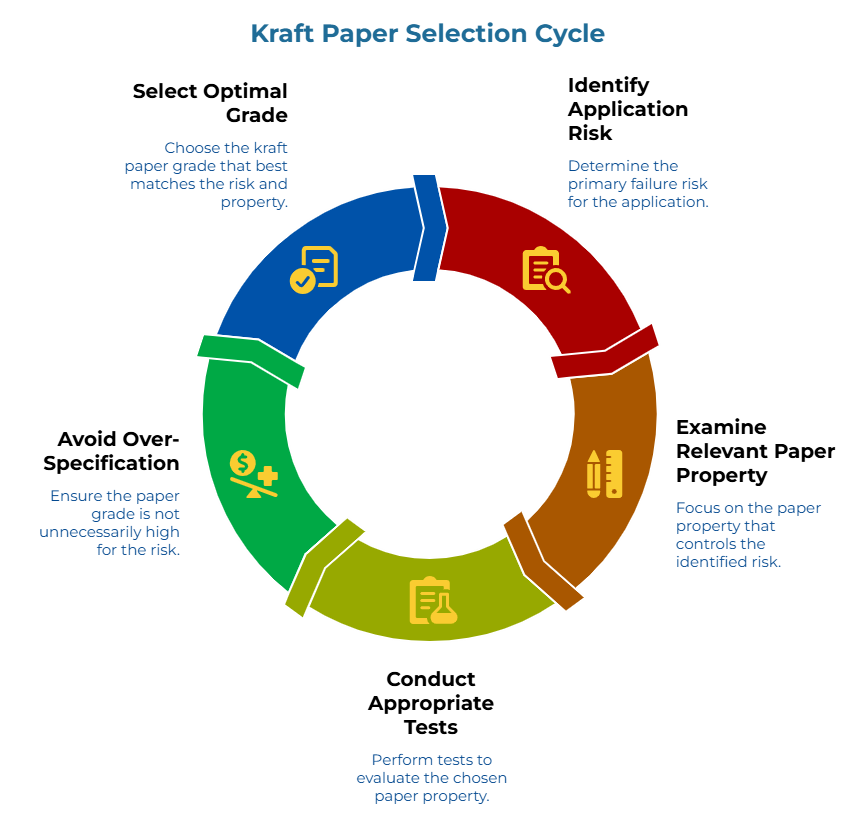
Right-specification kraft paper grade selection starts with one question: what is the actual failure risk? The answer points to the paper property that controls it. The table below maps six common application risks to the properties worth examining — and the over-specification traps to avoid.
| Application Risk | Paper Property to Examine | Why It Matters | Do Not Over-Specification By… |
| Product weight or pull force | Tensile strength, stretch, TEA, handle/load tests | Assesses resistance under pulling or carrying stress | Raising GSM without checking actual tensile performance |
| Tearing during filling, folding, or handling | Tear resistance (MD/CD direction) | Tear behavior differs by paper direction and converting process | Assuming “heavier” always means better tear behavior |
| Puncture or burst from product shape | Burst strength, puncture-style trial, product-contact testing | Critical for angular, dense, or shifting contents | Paying for high tensile when puncture is the real problem |
| Moisture exposure or damp storage | Cobb value, sizing, wet strength if needed | Water exposure can change mechanical performance | Specifying wet strength for dry storage and dry use |
| Machine runnability | Moisture, curl, caliper, stiffness, coefficient of friction, dust | A strong sheet that jams, curls, or dusts is not a good sheet | Treating strength specifications as the only quality measure |
| Print or brand appearance | Smoothness, shade, brightness, formation | Matters when paper is customer-facing | Buying premium surface for hidden wraps or liners |
ISO 536 specifies the test method for determining grammage — but grammage alone says nothing about whether the paper resists the failure mode the job faces. TAPPI T 494 covers tensile strength, stretch, tensile energy absorption, and tensile stiffness testing. ASTM International maintains broader paper and packaging standards for evaluating physical and mechanical properties.
For converters who want a deeper mapping of kraft paper properties to specific applications, the brown paper property–application match matrix provides a one-glance reference that translates directly into RFQ fields.
Quantifying Qualitative Customer Requirements
Customers often describe outcomes, not paper properties. “Strong kraft” may mean tensile strength for carrying, tear resistance during folding, burst resistance during filling, or puncture resistance from product corners. “Moisture resistant” may point to Cobb, sizing, storage conditions, or wet-strength requirements. “Premium look” may mean shade, brightness, smoothness, formation, or print surface consistency.
The converter’s job is to turn that language into testable requirements — not to argue against the customer’s concern.
Consultative technical alignment allows for objective grade determination. Identifying the failure mode (e.g., handle strength or moisture ingress) shifts the procurement focus to relevant metrics like load performance or Cobb values. If the concern is handle strength, we will test handle/load performance. If the concern is damp storage, we will review Cobb or wet-strength data. If the concern is appearance, we will check shade and surface requirements.
That moves the conversation from opinion to evidence. It also helps sales and estimating teams quote alternatives without sounding like they are simply pushing cheaper material. For RFQs and quoting, a specification-clarity-first framework explains why comparable technical requirements matter before price comparisons become meaningful.
High-Stakes Specifications: When to Hold
Hold the Spec
Some specifications exist for good reason and should not be relaxed without strong evidence. Hold the specification when the product is heavy, sharp, abrasive, oily, damp, or high-value. Hold it when the packaging must survive extended storage, rough transport, or repeated handling. Hold it when customer complaints carry significant commercial cost, when a regulated or contractual requirement governs the material, or when previous failures point to a specific paper property that must not be compromised.
A layered specification template that names test methods alongside tolerance ranges helps ensure these critical specifications are documented and enforceable rather than informal.
Challenge the Spec
Other specifications deserve scrutiny. Challenge the specification when the paper serves a short-life wrapping, dunnage, interleaving, or low-risk protective function. Challenge it when premium appearance is invisible to the end customer. Challenge it when wet-strength or barrier performance is specified for a dry-use application, when a legacy customer specification has not been reviewed in years, or when multiple strength properties are simultaneously maximized without a documented reason explaining which failure each one prevents.
Food-contact, medical, hazardous-material, export, and retailer-specific packaging requirements must be verified separately and independently. Cost reduction never overrides compliance.
Test the Spec
Between “hold” and “challenge” sits a third category: the plausible-but-uncertain grade change. The current grade works, a lighter or different grade looks viable on paper, but nobody has run it through production. That uncertainty does not justify staying with the old grade indefinitely — nor does it justify switching without evidence. A controlled trial resolves the question. When the decision is genuinely uncertain, the right move is not to hold or challenge but to test.
A Practical Right-Specification Checklist Before Changing Kraft Paper Grades
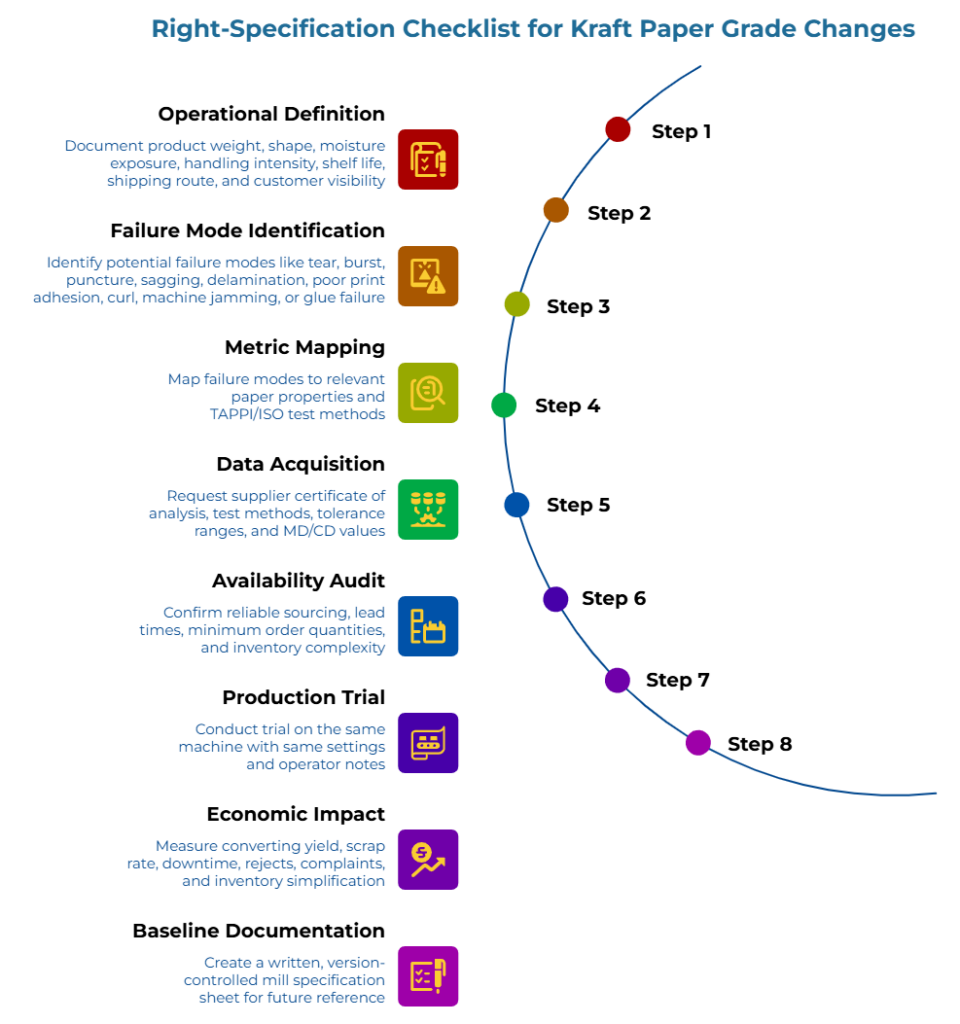
Switching grades without a structured process invites production failures and supplier disputes. The following eight-step workflow provides a defensible path whether the goal is cost reduction, inventory simplification, or supply continuity.
1. Operational Definition. Document product weight, shape, moisture exposure, handling intensity, shelf life, shipping route, and customer visibility. These variables determine which paper properties actually matter.
2. Failure Mode Identification. Tear, burst, puncture, sagging, delamination, poor print adhesion, curl, machine jamming, or glue failure — each one points to a different paper property. Without naming the failure, any grade change is guesswork.
3. Metric Mapping. GSM, caliper, tensile, TEA, tear, burst, Cobb, stiffness, porosity, coefficient of friction, moisture content, or surface finish. TAPPI’s paper property resources and independent testing facilities such as the University of Maine Process Development Center group common evaluation areas — from burst and tear to porosity, sizing, and printability — that help converters identify exactly which test matters for their job. For a ready-to-use table of which TAPPI and ISO test methods to require in a kraft paper RFQ, the plain-English reference maps 12 methods to acceptance clauses.
4. Data Acquisition. Request a supplier certificate of analysis, the test method used for each property, the tolerance range, and Machine and Cross Direction values where relevant. An RFQ built around named specifications produces comparable quotes. For guidance on what to demand before locking specifications, requesting COAs, machine conditions, and variation bands is a useful reference.
5. Availability Audit. A technically suitable grade is less useful if it creates long lead times, awkward minimum order quantities, or inventory complexity. Confirm that the grade can be sourced reliably before committing trial resources.
6. Production Trial. Same machine, same speed, same adhesive or ink system, same operator notes, same customer-use simulation. A documented supplier trial is the only defensible basis for a grade change — specification sheets alone are not enough.
7. Economic Impact. Measure converting yield, scrap rate, machine downtime, rejects, customer complaints, and any inventory simplification the change enables.
8. Baseline Documentation. Do not rely on informal “this one ran fine” memory. A written, version-controlled mill specification sheet becomes the baseline for all future orders and supplier evaluations.
That last step matters. “This one ran fine” is not a specification. It is a memory.
Practical Scenarios
Dry retail bag. A shop bag used indoors needs enough tensile and handle strength for carrying, but not automatically wet-strength paper — a distinction clarified in the guide on kraft paper grade selection for wrapping paper conversion. The right move is a handle-load trial run and customer-use simulation — not a jump to a heavier grade. Matching the property to the specific application prevents buying strength the bag will never need.
Protective wrap for non-fragile goods. When paper protects surfaces during short internal handling, premium brightness or high burst strength adds no value. Runnability, dust level, and sheet-to-sheet consistency matter more. If curl or moisture exposure is the real problem, the solution lies in conditioning and storage protocols — not a stronger grade.
E-commerce paper mailer. For shipping, the relevant risks are tear, puncture risk, seal integrity, and moisture exposure during transit — considerations mapped in detail in how to choose the right kraft paper grade for mailer manufacturing. Lab data plus transport simulation testing is more defensible than a generic “strong kraft” request. ISTA’s test procedures include simulation and screening tests designed to evaluate packaged-product performance against transport-related damage. For Cobb and surface properties specific to mailers, practical bands for Cobb value, printability, and adhesion provide test method-named tolerance ranges.
Common Mistakes, Objections, and Pitfalls
Treating GSM as a complete performance spec. GSM tells how much fiber sits in a square meter. It says nothing about whether that fiber resists the failure mode the job faces — a limitation examined in Beyond GSM: parent roll buying criteria that prevent breaks, waste, and downtime. GSM is a baseline, not proof of a fit-for-use specification.
Copying old customer specifications without review. Legacy specifications often carry forward requirements designed for a previous product, supplier, or converting line. Ask what risk the original requirement was meant to control.
Assuming virgin kraft is always commercially superior. Virgin fiber offers higher baseline strength, but recycled or blended grades may meet the job’s actual requirements at lower cost. Compare actual performance, converting behavior, visual requirements, sustainability claims, and customer risk before defaulting to virgin — a side-by-side evaluation using application-matched criteria keeps the decision grounded in evidence.
Focusing only on material price. A cheaper sheet that increases scrap rate, causes machine downtime, or generates customer complaints costs more than the grade it replaced. Evaluate yield, waste, downtime, rejects, storage costs, and supplier reliability alongside per-tonne price.
Grade Transitions Without Empirical Evidence: Paper specification sheets represent theoretical maximums/minimums under lab conditions; they do not account for the specific tensions and friction coefficients of a converter’s unique line.
Frequently Asked Questions
Is higher GSM always better for kraft paper converting?
No. Higher GSM means more material per unit area, but it does not automatically mean the paper performs better for the job. The right grade depends on the specific failure risk: tearing, bursting, moisture exposure, stiffness, printability, or runnability.
When should a converter pay for a stronger kraft paper grade?
When the added strength reduces a real, likely, and costly failure — heavy contents, rough handling, sharp product edges, high drop risk, repeated carrying, or proven complaints from lower-performing grades.
Can recycled kraft replace virgin kraft?
In many applications, yes — but the substitution should be trialed against the specific job. Performance metrics, surface aesthetics, and linting/dusting propensity must be weighted against machine runnability. Where recyclability is a requirement, AF&PA’s Design Guidance for Recyclability notes that coatings, barriers, adhesives, and wet-strength resins can affect whether paper-based packaging qualifies as recyclable.
Which specifications should buyers ask suppliers for?
Start with the properties tied to the job: grammage (basis weight), caliper, tensile, tear, burst, moisture content, Cobb value where water exposure matters, stiffness, porosity, coefficient of friction, surface finish, and tolerances. Always ask which test method was used, since different standards can produce different results for the same property.
How can a small business reduce kraft paper converting waste without increasing risk?
Use a controlled trial. Compare the current grade against a right-specification packaging material alternative on the same machine and job. Track runnability, scrap, rejects, handling performance, customer feedback, and total cost per finished unit.
Moving From “Safe” to Smart
Over-specification is an understandable instinct. But it carries its own risks: higher material costs, lower converting yield, unnecessary inventory, and margins that erode quietly across hundreds of jobs.
The U.S. EPA identifies source reduction — including lightweighting and reducing packaging material — as the highest-priority tier in sustainable materials management. Where sustainability certifications matter, FSC chain-of-custody verification confirms forest-based materials are tracked through the supply chain — but certification should complement application-level testing, not replace it.
Do not buy the strongest kraft paper by default. Buy the grade that passes the real job, on the real machine, under the real handling conditions — with documented evidence. What can fail? Which property controls that failure? What does the supplier data prove? What did the trial show? What should the approved specification sheet say? Those five questions separate right-specification procurement from hopeful purchasing.
Disclaimer:
This article is for educational and informational purposes only. It does not constitute technical, legal, or procurement advice. Material specifications, regulatory requirements, and testing standards should be verified independently with qualified professionals and relevant authorities before making purchasing or production decisions.
Our Editorial Process:
Our expert team uses AI tools to help organize and structure our initial drafts. Every piece is then extensively rewritten, fact-checked, and enriched with first-hand insights and experiences by expert humans on our Insights Team to ensure accuracy and clarity.
About the PaperIndex Insights Team:
The PaperIndex Insights Team is our dedicated engine for synthesizing complex topics into clear, helpful guides. While our content is thoroughly reviewed for clarity and accuracy, it is for informational purposes and should not replace professional advice.