
Assess suppliers systematically and make confident sourcing decisions.

How to Interpret Lab Test Reports for Kraft Paper: A Procurement-Friendly Guide
📌 Key Takeaways A kraft paper lab report isn’t paper science—it’s a procurement decision tool that determines whether a shipment moves forward, triggers corrective action, or gets rejected. Master these five principles and you transform reactive shipment checks into a disciplined procurement workflow that catches problems before they reach your ... Read More
Remote vs. On-site Supplier Audits for Kraft Paper: When Each Makes Sense
📌 Key Takeaways Choosing the right audit approach—remote, on-site, or hybrid—determines how quickly you gain confidence in a kraft paper supplier’s capability and compliance. Procurement managers, quality leads, and sourcing teams evaluating kraft paper suppliers will gain a structured framework here, preparing them for the detailed audit workflow and evidence ... Read More
Kraft Paper Supplier Audit & Compliance Program: A Practical Framework for Verifiable Supply
📌 Key Takeaways A reactive audit catches failures after they disrupt operations; a structured program prevents them before they reach your facility. Verified capability replaces reactive crisis management. Procurement managers, quality leads, compliance teams, and sourcing heads will find a complete program framework here, preparing them for the detailed implementation ... Read More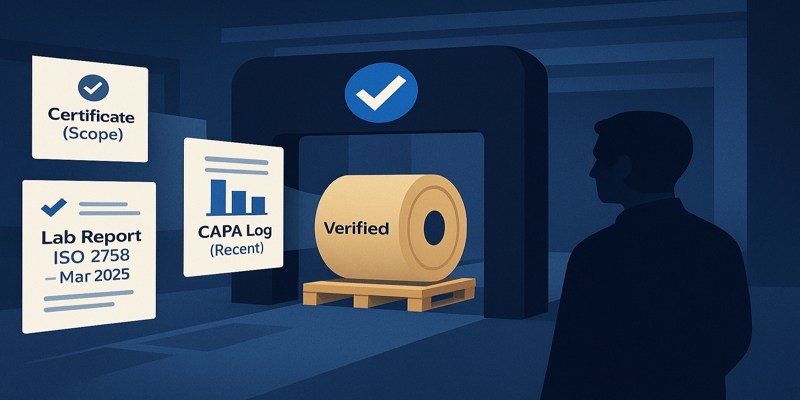
From Claims to Certificates: Why Verifiable Evidence Should Replace Supplier Promises in Kraft Paper Procurement
📌 Key Takeaways Supplier promises mean nothing until backed by verifiable proof—certificates, lab reports, and audit trails that withstand scrutiny. Evidence-first procurement eliminates the margin erosion that comes from emergency sourcing, inbound holds, and downstream claims when promises fail. Procurement and quality managers at packaging manufacturers will find a systematic ... Read More
Kraft Paper Manufacturer Certifications: FSC, ISO & Food-Contact – A Verification Guide for Buyers (and Evidence Playbook for Suppliers)
📌 Key Takeaways Certificate validity determines whether a kraft paper supplier makes your shortlist or gets filtered out—expired FSC certificates halt production, ISO scope mismatches trigger re-qualifications, and missing food-contact proof exposes brands to regulatory risk. Certificate integrity creates defensible proof that you can legally sell products made from that ... Read More
Kraft Paper Manufacturers vs Converters: Choose the Lower-Risk, Lower-Cost Partner
📌 Key Takeaways Choosing between manufacturers and converters isn’t about finding the cheapest quote—it’s about matching supplier capabilities to your demand profile, risk tolerance, and operational requirements. Evidence-based scorecards beat gut decisions every time. Procurement managers, supply chain directors, and operations teams sourcing kraft paper internationally will find the systematic ... Read More
Factory Audit for Kraft Paper Manufacturers: A Decision Checklist for Spec Consistency and Certification Integrity
📌 Key Takeaways Procurement decisions that start with price and end with audits create avoidable quality failures and supply disruptions. Audit before you negotiate, verify before you commit, and build your shortlist on evidence rather than sales presentations. Procurement and quality assurance professionals evaluating kraft paper mills will find this ... Read More
Integration Playbook: How Manufacturer Evidence + Exporter Reliability De-Risk International Kraft Paper Supply
📌 Key Takeaways Single-track vetting leaves half your risk unmanaged—mills prove capability, exporters prove execution, and you need verifiable evidence of both before signing contracts. Integration beats fragmentation—evidence-based evaluation filters out suppliers who cannot document their capabilities and creates reusable procurement infrastructure that raises supply base quality across award cycles. ... Read More
Kraft Paper Supplier Reliability Scorecard: Booking Lead Times, Lane Coverage & Documentation Accuracy Compared
Read More
Kraft Paper Manufacturers Capability Matrix: Compare GSM, BF/BST, Moisture Control, and Certifications Without Guesswork
Read More
Kraft Paper Manufacturers: An Evidence-First Capability Matrix for Consistent, Compliant Supply
📌 Key Takeaways Evidence eliminates guesswork from vendor selection when price alone can’t distinguish capable suppliers from those who’ll create costly problems months into a contract. For procurement managers and sourcing leads evaluating kraft paper manufacturers across quality systems, regulatory compliance, and supply chain reliability. Evidence-first decisions = defensible selections ... Read More