
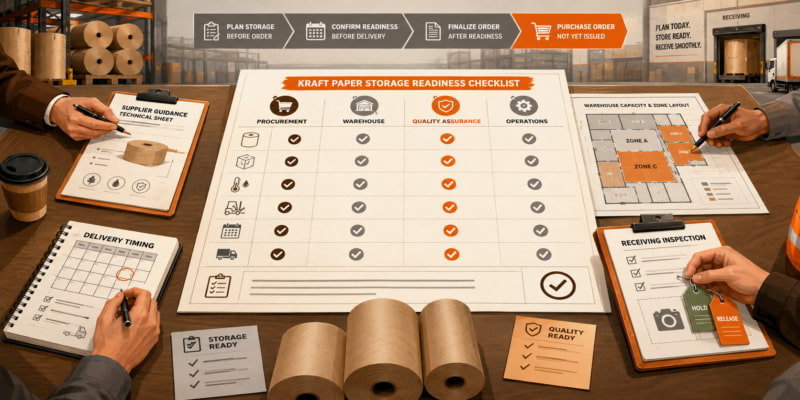
📌 Key Takeaways
Kraft paper storage problems start with the purchase order, not at the warehouse dock.
- Plan Storage Before You Buy: Check warehouse space, dock schedules, and environmental risks before confirming any order — not after the truck arrives.
- Share Supplier Guidance Early: Written storage instructions from suppliers must reach the warehouse and QA teams before delivery, not sit unread in procurement’s inbox.
- Define “Acceptable” Together: Procurement, warehouse, QA, and operations need shared definitions for when stock is acceptable, suspect, on hold, or ready for use.
- Document Damage Immediately: Photograph and record any packaging issues at receiving — without that evidence, no one can trace whether problems started with the supplier, shipper, or warehouse.
- Assign Ownership at Every Step: Each team should know exactly what it owns, what it confirms, and what it documents so nothing falls between the cracks.
Ask before ordering, document before receiving, and align before the handoff.
Procurement managers, warehouse supervisors, and QA leads coordinating kraft paper purchases will find a ready-to-use checklist and ownership framework here, preparing them for the detailed guide that follows.
~ ~ ~ ~ ~ ~ ~ ~ ~ ~ ~ ~ ~ ~ ~ ~ ~ ~
The purchase order appeared accurate on paper.
Rolls sitting on the dock in early-morning humidity, still wrapped but already exposed — because the dry storage bay was full when the truck arrived. Nobody checked warehouse capacity before the PO went out. The supplier’s storage documentation is still unread in someone’s inbox. Currently, procurement is fielding calls from the warehouse supervisor, who is pointing at damaged wrap with no photos, no hold procedure, and no clear answer for who dropped the ball.
Both sides feel exposed. Procurement worries about being blamed for buying material the facility cannot store. The warehouse team worries about being blamed for mishandling stock they were never consulted about receiving. Neither is wrong — and neither can fix the problem alone. This is a procurement handoff failure that initiates well before the delivery truck arrives. The following framework defines a cross-functional strategy for bridging the gap between purchasing and warehouse storage realities — covering what to ask, who owns each decision, and how to document the handoff so the next order does not repeat the same surprises.
Why Kraft Paper Storage Planning Should Start Before the Order Is Placed
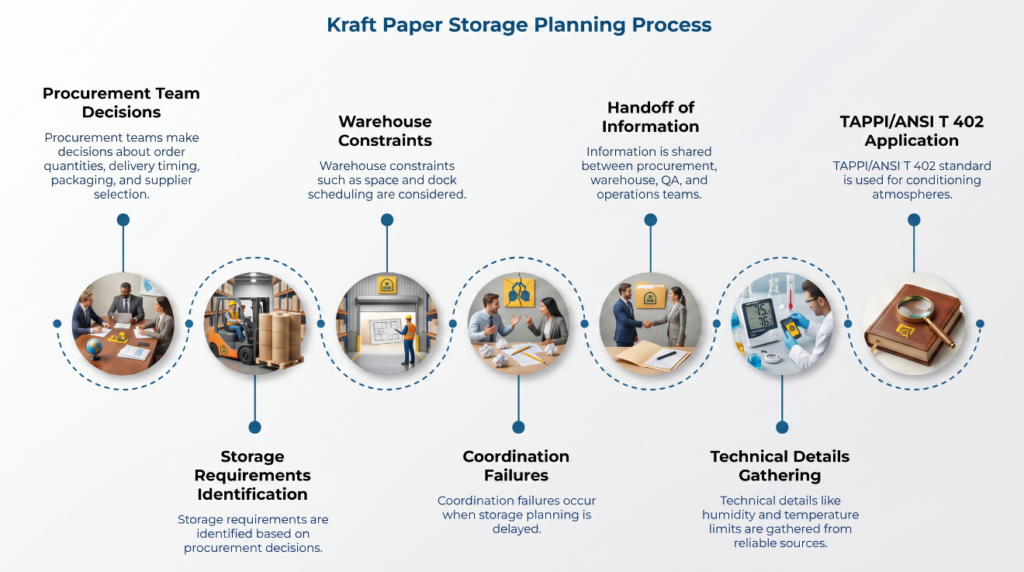
Kraft paper storage requirements — the combination of space, environmental conditions, handling expectations, receiving checks, and documentation needed to keep purchased rolls usable — are shaped by decisions made well before material reaches the warehouse floor. Order quantities, delivery timing, packaging specifications, and supplier selection all carry storage implications that procurement teams are best positioned to address.
When storage planning begins only after stock arrives, the warehouse inherits constraints it had no hand in setting. Available space may not match shipment size. Dock scheduling may conflict with delivery windows. Packaging conditions may not align with what the facility can protect against seasonal humidity or temperature swings. These are coordination failures, not warehouse failures; they affect inventory protection, production timing, and supplier conversations downstream.
Procurement usually sees supplier quotes, grade details, lead times, and order quantities. Warehouse teams see available space, traffic around the dock, storage-zone limitations, equipment availability, and practical movement paths. QA sees acceptance criteria and holds decisions. Operations sees when the material is actually needed. The handoff works only when those views are brought together early.
Exact humidity, temperature, shelf-life, and moisture limits should not be guessed. Those details should come from supplier technical documents, internal QA standards, facility engineering guidance, or applicable technical standards. TAPPI T 402 — a standard practice for preconditioning, conditioning, and testing atmospheres for paper and related products — provides useful context on conditioning atmospheres for paper products, though it describes testing conditions, not universal warehouse rules.
The Coordination Gap: What Procurement Knows vs. What Warehouse Teams Handle
Procurement typically works with supplier specs, pricing, lead times, and order quantities. Warehouse teams work with floor space, dock schedules, warehouse staging durations, handling equipment, and dock exposure risks. These views rarely overlap during the buying decision.
Hypothetical example: A procurement manager locks in a favorable price on a large order timed to a supplier’s production window. The warehouse was not consulted, and the only covered dry storage area is committed to another product for three weeks. Rolls arrive, sit near the dock in a storage risk zone — an area where environmental exposure or limited protection may compromise material condition — and by the time space opens, outer wrap on several pallets shows moisture damage. There is a QA hold, a supplier dispute, and no documentation of when the damage occurred — the kind of gap a structured kraft paper parent roll receiving controls checklist is designed to prevent.
A situation often seen across the industry: procurement and warehouse coordination needed to happen weeks earlier. What makes this gap persistent is that each function optimizes for different priorities — procurement for cost and lead time, warehouse for space and safety, QA for compliance, operations for production readiness. Without a shared framework, these priorities conflict. But the structure for resolving that conflict is more practical than most teams expect.
A Pre-Order Storage Checklist for Procurement and Warehouse Teams
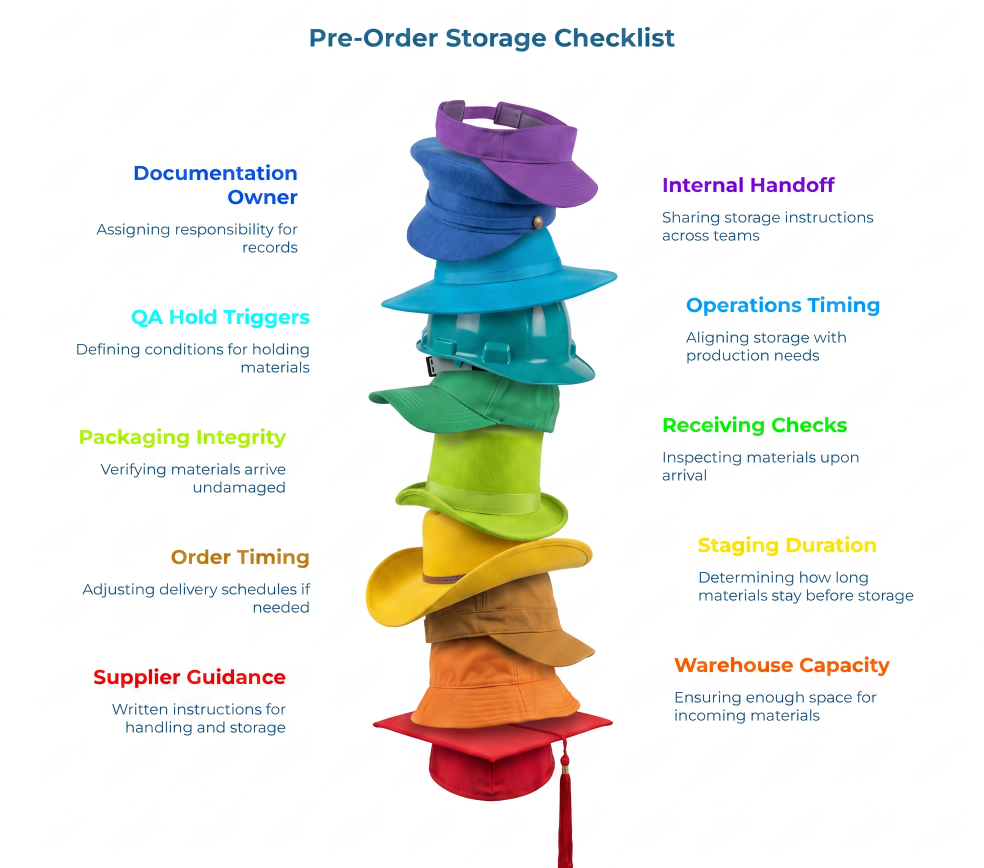
The checklist below gives teams a shared reference point before an order is confirmed. Adapt it to your facility, supplier relationships, and QA requirements.
- Supplier guidance: Request written storage, packaging, handling, receiving, and exception guidance — including a supplier technical datasheet — for the specific kraft paper grade or format. Supplier storage guidance refers to the written handling, packaging, environmental, and receiving recommendations a supplier provides.
- Warehouse capacity: Confirm whether clean, dry, suitable storage space is available for the expected quantity and delivery date. If storage is committed, does the delivery date need to shift?
- Order timing: Check whether delivery should be adjusted, split, or delayed if warehouse capacity or production timing does not support immediate storage.
- Staging duration: Identify whether the stock will move directly to storage or sit in temporary staging after receiving. Does the delivery window conflict with dock congestion, shift changes, or other receipts?
- Packaging integrity: Define expected arrival condition and documentation requirements for visible damage.
- Receiving checks: Define what receiving staff should inspect, photograph, record, and escalate. Receiving checks are the inspection and documentation steps performed at delivery to verify material condition, packaging, and documentation match expectations.
- QA hold triggers: Clarify when stock should be treated as acceptable, suspect, on hold, or ready for use. Teams should share definitions: “acceptable” means meeting documented criteria; “suspect” means a condition requires review; “hold” means material cannot be used until QA authorizes release; “ready for use” means all checks passed.
- Operations timing: Confirm when production or converting teams expect to use the material, especially if schedules may shift.
- Documentation owner: Assign responsibility for supplier guidance, receiving records, QA decisions, and warehouse exceptions. What documentation must exist before material moves from “received” to “accepted for use” — condition photos, storage placement confirmation, hold/release records, evidence supplier guidance was followed?
- Internal handoff: Store the final storage instructions where procurement, warehouse, QA, and operations can all access them.
If you plan to review kraft paper storage conditions before increasing order volume, start with this checklist.
What Procurement Should Ask the Warehouse Before Ordering
Procurement should involve warehouse and QA teams before committing to quantity and delivery timing. The discussion does not need to slow every purchase. It should focus on orders where volume, timing, storage duration, grade sensitivity, or supplier uncertainty creates practical risk.
Start with warehouse capacity. Ask whether the expected quantity can be stored in a clean, dry, suitable area. Ask whether the stock will be stored in its intended zone or placed in temporary staging. Ask whether dock congestion, seasonal conditions, or current inventory levels could affect receiving quality.
Then ask about timing. A shipment that looks efficient on a purchase plan can create problems if it arrives too early. If production is not ready to consume the material, storage duration increases. If production gets delayed after the shipment is received, temporary staging can quietly become longer-term storage.
Procurement should also ask what warehouse teams need from the supplier. That may include packaging expectations, roll or pallet labeling, delivery-document details, unloading coordination, and guidance on visible damage. These are operational questions, but procurement is often the team best placed to get answers before shipment.
Ask QA what conditions require review. Procurement does not need to define technical release rules. It does need to know when stock should not be treated as ready for use until QA has reviewed receiving notes, packaging condition, or possible exposure concerns.
The buying decision becomes stronger when it includes storage reality.
What Warehouse and QA Teams Should Confirm Before Receiving
The warehouse should confirm designated space is available, clean, dry, and accessible. If material will spend time near a dock door, the team should understand how long that exposure lasts and whether the storage environment introduces risk given the grade’s sensitivity. A location suitable for a short hold may not be appropriate for longer storage if production timing changes.
The receiving team needs clear receiving inspection criteria — the kraft paper receiving checks that determine what triggers a hold versus acceptance. Without shared definitions, one person accepts stock another would flag — a recurring pattern where QA, warehouse, and procurement operate with different unspoken definitions of “acceptable material.”
Teams should align on shared status definitions:
| Status | Practical meaning | Typical next action |
| Acceptable | No visible receiving concern has been identified under the defined checks. | Move to approved storage or normal receiving flow. |
| Suspect | A visible concern exists, but QA has not decided whether it affects use. | Document the concern and escalate for review. |
| On hold | Material is restricted from normal use pending QA decision. | Keep separated or controlled according to internal procedure. |
| Ready for use | Material has passed required receiving and QA checks for release. | Move into normal production or consumption planning. |
These are general definitions. Each facility should adapt them to its own QA procedure.
Hypothetical example: Kraft paper rolls arrive with visible wrap tears on two pallets. The receiving operator is unsure whether to accept, hold, or reject. No photos are taken. Two weeks later, moisture issues surface at production, but there is no documentation of the original condition. Had the team followed a documented hold procedure — photograph damage, record condition, escalate to QA — the root cause would be traceable.
QA must confirm hold and release procedures before delivery: identify who authorizes a hold, what evidence is required, how long material can remain in hold, and who the escalation path leads to when a situation falls between teams. A practical receiving controls checklist supports this process.
For handling involving powered equipment or heavy rolls, defer to facility safety procedures and qualified personnel. National safety regulators identify specific warehousing hazards; for example, the US OSHA regulates materials handling and storage (29 CFR 1910.176) and powered industrial trucks (29 CFR 1910.178), while also providing guidelines on ergonomics, slips, trips, and falls — a reminder that storage coordination should not become informal equipment or handling instruction.
How to Assign Ownership Across Procurement, Warehouse, QA, and Operations
| Team | Owns | Should Confirm | Should Document |
| Procurement | Supplier questions, storage guidance requests, order timing, and purchase planning. | Supplier guidance, packaging expectations, delivery timing, order quantity implications, and whether warehouse or QA input is needed before ordering. | Supplier guidance received, open supplier questions, storage-related RFQ requirements, delivery commitments, packaging specs, and agreed handoff points. |
| Warehouse | Storage execution, staging, space allocation, receiving logistics, and practical handling constraints. | Clean and dry storage availability, temporary staging duration, packaging condition on arrival, dock schedule, movement path, exposure risk, and facility procedure fit. | Receiving observations, condition photos, staging location, time in staging, storage exceptions, visible wrap concerns, and escalation evidence. |
| QA | Acceptance criteria, hold/release decisions, escalation triggers, and quality documentation standards. | Inspection criteria aligned with supplier guidance; what makes stock acceptable, suspect, on hold, or ready for use; hold area designated. | Hold decisions, release authorizations, inspection notes, exception evidence, and internal QA procedure references. |
| Operations | Production timing, material readiness, usability feedback, and consumption priorities. | Schedule communicated to warehouse and procurement; when stock is needed; whether schedule changes affect staging, storage duration, or release priorities. | Usage timeline, usability issues, condition at point of use, readiness concerns, timing changes, and communication that affects storage planning. |
No single team owns the entire problem. When production schedules change, that information must flow back to warehouse and procurement — a delayed production date extends storage duration and may change the risk profile. The routine is strongest when each team knows both its own role and its handoff point.
Common Mistakes That Create Storage Surprises
Treating storage as a warehouse-only issue. Procurement controls the upstream decisions — supplier guidance, order volume, delivery timing, receiving expectations — that determine what warehouse must accommodate. Storage requirements are a procurement planning input, not a warehouse afterthought.
Assuming all grades share the same requirements. Paper roll storage requirements vary by grade, supplier, packaging, duration, and facility. Do not apply one storage assumption to every kraft paper order. See how to protect rolls from warehouse moisture and temperature risks.
Waiting until receiving to ask storage questions. Receiving is too late for questions affecting order quantity, timing, and space planning. Ask storage, packaging, handling, and QA questions before shipment.
Treating temporary staging as harmless. Define how long temporary staging is acceptable and who owns the next move. A production delay can turn a short staging plan into a longer storage exposure that no one planned for.
Not documenting damaged wrap. Without photos and records, teams cannot determine whether issues originated with the supplier, freight, or internal handling — a gap that undermines any kraft paper parent roll receiving controls process.
Relying on verbal supplier guidance. A phone call about kraft paper moisture protection is worth less than written documentation shared with the receiving team.
Using technical standards as warehouse rules without context. Standards like TAPPI T 402 inform testing atmospheres — applying them as facility requirements without validation creates false confidence. Use standards and supplier documents to inform decisions, but confirm facility-specific requirements with QA, engineering, or qualified personnel.
How to Respond to Common Internal Objections
Some teams may say supplier specifications are too technical for procurement. That concern is fair. Procurement does not need to interpret every technical detail. It needs to collect the right documents, ask clarifying questions, and bring QA or warehouse teams into the review when guidance affects storage or release decisions.
Another common objection is that the facility has always stored paper the same way. Past practice has value, but it should not replace supplier guidance or QA review. A familiar routine may still need adjustment when order volume, storage duration, packaging format, delivery timing, or grade changes.
A third objection is time. Teams may worry that another approval step will slow procurement. This is not an approval layer — it is a communication step. One alignment conversation before the PO replaces weeks of reactive troubleshooting after delivery. The better approach is to add a short storage-readiness check for orders where volume, timing, or risk justifies it.
Teams that need deeper preparation can pair this process with related resources on kraft paper storage conditions before increasing order volume, packaging, delivery, and warehouse questions before kraft paper jumbo rolls arrive, and kraft paper parent roll receiving controls.
What Procurement Should Ask Suppliers Before Stock Arrives
Before finalizing an order, ask the supplier to confirm in writing: recommended storage conditions for the grade, packaging specifications for transit and staging, handling cautions, whether acclimation is needed, and what to do if packaging is damaged on arrival. A broad question such as “How should this be stored?” may produce a vague answer. A better question is: “What storage, packaging, handling, receiving, and exception guidance should our warehouse and QA teams follow for this kraft paper grade and delivery format?”
Hypothetical example: A procurement team receives a PDF specifying that rolls should be stored away from exterior walls and moved to covered storage within a defined window. Three weeks later, the shipment arrives — but the receiving team has never seen the document. Rolls are staged near a dock door for an extended period. The information existed; it simply did not travel from procurement to warehouse.
The fix is procedural: whatever the supplier provides must reach the warehouse and QA before delivery. Without kraft paper supplier storage guidance reaching the receiving team, a storage PDF in procurement’s email does not protect purchased inventory value — a risk explored further in how storage conditions affect kraft paper shelf life. Procurement should move supplier guidance into the internal handoff record, RFQ file, purchase record, receiving checklist, or shared storage instruction. Related procurement documentation can also be aligned with broader sourcing documents such as a kraft paper RFQ template when supplier conversations require more structure.
For bulk orders, explore shelf-life questions to ask before buying in larger quantities and packaging, delivery, and warehouse questions to ask before rolls arrive.
Next Step: Turn Storage Requirements Into a Repeatable Buying Routine
Before your next kraft paper order, gather the relevant teams for a brief alignment session. Review the checklist. Confirm supplier guidance is shared. Verify warehouse capacity. Agree on receiving criteria and QA triggers. Document who owns what.
When this becomes routine, supplier conversations sharpen because procurement arrives with specific questions. Warehouse teams receive stock they are prepared to handle. QA holds clear owners. And operations can plan production around material confirmed ready for use — not stock sitting in an unresolved hold.
For broader sourcing work, buyers can use the B2B industry directory — PaperIndex — to find kraft paper suppliers, review kraft paper parent roll listings, or monitor kraft paper buyer RFQs. Keep the commercial step separate from the storage-readiness step — the supplier conversation is stronger when internal requirements are already clear.
Frequently Asked Questions
Who should define kraft paper storage requirements — procurement or warehouse?
Shared ownership. Procurement gathers supplier requirements and buying context. Warehouse confirms operational feasibility. QA defines acceptance, hold, and release criteria. Operations confirms usage timing. No single team holds the full picture.
Should procurement ask suppliers for storage guidance before ordering?
Yes. Request written handling, packaging, storage, receiving, and exception guidance before stock ships. Specific technical instructions should come from supplier documentation, internal QA standards, or qualified facility guidance. For detail, see how humidity and moisture can affect kraft paper shelf life.
Do kraft paper storage requirements include climate control?
Not necessarily. Whether climate control is needed depends on grade, supplier recommendations, storage duration, packaging format, and facility conditions. ‘We do not have climate-controlled space’ does not mean kraft paper moisture protection is impossible — start with supplier guidance, storage risk zone awareness, exposure reduction, and documented QA procedures. Avoid assuming climate control is either required or irrelevant without technical review.
What should teams do if kraft paper arrives with damaged packaging?
Document immediately. Photograph damage, note location and extent, follow QA hold procedures. Stock with damaged packaging, suspected moisture exposure, or unclear storage history should not be treated as unaffected inventory without review. For a detailed workflow, see the kraft paper parent roll receiving controls checklist.
Closing Thought
A kraft paper order should not become a storage problem at the receiving dock. By then, the best planning window has already passed.
The better routine starts earlier. Procurement asks the supplier and warehouse the right questions. Warehouse confirms storage reality. QA defines the release path. Operations share timing changes before short-term staging becomes long-term uncertainty.
Good storage coordination is not a guarantee against every problem. It is a practical way to reduce avoidable surprises and make supplier conversations clearer.
Ask before ordering. Document before receiving. Align before the handoff.
Disclaimer:
This article provides general educational guidance. Storage, handling, receiving, QA, and safety requirements should be confirmed against supplier documentation, internal QA procedures, facility safety rules, and applicable regulations.
Our Editorial Process:
Our expert team uses AI tools to help organize and structure our initial drafts. Every piece is then extensively rewritten, fact-checked, and enriched with first-hand insights and experiences by expert humans on our Insights Team to ensure accuracy and clarity.
About the PaperIndex Insights Team:
The PaperIndex Insights Team is our dedicated engine for synthesizing complex topics into clear, helpful guides. While our content is thoroughly reviewed for clarity and accuracy, it is for informational purposes and should not replace professional advice.