
📌 Key Takeaways
Stored kraft paper doesn’t expire on a schedule — it needs inspection when storage conditions, damage, or missing records create doubt about whether it will run properly on the packaging line.
- Age Alone Isn’t the Risk: Paper stored for months can be fine if wrapping is intact and storage was clean — newer stock with torn wrap or unknown handling may need checking first.
- Inspect Before the Line Decides for You: A 15-minute check before release is faster than a four-hour production stoppage caused by material that should have been caught earlier.
- Not Every Flag Means Rejection: Most findings fall between “perfectly fine” and “scrap” — options include partial holds, QC review, testing, or supplier contact depending on what you find.
- Moisture Is the Hidden Troublemaker: Kraft paper absorbs moisture from its surroundings, so a roll that arrived within spec can drift outside it if the warehouse was humid, the wrap tore, or the pallet sat near a loading dock.
- Document Before You Escalate: Photos, lot numbers, storage notes, and production symptoms give suppliers enough to assess the issue — and give procurement a defensible record if the conversation turns to credits or replacements.
Inspect early, document everything, and let the evidence, not the pressure, drive the release decision.
Procurement professionals and warehouse teams managing aged or exposed kraft paper inventory will gain a clear decision framework here, preparing them for the detailed inspection and escalation guidance that follows.
~ ~ ~ ~ ~ ~ ~ ~ ~ ~ ~ ~ ~ ~ ~ ~ ~ ~
The pallet hasn’t moved in weeks.
Dust lines the top edge of the wrapping, and a corner of the outer layer is torn — likely from the last time a forklift shuffled it aside to reach newer stock. Production needs material by Thursday. The replacement shipment will not arrive until next week. Someone has to make a call: does this stock go to the packaging line, or does it need a closer look first?
You know the pressure. Releasing questionable material can mean jams on the converting line, inconsistent fold quality, or packaging that fails in transit. Holding perfectly usable stock wastes capacity and may force an emergency reorder. The core issue is uncertainty, which inevitably manifests as unplanned downtime or line inefficiency.
What follows is a practical way to decide when stored kraft paper warrants inspection, what to look for, and how to act on what you find.
Stored Kraft Paper Should Be Inspected When Age, Exposure, or Uncertain History Could Affect Packaging Use
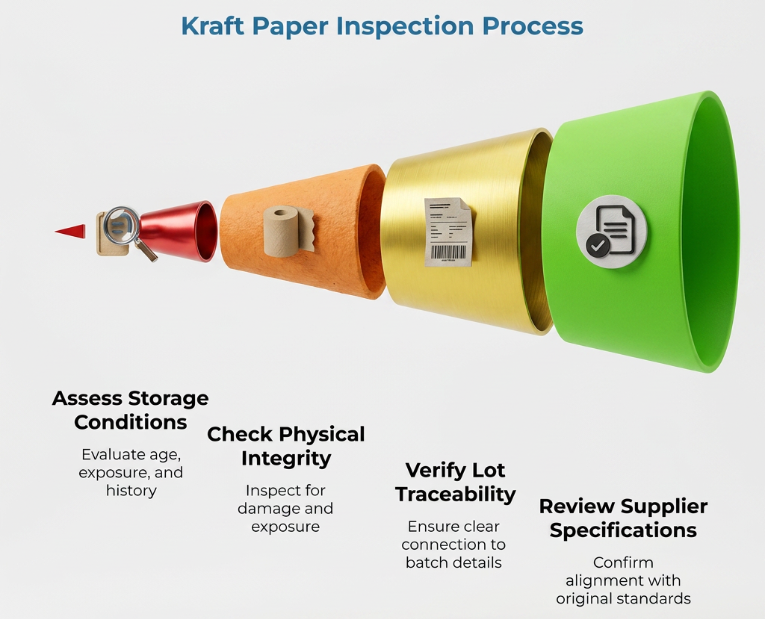
Stored kraft paper does not automatically become unusable over time. Its fitness for packaging depends on the conditions it experienced between delivery and production, not only on the specifications printed on the original certificate of analysis.
A common mistake is treating calendar age as the whole decision. A better question is: what has happened to this stock since delivery, and what will it be used for now? Kraft paper stored for a longer period may remain usable if it has clear lot traceability, intact wrapping, appropriate storage history, and no visible concerns. A newer roll may need inspection if the wrapping is torn, the edges are exposed, the pallet was stored in a dirty handling area, or the stock identity is unclear.
Pre-use inspection is a stock-readiness step, not a panic response. It is warranted when storage duration, environmental exposure, physical damage, or end-use sensitivity introduces enough uncertainty that releasing material without a second look carries avoidable risk. The goal is not to reject more stock. It is to catch problems before they reach the packaging line, where the cost of failure multiplies.
A few definitions help keep these conversations precise across procurement, warehouse, and quality teams. A pre-use inspection means checking stored material before it is released into packaging production. Stock readiness means the material is identified, available, physically suitable, and acceptable for the intended packaging use. A material hold means the stock is paused from normal release until the concern is reviewed. Lot traceability means the team can connect the material to its batch, roll, delivery, supplier, and purchase order details. A supplier specification is the technical or commercial document that defines what the material is expected to meet.
Those definitions matter because the inspection decision is rarely just “use or reject.” Most real decisions sit in the middle.
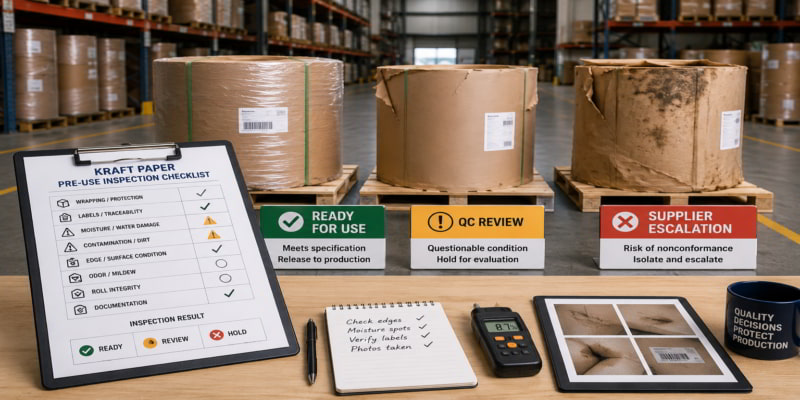
Quick Inspection Trigger Checklist for Procurement Teams
Use this checklist when stored kraft paper is about to move into packaging use after extended storage, relocation, damaged wrapping, uncertain handling, or previous quality concerns. Any item flagged should trigger closer review — not automatic rejection.
| Trigger Area | What to Look For | Practical Action |
| Storage history | Unknown storage duration, poor stock rotation, missing receiving date, relocated pallet | Trigger inspection before release |
| Lot identity | Mixed lots, partial pallets, missing labels, unclear batch or roll reference | Separate stock and verify traceability |
| Wrapping condition | Torn wrap, loose covering, exposed roll edges, damaged cores, opened partial pallet | Inspect affected areas and document with photos |
| Physical condition | Crushed edges, bent sheets, distorted rolls, broken pallets, deformation | Hold affected stock if usability is uncertain |
| Moisture indicators | Water marks, staining, waviness, tackiness, unusual odor, mould-like appearance | Isolate and escalate to QC |
| Storage exposure | Material stored near moisture sources, loading dock doors, areas with variable temperature, chemical odors, heavy dust, or sunlight | Review storage history and intended use |
| Environmental events | Storage area experienced a known event — roof leak, HVAC failure, flooding, or prolonged heat exposure | Trigger inspection; document the event |
| Pest or contamination concern | Pest evidence, dirt, foreign matter, odor transfer, stained outer layers | Hold and involve QC before release |
| Handling damage | Pallet damage, broken banding, evidence of rough handling, material moved multiple times or staged in temporary locations | Inspect affected area and document |
| Production feedback | Unusual tearing, inconsistent feeding, jamming, or folding irregularities not present in previous runs using the same grade | Stop similar stock from release until reviewed |
| End-use sensitivity | Critical or specification-sensitive packaging application, customer-facing use, previous quality complaint, regulated use | Require QC approval before production |
| Stock pressure | Replacement delay, insufficient usable quantity, emergency reorder risk | Inspect early and begin reorder planning if needed |
| Documentation gaps | Supplier specification sheet or certificate of analysis is missing or incomplete; storage history cannot be reconstructed | Verify what is available before releasing |
If none of these triggers apply, the stock is likely ready for release. If one or more apply, read on.
Why Stored Kraft Paper Can Become a Pre-Production Risk
Kraft paper is hygroscopic — it absorbs and releases moisture in response to the surrounding environment. A roll that arrived within specification can shift outside acceptable parameters if warehouse humidity, temperature, or handling conditions changed during storage. This is not a defect; it is cellulose fibre responding to its environment — the reason standards such as ISO 187 specify conditioning and testing atmospheres for pulp, paper, and board.
The risk extends beyond moisture. Prolonged storage can also allow dust accumulation, surface contamination, mechanical deformation from stacking weight, and slow degradation of wrapping integrity. A roll can look visually acceptable on the outside while carrying enough internal moisture variation or edge damage to cause feeding problems, folding inconsistencies, or print adhesion failures during converting. For a deeper look at how warehouse conditions influence material usability over time, see how storage conditions affect kraft paper shelf life.
The operational risk is straightforward. Procurement may see stored stock as available inventory. Production sees it as incoming material. QC sees it as a release decision. If those views are not aligned, the packaging line becomes the place where the uncertainty is discovered — and that is the expensive place to discover it.
Releasing uninspected material can lead to unplanned downtime, wasted material, and defective packaging reaching the customer. Holding perfectly usable material wastes capacity and triggers unnecessary reorders. The right response depends on the grade, the application, the storage history, and the internal quality requirements.
Practical Signs That Stored Kraft Paper Should Be Checked Before Release
Visible Damage
Tears in the outer wrapping, crushed roll ends, dented sheet edges, or broken banding are the most obvious flags. Outer wrapping protects the paper from environmental contact. Once that barrier is compromised, the material underneath may have absorbed moisture, collected dust, or been exposed to light — even if the surface looks fine. A forklift clips a pallet during repositioning, the wrapping tears along one side, nobody documents it, and two weeks later that roll reaches production with edge waviness nobody expected.
A roll with a crushed edge does not always need full rejection. The affected area may be limited. The correct first action is to inspect, photograph, and decide whether the damage is cosmetic, localized, or likely to affect feeding, folding, converting, or appearance. Damaged wrapping should trigger closer inspection and documentation before release, not immediate disposal. For a practical response framework, see warning signs kraft paper may have lost durability during storage.
Moisture or Contamination Indicators
Waviness, curling, or a limp feel to the sheet surface can signal moisture absorption. Water marks, staining, tackiness, or a musty odor are stronger indicators. If the paper smells like the warehouse rather than fresh pulp, something has migrated into the material. Moisture-affected kraft paper can cause feeding problems on converting equipment, poor fold quality, inconsistent glue adhesion, and print defects — problems that compound once the paper enters the packaging line. For procurement teams managing warehouse environments where these risks originate, understanding how humidity and moisture affect kraft paper shelf life in storage can help prevent the issue at its source.
Moisture concern should be treated more carefully than ordinary cosmetic damage. When the stock will be used in packaging where appearance, strength, consistency, cleanliness, or customer acceptance matters, isolation and QC review should happen before production use — not after.
Handling and Storage Concerns
A pallet moved multiple times across a warehouse floor may have accumulated handling damage not visible on the top sheet. Broken stretch wrap, tilted stacks, or a pallet that spent days on the loading dock before being relocated are signals worth checking. Poor covering, dirty handling areas, heavy dust, chemical odor exposure, sunlight, and damp floors can all weaken confidence in stock readiness.
Partial pallets deserve special care. The outer wrap may already be opened. The remaining quantity may no longer match the original batch documentation, making roll-level receiving controls essential before release. The label may have been removed or damaged. That creates a traceability problem before it becomes a production problem.
Mixed lots present a separate concern. Rolls from different suppliers, batches, or grades consolidated onto one pallet may not share the same storage history or specification tolerance. Separating and verifying identity before release prevents confusion from reaching the packaging line.
Production-Readiness Signals
Sometimes the first indication of a problem comes from the production floor itself. Unusual tearing, inconsistent feeding, jamming, or folding irregularities that were not present in previous runs using the same grade — these downstream signals suggest something changed in the material. Issues like these should trigger a hold on remaining stock from the same batch and a conversation between procurement, warehouse, and quality control.
The issue may not affect every roll or pallet. It may be limited to one damaged portion. Releasing more material from the same lot or storage condition without review can repeat the same disruption.
How to Decide: Use, Hold, Test, Escalate, or Reorder
Not every inspection finding calls for the same response. The decision depends on what was found and what the material is intended for.
| Condition Found | Recommended Action | Who to Involve | Documentation Needed |
| Clear identity, intact wrapping, no visible concern | Inspect and release if internal requirements are met | Procurement or stock control, warehouse | Lot details, inspection note |
| Older stock with good traceability and intact condition | Review storage history before release | Procurement, warehouse | Receiving date, storage location, lot reference |
| Minor cosmetic damage; wrapping intact; no moisture signs | Document condition and release with an inspection note | Procurement, warehouse | Photos, lot number, inspection date |
| Torn wrapping; uncertain exposure; no visible paper damage | Hold and inspect exposed area closely before release | Procurement, QC | Photos, exposure assessment, lot details |
| Mixed lots or partial pallets without clear identification | Separate and verify identity before release | Procurement, warehouse | Batch, roll, PO, supplier reference |
| Visible moisture signs — waviness, staining, odor, tackiness | Isolate from production-ready stock and escalate | QC, procurement, supplier | Full photo documentation, storage history, environmental incident records |
| Deformation, crushed edges, or structural compromise | Isolate and assess usability for the intended application | QC, production, procurement | Damage photos, handling history, end-use requirements |
| Previous quality complaint or production symptom tied to this batch | Hold related stock before further use | QC, production, procurement | Operator notes, symptom description, lot match, prior complaint records |
| Specification-sensitive end use or customer-facing application | Require QC approval before any release | QC (lead), procurement, production | QC test results, intended use, specification reference, approval record |
| Possible reconditioning question | Do not assume recovery; seek QC or supplier guidance | QC, supplier, procurement | Condition record, recommendation received |
| Insufficient usable stock after inspection | Begin replacement planning and supplier contact | Procurement, production planning, supplier | Quantity shortfall, production schedule impact, PO and specification reference |
The most important shift is to avoid a two-option mindset. Stored kraft paper does not have to be either “fine” or “scrap.” It may be usable after inspection. It may need a partial hold. It may require testing. It may justify supplier escalation. It may need replacement planning while QC completes the review.
The argument that “inspection slows production” misses the larger picture. A 15-minute documented check is faster than a four-hour line stoppage caused by material that should not have been released. If there is any doubt about performance in the intended application, involve the quality team before releasing. Confirm against supplier specifications and internal quality standards — the right decision depends on grade, end use, and storage conditions.
What to Do When QC Is Not Immediately Available
Limited QC availability is a real constraint. It does not remove the need for control.
If QC cannot review the stock immediately, procurement and warehouse teams should separate clearly acceptable stock from questionable stock. Material with unresolved moisture, contamination, identity, deformation, or critical-use concerns should remain on hold until the proper review can happen.
If internal rules allow production to use unaffected stock, release only the portion with clear identity, intact condition, and acceptable storage history. Do not use questionable material simply because testing capacity is limited.
A short hold can feel inconvenient. A preventable production failure costs more attention later.
What Procurement Should Document Before Supplier Escalation
When inspection findings suggest a material quality issue, documentation is needed before contacting the supplier. A well-documented escalation protects your position and speeds resolution.
- Lot or batch number from the label or delivery paperwork
- Delivery date and original purchase order reference
- Storage location and conditions since receipt, including any known environmental events
- Photos of the outer wrapping, pallet condition, affected roll or sheet edges, and any visible damage or contamination on the paper surface
- Quantity affected — number of rolls, sheets, or pallets involved
- Production symptoms, if any — feeding issues, converting defects, or quality complaints tied to this batch
- Internal inspection or QC notes summarising findings and the decision to hold or isolate
- Supplier specification sheet or certificate of analysis, if available, for comparison against observed condition (for guidance on what to look for in specification documents, see supplier specification details that help buyers evaluate kraft paper durability)
This documentation does not guarantee replacement or supplier liability. Supplier remedies depend on purchase terms, supplier policy, delivery condition, storage history, and the evidence available. Keep the first escalation factual and operational — it gives the supplier enough information to assess the issue and gives the procurement team a defensible record if the conversation moves toward replacement or credit.
When Visual Inspection Is Not Enough
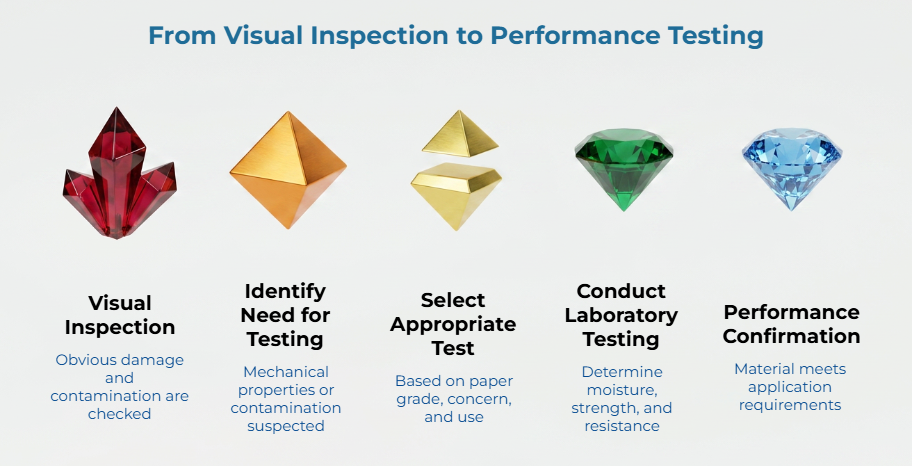
Visual checks catch obvious damage, contamination, and handling problems — but they have clear limits.
Moisture content, tensile strength, and burst resistance are not visible to the eye. When the question shifts from “does it look acceptable?” to “will it perform?”, the answer requires testing. QC involvement or laboratory testing may be needed when the material’s mechanical properties are critical to the packaging application, when contamination is suspected but not visually confirmed, when a supplier dispute requires objective and measurable evidence, or when previous visual-only approvals led to downstream production failures.
Industry standards published by organizations such as ASTM for paper and packaging materials can help QC teams identify appropriate evaluation methods. If tensile performance is part of the concern, TAPPI T 494 describes a procedure for determining tensile strength, stretch, tensile energy absorption, and tensile stiffness of paper and paperboard using constant-rate-of-elongation equipment. ASTM D828-22 also addresses tensile properties using constant-rate-of-elongation apparatus. The right test depends on the paper grade, the type of concern, and the intended use — there is no single universal method. Procurement should not prescribe a test method without QC, supplier, or technical review.
Regulated packaging applications — food-contact, pharmaceutical, or hazardous-goods — involve compliance requirements beyond standard material inspection. Do not rely on visual inspection alone for compliance-sensitive applications. Confirm suitability through qualified review, supplier documentation, and the applicable internal or regulatory requirements.
When Procurement Should Reorder Instead of Waiting
Reorder planning should start when the usable quantity is uncertain and production demand is real.
Not every questionable pallet requires replacement. But procurement should calculate the confirmed usable quantity, the quantity on hold, the quantity under review, and the lead time for replacement stock — considerations that are especially important when teams are weighing whether to increase order volume to build a safety buffer. That gives production planning a clearer picture before the packaging line runs short.
A practical reorder decision often depends on three questions. How much stock can be released with confidence? How much stock is on hold pending QC or supplier review? How long will replacement material take to arrive? If the answers create a supply gap, start replacement planning early. Waiting for final rejection may leave too little time to protect production continuity.
When procurement needs market visibility for replacement sourcing, supplier-discovery resources can help, including kraft paper jumbo roll suppliers, kraft paper factories, and packaging paper suppliers. For broader educational resources on kraft paper procurement, see PaperIndex Academy.
From Uncertain Stock to a Documented Release Decision
The pallet from the opening scenario does not have to become a crisis on Thursday morning.
Stored kraft paper is not inherently risky. But stored kraft paper with torn wrapping, uncertain exposure history, or no inspection record is a gamble — and the stakes multiply once it reaches the converting line. The inspection takes minutes. The production disruption it prevents can cost days.
Before releasing aged or exposed stock, use a documented pre-use inspection checklist. Confirm uncertain material with the quality team, supplier specifications, and internal quality standards before it reaches production. Inspect before doubt becomes disruption. Document before escalation becomes dispute. Release only when the decision is defensible.
Frequently Asked Questions
Does stored kraft paper always need inspection before use?
No. Inspection is most important when age, exposure, damage, uncertain storage history, unclear identity, previous production issues, or a specification-sensitive end use creates doubt about stock readiness. Stock received recently with intact wrapping, proper storage, and clear documentation can typically move to production without additional review.
Is visual inspection enough to approve stored kraft paper for production?
Visual inspection is a useful first screening step for obvious damage and handling concerns. When material performance, moisture content, specification compliance, or traceability is in question, QC review or laboratory testing may be needed.
Should kraft paper be discarded if the outer wrapping is damaged?
Not automatically. Damaged wrapping should trigger closer inspection of the affected material, documentation of the condition, and a possible QC hold — but not immediate disposal. The paper underneath may be perfectly usable if exposure was limited and the end use does not require pristine condition. Inspect, document, and decide based on what you find.
Can questionable kraft paper be reconditioned?
Possibly, but only with proper guidance. Procurement should not assume that exposed, moisture-affected, stained, or deformed kraft paper can be restored for packaging use. QC or supplier guidance should decide whether reconditioning is acceptable for the grade and end use.
What if the kraft paper is for food-contact or regulated packaging?
Treat the release decision more cautiously. Do not rely on general visual inspection for food-contact, medical, pharmaceutical, hazardous-goods, or other regulated applications. Confirm suitability against supplier documentation, internal quality standards, and applicable regulatory requirements.
When should procurement involve the supplier?
Involve the supplier when inspection findings suggest a quality issue tied to delivery condition, wrapping integrity, specification drift, or when the quantity affected is significant. If the issue may recur or a replacement decision is needed, early contact with documented evidence — photos, lot details, storage notes, affected quantity, and production symptoms — strengthens the procurement team’s position.
Disclaimer:
This article provides general operational guidance. Always confirm material suitability against supplier specifications, internal quality standards, and the requirements of the intended packaging application. Regulated packaging uses — including food-contact, pharmaceutical, and hazardous-goods applications — require separate compliance verification.
Our Editorial Process:
Our expert team uses AI tools to help organize and structure our initial drafts. Every piece is then extensively rewritten, fact-checked, and enriched with first-hand insights and experiences by expert humans on our Insights Team to ensure accuracy and clarity.
About the PaperIndex Insights Team:
The PaperIndex Insights Team is our dedicated engine for synthesizing complex topics into clear, helpful guides. While our content is thoroughly reviewed for clarity and accuracy, it is for informational purposes and should not replace professional advice.