
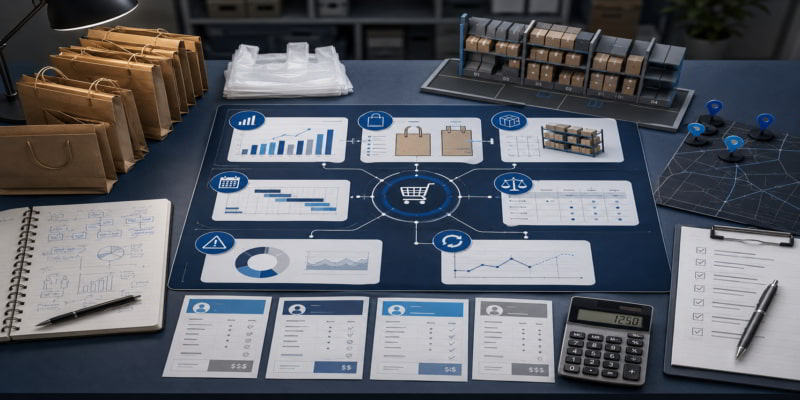
📌 Key Takeaways
Switching from plastic to paper bags costs more than the price per bag — storage, waste, rollout timing, and operational fit all affect the real budget.
- Map Usage Before Ordering: Base paper bag demand on actual store-level consumption, not company-wide purchase history, to avoid over-ordering or under-ordering by location.
- Match the Job, Not Just the Size: A paper bag with the same dimensions as the old plastic bag can still fail if it can’t handle the weight, moisture, or carrying distance the job requires.
- Align Specs Before Comparing Quotes: Two supplier quotes mean different things if the paper grade, handle type, coating, or printing specs don’t match across the RFQ.
- Plan the Overlap to Avoid Paying Twice: Order paper bags around remaining plastic stock, site readiness, and pilot timing so duplicate inventory doesn’t pile up in storage.
- Recalculate Reorder Points After Launch: Old plastic bag reorder triggers won’t fit paper bags — track real consumption by site and SKU before locking in new replenishment rules.
Control the transition budget by mapping the full cost picture before the first quote goes out.
Procurement, operations, and finance teams managing multi-location bag transitions will find a ready-to-use cost driver framework here, preparing them for the detailed overview that follows.
~ ~ ~ ~ ~ ~ ~ ~ ~ ~ ~ ~ ~ ~ ~ ~ ~ ~
When the decision to replace plastic bags with paper bags lands on a procurement team’s desk, the first move is almost always a price check. Pull quotes from a few suppliers, compare the per-bag number, pick the lower one, and move on.
However, unit price captures only a fraction of the total changeover cost. A plastic-to-paper transition can affect storage capacity, usage rates, supplier lead times, rollout timing across sites, reorder calculations, operational handling, and waste — all before a single paper bag reaches a customer. Finance may see a straightforward line-item swap, while operations sees new storage demands, different packing behavior, and potential damage patterns that never existed with the old material.
This is especially important for multi-location retail, QSR, grocery, café, delivery-first foodservice, and franchise operations. A paper bag program that looks simple at head office can behave differently across store formats, back-of-house spaces, peak periods, and packing routines.
Mapping these cost drivers before comparing quotes helps procurement teams avoid over-ordering, prevent duplicate inventory, reduce avoidable waste, and enter supplier conversations with the inputs needed for a meaningful comparison. That gives procurement, operations, warehouse, finance, and store teams a shared view of total changeover cost before the first large paper bag order is placed.
Start by Mapping Current Plastic Bag Usage
Paper bag demand should not be estimated from purchase history alone. Purchase records show what was ordered. They do not show what was actually used, what was wasted, or how consumption varied across locations and peak periods.
Start by documenting current plastic bag SKUs, bag sizes, average usage, peak usage, and remaining stock. Then separate usage by site type. A high-volume downtown cafe may go through bags at several times the rate of a quieter suburban outlet. That variation matters. Averaging across all sites produces a number that fits nowhere — overstating demand at low-volume locations and understating it where it counts most.
Existing plastic stock also needs a run-down plan. If paper bags arrive before plastic bags are used or phased out, duplicate inventory can build quickly. That creates storage pressure and can make finance see two packaging costs at once.
Plastic-to-Paper Bag Cost Driver Map
Use this map before supplier conversations so each team can see where changeover cost may enter the workflow.
| Cost Driver | What Can Change During the Switch | Who Should Provide Input | What to Ask Before Ordering | Verification Needed? |
| Bag size and SKU mix | Current plastic sizes may not translate one-for-one into paper bag needs. | Procurement, operations, store teams | Which sizes cover the most common orders without creating too many SKUs? | Internal usage review |
| Handle type and construction | Handles may affect carrying, packing speed, storage, and quote comparability. | Operations, store teams, suppliers | Does the handle suit the load, customer journey, and packing method? | Supplier specification confirmation |
| Paper grade and strength | Strength needs depend on load, moisture exposure, handling path, and bag design. | Procurement, QA, suppliers | Which paper grade, GSM, basis weight, and construction details are being quoted? | Supplier documentation; standards references such as ISO 536 or TAPPI/ANSI T 410 where relevant |
| Printing or branding | Branded bags can add artwork approval, production timing, minimum order, and obsolete-stock risk. | Marketing, procurement, suppliers | Are printed bags needed immediately, or can plain bags support the first phase? | Artwork and production approval |
| Coatings or food-service requirements | Grease, moisture, venting, or food-contact needs may add documentation requirements. | Food service, QA, suppliers | What proof is needed for the intended use? | Supplier documents and relevant official guidance, such as European Commission food-contact material guidance for EU contexts |
| MOQ and order frequency | Supplier minimums may not match phased rollout, storage capacity, or site demand. | Procurement, finance, warehouse | Does the order quantity fit actual usage and available space? | Supplier quote and internal capacity check |
| Supplier lead time | Initial order timing and repeat order triggers may need to change. | Procurement, suppliers | What lead time should be used for first orders and replenishment? | Confirm directly with suppliers |
| Storage and handling | Paper bags may need different storage discipline, protection, and stock rotation. | Warehouse, store teams | Where will bags be stored, and how will bundles be protected? | Site-level storage review |
| Plastic stock run-down | Remaining plastic inventory can create overlap cost. | Procurement, finance, operations | Which sites should run down existing stock before paper bags arrive? | Inventory count |
| Damage or double-bagging risk | Wrong sizing, weak fit, moisture exposure, or handling mismatch can create waste. | Store teams, operations | What failure patterns should be tracked during pilot or launch? | Pilot feedback |
| Store rollout timing | Different locations may be ready at different times. | Operations, procurement | Which sites should pilot, phase in, or receive exceptions? | Rollout plan |
| Reorder point changes | Paper bag usage may differ from plastic bag assumptions. | Procurement, warehouse, finance | What reorder trigger will be used after live usage is observed? | Post-launch consumption review |
Compare Bag Function, Not Just Bag Material
A paper bag replacement should be matched to the job it needs to perform, not just the dimensions it needs to fill. Replacing a plastic bag with a paper bag of the same width and height does not guarantee the same job gets done. Paper and plastic behave differently under load, in wet conditions, and over carrying distance.
A paper bag that matches on size may still fail if the actual use case involves heavy items, moisture from food packaging, long walks from counter to car, or rough handling during delivery. Matching the paper bag to the function the bag actually performs — basket size, food weight, grease exposure, branding needs, carrying distance, and packing conditions — prevents mismatches that show up as double-bagging, torn handles, or customer complaints. Each of those failures costs material, time, and reputation.
A core procurement principle applies here: compare function before comparing price. A lower quoted unit price may not help if the selected bag encourages double-bagging, slows packing, or does not fit common order types.
For a deeper operational fit, review a related guide on how to match paper bag specifications to basket size, food weight, and handling conditions.
Map Specification Choices That Change Supplier Quotes
Two paper bag quotes that look different on price may simply reflect different specifications. Procurement should align specifications before comparing prices.
Key fields include paper grade, GSM or basis weight, handle type, gusset, base construction, coating, color, finish, printing, packing format, order quantity, and SKU mix. In paper and board contexts, grammage is commonly used to describe mass per unit area, while basis-weight terminology may also appear in some markets. When these details matter technically, teams should confirm the relevant test method or terminology rather than relying on shorthand.
An unbleached flat kraft bag with no handle will quote very differently from a bag with twisted paper handles, a food-safe grease-resistant coating, and custom two-color printing. Both are paper bags. They are not comparable products. If different specifications go to different suppliers — even unintentionally — the resulting quotes measure different things.
Aligning specifications across the RFQ before sending it out removes one of the most common sources of mismatched comparison. Our guidance on paper bag material specification cost drivers can help teams prepare more comparable RFQs.
Where food-service use cases require grease resistance or moisture barriers, buyers should request supplier documentation confirming food-contact suitability rather than assuming compliance based on material type alone.
Account for Storage, Handling, and Damage
Storage is where the changeover can become visible to store and warehouse teams. Paper bags may need different handling discipline than the previous plastic bag setup.
Back-of-house areas and warehouse shelves that worked fine for flat-packed plastic bags may not accommodate bulkier paper bundles. During the changeover — when both materials may share the same storage — the space pressure gets worse. Crushed bundles, moisture-damaged stock, and disorganized storage lead to waste that never appeared in the procurement budget.
The exact requirement varies by bag type, packaging format, site layout, and storage conditions. In general, teams should review whether storage areas are dry, protected, organized, and large enough for the planned order quantity. Branded or custom-printed bags deserve extra attention — slow-moving stock in poor conditions may need to be discarded.
A simple storage review should cover capacity by location, FIFO practice, condition checks, bundle handling, and separation between remaining plastic stock and new paper stock.
Plan the Overlap Period Between Plastic and Paper Stock
Duplicate inventory is one of the most avoidable costs in a bag transition. It happens when paper bags are ordered before existing plastic stock is used up, or when rollout dates vary across sites without a coordinated schedule.
Tie the first paper order to remaining plastic stock, supplier lead time, site readiness, and pilot timing. That means estimating how long current plastic stock will last per site, selecting pilot locations, setting cutover dates by site type, and building in exceptions for high-volume locations that may burn through plastic faster than expected.
A phased rollout can also help teams test whether the selected size mix and handling assumptions work before wider ordering. This is a general implementation principle, not a guaranteed savings claim. Better sequencing can help reduce avoidable planning errors, but the actual cost effect depends on usage, storage, ordering terms, and operational discipline.
Example scenario: A multi-location cafe chain is replacing plastic takeaway bags with paper bags. The procurement team initially compares unit prices from three suppliers. After reviewing operations input, the team realizes it also needs to map remaining plastic stock per location, confirm storage capacity, match bag sizes to order types, verify supplier lead times against weekend peaks, and sequence the rollout through two pilot stores first. This is an illustrative scenario.
For rollout planning, our article on rolling out new paper bag specifications across stores, cafes, and takeaway operations may be useful.
Recalculate Reorder Points after Paper Bags Go Live
Old plastic bag reorder points should not automatically become paper bag reorder points. Usage rates may change, supplier lead times may differ, and the safety stock buffer that prevented plastic bag stockouts may not fit a new material with different ordering dynamics.
Once the switch begins, track actual paper bag consumption by SKU and site type. Usage may change because of size differences, carrying behavior, double-bagging, breakage, staff habits, or rush-period demand. Supplier lead time and MOQ should also be confirmed directly with suppliers instead of assumed.
Rush-period demand deserves particular attention. Weekend and holiday spikes may produce different consumption patterns than the old material, particularly if bag sizes, double-bagging behavior, or packing speeds have changed. A practical approach is to set a temporary launch rule, monitor live consumption, then revise reorder points after enough store-level data is available.
For replenishment planning, see PaperIndex Academy resources on paper bag reorder points and how lead times affect seasonal ordering windows.
Track Operational Waste and Pack-Out Friction
Operational waste often appears as a mismatch, not a material verdict. Some costs only become visible after the switch is underway.
Store teams may double-bag heavy orders because the paper bag feels less sturdy. Staff may tear bags during loading because paper is less flexible than plastic under the same motion. Handles may fail under weight that the previous bag supported without issue. If staff avoid certain sizes, reject damaged bundles, slow down while opening bags, or move bags around because storage is awkward, those patterns should be documented.
None of this means paper is the wrong material. It means the specification and the use case may not yet be aligned. The cost of these mismatches — extra bags consumed per shift, slower packing, customer-facing failures — should be tracked during the first weeks and fed back into the specification review before the next reorder cycle. That feedback loop is what turns a reactive transition into a controlled one.
Food-service teams should also be cautious with moisture, grease, steam, and contact-surface claims. Suitability for these use cases depends on the exact product, intended use, supplier documentation, and applicable market requirements. For environmental claims such as recyclable, compostable, or sustainable, buyers should request evidence and avoid repeating broad claims without support. The FTC Green Guides are one example of official guidance that emphasizes evidence for environmental marketing claims; other jurisdictions may apply different rules.
Before Requesting Paper Bag Quotes, Confirm These Inputs
Before sending an RFQ, procurement should collect a shared input set from operations, warehouse, finance, QA, marketing, and store teams:
- Current plastic bag SKUs and remaining stock at each location
- Actual weekly usage by location or store type, not just company-wide purchase totals
- Required paper bag sizes and load conditions for each order type
- Handle, coating, printing, and branding requirements
- Storage capacity and moisture exposure at each site
- Supplier lead time and minimum order quantity
- Pilot or phased rollout sequence
- Reorder trigger method after paper bags go live
- Waste or damage tracking method for the first weeks of use
- Documentation requirements for food-contact, sustainability, or certification claims
This is also the right moment to decide which claims need proof. Sustainability, recyclability, compostability, recycled content, food-contact suitability, certification, average lead time, average price, and quantified savings should be verified before they appear in internal approval documents, customer-facing language, or supplier comparisons.
Frequently Asked Questions
Are paper bags always more expensive than plastic bags?
Not automatically. Unit prices can differ, but procurement teams should compare the full operating context: storage, usage rate, specifications, waste, rollout timing, MOQ, and supplier lead time. Avoid universal price claims unless verified by current supplier quotes or credible pricing data.
What is the biggest hidden cost when switching to paper bags?
The biggest hidden cost often comes from mismatch: wrong size, wrong strength, poor rollout timing, duplicate inventory, or operational workarounds. The exact driver varies by site, product mix, storage setup, and supplier terms.
Should a business use the same number of paper bags as plastic bags?
Not automatically. Usage should be recalculated based on actual packing behavior, bag size, load, customer handling, double-bagging patterns, and site-level demand after launch.
What should be included in a paper bag RFQ after a transition plan?
Include size, handle type, paper grade, GSM or basis weight, printing, coating, order quantity, lead time, packing use case, storage conditions, delivery schedule, MOQ, documentation requirements, and any pilot or phased rollout assumptions.
Better Cost Control Starts Before the First Paper Bag Order
The total changeover cost of switching from plastic to paper bags extends well beyond unit price. Storage capacity, operational fit, usage rate changes, rollout timing, specification alignment, avoidable waste, and reorder planning all contribute to whether the transition stays within budget or generates surprises across sites.
Map before comparing quotes. Teams that control transition cost most effectively bring cross-functional inputs — from procurement, operations, warehouse, finance, and store teams — into the planning process before the first RFQ goes out.
After mapping bag sizes, storage constraints, rollout timing, and specification needs, teams can compare paper bag suppliers, explore paper bags, or prepare a clearer RFQ.
Disclaimer:
This article is for general informational purposes only. It is not a substitute for advice from a qualified professional, provider, or official source relevant to your situation. Always verify important decisions with the appropriate expert, authority, or service provider.
Our Editorial Process:
Our expert team uses AI tools to help organize and structure our initial drafts. Every piece is then extensively rewritten, fact-checked, and enriched with first-hand insights and experiences by expert humans on our Insights Team to ensure accuracy and clarity.
About the PaperIndex Insights Team:
The PaperIndex Insights Team is our dedicated engine for synthesizing complex topics into clear, helpful guides. While our content is thoroughly reviewed for clarity and accuracy, it is for informational purposes and should not replace professional advice.