
📌 Key Takeaways
Switching from plastic to paper bags changes your entire operation, so evaluate suppliers on transition support — not just price.
- Match Bags to Your Workflow: A paper bag that works for retail clothing may fail at a busy takeaway counter, so map your packing speed, load weight, and storage conditions before contacting suppliers.
- Align Specs Before Comparing Prices: Two quotes at similar prices often assume different materials, coatings, handles, and shipping terms — making them impossible to compare without a shared specification baseline.
- Demand Real-World Samples: Desk samples show how a bag looks, not how it performs at volume — request production-representative samples and pilot quantities tested under actual packing and storage conditions.
- Break Down Lead Times by Stage: A single “six-to-eight-week” estimate hides where delays happen — ask suppliers to separate artwork approval, production, shipping, and warehouse staging into individual timelines.
- Test Supplier Responsiveness Early: How a supplier handles questions before the first order predicts how they will handle problems during a live rollout across multiple locations.
Evaluate the transition, not just the bag.
Procurement teams, operations managers, and QA leads planning a plastic-to-paper changeover will gain a structured supplier comparison framework here, guiding them into the evaluation criteria and scorecard that follow.
~ ~ ~ ~ ~ ~ ~ ~ ~ ~ ~ ~ ~ ~ ~ ~ ~ ~
Replacing plastic bags with paper is not just a material substitution. It changes how bags are packed, stored, shipped, reordered, and handled at the point of use. Specifications shift. Storage demands change. Packing speed, brand presentation, lead-time planning, store training, and proposal comparison may all be affected. Furthermore, proposals from paper bag suppliers are often harder to compare than expected, as different suppliers quote against different assumptions about material grade, tolerances, coatings, print coverage, Incoterms, and documentation scope.
Generic supplier checklists focus on price, quality, MOQs, and delivery. That works when the product category is familiar. During a plastic-to-paper changeover, procurement teams face a different challenge: evaluating whether a supplier can support the transition itself — not just fill an order. The criteria below help buyers assess supplier readiness before quote pressure narrows the conversation.
Start with the Actual Changeover Use Case, Not the Catalog Bag
Supplier evaluation should begin with the buyer’s current workflow, not a supplier’s catalog. A paper bag that performs well for a retail clothing chain may be wrong for a cafe running a high-volume takeaway counter.
Practical details matter. What is the typical basket size and load weight? Are bags packed at a counter, warehouse station, or fulfillment line? Will the bag encounter grease, moisture, or condensation? Does the operation need plain kraft bags, branded printed bags, or coated bags?
A hypothetical cafe chain replacing lightweight plastic carryout bags, for instance, may need to test whether a paper bag opens quickly at the packing station, holds its shape during order assembly, tolerates short-term food-service handling, and stores safely in a limited back-of-house area. A retail chain may care more about handle comfort, printed appearance, shelf storage, and checkout speed. These differences mean the evaluation criteria should reflect the operation, not just the bag.
Multi-location operations add another layer. A flagship outlet and a small kiosk may pack differently, store bags in different conditions, and serve different order profiles. A kiosk, grocery store, takeaway counter, delivery-first location, and warehouse dispatch point may not use bags the same way. Mapping these variations before approaching suppliers avoids evaluating against a generic requirement that no single bag satisfies.
Evaluate Specification Clarity Before Evaluating Price
Unclear specifications make quotes incomparable. Two suppliers quoting similar prices may assume different grades, GSM values, gusset dimensions, handle methods, ink coverage, or coatings. Those hidden differences surface later — sometimes after the first production run ships.
Before requesting proposals, define the parameters that shape cost and performance: material grade, GSM range with tolerances, bag dimensions, handle type, coating or lamination, print specifications, finish, packing quantity, and delivery assumptions. Where burst strength or moisture resistance is critical, ask suppliers to reference recognized test methods—such as ISO 2758 for bursting strength or ISO 535 for water absorptiveness—rather than accepting descriptors like ‘strong’ or ‘heavy-duty.’
The same logic applies to trade terms. If suppliers quote under different Incoterms or delivery responsibilities, the unit price may not reflect the same landed or received cost basis. Buyers should confirm which costs, responsibilities, and delivery points are included before treating unit prices as comparable. The International Chamber of Commerce provides official information on the current Incoterms® 2020 rules for teams that need to interpret trade-term responsibilities.
The goal is not to over-engineer a specification document but to make quotes rest on the same assumptions so price differences reflect actual value. For more on how these variables shape B2B quotes, see this overview of cost drivers in paper bag specifications.
Check Whether the Supplier Can Support Sampling and Pilot Testing
Samples can create false confidence. A desk sample — one bag from existing inventory — confirms appearance and rough dimensions, but may not represent what a production run delivers. If a sample is handmade, produced on different equipment, or made with substituted materials, procurement should document that limitation before using it as approval evidence.
Production-representative samples matter more. For retail bags, test whether the bag handles a realistic load without tearing. For food-service applications, check grease and condensation resistance under actual packing conditions. For printed bags, examine color fidelity, surface durability, rub resistance, and how the bag looks after normal stacking and handling.
A pilot quantity — enough to test across two or three locations — reveals friction no single sample can. Store teams can check pack-out speed, ease of opening, and whether the bag stands upright during filling. Warehouse teams can check carton size, stacking stability, and protection from moisture exposure. Packing staff may find the bag harder to open. Back-of-house storage may need reorganizing. These signals need to surface before a full commitment. Related guidance is in the article on paper bag specification changes.
A sample should reduce uncertainty, not replace a rollout test.
Assess Production Consistency and Quality Communication
A supplier that delivers a strong first batch but drifts on the second creates compounding problems. Teams adjusting to a new material have less tolerance for variation — a subtle GSM shift or handle inconsistency can disrupt packing lines or trigger complaints.
Three questions reveal a lot about consistency practices. Are tolerances documented and shared? What happens when a raw material or mill source changes — does the supplier notify proactively, or does the change appear silently? Is there a named quality contact who fields questions without routing through a general inbox?
Lot traceability may also be relevant for programs where documentation, batch consistency, or compliance-adjacent claims matter. The buyer should know how the supplier identifies the relevant lot or batch and how quickly an issue can be escalated when a problem surfaces.
The point is not that every supplier needs identical certifications — requirements vary by use case. The point is to verify open communication about factors affecting what arrives. For more on structuring these questions, see supplier qualification questions for material consistency.
Review Lead Times, Approval Windows, and Logistics Fit
Lead time is not just production time. A paper bag order passes through artwork approval, sample review, production, shipping, customs clearance for cross-border orders, and warehouse staging. A delay in artwork approval can compress every stage that follows.
Ask suppliers to break lead time into components. A single “six-to-eight-week” estimate hides whether two weeks are artwork approval, whether shipping includes a port-delay buffer, or whether the estimate assumes a specific receiving date. For seasonal programs or phased launches, this visibility is critical. Buyers should also confirm MOQ, carton configuration, pallet details where relevant, and whether the proposed order quantity fits available storage space.
Storage deserves separate attention. Paper bags are more sensitive to humidity, compression, and stacking damage than most plastic alternatives. Warehouse conditions that protected polyethylene bags may not work for paper, and reorder cadence may shift if minimum order quantities are higher or shelf life in humid conditions is shorter. More on how ordering windows interact with these variables is in the guide on paper bag lead times.
Receiving checks should be part of the plan as well. Warehouse or QA teams may need to confirm carton condition, labeling, SKU accuracy, visible transit damage, and whether received goods match the approved specifications. Building receiving verification into the logistics timeline avoids treating inspection as an afterthought.
Match Documentation Requests to the Claim and the Use Case
The documentation a buyer needs depends on the claims that buyer intends to make or defend. A retailer promoting recycled-content packaging needs different proof than a QSR chain sourcing bags for hot food.
For sustainability claims such as recycled content, recyclability, or compostability, product-specific documentation is essential. A supplier’s general sustainability statement may not cover the particular product or market. Certification scope matters: a certificate for one product line does not automatically extend to another. Buyers can verify chain-of-custody claims through the public certificate databases of recognized bodies such as the FSC, PEFC, or SFI, depending on the supplier’s specific certification. More on structuring these requests is in the guide on sustainability documentation for paper bags.
For food-contact applications, ask suppliers to specify what has been tested, under what conditions, and for which markets. Coatings, inks, adhesives, and handle materials may each carry separate documentation considerations. Rather than accepting a blanket “food safe” assurance, request documentation scoped to the specific product and intended use. For teams dealing with US food-contact packaging questions, compliance must be verified against the relevant sections of Title 21 of the Code of Federal Regulations (CFR), including Part 176 governing “Indirect Food Additives for Paper and Paperboard”, alongside Good Manufacturing Practices. Other markets require adherence to their own statutory frameworks, such as the overarching Regulation (EC) No 1935/2004 in the EU, which mandates general material safety. Because there is currently no harmonized EU-wide specific measure for paper, the requirement for specific Declarations of Compliance is primarily driven by applicable national legislation in individual Member States, demanding qualified professional review.
Look for Implementation Support, Not Just Order Fulfillment
Procurement selects the supplier, but store staff, packers, warehouse teams, and delivery crews experience the result. A changeover crosses departmental lines, and suppliers offering more than order fulfillment reduce friction that procurement alone cannot solve.
Stakeholder alignment should happen before supplier approval. Procurement may prioritize quote clarity and MOQ. Operations may focus on packing speed and workflow. QA may need documentation and issue-resolution structure. Sustainability teams may need evidence for claims. Warehouse teams may need receiving and storage guidance. A useful supplier helps clarify assumptions across these teams rather than leaving procurement to translate between them.
Useful support includes phased delivery scheduling, packing guidelines for store teams, and a feedback loop for early orders so problems get escalated rather than repeated. SKU transition planning matters too — especially when replacing multiple plastic sizes with paper equivalents that may not map one-to-one. If staff report that bags are hard to open, handles feel inconsistent, printed surfaces scuff too easily, or cartons are difficult to store, the buyer needs a clear route for supplier response and specification review.
The clearest signal of implementation readiness is responsiveness before the first order. Suppliers slow to answer questions or vague about timelines rarely improve under live-order pressure.
Supplier Evaluation Scorecard for Plastic-to-Paper Changeovers
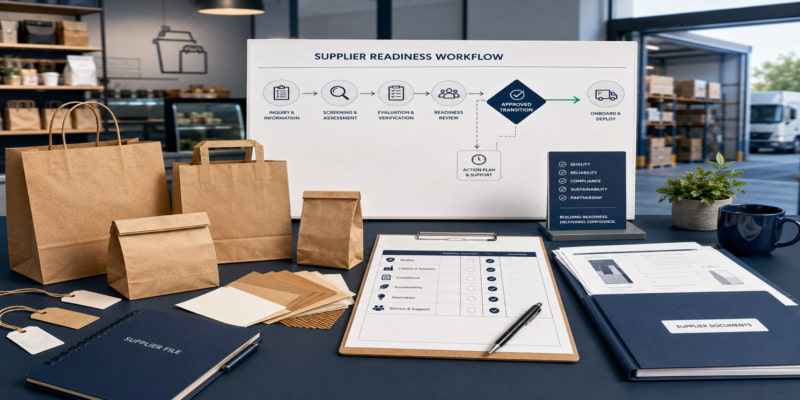
The following scorecard turns the criteria above into a structured comparison tool, separating supplier claims from verifiable proof.
| Evaluation Area | What to Ask | Evidence to Request | Why It Matters During Changeover | Red Flag |
| Use-case fit | Can you match bags to our format, load weight, and packing environment? | Spec sheets aligned to buyer use case | Prevents catalog-to-operation mismatch | Only generic “standard paper bag” offered |
| Specification clarity | What grade, GSM, tolerances, coatings, and handles does your quote assume? | Detailed spec sheet with tolerances | Makes quotes comparable across suppliers | Vague or missing spec details |
| Quote comparability | Are Incoterms, freight assumptions, print assumptions, and documentation scope clear? | Quote with delivery and responsibility assumptions stated | Prevents unit-price comparison on different cost bases | Unit price presented without Incoterms, freight, or print breakdown |
| Sampling and pilot | Can you provide production-representative samples and a pilot quantity? | Sample confirmation with timeline | Closes the desk-sample-to-production gap | Samples from stock only; no pilot option |
| Production consistency | How do you monitor batch quality and communicate material changes? | Tolerance docs; QA contact; change policy | Protects teams calibrating around new material | No tolerance docs or change process |
| Lead-time reliability | Can you break lead time into stages: artwork, sampling, production, shipping? | Stage-by-stage estimate | Helps plan rollout timing; prevents compression | Single aggregate estimate, no breakdown |
| Storage and logistics | What storage do your bags require? What are MOQ and reorder terms? | Storage guidance; replenishment terms | Paper may need different warehousing than plastic | No storage guidance provided |
| Documentation readiness | Can you provide product-specific documentation for sustainability or food-contact claims? | Certificates scoped to product and market | Enables buyers to verify and defend claims | Overbroad claims without evidence |
| Rollout support | Do you support phased rollouts, training, or early-order feedback? | Rollout plan; escalation contacts | Reduces store-level failures during transition | No support beyond fulfillment |
| Multi-location rollout support | How will supplier feedback and issue escalation work across locations during rollout? | Named escalation path; issue-response process | Determines resolution speed across outlet types | Supplier treats rollout as a routine repeat order |
| Issue Escalation & Multi-Location Support | What is the formalized protocol for capturing multi-site defects and resolving urgent specification deviations? | Documented SLA matrix, named escalation path, and cross-location feedback mechanisms | Determines resolution velocity across varied outlet footprints during critical transitional phases | Unclear pre-order response times or treating a multi-location rollout as a routine stock reorder |
Red Flags When Evaluating Paper Bag Suppliers for a Changeover
Not every warning sign disqualifies a supplier, but each adds uncertainty to a transition already introducing new variables:
- The supplier describes its product only as a “standard paper bag” without tailoring to the buyer’s use case, load requirements, or handling conditions.
- Proposals lack specification detail, or the supplier resists documenting material composition, coatings, or construction.
- Samples do not reflect stated production methods, and the supplier cannot explain how output at scale would differ.
- Lead-time estimates arrive as a single number with no breakdown across approval, production, and shipping stages.
- Sustainability or food-contact claims are broad — “eco-friendly” or “food safe” — without product-specific documentation.
- The supplier struggles with use-case questions about moisture, grease exposure, or packing-speed demands.
- There is no clear process for communicating material changes or quality concerns after the initial order.
- Poor responsiveness during evaluation itself. If a supplier struggles to answer questions before an order is placed, issue resolution during rollout is unlikely to improve.
Frequently Asked Questions
What should buyers ask a paper bag supplier before switching from plastic?
Start with the use case: bag dimensions, load weight, handling path, food-contact requirements, storage conditions, and delivery exposure. Then ask about specification documentation, sampling options, lead-time breakdown by stage, what assumptions the quote includes, and what support the supplier provides during rollout.
Is a paper bag sample enough to approve a supplier?
A desk sample confirms appearance and dimensions but rarely represents production output at volume. Request production-representative samples and, where feasible, a pilot quantity tested under real packing, storage, carry, and delivery conditions before committing.
Should buyers compare paper bag suppliers by price first?
Price comparison becomes meaningful only after specifications are aligned. If proposals assume different grades, coatings, handles, print assumptions, documentation scopes, freight terms, or Incoterms, unit price alone obscures actual differences. Align the specification first; compare total value second.
What documentation should paper bag buyers request?
Match the request to the claim. Sustainability claims need certification scoped to the actual product and market. Food-contact uses need evidence of testing for the intended application and destination market. Performance claims should reference named test methods or data sheets rather than general assurances.
How should multi-location teams test a new paper bag supplier?
Run a pilot across representative locations covering different store formats or climate conditions. Collect structured feedback from procurement, operations, warehouse, QA, sustainability, and store teams on performance, packing speed, storage suitability, documentation availability, and supplier responsiveness before scaling.
Protecting the Changeover, Not Just Securing a Quote
Supplier evaluation for a plastic-to-paper changeover is a process of testing operational readiness, not a one-round price negotiation. The right supplier is the one whose capabilities, communication, and support structure match the demands of the transition.
Use these criteria to structure supplier conversations before requesting or comparing quotes. Organizations with established criteria should issue formal RFQs across qualified B2B networks to benchmark vendors.
Disclaimer:
This article is for general informational purposes only. It is not a substitute for advice from a qualified professional, provider, or official source relevant to your situation. Always verify important sourcing, packaging, compliance, and operational decisions with the appropriate expert, authority, supplier, or service provider.
Our Editorial Process:
Our expert team uses AI tools to help organize and structure our initial drafts. Every piece is then extensively rewritten, fact-checked, and enriched with first-hand insights and experiences by expert humans on our Insights Team to ensure accuracy and clarity.
About the PaperIndex Insights Team:
The PaperIndex Insights Team is our dedicated engine for synthesizing complex topics into clear, helpful guides. While our content is thoroughly reviewed for clarity and accuracy, it is for informational purposes and should not replace professional advice.