

📌 Key Takeaways
Quote evaluation requires systematic triage that separates legitimate suppliers from elevated-risk sources before comparing price.
- Reject Outlier Pricing First: Quotes 30%+ below comparable offers commonly indicate hidden scope gaps, downgrades, or unverifiable suppliers rather than better value.
- Demand Spec-Complete Quotes: Paper weight, dimensions, handle attachment, printing details, packaging method, and named Incoterm must be explicit before quotes are comparable.
- Verify Identity Before Payment: Company names, registration documents, and banking beneficiary details must match exactly across all documentation to prevent fraud exposure.
- Flag Payment Manipulation Patterns: Urgent transfer requests, mid-transaction banking changes, or personal account instructions align with documented business email compromise tactics.
- Lock Delivery Responsibilities: Incoterms define risk transfer and cost allocation—fuzzy terms like “FOB China” without named ports shift unquantified risk to buyers.
Triage gates prevent verification time spent on quotes that fail basic accountability thresholds.
Procurement managers sourcing paper bags internationally will eliminate preventable supplier risks here, preparing them for the verification protocols that follow.
The quote lands in the inbox. The price looks good—maybe too good. The procurement manager has 72 hours to secure packaging for peak season, and three suppliers are waiting for a decision.
Here’s the problem: a supplier quote can hide risk just as easily as it reveals price. While B2B marketplaces expand supplier options, they also demand more sophisticated evaluation frameworks to separate legitimate offers from elevated-risk proposals. Without a systematic way to evaluate what’s actually in front of you, “gut feel” becomes the default—and gut feel doesn’t scale when the stakes include a $40,000 wire transfer to a factory overseas.
This article provides a fast, repeatable checklist that transforms quote evaluation from guesswork into a triage system with clear outcomes: reject, clarify, or advance to verification.
The 5 Red Flags (Quick Scan)
Before diving deeper, here’s the snapshot. These five signals indicate when a quote deserves extra scrutiny—or immediate rejection:
- Materially lowest price vs. the rest — An outlier quote often means missing scope, not better value.
- Missing or vague specs — If you can’t compare apples to apples, you’re comparing assumptions.
- Unverifiable company identity — Inconsistent names, addresses, or registration details signal elevated counterparty risk.
- Payment pressure or unusual instructions — Requests for urgent transfers or changed bank details are classic fraud patterns.
- Fuzzy delivery and packaging terms — When responsibilities aren’t explicit, risk silently shifts to the buyer.
Each flag below includes how to spot it, what it typically means, and what to do next.
Supplier Red Flag Cheat Sheet
Use this decision framework on every quote you receive:
Reject immediately if:
- The supplier refuses to provide basic company verification documents
- Payment beneficiary does not match the quoted legal entity, or banking details “change” via email
- The supplier will not state an Incoterm with named location and explicit scope
Request clarification when:
- Key specifications are missing (paper weight, dimensions, handle type, printing details, packaging method)
- Lead time is stated as a single number without production, proof approval, or dispatch milestones
- Export packing and moisture protection methods are not defined
Advance to verification when:
- The quote addresses all specification fields with measurable parameters
- Delivery responsibilities are explicit and verifiable
- Company identity is consistent across all documentation
Save this framework and apply it before comparing price. A quote that fails the “reject” criteria isn’t worth your time, regardless of how attractive the price appears.
Red Flag #1: The Price Is Materially Below the Rest
How to Spot It
Three quotes come in for the same spec set. Two clusters around $0.18 per bag. The third quotes $0.11. That gap—a 39% discount from the market cluster—isn’t competitive pricing; it is a structural anomaly. It’s a signal.
What It Usually Means
Low pricing commonly indicates hidden downgrades, scope exclusions, or unrealistic production economics. Understanding kraft paper grades helps buyers recognize when a materially lower price reflects inferior base materials rather than genuine efficiency. A materially lower price often reflects one of several issues: the supplier has made assumptions about specs that don’t match yours, critical components (printing, handles, moisture protection) have been omitted, or the quote reflects production costs that can’t be sustained. This often masks elevated counterparty risk, signaling a supplier that lacks the capacity or intent to fulfill the contract.
What to Ask for Next
Request a full line-item breakdown that separates materials and specs, printing costs, packaging method, delivery terms (with named Incoterm), and production lead time. If the supplier cannot or will not provide this level of detail, that’s a second red flag stacking on the first.
Red Flag #2: The Quote Hides or Omits Critical Specs

Missing Spec Fields to Watch
A complete paper bag quote should address these elements: bag type and dimensions, paper weight (gsm), handle style and attachment method, printing coverage and ink types, tolerance ranges, carton and palletization details, moisture protection specifications, and whether samples are included or quoted separately.
When any of these fields are missing, the quote is incomplete—and incomplete quotes create scope gaps that turn into disputes or surprise costs after payment.
A Simple “Spec-True” Quote Template
Use this as a baseline. If a quote doesn’t include these fields, it’s not ready for comparison:
| Field | Required Value |
| Bag type + size (mm) | W × G × H |
| Paper (grade, g/m², ply) | Specify grade family, basis weight, and construction |
| Handle + reinforcement | Type and attachment method |
| Printing (colors/sides/finish) | Coverage area and ink specifications |
| Packaging + moisture protection | Carton specs, palletization, barrier method |
| Incoterm + named location | Exact term and place (e.g., “CIF Los Angeles”) |
| Lead-time milestones | Proof approval → production → dispatch |
How to Force Apples-to-Apples Comparison
Require every supplier to respond using the same spec template before comparing price. This eliminates hidden assumptions and ensures you’re evaluating equivalent offers. A supplier unwilling to complete the template is telling you something about how they’ll handle documentation throughout the relationship.
Red Flag #3: No Verifiable Company Identity (or Inconsistent Details)
Identity Checks That Can Be Done in Minutes
Cross-reference these elements for consistency: the company name on the quote, the invoice header, the email domain, any business registration documents provided, and the banking beneficiary name. Mismatches between any of these—particularly between the company name and the bank account beneficiary—warrant immediate clarification.
Document Set to Request
For paper bag suppliers you’re evaluating seriously, request: business registration certificate, factory address confirmation (with recent timestamped photos or video), and optionally, reference customers who can confirm recent transactions. These documents don’t guarantee legitimacy, but evasive responses to basic requests reveal a great deal. Buyers can begin their search with pre-verified options by submitting RFQs to suppliers who have already completed platform-level verification.
When to Walk Away
Walk away when you encounter mismatched company names across documents, addresses that don’t resolve to real locations, refusal to provide basic registration proof, or explanations that keep shifting. The cost of walking away from a questionable supplier is always lower than the cost of recovering from a failed transaction.
For a structured approach to this process, the 5-step paper bag supplier verification checklist provides a systematic framework.
Red Flag #4: Artificial Urgency and Payment Deviations
Common Manipulation Patterns
Watch for these scenarios: demands to “pay today” with artificial urgency, requests to send funds to a “new” bank account (especially mid-transaction), instructions to pay to a personal account rather than a company account, or unexpected fees required to “release” a shipment. These patterns align with business email compromise tactics that target international trade transactions, where attackers intercept legitimate email threads and insert fraudulent payment instructions.
The FBI’s Internet Crime Complaint Center documents how these schemes exploit the trust built during supplier negotiations, with average losses historically exceeding $100,000 per incident. [Confirm specific 2024/2025 average loss statistic from latest IC3 Report].
Safe Counter-Moves
When payment details seem unusual, use a “call-back” verification step: contact the supplier through independently sourced contact details (not the phone number in the suspicious email). Require written confirmation of any bank detail changes on company letterhead, with the beneficiary name matching the registered company name exactly.
The Federal Trade Commission’s guidance on business phishing prevention maps directly to supplier payment safety—demonstrating that verification protocols designed for email security apply equally to cross-border payment authorization.
Internal Controls for Approvals
Implement two-person approval for any bank detail change and establish a mandatory hold window (24-48 hours) before executing first-time transfers to new accounts. These controls add minimal friction but provide meaningful protection. For deeper guidance on structuring payment approaches, see negotiating payment terms for paper bags.
Red Flag #5: Delivery Terms, Packaging, and Responsibilities Are Fuzzy
Incoterms and What Must Be Explicit
A quote that says “FOB China” without specifying the port leaves critical questions unanswered. Incoterms define responsibilities, risk transfer points, and cost allocation between buyer and seller in international transactions, and understanding how to calculate landed cost for paper bags requires clarity on these terms from the outset. The Incoterms® 2020 rules published by the International Chamber of Commerce specify exactly which party bears the costs and obligations for each step—and where risk transfers. Your quote should specify the Incoterm, the named place, and confirm both parties understand the division of responsibilities.
The U.S. International Trade Administration’s Incoterms guide provides a practical overview for buyers navigating these terms, with particular attention to the distinction between transport-mode-neutral terms (FCA, CPT, CIP, DAP, DPU, DDP) and maritime-specific terms (FOB, CFR, CIF).
Packaging and Moisture Protection Questions
When suppliers state ‘export packing included’ without details, they’re offering a vague promise rather than a specification. Kraft paper bags and other paper packaging are hygroscopic materials, making explicit moisture protection protocols essential for international shipments. Clarify exactly what moisture protection steps will be taken, what materials will be used, and what documentation will accompany the shipment. Paper bags are hygroscopic; vague packaging language creates real risk of wet cargo and unusable inventory. For detailed guidance, stop wet cargo: preventing moisture damage in paper bag shipments addresses this directly.
Lead Time and Shipment Milestones
Pin down production lead time, sample approval gates (and their impact on the schedule), the shipment date window, and when documentation will be provided. Fuzzy timelines create downstream chaos when peak season inventory doesn’t arrive as assumed.
A 10-Minute Quote Triage Workflow
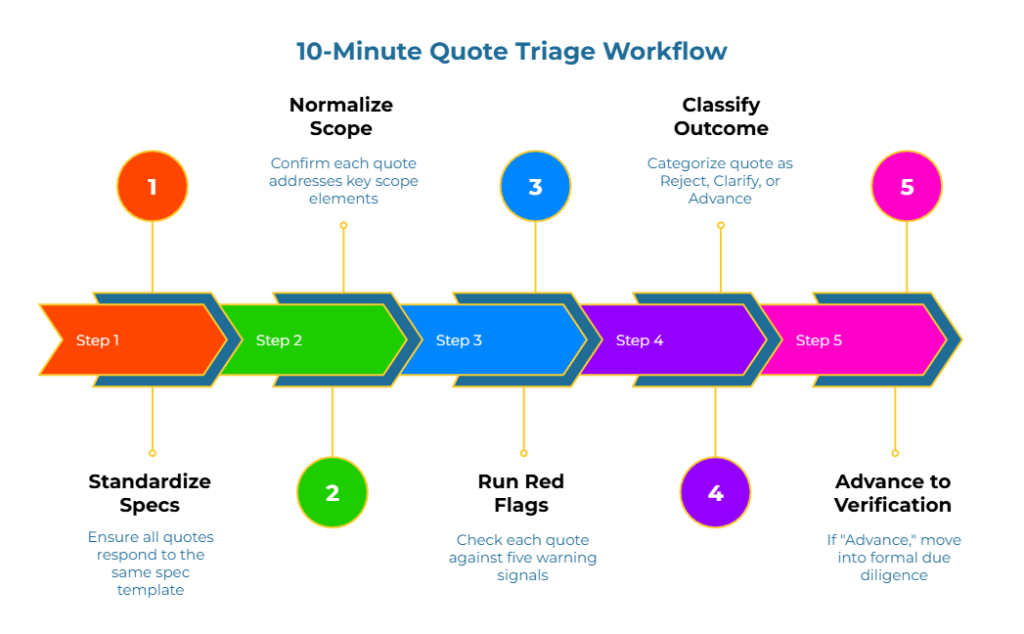
This process transforms quote evaluation into a repeatable system:
- Standardize specs — Ensure all quotes respond to the same spec template before comparison.
- Normalize scope — Confirm each quote addresses packaging method, delivery term, payment expectations, and lead time.
- Run the 5 red flags — Check each quote against the signals above.
- Classify the outcome:
- Reject — High-risk signals combined with refusal to clarify
- Clarify — Missing data, but supplier is responsive and identity is verifiable
- Advance to Verification — The quote is technically complete and identity is consistent
- If “Advance” — Move into formal due diligence using the protocol outlined in how to verify international suppliers without travel.
This triage doesn’t replace verification—it ensures you invest verification time only on quotes worth pursuing.
Next Steps
Integrating Triage into Procurement SOPs. Transition from manual quote review to a mandatory ‘Gate-Check’ system. Every quote must pass the Identity and Spec-True audits before reaching the Finance Desk. What comes next builds lasting supply chain resilience:
From quote triage to supplier verification: Convert the triage findings into a Standard Operating Procedure (SOP). Consistent application ensures that only ‘Grade A’ quotes reach the final negotiation stage, protecting your capital from the outset.
From payment red flags to safer terms: Move beyond spotting manipulation toward negotiating staged payment structures and controls that reduce exposure by design. From spot-buying to strategy provides a framework for this evolution.
From single quote to diversified sourcing: A single supplier creates single points of failure. Building a shortlist with verified backups protects fulfillment when primary suppliers face disruptions. Explore paper bags across multiple verified sources to reduce concentration risk.
Resources
- Stop Wet Cargo: Preventing Moisture Damage in Paper Bag Shipments
- The 5-Step Paper Bag Supplier Verification Checklist
- How to Verify International Suppliers Without Travel: A Five-Step Checklist
- Negotiating Payment Terms for Paper Bags: A Guide for Cash-Flow Management
- Building a Shortlist: Criteria for Choosing Wholesale Paper Bag Suppliers
Disclaimer: This article is for informational purposes only and does not replace professional legal, financial, or logistics advice.
Our Editorial Process:
Our expert team uses AI tools to help organize and structure our initial drafts. Every piece is then extensively rewritten, fact-checked, and enriched with first-hand insights and experiences by expert humans on our Insights Team to ensure accuracy and clarity.
About the PaperIndex Insights Team:
The PaperIndex Insights Team is our dedicated engine for synthesizing complex topics into clear, helpful guides. While our content is thoroughly reviewed for clarity and accuracy, it is for informational purposes and should not replace professional advice.