
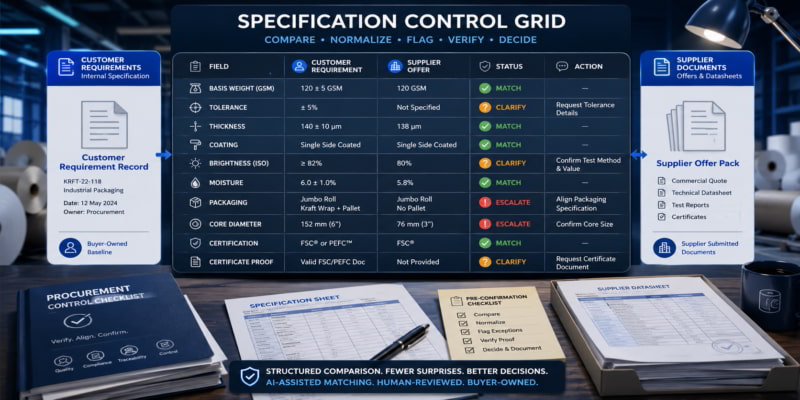
📌 Key Takeaways
AI helps paper procurement teams catch specification mismatches before they become costly disputes — but humans still make the final call.
- Capture Requirements Up Front: Record exact customer specifications — like GSM tolerances and coating details — before comparing any supplier quotes, so vague requests don’t become hidden assumptions.
- Normalize Before You Compare: Convert every supplier offer into the same format as the customer requirement, because mismatched layouts hide mismatched specifications.
- Flag Gaps, Not Just Conflicts: A missing field — like a tolerance or certification document — is just as risky as a wrong one, and easier to overlook.
- Certificates Need Proof, Not Mentions: A supplier saying “FSC certified” in an email isn’t verification — only attached, current documentation counts.
- Match, Clarify, or Escalate Every Field: End each specification check with a clear decision per field so nothing stays in a grey zone at order confirmation.
Repeatable specification checks prevent the small, quiet mismatches that cause the biggest commercial damage.
Paper trading procurement teams and operations coordinators will gain a practical, field-by-field review framework here, preparing them for the detailed checklist and workflow guidance that follows.
~ ~ ~ ~ ~ ~ ~ ~ ~ ~ ~ ~ ~ ~ ~ ~ ~ ~
The supplier PDF is open. The customer email sits beside it. The GSM reads 80 in one and “approximately 80” in the other — and the order needs confirmation by end of day.
A coating described as “light” in the customer brief but listed as “matte” on the supplier’s specification sheet. A certification mentioned during a call but absent from the shipping documents. A tolerance range the customer assumed was obvious but never stated.
That is where paper trading errors often begin. They rarely begin with a major failure; instead, they stem from details that are assumed, copied loosely, or left for someone else to confirm.
AI-assisted specification matching can help procurement teams reduce that manual risk. It can extract fields, compare documents, flag omissions, and make uncertainty visible before order confirmation. It should not approve the order by itself. Supplier documentation, tolerance confirmation, certification checks, and human commercial judgment still matter.
Why Small Specification Mismatches Create Commercial Friction
Paper trading depends on fields that procurement teams handle every day: GSM, grade, size, coating, brightness, packaging, tolerance, and certification claims. These terms may be familiar, but familiarity can create risk. A buyer may scan a supplier offer quickly because the grade looks right and the price is competitive, while a missing tolerance or unsupported claim sits unnoticed in the background.
The consequences go beyond paperwork. A rejected shipment creates freight and storage costs. A delayed re-order disrupts the customer’s production schedule. A certification gap discovered after delivery can affect regulatory acceptance. Even a tolerance deviation that seems small on paper can erode buyer confidence and complicate future negotiations.
A common mistake is checking price and delivery before confirming specification completeness. Price comparison is useful only after the quoted material is comparable — a principle explored in depth in our guide, why paper RFQs are hard to compare manually and where AI can help first. Otherwise, the team may be comparing two different offers that only look similar on the surface.
One mismatch on one order might resolve quickly. Repeated mismatches across orders signal a process gap — the kind that weakens both supplier relationships and internal credibility.
Start With Cleaner Customer Requirement Capturem
Supplier comparison starts before the supplier sends a quote.
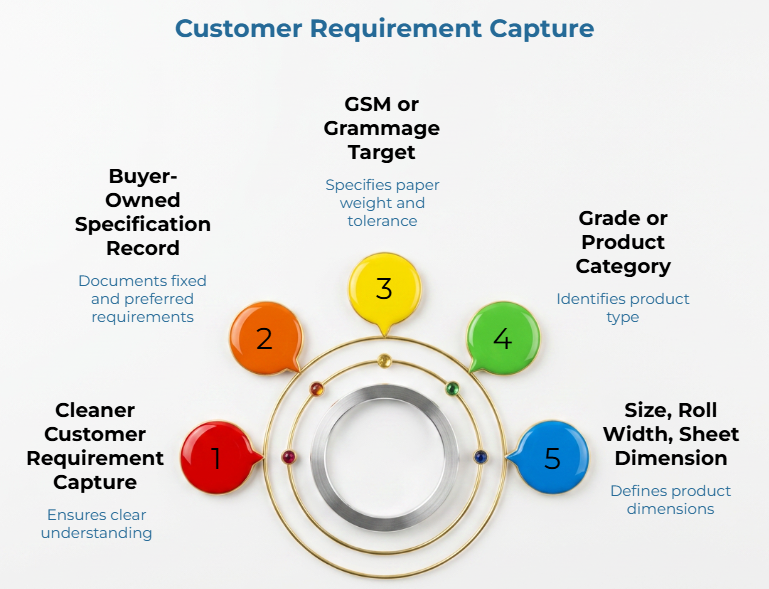
The customer requirement should be converted into a buyer-owned specification record. That record does not need to be complicated, but it must separate fixed requirements from preferences. A customer who states “80 GSM ± 2%” has a different tolerance expectation than one who says “around 80 GSM.” Recording that distinction at intake prevents small ambiguities from compounding downstream.
At minimum, the intake record should capture:
- GSM or grammage target, including whether a tolerance range is acceptable or the value is fixed
- Grade or product category
- Size, roll width, sheet dimension, or reel details
- Coating, shade, finish, or surface requirement, including coat weight if specified
- Brightness requirement, including measurement standard if referenced
- Packaging, palletization, wrapping, and labeling expectations
- Tolerances or acceptance rules
- Certification requirements or supplier claim expectations, such as FSC or PEFC chain-of-custody
- Intended end use, when the customer provides it
- Required supporting documents before order approval
This is a general procurement principle, not a guarantee of acceptance. Requirements vary by customer, product, market, and contract terms. The point is to prevent informal requests from becoming hidden assumptions.
If a field is unknown, mark it as unknown. Do not treat silence as flexibility — a principle that applies equally when building quote-ready fields without making suppliers guess.
Normalize the Supplier Offer Before Comparing
Supplier offers often arrive in inconsistent formats. One supplier sends a formal specification sheet. Another writes values inside an email. A third attaches a scanned document with product code, packing notes, and certificate references spread across different pages. The terminology varies between suppliers and regions — one supplier may describe a product as “C1S board” while another uses “single-side coated.” Both could refer to the same product—or they might not.
Before comparing offers, normalize the supplier’s information into the same structure as the customer requirement. This is the same principle used in quote comparison: supplier inputs must be made comparable before commercial judgment begins, as outlined in the guide, how to standardize paper supplier quotes before using AI to compare them.
AI can help extract values from supplier PDFs, emails, and spreadsheets. It can also highlight missing fields or inconsistent language. That does not make the extraction automatically correct. Ambiguous descriptions, local grade names, abbreviations, and supplier-specific terminology still need review by someone who understands the order context.
Missing fields matter as much as mismatched ones. If the supplier offer doesn’t state a brightness value and the customer requires one, that gap needs flagging before price or delivery evaluation begins. For a structured approach to this discipline, see our article, the spec-true mindset that reduces RFQ chaos.
The output should be a clear comparison record. Not a prettier document. A safer decision base.
The Pre-Confirmation Paper Specification Matching Checklist
Use this checklist after supplier normalization and before order confirmation. It is designed as a practical review tool, not a technical testing procedure.
| Specification field | What to check | Common mismatch risk | AI flag? | Human review needed when… | Verification needs |
| GSM / grammage | Match the requested grammage against supplier value and stated tolerance. | Supplier quotes the target GSM but omits tolerance or test reference. | Yes. | Tolerance differs, is missing, or the customer treats the value as fixed. | If a standard reference is required, ISO 536 covers determination of grammage for paper and board. |
| Grade | Compare grade name, product family, furnish notes, and application fit. | Similar grade names may represent different performance expectations. | Partly. | Grade language is broad, local, or supplier-specific. | Supplier specification sheet and customer approval record. |
| Size / dimensions | Check sheet size, roll width, reel diameter, core size, and unit format. | Values appear in different units or omit machine-critical details. | Yes. | Customer equipment or the converting process has fixed limits. | Customer requirement, supplier specification sheet, and drawing where relevant. |
| Coating / finish | Match coating type, coated side, finish, shade, and print requirement. | “Coated” may not match the required surface or application. | Partly. | Coating affects printing, lamination, converting, or customer appearance. | Supplier technical sheet or customer-approved sample record. |
| Brightness | Confirm whether brightness is required, stated, and linked to an accepted method if needed. | Brightness is quoted without method, tolerance, or customer relevance. | Yes. | Brightness affects print contrast, shade approval, or customer acceptance. | If a reference is needed, TAPPI T 452 covers brightness by directional reflectance at 457 nm. |
| Packaging | Match wrapping, palletization, labeling, roll protection, and shipping marks. | Core specifications match, but packing fails receiving or handling expectations. | Yes. | Packaging affects storage, moisture exposure, handling, or customer acceptance. | Supplier packing description, photos, or packing list requirement. |
| Tolerances | Compare allowed variation for critical fields. | “Close enough” is assumed without customer approval. | Yes. | No tolerance is stated or the supplier tolerance is wider than the customer allows. | Customer acceptance rule and supplier tolerance statement. |
| Certifications | Check required or claimed certification status and document continuity. | Certification is mentioned but not supported by documents. | Partly. | The claim affects customer approval, labeling, or sustainability reporting. | Supplier certificate, invoice claim wording, and official scheme resources such as FSC or PEFC. |
| Supplier documentation | Confirm the formal offer, specification sheet, certificates, and supporting documents are complete. | Important proof appears only in email text. | Yes. | A required field lacks supplier-issued support. | Supplier document pack and internal approval file. |
| Exception notes | Record any mismatch, clarification, or approved deviation. | Exceptions stay buried in email threads. | Yes. | Any deviation has commercial, quality, delivery, or customer impact. | Approval trail with source documents attached. |
If a customer requests 80 GSM ± 2% and the supplier offers 80 GSM with no tolerance mentioned, that gap is worth clarifying before confirmation. A supplier who mentions FSC certification in an email but doesn’t attach a certificate hasn’t provided verification — just a claim. Understanding what FSC and PEFC labels do and don’t prove helps procurement teams distinguish between participation and documented compliance. And even when core paper specifications align perfectly, a packaging mismatch (different pallet sizes, for instance) can create acceptance problems at the customer’s receiving dock.
A useful checklist ends with a decision, not a pile of observations. Each field should be marked as match, clarify, or escalate. That three-part decision trail helps procurement managers, trading operations teams, sales support, and quality coordinators work from the same facts.
Where AI-Assisted Checks Can Reduce Manual Risk
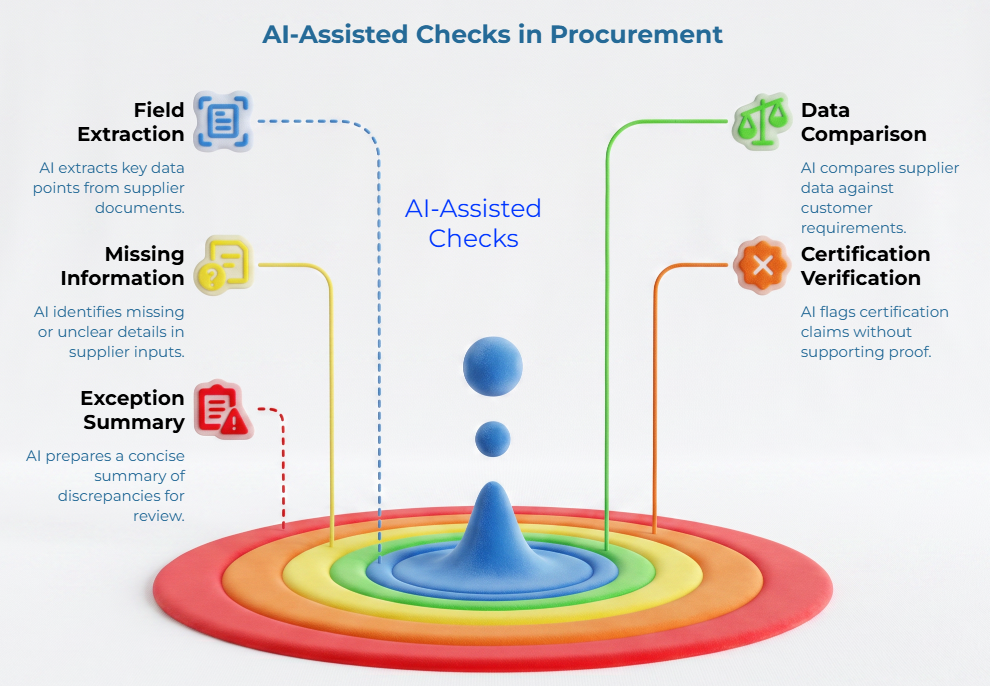
AI is most useful in repetitive, document-heavy review work. In paper specification matching, that means extracting fields, structuring supplier inputs, comparing normalized data, identifying missing information, and drafting exception notes for review.
It can support tasks such as:
- Pulling GSM, grade, size, coating, brightness, packaging, and certification references from supplier documents
- Comparing supplier offer fields against a customer requirement record
- Flagging missing tolerance values or unclear acceptance notes
- Highlighting certification claims that lack attached proof
- Preparing a short exception summary for human approval
These are general capabilities, not claims about any specific product. Actual performance depends on document quality, system design, training data, workflow controls, and human review. A clean supplier PDF is easier to process than a scanned image with handwritten notes. A structured customer requirement is easier to compare than a loose email chain.
The practical value is not in replacing expertise. It is in reducing the chance that a field gets overlooked because the review was rushed, the document format was unfamiliar, or the comparison involved too many variables for a single pass.
A common pitfall is treating an AI-generated match as a confirmation. An AI tool can compare values and flag discrepancies, but it cannot assess whether a supplier substitution is commercially acceptable or whether a certification claim is adequately documented. Those decisions remain with the procurement team.
For teams comparing broader commercial offers after specification checks, dedicated resources on AI-assisted quote comparison for paper buyers can be a useful related resource.
AI Can Assist; Humans Still Decide
| AI can help with | Humans should decide on |
| Extracting fields from customer requests and supplier offers | Whether an ambiguous customer requirement is acceptable |
| Comparing normalized values across documents | Whether a supplier substitution should be approved |
| Flagging missing fields or conflicting values | Whether tolerance differences are commercially acceptable |
| Drafting exception notes for review | Whether certification evidence is sufficient for the customer requirement |
| Maintaining a repeatable review checklist | Whether the order should proceed, pause, or be escalated |
This split is important because supplier documentation is not always complete. Certifications and tolerances are also nuanced. Treating them as simple yes-or-no fields can create false confidence.
For chain-of-custody claims, FSC explains that certification supports use of FSC labels and trademarks when chain-of-custody requirements are met through the supply chain. PEFC also provides resources for checking certified entities and related certification information. These resources can support verification, but the buyer still needs to match the claim to the supplier, product, document wording, and customer requirement.
Consulting specific guidance on how to run a quick registry check for FSC/PEFC certificates is a generally relevant next step when certification proof is part of the order review.
What Still Needs Human Review
Certain specification checks require contextual judgment that automated tools cannot reliably provide: ambiguous customer requirements where the intent behind a specification is unclear, supplier substitutions where a different grade or coating is offered as equivalent, tolerance deviations that fall outside the stated range but may still be functionally acceptable, certification claims not yet supported by verifiable documentation, and packaging differences that may affect logistics or customer acceptance.
A common objection: “Our buyers already know what to check.” They likely do. The checklist is not a replacement for that expertise — it is a consistency tool for handoffs, team changes, and fast-moving requests where pressure to confirm creates pressure to skip. Human review is not a bottleneck. It is the control layer that prevents a fast, automated check from becoming a fast, automated mistake.
How To Handle Exceptions Before Confirming The Order
Exceptions should be handled in a visible, repeatable way. Do not leave them scattered across an email chain.
Use a four-step process:
- Flag the mismatch clearly. State the field, the customer requirement, the supplier offer, and the source document.
- Clarify ownership. Decide whether the supplier, customer, QA team, sales team, or procurement lead must answer.
- Approve or reject the deviation. Avoid vague phrases such as “should be fine” unless the internal approval process accepts them. Claim wording on quotes, POs, and invoices matters — particularly for FSC/PEFC transactions where documentation precision determines whether a certified claim survives the supply chain.
- Document the final decision. Attach the supplier proof, customer confirmation, or internal approval note before order confirmation.
For example: a supplier offers the correct GSM and grade, but proposes different packaging from the customer’s stated requirement. That may be acceptable for some orders and unacceptable for others. The decision should not depend on memory. It should be recorded before confirmation.
The same discipline applies to tolerances. If a supplier’s value is close but not exact, the team should confirm whether the customer requirement allows that variation. Do not assume acceptance because the difference looks small.
Skipping documentation is a recurring gap. When exceptions are approved verbally but not recorded, the same mismatch reappears on the next order without any institutional memory of how it was handled.
Frequently Asked Questions
Can AI fully automate paper specification matching?
No. AI can assist with extraction, comparison, and mismatch flagging. Human review is still needed for ambiguous specifications, tolerance differences, supplier substitutions, certification claims, and order acceptance decisions.
Which paper specifications should procurement teams check first?
Start with the fields that define whether the supplier offer matches the customer requirement: GSM, grade, size, coating, brightness where relevant, packaging, tolerances, and certifications if required or claimed. The pre-confirmation checklist above provides a structured approach. Price and delivery should come after specification completeness.
How should certification claims be handled?
Certification claims should be checked against supplier-provided documentation and official scheme resources where relevant. A mention of FSC or PEFC in a supplier email does not constitute verification — just a claim. For a practical verification workflow, see the buyer’s guide to paper certifications: FSC, PEFC, and beyond. The required depth of review may vary by customer, claim type, and transaction context.
What if the supplier offer is close but not exact?
Treat it as an exception. Record the difference, ask for clarification, confirm whether the deviation is acceptable, and keep the approval trail with the order file. “Close” is only acceptable when the customer requirement or approval record allows it.
Is brightness the same as whiteness?
No. Brightness typically refers to reflectance at 457 nm, with standards such as TAPPI T 452 defining the methodology. Whiteness is a broader perceptual measure. When brightness is part of the customer requirement, compare the stated brightness value and any required method or tolerance rather than relying on visual descriptions alone.
Make Specification Matching Repeatable Before Making It Faster
A rushed order confirmation feels efficient until a missing field reappears as a dispute.
The pattern that causes the most damage is not a single dramatic error. It is the small, avoidable mismatch that nobody caught because the process did not require them to look.
The better approach is slower only at first. Capture the customer requirement. Normalize the supplier offer. Compare the fields that matter. Use AI to flag gaps. Keep human review for judgment, exceptions, tolerances, certifications, and commercial acceptance.
That is how AI-assisted specification matching earns its place in paper trading procurement. Not as a promise of error-free ordering, but as a practical control that helps experienced teams catch what hurried manual review can miss.
AI-assisted checks can help procurement teams standardize comparison, reduce extraction effort, and maintain a consistent checklist across orders and paper suppliers. Use the checklist to review the current spec-matching workflow before the next supplier offer is confirmed.
Disclaimer:
This article is for general educational purposes and does not replace supplier documentation review, contractual review, technical quality assurance, or certification verification.
Our Editorial Process:
Our expert team uses AI tools to help organize and structure our initial drafts. Every piece is then extensively rewritten, fact-checked, and enriched with first-hand insights and experiences by expert humans on our Insights Team to ensure accuracy and clarity.
About the PaperIndex Insights Team:
The PaperIndex Insights Team is our dedicated engine for synthesizing complex topics into clear, helpful guides. While our content is thoroughly reviewed for clarity and accuracy, it is for informational purposes and should not replace professional advice.