
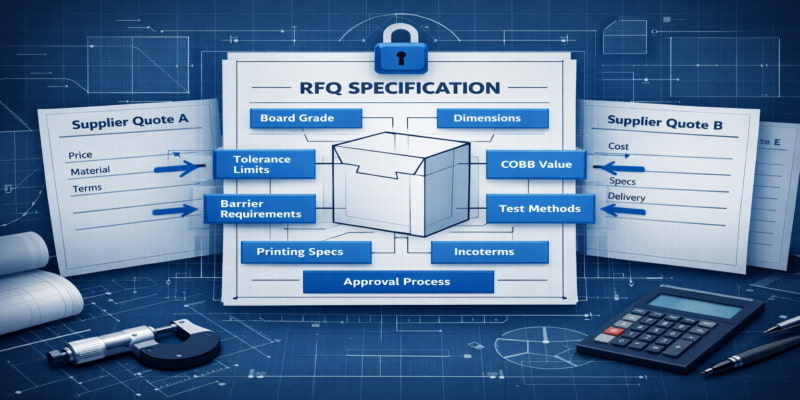
📌 Key Takeaways
Supplier quotes only compare fairly when every supplier prices the exact same package—not their own interpretation of it.
- Name What Matters, Not Just Size: Dimensions and material type invite guesswork; tolerances, test methods, and barrier specifications force consistent pricing.
- Block the Guessing Game: Each checklist field should answer what’s required, how it’s measured, and what supplier assumption it prevents.
- Vague Wording Costs Money: “Moisture resistant” means nothing without a COBB value and test method; suppliers fill gaps with the cheapest acceptable option.
- Test Your RFQ Before Sending: If two suppliers could read it and price different products, the specification still needs work.
- Start Simple, Then Sharpen: Your first checklist won’t be perfect—each order cycle reveals which fields actually matter for your product.
Clearer specifications today mean fewer surprises after the folding cartons arrive.
Procurement managers and packaging buyers drafting their first serious supplier requests will gain a ready-to-use framework here, preparing them for the detailed parameter guidance that follows.
~ ~ ~ ~ ~ ~ ~ ~ ~ ~ ~ ~ ~ ~ ~ ~ ~ ~
The RFQ template sits open, and you realize that “paperboard folding carton, 300 gsm, holds 500g product” leaves too much room for interpretation. One supplier might assume moisture resistance is required. Another quotes the cheapest board grade that technically fits. A third adds barrier coatings you never requested—and prices accordingly.
A packaging parameter checklist is the minimum set of technical and commercial fields that should be named before suppliers quote for folding cartons or other packaging formats. It is the first step in specification alignment: getting everyone to price the same package, not their own interpretation of it.
This is where the first RFQs go wrong. You know what the folding carton must do, but you have not yet translated that knowledge into the technical language suppliers need to quote accurately. The result is a stack of proposals that look comparable but describe fundamentally different products.
A standardized checklist serves as the technical foundation for the RFQ, providing a structured framework that defines critical variables and prevents supplier-side assumptions. Material grades, tolerances, barrier requirements, test methods: when these are explicit, every supplier quotes against the same baseline. With this checklist, you can draft an RFQ that produces comparable responses and positions you as a prepared buyer from the first interaction.
Why First RFQs Fail When They Only Include Dimensions And Material
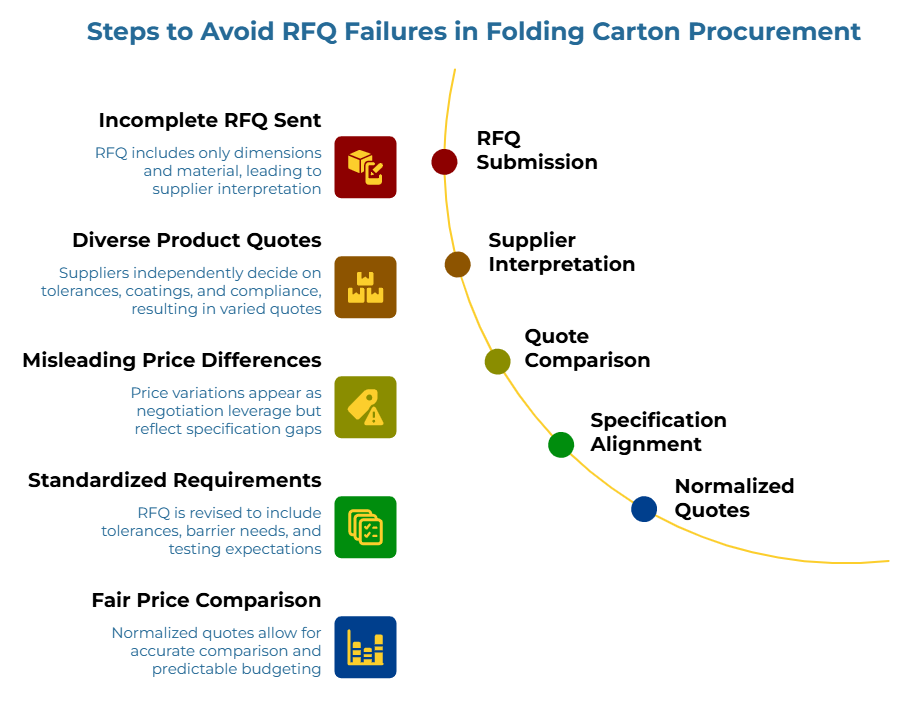
A successful RFQ requires more than dimensions and material type. It requires precise tolerance parameters, named test methods, and explicit assumptions about everything from print registration to moisture exposure.
When an RFQ states only “SBS board, 350 gsm, 120 × 80 × 40 mm,” each supplier must independently decide what caliper variance is acceptable, whether the board needs sizing for humidity resistance, what print method to assume, and how to handle unspecified barrier needs. Three suppliers might return quotes for three meaningfully different products—all technically matching the brief.
The problem compounds at comparison time. Price differences that look like negotiating leverage often reflect specification differences you never intended to create. One quote includes aqueous coating; another assumes UV varnish. One supplier priced food-grade compliance; another quoted industrial-grade stock. Gaps invite suppliers to fill in the blanks with the cheapest acceptable interpretation.
As a general procurement principle, a stronger RFQ names not only the package, but also the tolerance parameters, barrier requirements, approval logic, and testing expectations that define the package in use—an approach detailed in our guide, the guesswork gap: using specification-true quotes to build a predictable folding carton packaging budget. Specification alignment must come before quote comparison—a principle explored in depth in how to normalize your first folding carton quote. You cannot normalize pricing across suppliers who interpreted your requirements differently.
The Baseline Packaging Parameter Checklist For Your First RFQ
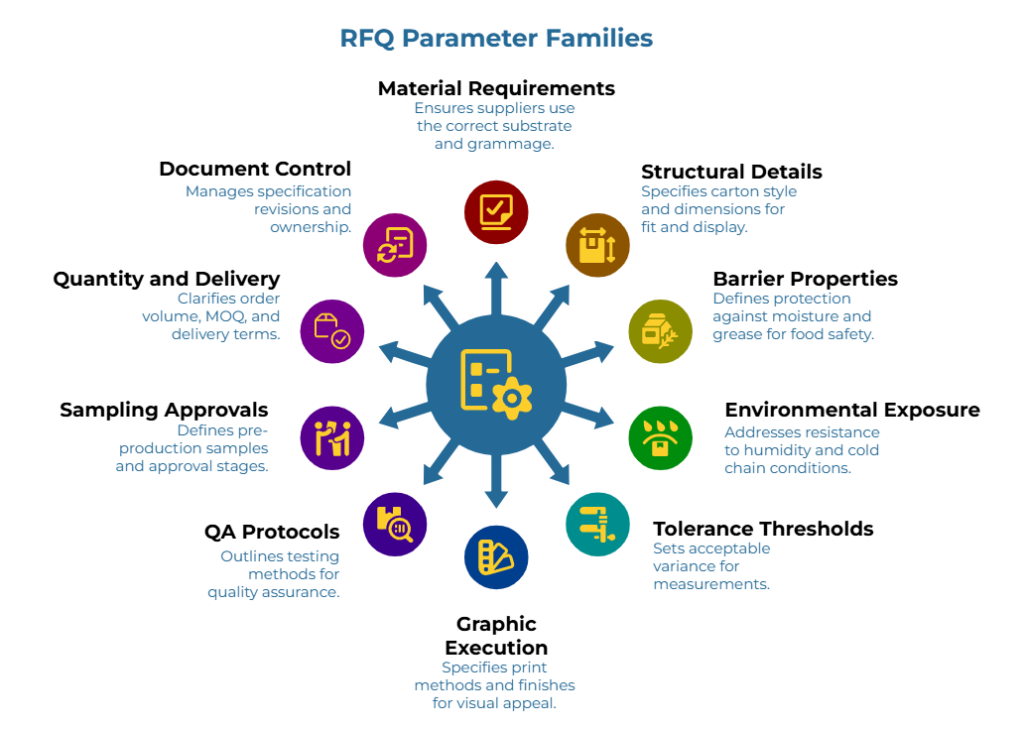
Use these ten parameter families as your RFQ foundation. For each category, name the specific field, state your requirement, and note the test method or standard where applicable.
Each parameter family should answer four questions: what must be named, why it matters, what ambiguity it prevents, and what supplier guesses it blocks.
1. Material And Board-Grade Requirements
State the substrate type (SBS, FBB, recycled board), the target grammage with acceptable tolerance, and caliper if critical to your filling equipment. For detailed guidance on tolerance specifications, see board grade tolerances explained: securing folding carton specifications across suppliers. Reference ISO 536 for grammage measurement when specifying tolerance bands. Without this clarity, suppliers choose board grades based on their own inventory economics, not your performance needs. This prevents suppliers from assuming visual similarity equates to mechanical performance.
2. Dimensions, Style, And Structural Construction Details
Provide internal dimensions for product fit, external dimensions if shelf-space matters, and the folding carton style (tuck-end, auto-bottom, sleeve). Specify wall thickness assumptions and any die-line requirements. Omitting style details means suppliers quote their default construction—which may not suit your filling line or retail display requirements. This prevents suppliers from quoting a simpler, cheaper structure than the one actually required.
3. Barrier, Migration, And Product-Contact Requirements
For applications involving food-contact paper, food packaging paper or folding cartons, this section cannot remain implied. State whether the folding carton contacts food directly or indirectly, what barrier properties you need (grease resistance, moisture vapor transmission), and the regulatory framework governing your market. Reference the FDA food-contact substances guidance, FDA 21 CFR Part 176 for paperboard components (alongside Parts 175 or 177 for any applied barrier coatings or adhesives) for U.S. requirements, or EU Regulation 1935/2004 for European markets. When barrier expectations stay implied, the unexpected production downtime becomes a significant risk—wrong COBB values discovered only after folding cartons arrive and fail on the line. This blocks the dangerous guess that “food-safe” is self-explanatory.
4. COBB Values, Moisture Limits, And Environmental Exposure
If your product ships through humid environments or faces cold-chain exposure, specify COBB values (water absorptiveness) per TAPPI T 441 and moisture content limits per ISO 287. State storage and transit conditions the folding carton must withstand. These parameters prevent the frantic finger-pointing calls that follow when folding cartons warp or delaminate in transit because environmental exposure was never defined. This blocks the guess that a standard indoor-storage board is acceptable for a demanding environment.
5. Dimensional and Material Tolerance Thresholds
Define acceptable variance for every measurable specification. A ±5% tolerance on grammage means something different than ±2%. Name the acceptance criteria clearly: what triggers rejection, what requires concession pricing, what passes without question. Without stated tolerances, “within spec” becomes a matter of interpretation rather than measurement.
6. Graphic Execution and Surface Finish Specifications
Specify the print method (offset, flexo, digital), color matching standard (Pantone, CMYK with Delta-E tolerance), coating type (aqueous, UV, soft-touch lamination), and artwork file format. State who owns die-line creation and how many proof rounds are included. Print assumptions left unstated result in quotes that cannot be compared—one supplier prices four-color offset with UV coating while another quotes two-color flexo with aqueous finish. Leaving this undefined ensures suppliers will quote the cheapest acceptable finish, or assume an outdated artwork file applies.
7. Quality Assurance (QA) Protocols and Validation Standards
Name the specific test methods you expect suppliers to use for incoming material verification and finished-goods inspection. Referencing industry standards removes ambiguity about how compliance will be measured. If you require a Certificate of Analysis with each shipment, state that requirement here. For a structured approach to organizing supplier documentation, see from claims to proof: a practical guide to supplier evidence packs for folding cartons. Test results are only comparable when the method is comparable. This blocks the guess that any internal supplier method is good enough.
8. Sampling, Approvals, And Production-Stage Checkpoints
Define how many pre-production samples you require, what approval milestones trigger production release, and whether you expect on-press approvals for color-critical work. For guidance on evidence requirements, see what proof to request at RFQ stage for folding cartons. State turnaround expectations for each approval stage. Undefined approval flows create timeline disputes when suppliers assume one round of samples and you expect three. This blocks the guess that production can start from an informal email approval.
9. Quantity, MOQ, Lead Time, And Delivery-Basis Assumptions
Provide the initial order quantity, expected annual volume, and delivery schedule. State the applicable Incoterm®—such as FCA, DAP, or DDP for multimodal transport, or FOB and CIF for ocean freight—to ensure landed-cost comparability. Ask suppliers to confirm their minimum order quantity and standard lead time. Missing delivery-basis assumptions make true cost comparison impossible—a lower unit price means nothing if it excludes freight you must arrange separately. This blocks the guess that a price based on a very different volume or delivery basis is still comparable.
10. Document Control, Revision History, And Version Ownership
Specify who controls the master specification document, how revisions are numbered and communicated, and what approval process governs specification changes after production begins. This prevents confusion when design updates occur mid-relationship. It blocks the guess that an older drawing or artwork file still applies.
How To Write Each Checklist Line So Suppliers Do Not Guess
The difference between vague and quote-ready phrasing determines whether suppliers interpret or execute.
A useful checklist line follows a simple structure: field name, required condition, acceptable range or approval basis, and test or reference method where relevant.
Weak wording invites interpretation:
- “Use suitable board”
- “Food-safe material”
- “Standard moisture resistance”
- “Board should be moisture resistant”
- “Standard print quality expected”
Quote-ready wording reduces guesswork:
- Board grade: state approved substrate family, grammage basis, and whether substitution requires written approval
- Product contact: state direct or indirect contact and the applicable food-contact framework
- Moisture behavior: state the operating environment and the test or approval basis used to judge suitability
- “Cobb60 value ≤ 25 g/m², tested per TAPPI T 441. Folding cartons will be stored in ambient warehouse conditions (15–25°C, ≤65% RH) and shipped via ocean freight with 21-day transit exposure.”
- “4-color process offset lithography. Color matching to Pantone Solid Coated references provided. Delta-E ≤ 2.0 for brand colors. Aqueous gloss coating on exterior panels.”
Each line should answer three questions: What is the requirement? How is it measured? What conditions apply? For deeper guidance on structuring quote-ready fields, see how to build quote-ready folding carton fields without making suppliers guess.
Common Omissions That Create Quote Chaos In A RFQ
Watch for these frequently missing elements that undermine quote comparability:
- Missing tolerance ranges. Stating “350 gsm” without “±3%” forces suppliers to assume their own acceptable variance—and those assumptions will differ.
- Implied barrier expectations. Assuming suppliers know your product is food-contact or moisture-sensitive without stating it explicitly invites mismatched quotes.
- No test-method reference. Requesting “moisture resistance” without naming COBB values or the test standard leaves measurement undefined and disputes inevitable.
- Unclear approval flow. Failing to state how many sample rounds, who approves, and what timeline applies creates scheduling conflicts after orders are placed.
- No version ownership. Omitting who controls the master specification document creates confusion when changes arise mid-production.
- Missing delivery-basis assumptions. Quoting without a named Incoterm makes landed-cost comparison impossible across suppliers in different regions.
Each omission creates room for supplier assumptions. That is why specification alignment must come before RFQ normalization, supplier vetting, or cost forecasting. Understanding why folding carton clarity matters before supplier review starts helps mitigate systemic procurement risks.
A 5-Point Pre-Send Review Before Your RFQ Goes Out
Before releasing your RFQ, confirm these five checkpoints:
- Can two suppliers read it and price the same package? Every measurable specification includes a tolerance band. Grammage, caliper, dimensions, color accuracy—if it can be measured, it needs an acceptable range.
- Are barriers and compliance requirements explicit, not assumed? If food-contact, name the regulation. If moisture-sensitive, state the COBB target.
- Is at least one test method named? Referencing ISO, TAPPI, or ASTM standards signals technical preparedness and ensures measurement consistency across suppliers.
- Do delivery terms use a named Incoterm? FOB, CIF, or DDP—without this, you cannot compare landed costs.
- Does the document name a version and owner? Even “Rev 1.0 – Issued by [Your Company]” establishes control and enables clean revision tracking.
If your RFQ passes all five points, you have built a foundation for comparable supplier responses. If the answer to any of those is no, the RFQ still needs work.
Start With A Checklist, Then Improve Precision With Each RFQ Cycle
The goal of a first checklist is not perfection. It is to stop supplier interpretation from doing the design work for you.
Each procurement cycle teaches you which parameters matter most for your product category, which tolerances your filling lines actually require, and which supplier assumptions caused problems in past orders. Your checklist will grow more precise with every iteration—moving you from “I know I need quotes” to “I know exactly what fields must be named before I ask for quotes.”
Providing a standardized parameter checklist prevents suppliers from making dangerous assumptions. In the language of Specification-True Sourcing, the first control is not a clever negotiation tactic. It is a clearer definition. That single shift—from reactive correction to proactive specification—is the first practical step in the Specification-True Mindset that separates structured procurement from quote chaos.
For a comprehensive framework connecting specification alignment to supplier vetting, explore the folding carton specification alignment checklist. When ready to connect with qualified suppliers, find folding carton suppliers through the PaperIndex directory.
Disclaimer:
This article provides general educational guidance on packaging procurement practices. Specifications, tolerances, and regulatory references (FDA, EU, ISO, TAPPI) are illustrative and may not reflect current requirements. Consult qualified packaging engineers and legal advisors for application-specific compliance. Test methods and standards cited should be verified against current published editions.
Our Editorial Process:
Our expert team uses AI tools to help organize and structure our initial drafts. Every piece is then extensively rewritten, fact-checked, and enriched with first-hand insights and experiences by expert humans on our Insights Team to ensure accuracy and clarity.
About the PaperIndex Insights Team:
The PaperIndex Insights Team is our dedicated engine for synthesizing complex topics into clear, helpful guides. While our content is thoroughly reviewed for clarity and accuracy, it is for informational purposes and should not replace professional advice.