

📌 Key Takeaways
Folding carton quotes become comparable only after you confirm every supplier priced the exact same job.
- Price Gaps Signal Specification Gaps: A 15% spread between quotes usually means suppliers interpreted your request differently, not that one is cheaper.
- Freeze the Ranking Reflex: Spend the first 48 hours mapping assumptions and blanks instead of comparing bottom-line numbers.
- Align Five Baselines First: Material, structure, performance, proof requirements, and delivery terms must match before any price comparison means anything.
- Re-Quote for Clarity, Not Discount: Ask suppliers to quote against one shared specification sheet—you’re standardizing the job, not negotiating the price.
- Surface Hidden Assumptions: Add an “unresolved assumptions” column to your worksheet so nothing stays buried in fine print.
Same specification, same terms, then compare.
Procurement managers and packaging buyers sourcing folding cartons for the first time will gain a practical framework here, preparing them for the detailed step-by-step guide that follows.
~ ~ ~ ~ ~ ~ ~ ~ ~ ~ ~ ~ ~ ~ ~ ~ ~ ~
Comparing folding carton quotes often feels like an exercise in frustration. When three suppliers return three vastly different bottom-line figures, the lack of a clear winner usually stems from a lack of technical alignment. One supplier quoted 300 gsm board, another listed “standard cartonboard,” and the third mentioned calipers in microns without specifying grammage at all. You came looking for a price comparison. What you got was three documents that cannot be compared.
This is quote-normalization territory—a challenge familiar to any buyer sourcing folding cartons from multiple suppliers. Normalization is the process of stripping away hidden assumptions and unstated variables so that every supplier prices the exact same specification. Think of it like creating an architectural blueprint before asking builders to bid on a house.
That reframe is what experienced buyers call a specification-true mindset. Price comes second. Specification alignment comes first.
You can address these discrepancies immediately upon receiving your initial quotes. This guide walks you through a practical framework for normalizing folding carton quotes so your next comparison actually means something.
Why Folding Carton Quotes Become Incomparable
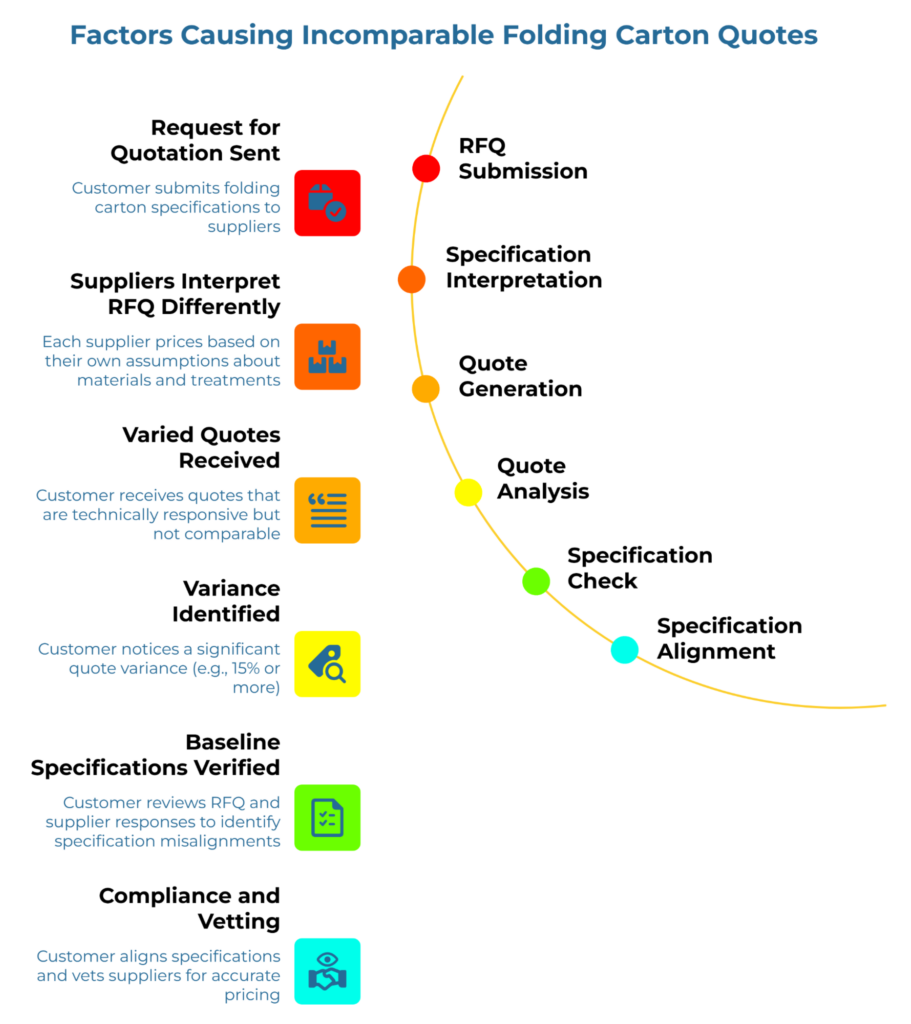
Quote variance rarely reflects true market price differences. More often, it reflects specification variance—suppliers interpreting your RFQ differently and pricing different jobs.
Here is how the same request generates wildly different quotes. Consider a ‘food-grade’ request: Supplier A might price a polyethylene (PE) barrier, Supplier B a greaseproof treatment, and Supplier C an uncoated board. Each is ‘correct,’ yet they are pricing three different products. All three quotes are technically responsive to your request. None of them can be compared fairly.
The same divergence happens with board grade terminology. One supplier quotes “SBS” (solid bleached sulfate), another quotes a recycled alternative, and a third uses a proprietary grade name that maps to neither. Unless you specified grammage and calipers with explicit tolerances, each supplier filled in the blanks using their own assumptions.
A useful working rule: a quote variance of 15% or more often points to misaligned specifications rather than pure market price differences. The exact percentage can vary by product, supplier mix, raw material volatility, and how incomplete the original RFQ was, but the principle generally holds. When the spread looks surprisingly wide, check the baseline before judging the supplier. For a deeper explanation of why specification fields drive quote accuracy, see the folding carton specification alignment checklist: connecting compliance to supplier vetting.
What to Do in the First 48 Hours After Quotes Arrive
Resist the urge to rank quotes by bottom-line price immediately. That number is meaningless until you confirm what each supplier actually priced.
A clean first-48-hours triage follows this sequence:
- Set aside the bottom-line comparison.
- Isolate every technical and commercial assumption each supplier made.
- Mark blanks, substitutions, and mismatched terms.
- Build one shared comparison sheet with every supplier in rows and every specification field in columns.
- Send one unified re-quote request back to every supplier.
Common assumption zones include board grade and grammage, coating or barrier type, dimensional tolerances, proof or sample requirements, and delivery terms. If Supplier A quoted a specific coating and Supplier B left that field blank, mark it. If Supplier C quoted a different caliper than the others, mark it. These are the gaps that make comparison impossible.
You are not asking suppliers to lower their price. You are asking them to re-quote against the same specification baseline so you can compare accurately.
The 5-Point Quote Normalization Framework
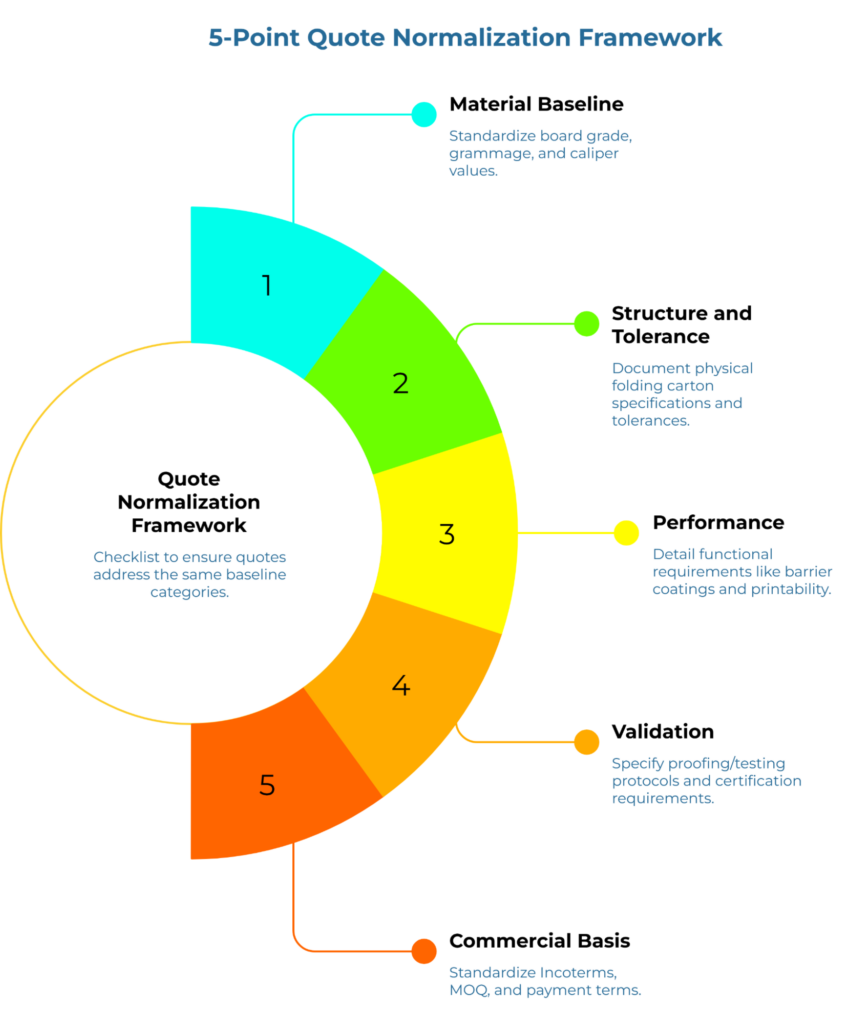
Use this checklist to confirm that every quote addresses the same five baseline categories before you compare prices.
1. Material Baseline: Standardize board grade (SBS, FBB, CUK), grammage (gsm), and caliper (microns/pt). If one supplier quoted 280 gsm and another quoted 320 gsm, you are not comparing the same folding carton. Look for substrate type (virgin fiber, recycled, or blended), explicit grammage and caliper values, and any material substitutions flagged by the supplier.
When quotes use formal paper and board terms, keeping the language consistent helps. ISO 536 is the standard reference for grammage, and ISO 534 is the standard reference for thickness and related measures. You do not need to become a standards specialist. You do need the same words to mean the same thing across all suppliers.
2. Structure and Tolerance: Document physical folding carton specifications. This includes external dimensions and internal clearances, folding style and closure mechanism, and tolerance expectations for fit-critical features. A folding carton that is 2 mm shorter than specified may not fit your filling line. If tolerances were not defined in your RFQ, suppliers assumed their own. Understanding board grade tolerances helps prevent downstream disputes that arise when suppliers interpret specifications differently.
3. Performance: Detail functional requirements. This includes barrier coatings (moisture, grease, oxygen), surface treatments and printability requirements, and regulatory compliance for food contact or other end-use conditions. If your product requires grease resistance, verify that each supplier quoted the same barrier performance level.
4. Validation: Specify proofing/testing protocols.. Some suppliers include first-article samples in the quoted price. Others treat samples as a separate billable item. Clarify whether the quote covers named test methods, production samples or proofs, and any certification documentation required before approval.
For moisture-related performance verification, ISO 535 (or TAPPI T 441 in North America) is generally the recognized standard reference for Cobb water absorptiveness. The exact proof package varies by product, market, and internal approval process—that part is context-specific. The principle holds: if one quote includes proof obligations and another does not, the quotes are not yet aligned. A structured proof ladder helps sequence evidence requirements so that quote-stage asks remain proportionate while deeper validation follows. For guidance on what evidence to request at the quoting stage, see what proof to request at the RFQ stage for folding cartons.
5. Commercial Basis: Standardize Incoterms and MOQ. A quote priced EXW (Ex Works) is not comparable to a quote priced DDP (Delivered Duty Paid) without adjusting for freight, duties, and handling. Check that delivery terms follow a consistent Incoterms 2020 basis, minimum order quantities and price-break thresholds are stated, and payment terms and lead times are explicit rather than assumed.
Delivery terms are a common source of confusion. The ICC Incoterms rules are the formal reference when delivery basis affects comparability. Separate technical comparability from commercial terms, then align both.
Un-Normalized vs. Normalized Quote Comparison
| Area | Un-Normalized Quote | Normalized Quote |
| Material | Board grade named loosely or differently | Board grade, grammage, caliper, and substrate aligned |
| Structure | Dimensions or tolerances interpreted by supplier | Dimensions, style, and tolerance expectations fixed |
| Performance | Coating, barrier, finish, or print needs implied | Performance requirements named clearly |
| Validation | Proof and test expectations unclear | Proof and evidence requirements stated upfront |
| Commercial basis | Freight, tooling, or delivery assumptions buried | Inclusions, exclusions, and quote basis stated separately |
Once hidden assumptions are surfaced, price becomes readable.
How to Ask for a Normalized Re-Quote
Going back to suppliers does not have to be adversarial. Frame the request as a clarification, not a negotiation. Normalization is a process discipline, not a negotiation trick. You are not pushing suppliers into a corner. You are shifting control back to the buyer.
Send each supplier a brief message that includes your updated specification sheet with all fields explicitly defined, a request to re-quote against that specification without changing their pricing methodology, and a deadline that gives them reasonable time to respond.
Ask each supplier to declare unresolved assumptions explicitly rather than filling them silently. That last instruction matters because suppliers who take specification discipline seriously will appreciate the clarity. For a ready-to-use specification structure, adapt the framework in the baseline packaging parameter checklist: structuring your folding carton specification requirements.
Build a Simple Comparison Worksheet
Once re-quotes arrive, organize them in a single worksheet. Use columns for supplier name, material baseline (board grade, grammage, caliper), structure and tolerance baseline (dimensions, folding style, tolerances), performance baseline (coatings, barriers, compliance), validation baseline (samples, test methods, certifications), commercial basis (Incoterms, MOQ, payment terms), quoted unit price, and unresolved assumptions or open questions.
| Supplier | Supplier A | Supplier B | Supplier C |
| Material Baseline | |||
| Structure / Tolerance | |||
| Performance Baseline | |||
| Validation Baseline | |||
| Commercial Basis | |||
| Quoted Unit Price | |||
| Unresolved Assumptions |
Keep the worksheet simple enough to recreate in any spreadsheet application. The goal is a side-by-side view where every row uses the same specification language. Mark each field as aligned, mismatched, or unresolved. If a cell is blank or contains a different value than the others, that quote is not yet normalized.
What to Do After the Quotes Are Normalized
Normalized quotes are a starting point, not a finish line. Once you can compare prices fairly, the next steps become clearer.
First, tighten your specification. If the normalization process revealed fields you had not defined clearly, update your internal specification document before your next RFQ. This prevents the same gaps from recurring.
Second, define proof expectations. Decide which test methods and certifications you require, and build those requirements into your supplier qualification process rather than negotiating them after quotes arrive. Keep in mind that certificates alone do not qualify a folding carton supplier—you need evidence tied to your specific specifications.
Third, deepen supplier vetting. With quotes normalized, you can now evaluate suppliers on factors beyond price: production capacity, quality consistency, lead-time reliability, and communication responsiveness. For a systematic approach, see from guesswork to governance: a comprehensive folding carton supplier verification methodology.
Buyers in food and beverage, beauty, household goods, private-label products, and contract packaging often feel pressure to move straight to negotiation because the clock is running and the budget is waiting. Understandable. Risky. A more reliable path is slower at the start and faster later. Clean up the quoting frame. Re-quote against a unified structure. Then compare suppliers on the same baseline.
Quote normalization is not a one-time fix. It is the foundation of a disciplined sourcing process that reduces disputes, prevents cost overruns, and builds confidence in every purchasing decision.
Explore the PaperIndex Academy for more folding-carton sourcing guides. When you are ready to connect with qualified suppliers, browse folding carton suppliers to begin building your shortlist.
Disclaimer:
This article is for educational purposes only.
Our Editorial Process:
Our expert team uses AI tools to help organize and structure our initial drafts. Every piece is then extensively rewritten, fact-checked, and enriched with first-hand insights and experiences by expert humans on our Insights Team to ensure accuracy and clarity.
About the PaperIndex Insights Team:
The PaperIndex Insights Team is our dedicated engine for synthesizing complex topics into clear, helpful guides. While our content is thoroughly reviewed for clarity and accuracy, it is for informational purposes and should not replace professional advice.