
📌 Key Takeaways
Damaged cartons point to specific failure types and each one needs a different paper property, not just “stronger” material.
- Name the Failure, Not the Fix: Crushing, tearing, puncture, and bursting each trace back to different paper properties, so “stronger” without a diagnosis wastes money.
- Check the Whole System First: Box design, pallet patterns, humidity, and handling cause as many failures as the paper itself — don’t skip them.
- Match the Test to the Problem: Burst strength, tear resistance, and crush performance answer different questions, and using the wrong one leads to the wrong upgrade.
- Over-Specifying Costs You Quietly: Paying for extra strength that doesn’t address the actual failure adds weight, cost, and fibre use without reducing damage.
- Collect Evidence Before Changing Specifications: Photos, failed samples, shipment records, and supplier data build a case that protects your budget and your specification.
Diagnose the damage first — then specify the property that actually prevents it.
Procurement managers, packaging engineers, and QA leads working with corrugated packaging will gain a clear method for turning carton failures into precise supplier conversations, preparing them for the detailed diagnostic framework that follows.
~ ~ ~ ~ ~ ~ ~ ~ ~ ~ ~ ~ ~ ~ ~ ~ ~ ~
Crushed corners. Split sidewalls.
Carton damage identified during warehouse receiving often prompts an immediate request for ‘stronger’ paper. We need stronger Kraft paper. But “stronger” is not a specification. A carton that collapses under pallet load requires a different durability conversation than one that tears at a flap or punctures during parcel handling.
You have likely been here before: suppliers quoting strength metrics that are hard to interpret, internal pressure to either cut material cost or “just upgrade the paper,” and no clear way to connect the damage you see with the durability property you should specify.
The goal is to move from “our cartons are getting damaged” to “which durability requirement should we discuss with our brown paper jumbo rolls supplier, converter, or packaging engineer?” A structured diagnostic approach lets you build performance-based specifications that balance durability, cost, sustainability, and end-use risk — giving suppliers something defensible instead of a vague request for more strength.
Why “Stronger Kraft Paper” Is Usually the Wrong Starting Point
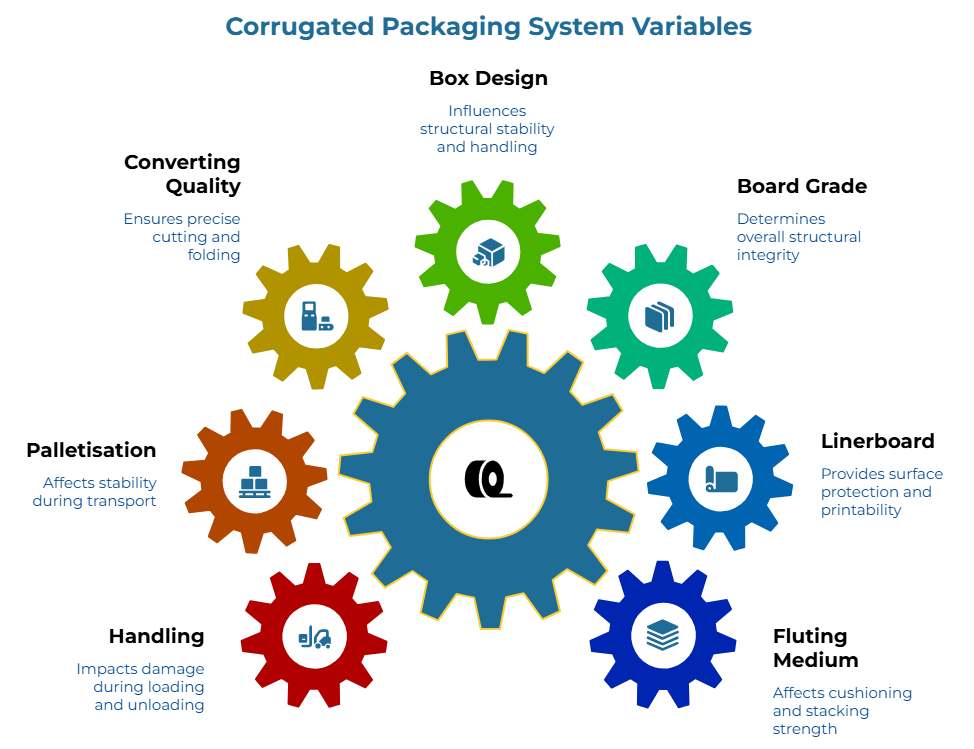
Damaged cartons create claims, complaints, waste, and supplier disputes. The instinct to request stronger paper is understandable. But Kraft paper durability is only one variable inside a corrugated packaging system that includes board construction, flute profile, box design, converting quality, palletisation, and handling.
A kraft paper mother roll delivers specific properties to the converting process. The finished carton’s performance depends on how that paper interacts with the fluting medium, the linerboard, the board grade, and the box geometry. Visible failure patterns — not generic strength requests — should guide the specification conversation.
It helps to think of the packaging system in three layers. Paper-level properties describe the Kraft paper or linerboard itself. Board-level properties describe the combined corrugated board structure. Box-level performance describes the finished carton under actual use conditions. For a broader specification discipline, our guide on defining and enforcing corrugated box specifications is a useful companion.
Diagnosing the Failure Mode
Before changing paper requirements, diagnose the visible failure pattern. Collect photos, failed cartons, successful cartons, shipment records, customer complaints, retained samples, pallet details, storage notes, and converting records. Note where damage appears in the supply chain — a box damaged during parcel handling is not exposed to the same stress as a box softened during humid warehouse storage.
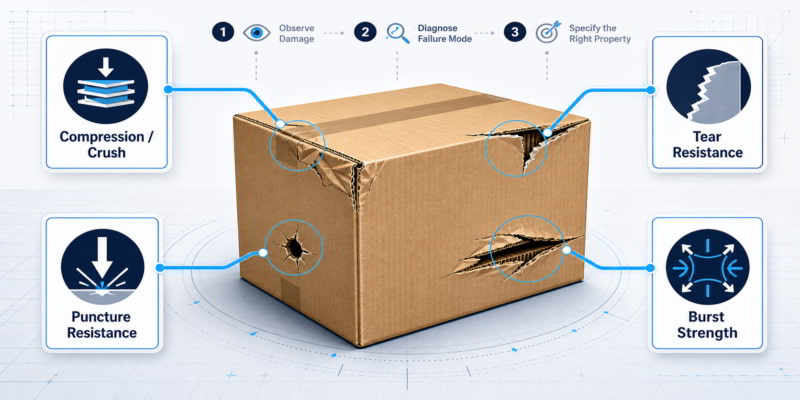
Each category of damage points toward different durability concerns — and sometimes toward causes unrelated to the paper.
- Crushing or compression failure
Cartons that collapse, bow, or deform under pallet loads raise questions about compression-related performance. Stacking load, warehouse storage height, humidity, board construction, board grade, flute structure, box dimensions, and palletisation all play a role. A corrugated box that fails in stacking may need a board construction review before a paper grade change.
If the cartons fail after long storage in a damp environment, changing paper grade alone may not resolve the issue. Compression-related tests and acceptance criteria should be verified with suppliers, packaging engineers, or a qualified lab. ISO 3037, for example, specifies a test method for determining edgewise crush resistance of corrugated fiberboard — but specific applicability should be confirmed for the material and use case.
- Tearing during handling or opening
Cartons that rip at corners, flaps, seams, or hand holes point toward tear resistance. Handling test methods, flap design, scoring, converting quality, and stress concentration at cutouts matter just as much. A tear at a poorly designed hand hole will not improve with a paper upgrade alone.
Tear resistance matters most when damage begins at a cut, edge, crease, handle, or weak point and then propagates. ISO 1974 describes the Elmendorf method for determining the internal tearing resistance (out-of-plane) of the paper. While it is a standard metric for paper durability, for heavy-duty Kraft linerboard used in corrugated shipping containers, tearing resistance is often influenced by fiber orientation and refining levels. Designers should confirm whether ISO 1974 or internal mill specifications for ‘Cross-Direction Tear’ are the primary benchmark for the specific board grade in use.
- Puncture or product-edge damage
Cartons punctured by sharp products, internal movement, external impact, strapping, or rough handling connect to puncture resistance. Product geometry, void fill, internal fit, and distribution handling often contribute as much as the paper. Design changes may be needed alongside — or instead of — a Kraft paper change.
- Burst or sidewall rupture
Cartons that split or burst from internal pressure, overfilling, bulging, or product movement raise burst-related questions. Burst strength should not be treated as a universal proxy for corrugated packaging performance.
ISO 2758 specifies the test method for measuring the bursting strength of paper. However, for the heavier paperboards and Kraft liners typically used in corrugated packaging (specifically those with bursting strengths above 350 kPa), ISO 2759 is the appropriate standard for board-level testing. Ensuring the correct standard is applied prevents calibration errors when moving from paper-level specifications to combined-board requirements. That distinction matters — a paper-level test result and a finished-carton result are not the same thing.
- Inconsistent carton performance
When damage appears in some shipments but not others — across lanes, seasons, suppliers, or production runs — the issue may be moisture exposure, lot variability, converting process variation, supplier consistency, or storage conditions. Compare damaged and undamaged samples from the same design before concluding paper quality is the variable.
Parent roll specifications become especially important here. Basis weight consistency, moisture balance, formation, and roll-to-roll variation can affect converting behaviour. In practice, poor runnability on brown paper parent rolls may show up as web breaks, inconsistent scoring, creasing problems, glue issues, converting rejects, or cartons that perform differently by production run.
Translate Each Failure Pattern into a Durability Conversation
This mapping may help connect field observations to supplier conversations. It is diagnostic guidance, not root-cause proof — lab testing and supplier data should inform any specification change.
| Observed carton issue | Possible risk signal | Durability area to discuss | Other causes to investigate |
| Cartons collapse in stacking | Compression or crush-related weakness | Compression-related paper/board performance; board construction | Pallet pattern, humidity, box design, warehouse load |
| Cartons tear at flaps or corners | Tear propagation under handling stress | Tear resistance, converting quality, score performance | Aggressive handling, poor scoring, weak flap design |
| Cartons puncture during transit | Localised impact or sharp-edge risk | Puncture resistance, liner durability | Product fit, void fill, sharp product edges, strapping damage |
| Sidewalls split or burst | Internal pressure or impact stress | Burst-related performance, liner/board selection | Overpacking, product movement, box dimensions |
| Performance varies by shipment | Material or process inconsistency | Paper consistency, moisture profile, supplier QC | Storage, converting variation, transport lane differences |
Supplier data, lab testing, and controlled trials should be reviewed before changing specifications. A table can guide the conversation; it cannot replace validation.
The Main Kraft Paper Durability Signals Buyers Should Understand
Different failure modes point to different paper properties. Burst, tear, tensile, puncture, and crush-related indicators are not interchangeable — using one metric as a universal answer is a common and costly mistake.
Tensile strength
Tensile strength relates to resistance when paper is pulled or stretched. It may affect converting performance, web breaks during production, and certain structural behaviours — making it relevant to both procurement buyers and production planners. Specific test methods should be verified against current TAPPI or ISO standards.
Tear resistance
Tear resistance matters when damage begins at a cut, edge, crease, handle, or flap and then propagates. This helps explain why cartons sometimes rip during manual handling even when they seem strong in other ways. Prioritize tear metrics if failure originates at geometric stress concentrations (scores, hand holes, or seams).
Burst strength
Burst strength (Mullen) measures the force required to puncture corrugated board liners and is historically used to gauge a box’s ability to contain heavy contents. While still relevant for preventing sidewall rupture from internal pressure, modern logistics—which prioritize stacking—often favor the Edge Crush Test (ECT) as a more accurate predictor of pallet success [TAPPI T 811]. It is generally recommended to specify both if the product is dense or prone to shifting. Board-level performance testing — as described in FEFCO’s technical standards — may be more relevant depending on the failure mode. For a deeper comparison of burst and compression specifications, see our article on ECT vs. bursting strength of paper.
Compression or crush-related performance
Crushing and stacking failures require looking beyond paper alone. The difference between paper-level strength, board-level performance, and finished-box compression is critical. Each tier may point to different solutions — and buyers who can separate these layers are less likely to overpay for the wrong upgrade.
Puncture resistance
Puncture addresses localised damage from impact, sharp product edges, tools, straps, or rough handling — especially relevant for products with hard corners, irregular shapes, or dense items.
Consistency and runnability
Durability is not only about peak strength numbers. Consistency across rolls, moisture balance, basis weight, formation, and converting behaviour affect real-world performance significantly. A grade that looks acceptable on a data sheet can still create production instability if roll moisture, formation, or converting behaviour varies between lots. Verify these parameters with kraft paper suppliers and your internal quality records.
TAPPI’s strength-test education materials identify common paper and board strength tests — including tensile, burst, stiffness, tear, internal bond, and ring crush — and note that different grades face different stresses. Use those references to frame questions, then confirm the exact test method and acceptance criteria with the supplier or lab.
Why Over-Specification Can Be as Risky as Under-Specification
Under-specification is visible. It shows up as damage, complaints, returns, claims, rework, and customer dissatisfaction. Over-specification is quieter. It may increase cost, weight, fibre use, and material intensity without reducing the actual failure risk. That matters for both commercial and sustainability reasons.
The goal is not maximum strength — it is fit-for-risk durability.
When Stronger Kraft Paper Does Not Fix the Problem
Teams sometimes blame parent roll durability when the issue sits elsewhere. Non-paper causes worth investigating include wrong flute profile or board construction, poor scoring or gluing, excessive pallet stacking, moisture exposure, product movement inside the box, sharp product edges without internal protection, rough handling, and incorrect box size causing bulging, void space, or load concentration.
Moisture exposure can also change carton behaviour significantly. A carton that performs well in dry storage may weaken after humid warehousing, sea freight, or poor dock handling.
This is not about deflecting blame — it is about system-level diagnosis. Cross-functional review between procurement, engineering, operations, quality, converters, and kraft liner suppliers usually reaches the root cause faster than a unilateral material upgrade. Procurement brings supplier data and cost trade-offs. Packaging engineering interprets design and test relevance. Quality brings claims and defect patterns. Operations explains storage, palletization, and handling. The converter and paper supplier can help separate material, board, design, process, and handling variables. For RFQ alignment between these teams, the shared checklist for corrugated box RFQs can help procurement and engineering work from the same evidence pack.
If the response is “we just need a stronger grade quickly” — a targeted durability requirement is faster and more commercially defensible than a vague upgrade. Without diagnosing the failure mode, the team may pay more and still see damage. And if procurement pushes back with “we don’t need technical detail” — procurement does not need to become a lab expert, but it does need enough understanding to ask better questions and avoid buying the wrong performance attribute.
Common Mistakes to Avoid
Treating “stronger Kraft paper” as a complete requirement is the most frequent mistake. Specify the risk, not the emotion behind the failure.
Using one strength metric as a universal answer is equally problematic. Burst, tear, tensile, puncture, and crush-related indicators answer different questions about different failure modes.
Ignoring the finished box leads to misplaced specifications. Paper matters, but box design, board construction, and converting quality also influence carton performance.
Upgrading material before diagnosis can raise costs without solving the root cause. If the failure is driven by pallet height, humidity, or product movement, stronger paper changes the cost line without changing the damage pattern.
Focusing only on lab data creates a blind spot. Lab results help, but real shipment conditions, handling practices, and field damage patterns must also be reviewed.
Excluding the converter or supplier until after a specification change is locked in wastes the opportunity to identify whether the issue is material, board, design, process, or handling related — before the wrong change is committed.
How to Build a Risk-Based Kraft Paper Durability Requirement
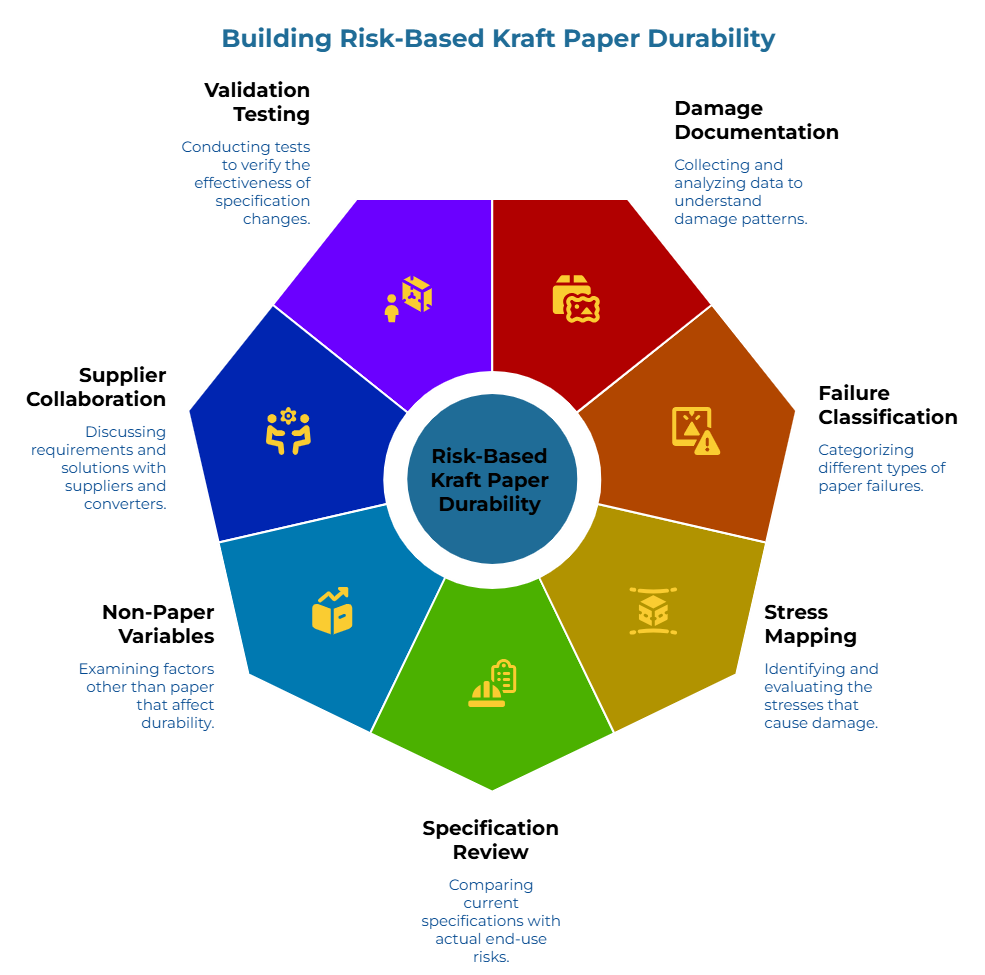
- Document the damage pattern. Collect photos, damaged and successful samples, shipment records, internal claims data, warehouse reports, and customer complaints. Your own company records are essential — they connect paper requirements to actual end-use risk.
- Classify the failure mode. Categorized as crushing, tearing, puncture, burst, moisture-related weakening, converting failure, denting, or inconsistency.
- Map the failure to stress conditions. Identify what the carton experienced: stacking load, drops, vibration, compression, abrasion, handling, strapping, product movement, or humidity. Standards like ASTM D4169 provide established test methods for evaluating shipping units against distribution hazards, while ISTA publishes transport packaging test procedures that help teams choose appropriate validation methods. For test-report interpretation, our guide on reading corrugated box drop test reports is directly relevant.
- Review current specifications. Compare current paper, board, and box specifications against actual end-use risk and distribution environment.
- Check non-paper variables. Review design, palletisation, handling, storage, converting, and product fit before concluding that the paper grade is the root cause.
- Discuss targeted requirements with suppliers and converters. Ask kraft linerboard sellers and corrugated box makers which indicators matter most for the observed failure mode.
- Validate with testing. Lab testing, production trials, and shipment monitoring should precede full-scale specification changes. Verify protocols using standards from TAPPI, ASTM, or ISTA.
Supplier Questions to Ask Before Changing Specifications
Questions that force the discussion toward evidence lead to better specifications. Before revising paper or board requirements, ask the supplier or converter:
- Which durability property is most relevant to this failure mode?
- Is this paper-level, board-level, box-design-related, converting-related, or handling-related?
- What test data can you provide for the current and proposed grade?
- How consistent is this property across production lots?
- What trade-offs come with increasing this property?
- Would a different board construction solve the problem more efficiently than changing only the paper?
- Are moisture, storage, or converting conditions reducing real-world performance?
- Can retained samples from damaged and successful shipments be compared?
- How should the change be validated before revising the specification?
If a supplier conversation starts with these questions, the specification becomes more defensible — and the team is less likely to pay for the wrong upgrade.
Practical Scenarios
E-commerce cartons arrive punctured. Review puncture resistance, liner selection, product immobilisation, void fill, and distribution handling. Do not assume the paper is the problem before checking product fit.
Palletised cartons collapse in warehouse storage. Review compression-related performance, box compression testing, stacking conditions, pallet height, and storage environment. Finished-box performance and humidity often matter more than paper strength alone.
Cartons tear around hand holes. Review tear resistance, die-cut design, reinforcement, score and cut quality, and manual handling practices. A stronger paper grade may not fix a weak hand-hole geometry.
The same carton performs differently across shipments. Review quality records, roll data, moisture exposure, converting settings, and shipment route conditions. Do not change specifications until the team identifies whether the variation is material-driven or process-driven.
Frequently Asked Questions
What does Kraft paper durability mean in corrugated packaging?
The paper’s ability to withstand pulling, tearing, bursting, puncture, compression-related forces, handling, and converting stresses. Durability should be evaluated relative to the carton’s end use, not as a single strength score.
Which Kraft paper property matters most for carton damage?
No single property matters most in every case. Crushing, tearing, puncture, burst, and inconsistent performance each point to different durability questions. The right one depends on the observed failure mode and distribution environment.
Does higher burst strength mean a better corrugated carton?
Not always. Burst strength can be relevant for pressure or rupture risks, but finished-carton performance also depends on board construction, box design, converting quality, product fit, and handling conditions.
When should buyers review tear resistance?
Review tear resistance when cartons rip at flaps, corners, hand holes, cutouts, edges, scores, or other stress points during handling or use. Tear resistance is most relevant when damage begins at a vulnerable point and then propagates.
What should buyers do when cartons are crushed in stacking?
Review compression-related performance, board construction, box design, pallet pattern, storage conditions, humidity exposure, and stacking load. Kraft paper properties may be part of the review, but finished-box and supply-chain factors are also important.
Can stronger Kraft paper reduce puncture damage?
It may help, but puncture damage often involves product shape, sharp edges, internal movement, void fill, or rough handling. Diagnose the source before changing specifications.
What information should buyers collect before changing paper requirements?
Photos of damage, failed and successful samples, shipment routes, storage conditions, product weight and shape, palletisation details, supplier specifications, converting records, and test data.
How can buyers avoid over-specifying Kraft paper?
Link each durability property to a specific end-use risk, validate through testing, and check whether design or handling changes could solve the issue more efficiently.
The Principle Worth Repeating
Do not specify Kraft paper durability by asking for “more strength.” Identify the failure risk, map it to the relevant property, check non-paper causes, and validate with supplier data or testing. The damaged cartons identified during receiving are telling you something specific. The right specification starts with listening.
Disclaimer:
This article is for educational purposes only. Test methods, thresholds, and standards referenced should be verified against current editions (TAPPI, ISO, ASTM, ISTA, FEFCO) and qualified supplier or laboratory documentation before use in specification decisions.
Our Editorial Process:
Our expert team uses AI tools to help organize and structure our initial drafts. Every piece is then extensively rewritten, fact-checked, and enriched with first-hand insights and experiences by expert humans on our Insights Team to ensure accuracy and clarity.
About the PaperIndex Insights Team:
The PaperIndex Insights Team is our dedicated engine for synthesizing complex topics into clear, helpful guides. While our content is thoroughly reviewed for clarity and accuracy, it is for informational purposes and should not replace professional advice.