
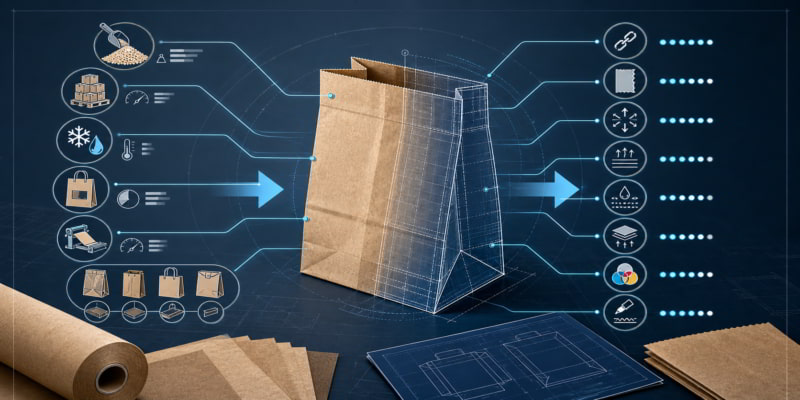
📌 Key Takeaways
Picking the right kraft paper grade starts with what the bag must survive—not what’s cheapest on the specification sheet.
- GSM Alone Misleads: Two papers at the same weight can perform very differently because fiber quality, stretch, and surface treatment matter just as much.
- Start With the Bag’s Job: Define what the bag holds, how it’s handled, where it’s stored, and how it’s made before you ever contact a supplier.
- Match Grade to Bag Type: A lightweight bakery bag, a handled shopping bag, and a 25 kg cement sack need completely different paper properties—there is no universal “best” grade.
- Over-Specifying Wastes Money, Under-Specifying Wastes More: Buying heavy-duty paper for light jobs kills margins, but buying too light causes line breaks, rejects, and lost customers.
- Datasheets Don’t Replace Trials: Always test a new grade on the actual converting line with the real bag design, fill product, and handling conditions before committing.
The paper that looks fine on a sample sheet can still fail at production speed—trial-verified specifications beat catalog guesswork every time.
Paper bag converters and packaging procurement teams will gain a clear grade-selection process here, preparing them for the detailed property-matching guide that follows.
~ ~ ~ ~ ~ ~ ~ ~ ~ ~ ~ ~ ~ ~ ~ ~ ~ ~
The paper looked fine on the sheet.
The roll arrived on time, the GSM matched the purchase order, and the price was competitive. Then the converting line started a new job—different gusset design, heavier fill product, higher print coverage. Within the first 1,400 meters, the web broke twice. Bottoms opened under stacking loads. The paper is not defective; It was simply never selected for this application.
That disconnect between what gets ordered and what a bag actually demands is one of the most expensive recurring problems in small and mid-sized converting operations. “Kraft paper” is not one uniform material. The right grade depends on bag format, fill weight, product type, machine speed, sealing and gluing method, handling route, moisture exposure, print requirements, and acceptable failure risk. When any of these variables change, the previous grade may no longer fit—and the costs surface as downtime, rejects, complaints, or margins quietly eroded by over-specified paper.
Start With the Bag’s Job, Not the Paper Specification Sheet
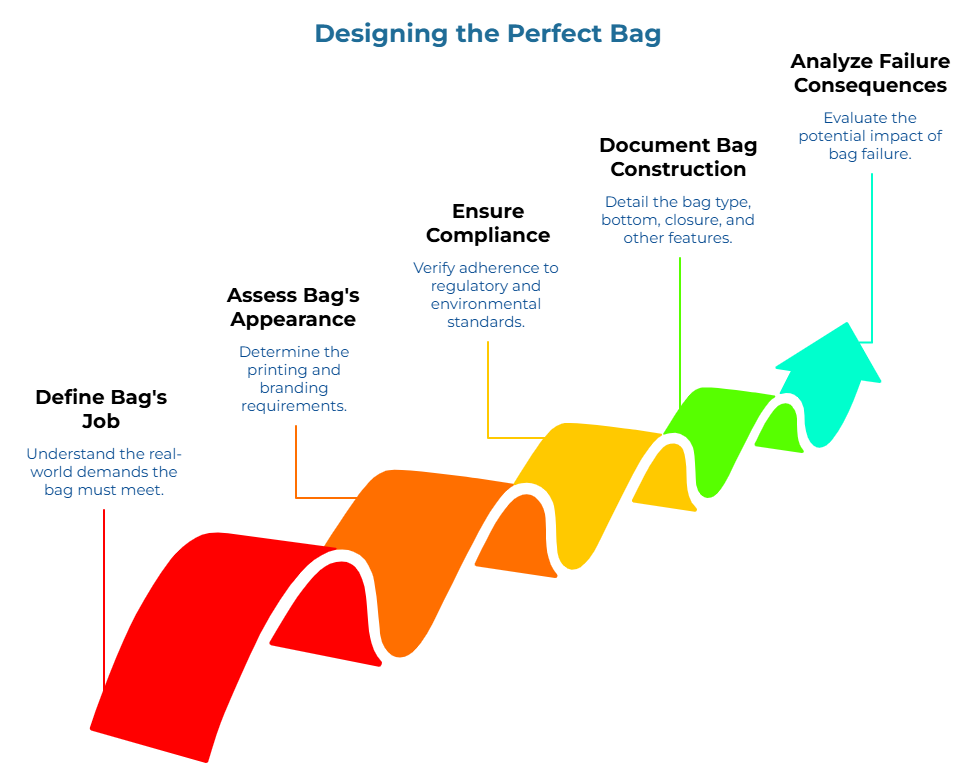
Grade selection should begin with the finished bag’s real-world demands—not the supplier catalog. Before approaching any paper supplier, document the application systematically.
- What the bag must survive. What will it hold, and how heavy is the fill? Is the product dry, powdery, oily, abrasive, sharp-edged, frozen, damp, or hygroscopic? Will the bag be hand-filled or machine-filled, dropped, stacked, palletized, shipped by courier, or carried by a consumer? Indoor storage, outdoor exposure, refrigeration, or humid conditions?
- What the bag must look like. Is high-quality printing, branding, or shelf presentation important? A boutique retail bag may need a smooth, printable surface and clean fold quality far more than industrial-grade burst strength.
- What the bag must comply with. Food-contact suitability, recyclability or plastic replacement mandates, and regional regulatory obligations.
- How the bag will be made. Document the bag type—flat bag, SOS bag, shopping bag, food bag, e-commerce mailer, open-mouth sack, pasted-valve sack, or multiwall sack. Note the bottom construction, closure method, handle type, gusset design, printing method, machine type and converting speed, filling process (manual, gravity, auger, valve, high-speed, vacuum/deaeration), and distribution route. Also assess failure consequences: minor inconvenience, product loss, safety issue, contamination risk, or brand damage.
This should function as a pre-purchase worksheet. A lightweight bakery bag, a retail shopping bag, and a 25 kg pasted-valve cement sack may all use brown paper, but their strength, porosity, surface, and moisture-resistance requirements share almost nothing in common. CEPI Eurokraft and EUROSAC distinguish paper sacks as larger flexible containers for industrial products, often exceeding 10 kg net content, where strength becomes a defining feature. For guidance on turning this application map into supplier-facing documentation, creating internal paper bag specification sheets your team and suppliers will actually use offers a practical companion framework.
The Paper Properties That Actually Affect Bag Performance
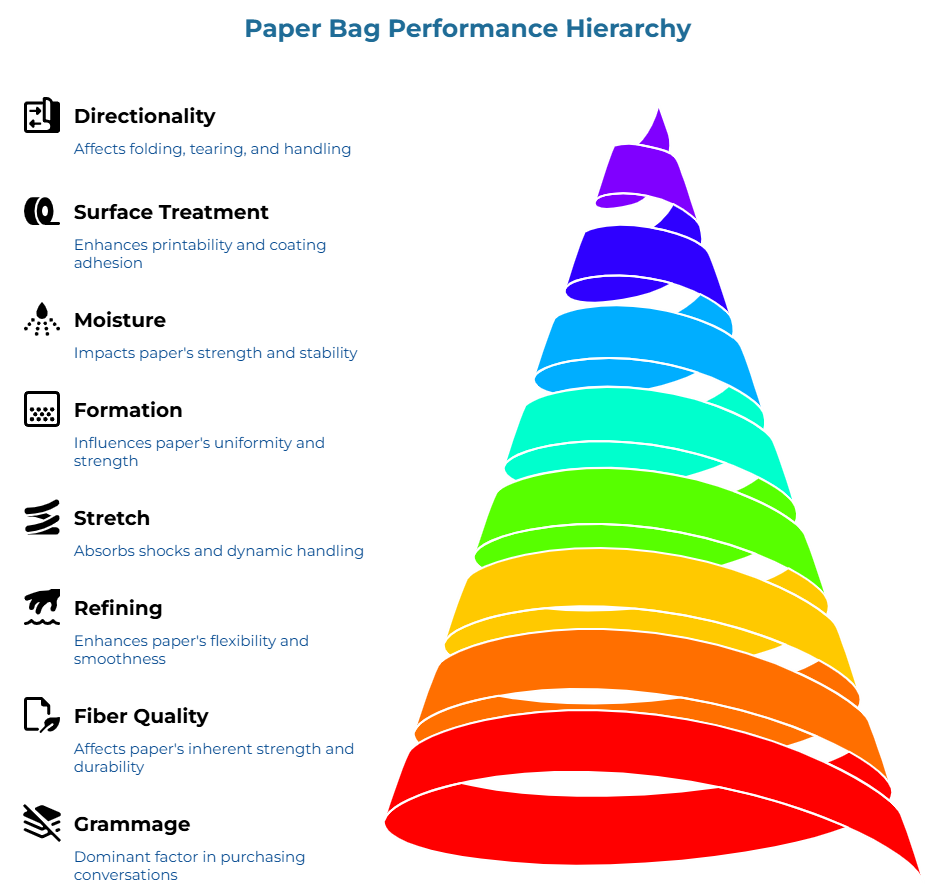
Grammage—also called basis weight—dominates most purchasing conversations, but it is only one variable. Two papers at identical GSM can behave very differently depending on fiber quality, refining, stretch, formation, moisture, surface treatment, and machine direction versus cross direction properties. Understanding why GSM alone does not predict bag strength is the first step toward better grade selection. ISO 536 specifies the method for determining grammage; ISO 536:2019 remains the prevailing international standard for grammage determination.
That distinction between machine direction and cross direction deserves closer attention. Paper properties can differ significantly depending on the direction of measurement—and this affects folding, tearing, handling performance, print registration, bag loading, and side-seam behavior. A paper may look acceptable in a sheet test but fail when the stress direction changes during gusseting, bottoming, filling, or carrying.
- Tensile strength and stretch. Tensile strength resists pulling forces during converting, filling, and carrying. Stretch (extensibility) matters when bags must absorb shocks, drops, or dynamic handling. TAPPI/ANSI T 494 covers four tensile breaking properties: tensile strength, stretch, TEA, and tensile stiffness. These properties are critical for shopping bags, handle bags, industrial sacks, and high-speed converting.
- TEA (tensile energy absorption). TEA measures energy absorbed before breaking. For heavy-duty sacks subject to shock loading—drops, rough transport, sudden deceleration—TEA often predicts field performance better than tensile strength alone.
- Tear resistance. Tear resistance matters after a nick, cut, or puncture initiates a tear. TAPPI/ANSI T 414 measures internal tearing resistance, though it does not measure edge-tear resistance. Handle cutouts, gusset folds, and sharp product edges concentrate tear stress.
- Burst strength. Burst strength indicates resistance to rupture under pressure—relevant where filled products push against bag walls or bags are stacked and compressed. TAPPI/ANSI T 403 provides the test method.
- Porosity and air permeability. For powdered products in valve sacks, porous paper supports faster filling, smaller sack volume, and cleaner filling. TAPPI/ANSI T 460 measures air resistance using the Gurley method. The Billerud sack handbook notes that for powdered goods in valve sacks, high permeability supports faster and cleaner filling—but too much openness conflicts with dust control and product protection.
- Cobb value and water absorptiveness. Bags facing humidity, condensation, refrigerated storage, or outdoor handling need low Cobb values or wet-strength treatments. TAPPI/ANSI T 441 describes the standard Cobb test. Ordinary kraft can lose significant strength when exposed to moisture—never assume it will perform in wet conditions without testing.
- Surface quality, smoothness, printability, and coefficient of friction. Paper surface affects print quality, ink holdout, coating adhesion, and brand appearance. Coefficient of friction affects stacking stability and machine handling—an overlooked property that can cause problems on high-speed lines and during palletized storage. Stiffness influences feeding, folding, stand-up behaviour, and perceived bag quality. For premium retail bags, appearance may matter as much as mechanical strength. For coated or heat-sealable formats, the base paper must suit the coating process—glueability and surface energy become selection factors.
- Food-contact suitability. Food-contact suitability cannot be assumed from the word ‘kraft’—a common misconception explored in depth in the guide to food-grade certification standards for delivery packaging bags. For U.S. applications, FDA regulations under 21 CFR 176.170 and 21 CFR 176.180 address paper components for food contact. In the EU, Regulation (EC) No. 1935/2004 provides the general framework for materials intended for food contact. FSSAI and other regional frameworks may also apply. Compliance depends on jurisdiction, food type, additives, coatings, inks, adhesives, and the finished structure. Always request current supplier declarations.
Match the Grade to the Bag Type and Converting Process
Lightweight retail, pharmacy, and merchandise bags need good appearance, reliable converting, moderate strength, printability, and cost control. Virgin or recycled, bleached or unbleached—the choice depends on brand requirements, strength needs, and food-contact demands. Handle bags require attention to tear resistance around handle holes and patches. Over-specifying heavy sack paper for lightweight products wastes margin.
Grocery, bakery, takeaway, and dry food bags require food packaging paper that meets food suitability, odor control, cleanliness, and printability standards. Separate dry food contact from greasy, moist, frozen, or hot food applications—coatings, liners, or treated paper may be necessary. Verify food-contact documentation, migration requirements, and ink compatibility.
Shopping bags with handles—among the most commonly sourced kraft paper bags—concentrate stress at handle attachment areas, not the middle of the sheet. Handle reinforcement and patch material selection matter as much as the base paper grade. Test with actual load, handle type, fold design, and realistic customer handling.
Ecommerce mailers need tear resistance, puncture resistance, fold endurance, sealing compatibility, and automation performance—and when those specifications are left vague, the five common specification gaps in e-commerce and delivery bags become the root cause of field failures. Extensible kraft papers stretch without tearing and resist puncture—qualities relevant to automated packaging lines and courier handling.Extensible kraft is engineered to yield under sudden stress, a property necessary for high-speed automated packaging where rigid papers typically snap.
Industrial open-mouth sacks require high TEA and burst strength to withstand the kinetic energy of gravity-filling and subsequent pallet stacking.
Pasted-valve sacks for powders (cement, chemicals, minerals, food powders, animal feed) require fast filling, controlled air release, dust reduction, and strength during filling and palletizing. Porosity, air resistance, and multiwall construction become primary selection criteria. CEPI Eurokraft and its member producers supply sack kraft grades designed for these demanding applications. Mondi’s sack kraft portfolio includes brown, white, and PE-coated grades for valve and open-mouth industrial bags used in building, food, agricultural, and chemical industries. Where coatings, inks, adhesives, barriers, and sack construction may affect recyclability, CEPI Eurokraft and EUROSAC’s design-for-recyclability guidelines provide useful reference criteria.
Converting process variables matter equally. A technically strong paper can still fail if it does not run well on the converter’s equipment. Printing method (flexo, offset, digital), slitting, creasing, tubing and gusset formation, bottom forming, glue absorption, handle patching, heat sealing, machine speed, web tension, and kraft paper jumbo roll consistency—including moisture profile, curl, and dimensional stability—all affect runnability. A paper that looks acceptable in a sample sheet may fail at production speed because of curl, dusting, inconsistent moisture, or poor glue performance. A grade that creates quality variance on the line costs far more than its price per ton suggests—a dynamic quantified in the high cost of “cheap” paper: how quality variance kills production margins.
Quick Application-to-Property Matrix
| Bag Application | Properties That Usually Matter Most | Selection Note |
| Lightweight retail bag | Printability, stiffness, fold quality, moderate tear strength | Avoid heavy-duty grades unless handles or premium feel require them. |
| Shopping bag with handles | Tensile, tear resistance, handle reinforcement, stiffness | Test handle holes, patches, and real carrying loads. |
| Bakery or dry food bag | Food-contact suitability, cleanliness, printability | Verify dry-food suitability, inks, adhesives, and declarations. |
| Grocery bag | Tear, tensile, bottom strength, moisture exposure | Consider mixed product loads and real carrying behavior. |
| Ecommerce mailer | Tear, puncture, fold endurance, sealing, returnability | Consider extensible or coated grades when automation or sealing demands it. |
| Open-mouth sack | Tensile, TEA, burst, tear, seam and bottom strength | Validate against fill weight, product density, and stacking. |
| Pasted-valve powder sack | Porosity, air release, TEA, burst, dust control | Filling speed and deaeration are central. |
| Damp or refrigerated use | Cobb value, wet strength, barrier options | Do not assume ordinary kraft retains enough strength when damp. |
This matrix is a planning tool. Exact property targets require supplier data, standards-based testing, and production trials.
The Specification Traps: Over-Buying and Under-Buying
Over-specification happens when converters choose high GSM because they lack strength-property data, use virgin fiber for every job without evaluating recycled options, apply sack-grade paper to lighter retail applications, specify wet strength where the bag stays dry, select premium printability grades for low-visibility applications, or add coating without confirming actual exposure risk.
A practical decision rule: if the bag has low fill weight, low handling stress, dry indoor use, and minimal branding requirements, a simpler grade may suffice. But verify with controlled converting trials and finished-bag testing before simplifying.
Under-specification costs more—often much more. Web breaks, misfeeds, glue failure, bottom leaks, handle tear-out, bag bursting, dusty filling, customer complaints, rejected shipments, product loss, food-contact failures. Production managers do not only fear material waste. They fear losing customer trust, missing dispatch deadlines, and being blamed for failures that began at the purchasing stage. Diagnosing where bag failures originate is often the first step toward correction. PaperIndex’s analysis of what happens when you over- or under-specification paper bags extends this cost-and-risk logic into supplier selection and customer experience decisions.
Common Mistakes to Avoid
The most common mistake is choosing by GSM alone. The second is treating every kraft paper as food-safe. The third is ignoring machine direction and cross direction differences.
Other costly errors include testing the paper but not the finished bag, assuming datasheets replace converting trials, overbuying premium grades to avoid complaints, underestimating moisture exposure in storage or transit, and ignoring filling speed or air release requirements for powdered products. Each of these errors creates costs that rarely appear on the paper invoice but accumulate steadily through downtime, rejects, and customer attrition.
The Grade-Selection Protocol
1. Define the bag application. Product, fill weight, bag format, closure method, handling route.
2. Rank the failure risks. Tear, burst, puncture, moisture weakening, print failure, glue failure, dust leakage, handle failure—prioritize by severity.
3. Identify must-have paper properties. GSM, tensile, TEA, tear, burst, porosity, Cobb, stiffness, smoothness, food-contact suitability—driven by the failure risks above.
4. Match grade to converting process. Machine speed, web tension, folding, gluing, printing, coating, sealing.
5. Ask suppliers the right questions. Request datasheets with typical and minimum values, test methods, batch-to-batch tolerances, fiber composition (virgin, recycled, or blended), finish type (machine-glazed, machine-finished, extensible, semi-extensible, coated, wet-strength, or barrier-treated), flexographic printing suitability, compatible glue systems, food-contact declarations, compliance documentation, trial roll availability, and known grade limitations.Building a formal mill spec sheet prevents ambiguity in these conversations.
6. Run controlled trials. Test the actual bag design on the actual converting line with the real fill product, sealing system, print coverage, and handling conditions. Datasheets help shortlist grades; trials confirm real-world performance. Finished-bag testing reveals problems sheet-level testing misses.
7. Document the approved specification. Include performance properties—not just GSM and price. For supplier-facing documentation, anatomy of a perfect brown paper RFQ and the quality blueprint: how to define & enforce kraft paper technical specifications provide ready-to-use frameworks for translating approved specifications into enforceable RFQ and qualification documents.
Supplier Questions to Ask Before Buying
A grade shortlist is only as good as the supplier data behind it. Before committing to a trial roll from kraft or brown paper mills or regional distributors, ask questions that force application-specific answers rather than generic marketing claims.
What bag applications is this grade designed for? What are the typical and minimum values for tensile, stretch, TEA, tear, burst, porosity, Cobb, stiffness, and smoothness? Which test methods back those values? What tolerances apply across rolls and batches? Is the paper virgin, recycled, or blended? Is it bleached, unbleached, machine-glazed, machine-finished, extensible, semi-extensible, coated, wet-strength, or barrier-treated?
Inquire specifically about surface energy for glue adhesion, heat-seal temperature windows for PE-coatings, and the specific ISO or ASTM methods used to derive their TDS (Technical Data Sheet) values.
Frequently Asked Questions
What is the best kraft paper grade for bag manufacturing?
There is no single best grade. The right choice depends on bag type, fill weight, converting process, handling conditions, and compliance needs.
Is higher GSM always better for paper bags?
No. Higher GSM increases material use and stiffness but does not guarantee better tear resistance, tensile performance, stretch, porosity, or runnability.
What kraft paper should be used for shopping bags?
Shopping bags usually need tensile strength, tear resistance around handles, suitable stiffness, printability, and reliable fold and glue performance. The right grade depends on handle type, load, and bag design—test the final grade with the actual handle and bag construction.
What properties should be checked besides GSM?
Tensile strength, stretch, TEA, tear resistance, burst strength, porosity, Cobb value, stiffness, smoothness, printability, glueability, and any food-contact or barrier requirements.
What is sack kraft paper?
Sack kraft is designed for heavier-duty open-mouth and valve sacks carrying building materials, chemicals, agricultural products, food powders, or animal feed. For a broader view of how sack kraft fits within the full range of kraft paper grades for making paper bags, PaperIndex Academy’s strategic guide maps grade families to bag load ranges. Grade choice depends on filling method, fill weight, porosity needs, and handling risk.
When is wet-strength kraft paper needed?
When bags face humidity, condensation, damp products, refrigerated use, or outdoor handling. Verify through application testing.
Can recycled kraft paper be used for all bags?
Not always. Strength, appearance, cleanliness, odor, food-contact suitability, and customer specifications must be verified per application.
How should converters test a new kraft paper grade?
Test on the actual converting line with the real bag design, glue or sealing system, print coverage, filling process, and handling route. Finished-bag testing is more useful than sheet testing alone.
The converter from the opening scenario did not have a paper quality problem. The grade was not matched to the application. Selection that starts with the bag’s real job and ends with documented, trial-verified specifications replaces guesswork with a repeatable process. By moving beyond grammage-based procurement, converters can stabilize their production lines and protect their margins from the hidden costs of application mismatch.
Disclaimer:
This article is for informational and educational purposes only. Paper properties, grade suitability, and regulatory compliance vary by application, equipment, supplier, and jurisdiction. Always verify grade selection through supplier technical data, standards-based testing, and production trials. This content does not constitute engineering, regulatory, or legal advice.
Our Editorial Process:
Our expert team uses AI tools to help organize and structure our initial drafts. Every piece is then extensively rewritten, fact-checked, and enriched with first-hand insights and experiences by expert humans on our Insights Team to ensure accuracy and clarity.
About the PaperIndex Insights Team:
The PaperIndex Insights Team is our dedicated engine for synthesizing complex topics into clear, helpful guides. While our content is thoroughly reviewed for clarity and accuracy, it is for informational purposes and should not replace professional advice.