
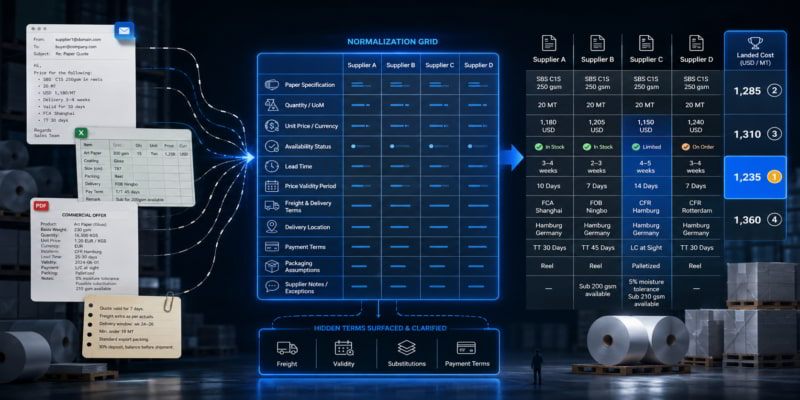
📌 Key Takeaways
Supplier quotes only become comparable after you put them on the same basis — not before.
- Normalize Before You Compare: Quotes that look similar often differ in freight, payment terms, and specs — sorting those gaps first prevents bad decisions.
- Unit Price Can Mislead: A lower price per ton means little if one quote bundles freight and another doesn’t — landed cost tells the real story.
- Structure Your RFQ Up Front: Telling suppliers exactly which fields to fill in reduces messy, inconsistent responses that slow down every comparison.
- AI Helps With Sorting, Not Deciding: Software can pull data from emails and flag mismatches fast, but only your team knows which trade-offs actually matter.
- Hidden Terms Change the Deal: Footnotes about substitutions, short validity windows, or vague availability can quietly reshape an offer’s true value.
Same fields, same basis, same visibility — that’s what turns quote comparison from guesswork into a real decision.
Procurement managers and sourcing professionals handling multi-supplier paper RFQs will find a practical framework for cleaner comparisons here, preparing them for the detailed overview that follows.
~ ~ ~ ~ ~ ~ ~ ~ ~ ~ ~ ~ ~ ~ ~ ~ ~ ~
Multiple quotes. Multiple formats. Multiple assumptions buried in the fine print.
When several suppliers respond to the same paper RFQ, the hardest part isn’t collecting prices; it’s figuring out whether those prices are actually comparable.
Procurement teams in the paper industry know this friction well. Quotes arrive as spreadsheets, email threads, and PDF attachments — each supplier describing their offer differently. Why does this keep taking so long? The bottleneck isn’t the volume of quotes. It’s that the quotes aren’t structured for comparison in the first place.
The inputs are commercially variable. This variance is what complicates the workflow, rather than a lack of discipline from the procurement team. With a clearer understanding of where hidden differences live, you can compare faster without missing the details that affect landed cost or fulfillment reliability.
Paper RFQ Comparison Is Slow Because the Quotes Are Rarely Equivalent
Procurement teams often assume the bottleneck is volume: too many suppliers, too many emails. While that is often part of the challenge, industry observation suggests the structural cause generally goes deeper.
Two suppliers may both quote “kraft paper,” “printing paper,” or “tissue parent roll,” yet their responses may not describe the same commercial offer. One supplier quotes freight-excluded pricing with a 14-day validity window. Another includes freight with 30-day validity but a longer lead time. A third matches the grade but adds a footnote about substituting a different brightness level if stock runs low. Each difference changes what the quote actually means.
Grade names alone rarely tell the full comparison story. A related industry framework — such as a guide to comparing kraft paper parent roll offers beyond grade names — illustrates the same practical principle for technical paper categories.
Faster comparison comes from exposing these commercial variances prior to the evaluation phase.
The Hidden Differences That Make Paper Quotes Hard to Compare
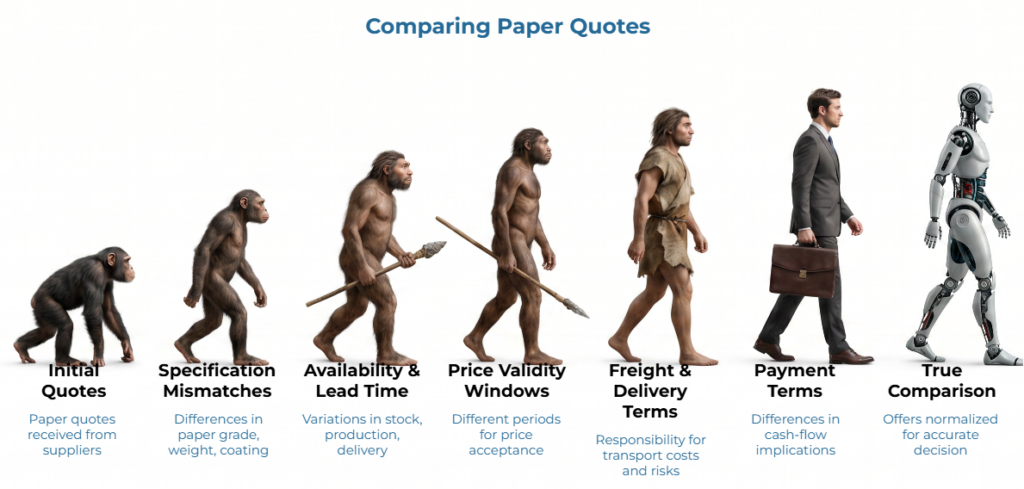
Paper isn’t a commodity where every supplier delivers an identical product. Even when responding to the same RFQ, suppliers may return quotes that differ across fields directly affecting whether offers are truly comparable.
Specification mismatches are among the most common problems. Two suppliers may both quote a paper at a similar grade and weight, but one specifies a different coating, brightness level, or certification. The mismatch may also involve GSM (grams per square meter), size, roll or sheet format, packaging, or tolerance details. In paper procurement, these distinctions affect converting-line performance, end-use suitability, and whether a downstream customer will accept the product — which is why defining and enforcing technical specs before soliciting quotes prevents disputes later.
Consider a procurement manager reviewing quotes for uncoated kraft paper. Both suppliers quote the same weight range, but Supplier A’s footnote mentions the quoted grade “may be substituted based on mill availability,” while Supplier B provides an exact specification match with no exceptions. On a comparison sheet, these quotes sit side by side as if they’re equivalent. They aren’t.
Availability and lead time create another layer of hidden risk. One supplier may be quoting from current stock; another from future production with delivery weeks later. “Available” can mean ready stock, planned production, expected sourcing, or availability subject to confirmation — and those are not equal positions. A trader may care about responsiveness, while Operations may care about whether the delivery window is realistic. Finance may focus on the cash-flow effect of the payment terms. Supplier availability can change between the time a quote is received and the time a decision is made, so quote data must be current when the final comparison happens.
Price validity windows vary too. Price validity is the period during which a supplier’s quoted price remains open for acceptance. A quote valid for seven days carries a different meaning than one valid for 28. If comparison outlasts the shortest validity window, offers may expire before anyone decides.
Freight and delivery terms are a frequent source of mismatch. One supplier may quote freight-exclusion, leaving transport costs to the buyer, while another includes freight to the destination port. In general trade usage, freight terms describe which party is responsible for transport-related tasks, costs, or risks. If formal Incoterms are used, buyers should refer to official guidance from the International Chamber of Commerce because these rules define responsibilities between buyers and sellers in international transactions. Without normalizing to a common delivery basis, comparing unit prices alone is misleading — a challenge explored in depth in this guide to comparing quotes across Incoterms for true to-door decisions. Industry benchmarks and proprietary databases provide the context needed to quantify how varying commercial terms shift the actual landed cost.
Payment terms differ too. A 30-day quote and a 90-day quote may look similar on price but carry different cash-flow implications — a dynamic explored further in our guide to negotiating payment terms beyond advance-only structures.
Packaging, quantity assumptions, and supplier exceptions round out the list. Conditions buried in footnotes — minimum order adjustments, partial shipment terms, or exclusions — can change the commercial profile without changing the headline price.
Why Unit Price Alone Can Mislead the Comparison
Unit price is the number procurement teams see first. But a lower unit price doesn’t always mean a better commercial outcome.
Landed cost — the total cost of getting paper to your facility — depends on more than the supplier’s price per ton, as detailed in the landed-cost framework for kraft paper. It may include freight, insurance, duties or fees where applicable, and other components that differ based on delivery terms. For domestic sourcing, the major issue may be delivery location or freight inclusion. For cross-border buying, additional factors may enter the analysis, such as customs valuation or import-related charges. The World Customs Organization describes the WTO Customs Valuation Agreement as a system that primarily bases customs value on the transaction value of imported goods, with certain adjustments.
A supplier quoting freight-included pricing has bundled transport costs in. A supplier quoting freight-excluded hasn’t. Comparing those prices at face value means comparing a bundled offer against an unbundled one — and as ocean freight can represent a significant share of landed cost, freight scenarios can even flip supplier rankings when rates shift.
Payment terms also matter. Extended terms can reduce short-term cash pressure, which may matter as much as a marginal price difference on high-volume orders.
The following table summarizes what separates a quoted price from a comparable cost basis:
| Field | What It Tells You |
| Unit price | The visible quoted price for the product |
| Freight assumption | Whether transport cost is included, excluded, or unclear |
| Delivery point | Where responsibility or delivery expectation is being measured |
| Availability | Whether the quote can realistically support the required timing |
| Payment terms | How cash timing or credit terms affect the commercial view |
| Price validity | How long the quoted price remains usable for decision-making |
The practical takeaway: separate the quoted price from the comparable cost basis before ranking offers. Put each quote on the same footing — same delivery point, same included cost components, same validity assumptions.
1. Standardizing the RFQ Before Supplier Responses Arrive
Much of the comparison difficulty starts before suppliers respond. If the RFQ doesn’t specify what information is required, suppliers fill in the gaps with their own assumptions. Those assumptions are where mismatches originate.
A more structured RFQ reduces interpretation downstream. Suppliers need enough structure to respond consistently, and buyers need enough detail to identify gaps quickly — especially when several internal stakeholders review the same quote. As a practical starting point, request every supplier response covers: product specification (grade, weight, size, relevant certifications) or intended application, quantity, unit of measure, unit price, currency, delivery basis and location, lead time, availability status, price validity period, payment terms, packaging assumptions, supplier exceptions or substitutions, and preferred response format.
This isn’t about imposing a rigid template — and it won’t solve every RFQ problem. It’s about making comparison requirements clear up front so that when quotes arrive, you know which fields to check and which gaps need follow-up. Paper categories vary, and highly technical purchases may need more detail. Buyers dealing with vague grade descriptions may need to ask more specific supplier questions, generally focusing on acceptable tolerances and technical specifications.
Standardization doesn’t remove supplier variability. But it makes differences easier to spot because every response is structured around the same expected fields. For a detailed example, a guide to structuring a spec-true kraft paper RFQ breaks down the approach field by field.
2. Normalizing Supplier Quotes Prior to Comparison
Even with a standardized RFQ, supplier responses won’t arrive in identical formats. Some will match your structure closely. Others will paraphrase, omit fields, or add conditions that don’t fit neatly.
Quote normalization — the process of putting each supplier’s response into a common comparison structure — makes real differences visible before evaluation. It means mapping every response to the same fields, flagging blanks or non-standard answers, and separating exact matches from exceptions — an approach that a spec-true mindset for reducing RFQ chaos treats as the prerequisite to any price comparison.
The goal isn’t to make all offers look equal. It’s the opposite: normalization makes differences visible so the team can evaluate them deliberately rather than discovering them after a decision has been made.
A practical starting point is a paper RFQ comparison checklist. Before ranking any offers, verify each supplier’s response against the fields that matter:
| Quote Field | Why It Matters | What to Check | Can AI Help? |
| Paper specification (grade, GSM, size, coating, certification, tolerances) | Spec mismatches make quotes non-equivalent | Does the response match the RFQ exactly? | Yes — deviation flagging |
| Quantity and unit of measure | Different units or MOQ assumptions distort price comparison | Units, order size, MOQ, partial shipment assumptions | Yes — normalization |
| Unit price and currency | Starting point for comparison | Price basis, included charges, unit of measure, currency consistency | Yes — extraction |
| Availability status | Estimated vs. confirmed stock affects fulfillment risk | Ready stock, planned production, or estimated sourcing? | Yes — conditional language flagging |
| Lead time | Affects timeline feasibility and internal planning | Start point, production time, dispatch timing | Yes — extraction |
| Price validity period | Short windows may expire before decision | Valid-until date or number of valid days | Yes — expiry flagging |
| Freight and delivery terms | Different bases make price comparison misleading | Freight inclusion, responsibility, delivery basis | Yes — term identification |
| Delivery location | Anchors the commercial comparison | Port, warehouse, mill, plant, or customer site | Yes — extraction |
| Payment terms | Affects cash flow and real cost | Advance, credit, LC, due date, or other terms | Yes — extraction |
| Packaging / shipment assumptions | Hidden cost or logistics risk | Pallets, rolls, sheets, wrapping, load assumptions | Yes — exception flagging |
| Supplier notes and exceptions | Can override headline terms | Substitutions, exclusions, unclear remarks | Yes — deviation summary |
This structured check takes time manually. But it prevents the more expensive problem: choosing a supplier based on an incomplete comparison and discovering the mismatch after placing the order.
This checklist also helps diagnose whether the workflow itself needs improvement. If your team repeatedly reworks quotes, copies data by hand, argues over missing fields, or discovers freight and payment terms late in the process, the issue isn’t just supplier behavior. It’s the structure of the comparison process.
Where AI Can Help First in Paper RFQ Workflows/
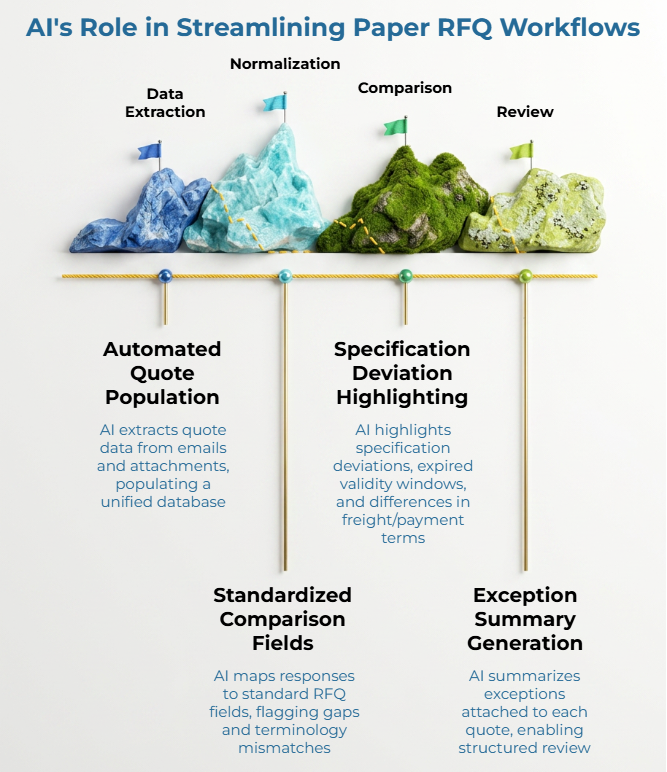
AI isn’t a replacement for procurement judgment. But it can help with the repetitive, structured parts of the RFQ workflow that consume the most manual time. The following observations describe general workflow principles rather than specific tool capabilities.
AI automates the extraction of quote data from emails and attachments, populating a unified database to eliminate manual entry errors. At the normalization stage, it can map responses to standard RFQ fields, flagging gaps or terminology mismatches so the team knows which quotes need follow-up. If three suppliers describe availability differently, AI can bring those statements into one comparison field so the procurement manager reviews them together.
At the comparison stage, AI can highlight specification deviations, flag expired validity windows, and surface differences in freight or payment terms. At the review stage, it can summarize the exceptions each supplier has attached to their quote — so instead of reading every footnote, the team reviews a structured summary of deviations.
| AI can help with | Humans still need to review |
| Extracting fields from emails, PDFs, or spreadsheets | Supplier reliability and relationship history |
| Mapping responses into standard RFQ fields | Whether a substitute grade is acceptable |
| Flagging missing validity, freight, or payment terms | Customer urgency and fulfillment tolerance |
| Highlighting specification differences | Margin implications and commercial trade-offs |
| Summarizing supplier exceptions | Final supplier selection and accountability |
The value is in reducing repetitive extraction and flagging work — preparing a cleaner decision surface — not in replacing the expertise your team already has.
What Still Needs Human Review
While software automates data collation and variance flagging, several parts of the comparison process depend on judgment that sits with the procurement team.
Supplier reliability is one example — your team may know from experience that a particular supplier has a history of delayed shipments, and that context doesn’t appear in the quote data. Substitution acceptability is another: if a supplier proposes a different grade, only the buyer’s team can judge whether it works for the intended end use. A higher unit price may be justified if the supplier has confirmed stock and the order is urgent. A payment term may be workable for one buyer but unsuitable for another.
Timing sensitivity, margin implications, and relationship considerations all factor into the final decision. Distinguishing between data comparison and final procurement adjudication is vital; automated tools excel in the former, while experts own the latter.
Internal alignment matters here too. Procurement may prioritize speed and quote completeness. Trading teams may focus on responsiveness and margin. Operations may care about fulfillment feasibility. Finance may look closely at landed cost and payment terms. A better workflow doesn’t remove those conversations — it gives each team the same set of facts to work from.
Common RFQ Comparison Mistakes to Avoid
Even experienced teams fall into patterns that weaken comparisons:
- Comparing quotes before normalizing them. If quotes aren’t on the same basis, the comparison is unreliable — no matter how carefully the numbers are reviewed.
- Choosing the lowest unit price without checking landed-cost inputs — a pattern examined in depth in the guide to common pitfalls in landed-cost estimates. Freight assumptions and payment conditions can shift the ranking once included.
- Treating supplier availability as guaranteed when it’s described as estimated or subject to confirmation.
- Overlooking price validity. The winning quote may already be expired by the time the order is placed.
- Ignoring specification differences in footnotes that change the product being offered.
- Copying supplier responses into a comparison sheet without standardizing the fields first — turning the sheet into a source of confusion rather than clarity.
- Overlooking payment terms until late in the review process, when cash-flow implications should have been visible from the start.
- Standardization is a diagnostic lens, not a forcing function; its purpose is to expose variance, not to homogenize supplier behavior.
Making Differences Visible Before Making Decisions
At the start of this article, the problem was familiar: multiple quotes, inconsistent formats, a comparison process that feels slower than it should. The belief many teams carry is that comparison is slow because suppliers send messy quotes. The more accurate framing: comparison is slow because quotes often aren’t normalized, and the first improvement is to standardize the data before judging price or supplier fit.
When the RFQ captures the right fields, responses become easier to normalize. When normalization happens before comparison, the team evaluates real commercial differences rather than format differences. And when AI handles extraction and flagging, manual burden shrinks without removing the judgment that makes the final decision sound.
Audit your existing RFQ templates to ensure they mandate the specific fields required for cross-quote normalization. Then check whether your comparison sheet separates exact matches, missing fields, ambiguous responses, and supplier exceptions. If you’re still building the supplier side of the workflow, you can explore PaperIndex resources to find paper suppliers or submit an RFQ.
Frequently Asked Questions
What makes paper RFQs harder to compare than simple price quotes?
Paper RFQs involve more than unit price. Supplier responses may differ across specification details, availability, lead time, freight terms, payment terms, price validity, and delivery assumptions — making direct price comparison unreliable without normalization.
What should be standardized in a paper RFQ?
As a practical starting point, standardize the fields you need for comparison: product specification (grade, weight, size, certifications) or intended application, quantity, currency, delivery basis, delivery location, lead time, availability, price validity, payment terms, packaging assumptions, and supplier response format. Treat this as a baseline and adjust for the paper category being sourced.
Can AI compare supplier quotes automatically?
AI can help extract, normalize, and flag differences in supplier responses at a general workflow level. Final supplier decisions still depend on human review of commercial context, supplier reliability, substitution acceptability, and timing requirements.
Why is landed cost important in quote comparison?
Landed cost accounts for the fuller commercial impact of a quote beyond unit price — including freight, delivery terms, payment conditions, and other context-specific cost components. Comparing unit price alone is misleading when suppliers quote on different delivery bases.
Disclaimer:
This article provides general educational guidance on paper RFQ comparison workflows and is not a substitute for professional procurement, legal, or financial advice. References to AI capabilities describe general workflow principles, not specific product features. Trade term descriptions are simplified; consult official ICC Incoterms guidance for contractual use. All supplier scenarios are illustrative. Verify current regulations, pricing, and terms independently before making sourcing decisions.
Our Editorial Process:
Our expert team uses AI tools to help organize and structure our initial drafts. Every piece is then extensively rewritten, fact-checked, and enriched with first-hand insights and experiences by expert humans on our Insights Team to ensure accuracy and clarity.
About the PaperIndex Insights Team:
The PaperIndex Insights Team is our dedicated engine for synthesizing complex topics into clear, helpful guides. While our content is thoroughly reviewed for clarity and accuracy, it is for informational purposes and should not replace professional advice.