
📌 Key Takeaways
COBB values measure how much water your folding carton board absorbs—and specifying them correctly prevents moisture-related failures before they happen.
- Name Both Value and Range: A COBB target without a tolerance (like ±5 g/m²) lets every supplier interpret the requirement differently, turning each delivery into a guessing game.
- Match Specifications to Real Conditions: Start with the moisture your folding cartons will actually face—humid warehouses, cold-chain transport, or dry storage—then work backward to the right COBB requirement.
- Always Specify the Test Method: ISO 535 and TAPPI T 441 produce similar but not identical results, so naming the method prevents disputes when test numbers don’t match.
- COBB Alone Isn’t Enough: The test compares water absorption between sheets under controlled conditions—it doesn’t predict how folding cartons handle condensation, coatings, or cold-chain transitions.
- Place COBB Near Related Fields: Grouping COBB with board grade, coatings, and tolerance bands helps suppliers and your team see the full picture instead of filling gaps with assumptions.
Define moisture requirements before quotes arrive, not after quality problems surface.
Procurement managers and packaging buyers sourcing folding cartons will gain clarity on translating real-world moisture risks into enforceable specifications, preparing them for the detailed guidance that follows.
~ ~ ~ ~ ~ ~ ~ ~ ~ ~ ~ ~ ~ ~ ~ ~ ~ ~
Someone asks whether your folding cartons can handle humid warehouse conditions. You know they should. You are less certain what that actually requires on paper and you have no documented proof one way or the other.
The COBB value quantifies surface water absorption by measuring the mass of liquid (in g/m²) that a square meter of board retains under pressure over a standardized duration, typically 60 or 120 seconds. The result, expressed in grams per square meter (g/m²), tells you how “thirsty” that board is. A lower COBB value means less water absorption; a higher value means the surface takes in more moisture.
That single number connects directly to whether your folding cartons hold their shape in a humid distribution center, whether printed surfaces stay crisp, and whether adhesives bond reliably during converting. Procurement teams must identify the specific moisture conditions your packaging will face—and translating that reality into a specification folding carton suppliers can quote against consistently.
“Translating functional needs into technical tolerances is the core of Specification-True Sourcing.”
What a COBB Value Actually Tells You
Think of the COBB test as controlled water exposure, not generic durability. A sample of your board sits under a cylinder of water for a defined period, then gets weighed. The difference between the dry weight and wet weight in grams is then multiplied by an area factor—typically 100 for a standard 100 cm² testing ring—to calculate the COBB value. This provides a direct measurement of water absorptiveness expressed in g/m² under standardized conditions.
ISO 535:2023 and TAPPI T 441 are the most commonly referenced test methods—the same standards referenced in TAPPI/ISO in plain english: which test methods to require in your kraft paper RFQ for broader packaging procurement. The ISO standard specifies that this method applies to paper and board, including corrugated fiberboard, though it notes the test is not suitable for materials below 50 g/m² basis weight, for embossed paper, or for highly porous papers that may need a different method. While ASTM D3285 historically provided a related reference for nonbibulous paper and paperboard, it was officially withdrawn in 2010 without replacement, making ISO and TAPPI the definitive active standards for modern procurement.
The COBB value itself is not a pass/fail verdict. A board with a COBB value of 25 g/m² absorbs less water than one measuring 40 g/m². Whether 25 or 40 is appropriate depends entirely on what your folding cartons will face after they leave the supplier’s facility. Critically, while the COBB test measures absorption between sheets, it is not a comprehensive ‘water-proof’ rating. Condensation behavior, cold-chain transitions, and coating performance involve variables the COBB test alone does not capture.
Why Non-Engineers Still Need to Specify It
The procurement objective is to convert environmental risks—like high-humidity storage—into enforceable technical requirements.
Moisture changes how paperboard behaves. A folding carton that performs perfectly in dry indoor storage can soften, warp, or lose dimensional stability after 48 hours in a humid distribution center. Print quality degrades when moisture disrupts surface coatings. Adhesive bonds weaken when the substrate absorbs water faster than the glue can set. Line performance suffers when moisture-compromised folding cartons jam filling equipment or feed inconsistently through packaging machinery.
These are operational problems, not lab curiosities. They show up as packaging complaints from customers, rejected shipments, supplier mismatch when different vendors deliver different moisture performance under the same vague spec, and rework costs that never appear in the original quote comparison.
Undefined COBB requirements defer critical quality conversations to the point of failure, where procurement leverage is lowest. Specifying a COBB value forces an early answer to a simple question: how much water absorption is acceptable for this application?
Formalize these limits in the master specification before tendering. This prevents quality disputes by establishing a performance baseline that applies to all prospective vendors.
COBB Value vs. Tolerance: What Each One Means in a Specification
A COBB value names a property. A tolerance defines how much variation you will accept around that property. The difference matters.
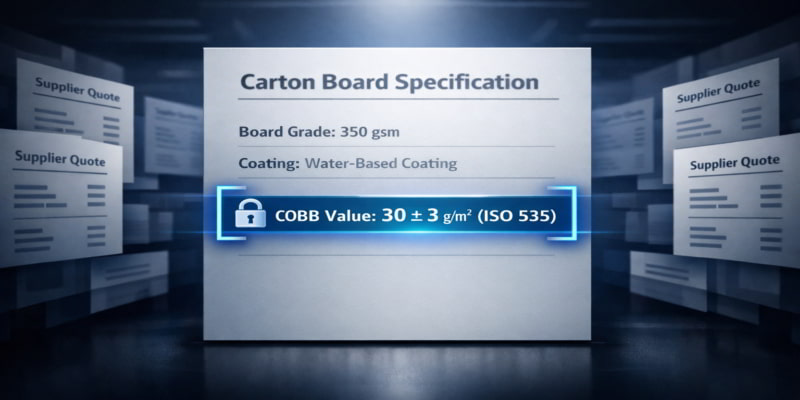
If your specification states only “COBB 30 g/m²,” you have named a target but left the acceptable range undefined. Does 32 g/m² trigger a rejection? Does 28 g/m²? Without a tolerance band, every supplier interprets the requirement differently—and every incoming shipment becomes a judgment call.
| Element | What It Is | Example |
| COBB Value | The property being measured | 30 g/m² |
| Tolerance | The acceptable band around that value | ± 5 g/m² |
| Specification | Both elements combined | COBB 30 g/m² ± 5 g/m² |
A complete specification includes both: the target value and the allowable deviation. “COBB 30 g/m² ± 5 g/m²” sets a clear window. Anything from 25 to 35 g/m² passes; anything outside that range requires action.
Tolerances also signal your actual requirements to suppliers—a core principle explored in the danger of vendor-led data sheets: establishing rigid folding carton specification requirements. A tight tolerance (± 2 g/m²) tells the supplier you need precise control—perhaps for a moisture-sensitive application. A wider tolerance (± 8 g/m²) signals flexibility. Both are valid. The key is making the decision explicit before quotes arrive.
For related guidance on setting tolerance bands for other board properties, see board grade tolerances explained: securing folding carton specifications across suppliers.
How to Translate Your Environment into a Reasonable COBB Requirement
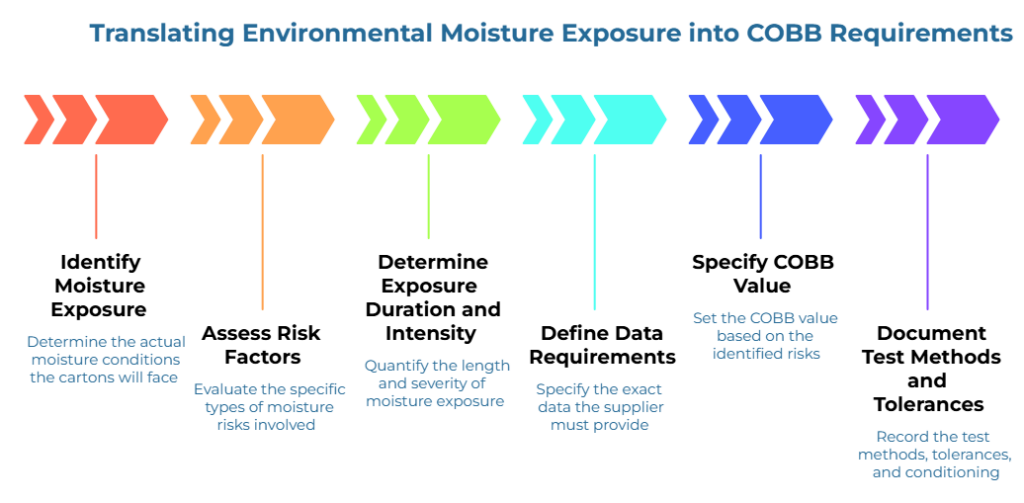
Start with the moisture exposure your folding cartons will actually face. Work through these questions:
- What moisture does the pack actually face during storage and transit?
- Is the risk humidity, splashing, condensation, refrigerated handling, or storage drift?
- How long does exposure last, and at what intensity?
- What exact data must the supplier provide to prove compliance?
The COBB value you specify should reflect these realities, not a generic industry benchmark copied from a supplier’s data sheet.
Requirements Bridging Chart
| Real-World Environment | What Risk Moisture Creates | What to Clarify in Plain English | Specification Field to Define | Test Method / Conditioning Note | Tolerance Note |
| Humid warehouse (>70% RH) | Board softens, loses rigidity | Expected humidity range and storage duration | COBB requirement (lower value needed) | ISO 535 or TAPPI T 441; condition samples per ISO 187 | Tighter tolerance for structural applications |
| Refrigerated transport | Condensation on temperature transitions | Cold-chain stages and condensation contact risk | COBB + barrier/coating note | Include conditioning context for cold-chain simulation | Document whether direct condensation contact is expected |
| Dry indoor storage | Over-specification risk | Whether high moisture resistance is actually needed | COBB review note | Standard conditioning sufficient | Wider tolerance acceptable; avoid unnecessary cost |
| Printed folding carton with adhesion sensitivity | Ink/finish problems, adhesive failure | Print and converting sensitivity to surface moisture | COBB + surface/printability companion note | Tie to test method relevant to print adhesion | Match tolerance to converting process sensitivity |
This chart is a translation framework, not a lookup table of correct answers. Your job is to identify the moisture conditions in the left column, then work rightward to define what belongs in your specification.
A useful question ties this together: what exactly must the supplier prove or state? In most cases, the answer should include the named test method, the stated requirement, the tolerance, the conditioning or test context if relevant, and the format in which results will be reported.
For applications involving frozen food or barrier coatings, how to define safe contact barriers for frozen food folding carton packaging extends this logic to food-contact requirements.
Where COBB Belongs Inside Your Master Specification Sheet
COBB requirements sit alongside other board performance parameters—not isolated as a standalone field. A well-structured specification groups related requirements so suppliers and internal teams see the full picture.
Place your COBB requirement near board grade, basis weight, and caliper. Follow it immediately with the test method (ISO 535 or TAPPI T 441), conditioning requirements, and the tolerance band. If barrier coatings or surface treatments affect moisture performance—such as those discussed in mapping folding carton barrier requirements to your budget—cross-reference those fields in the same section.
The structure matters because specification alignment depends on related requirements appearing together. A COBB value disconnected from board grade and coating notes creates gaps that suppliers fill with their own assumptions—and those assumptions rarely match yours.
For a complete parameter structure, see the baseline packaging parameter checklist: structuring your folding carton specification requirements.
The Common Mistakes That Make COBB Requirements Useless
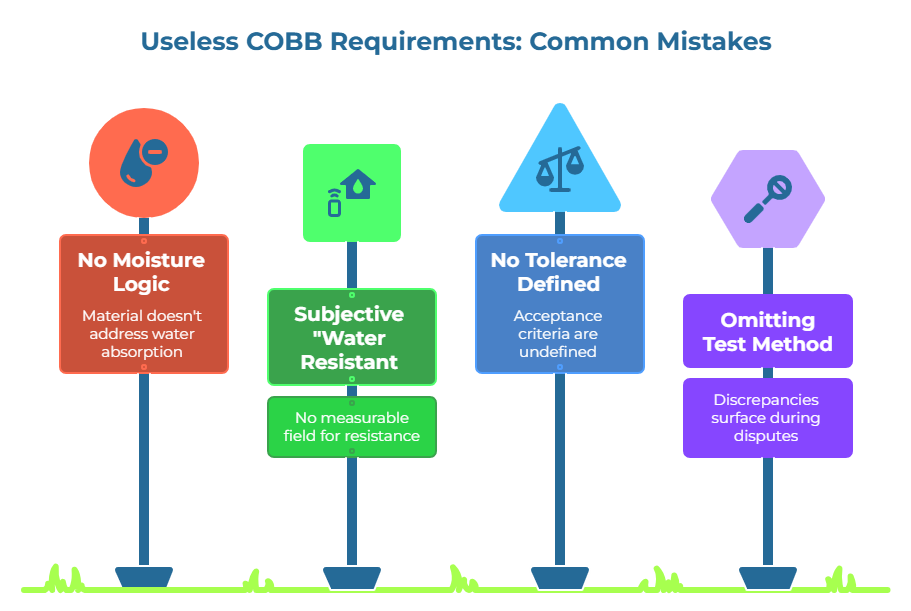
Four patterns undermine COBB specifications repeatedly.
Naming a board grade without moisture logic. “SBS 18 pt” tells the supplier what material to use. It says nothing about water absorption performance. Two suppliers quoting the same grade can deliver boards with meaningfully different COBB values.
Asking for “water resistant” with no measurable field. The phrase is subjective. Without a COBB target, test method, and tolerance, “water resistant” means whatever the supplier decides it means.
Copying supplier data sheet language without defining tolerance. A supplier’s published COBB value is a typical result, not a guaranteed range—a problem addressed in the truth decay of data sheets: why relying on supplier specifications ruins folding carton specifications. Lifting that number into your specification without adding a ± tolerance leaves acceptance criteria undefined.
Omitting the test method. ISO 535 and TAPPI T 441 produce comparable but not identical results. A specification that names a COBB value without naming the method invites discrepancies that surface only during disputes—the same pattern that undermines claims to proof: a practical guide to supplier evidence packs for folding cartons.
A Simple Starter Template Non-Engineers Can Copy
Use this structure to document your COBB requirement. Fill in the bracketed fields with values appropriate to your application.
- Property Name: Water Absorptiveness (COBB Value)
- Target Requirement: [30 g/m²]
- Tolerance / Allowable Variation: [± 5 g/m²]
- Test Method: [ISO 535:2023 or TAPPI T 441 om-24]
- Conditioning / Test Context: [e.g., Samples conditioned per ISO 187 at 23°C, 50% RH for minimum 24 hours]
- Acceptance Note: [e.g., Values outside tolerance require supplier notification before shipment; rejection threshold at ± 8 g/m²]
- Exception Approval: [e.g., Deviations require written approval from Procurement Lead]
This template is a starting point. Adapt it to your documentation format and internal approval workflows. The goal is a specification field that suppliers can quote against and your team can enforce consistently.
Frequently Asked Questions
What is a COBB value?
A COBB value measures how much water a paper or board surface absorbs under standardized test conditions, expressed in grams per square meter (g/m²). Lower values indicate less water absorption.
Why does COBB matter in folding carton specifications?
Moisture absorption affects folding carton rigidity, print quality, adhesive bonding, and line performance. Folding cartons that absorb too much water can soften in humid environments, leading to structural failures and customer complaints.
What is the difference between a COBB value and a tolerance?
The COBB value is the target property (e.g., 30 g/m²). The tolerance is the acceptable variation around that target (e.g., ± 5 g/m²). Both must appear in a complete specification.
Where should COBB requirements appear in a specification sheet?
Place COBB alongside related board properties — board grade, basis weight, caliper—followed immediately by the test method, conditioning requirements, tolerance band, and acceptance criteria.
Your Next Step
With a clearer understanding of COBB values and tolerances, you are ready to build or refine your master specification sheet. Continue with The folding carton specification alignment checklist: connecting compliance to supplier vetting for a complete framework.
When your specifications are defined, explore verified folding carton suppliers to request quotes against your documented requirements, or submit your buying requirements to receive quotes from qualified suppliers.
Disclaimer:
This article provides general educational guidance on COBB values and moisture specifications for packaging procurement. Specific targets, tolerances, and test methods (ISO 535, TAPPI T 441) are illustrative examples—not prescriptive recommendations. Consult qualified packaging engineers and testing laboratories to determine appropriate specifications for your specific application, environmental conditions, and regulatory requirements.
Our Editorial Process:
Our expert team uses AI tools to help organize and structure our initial drafts. Every piece is then extensively rewritten, fact-checked, and enriched with first-hand insights and experiences by expert humans on our Insights Team to ensure accuracy and clarity.
About the PaperIndex Insights Team:
The PaperIndex Insights Team is our dedicated engine for synthesizing complex topics into clear, helpful guides. While our content is thoroughly reviewed for clarity and accuracy, it is for informational purposes and should not replace professional advice.