
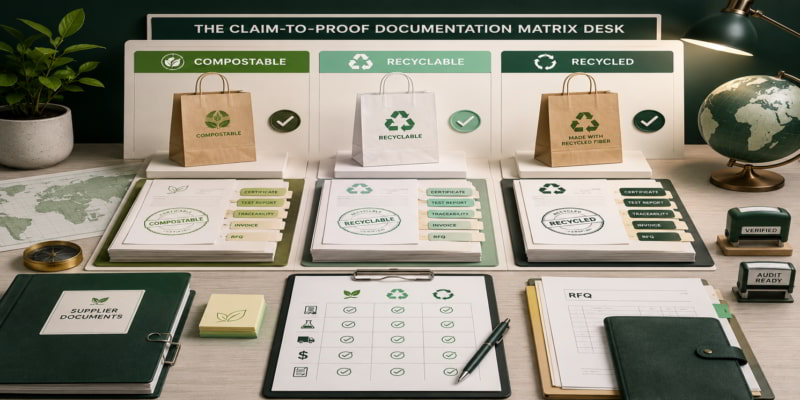
📌 Key Takeaways
Compostable, recyclable, and recycled are three separate claims — each one needs its own proof before you compare suppliers.
- Three Claims, Three Proof Trails: A recycled bag is not automatically recyclable, and a recyclable bag is not automatically compostable — treat each label as a separate question with its own documents.
- Match Claims to the Finished Bag: Certificates for base paper may not cover the final product once coatings, inks, handles, adhesives, or windows are added.
- Check the Market, Not Just the Material: A bag designed for recycling in one country may be rejected in another due to different collection, sorting, or composting systems.
- Lock Claims into Every Document: If a sustainability claim appears in the quote but disappears from the purchase order or invoice, you may lack the proof you need for audits or customer reviews.
- Replace Vague Labels with Specific Language: Swap terms like “eco-friendly” or “sustainable” for exact claim wording that names the standard, percentage, or certification behind it.
Specific proof beats broad labels — every time.
Global procurement teams sourcing paper bags across markets will gain a clear framework for verifying supplier claims, preparing them for the detailed documentation guide that follows.
~ ~ ~ ~ ~ ~ ~ ~ ~ ~ ~ ~ ~ ~ ~ ~ ~ ~
Sustainability labels show up early in paper bag sourcing. A supplier’s data sheet may describe the same product as compostable, recyclable, or made from recycled content — sometimes in the same paragraph. The words sound similar. In procurement terms, they are not.
Each term represents a different type of claim, supported by different documentation, tested under different conditions, and dependent on infrastructure that varies from one market to the next. When buyers accept these labels without asking what sits behind them, they risk carrying unsupported language into RFQs, purchase orders, packaging artwork, and internal sustainability reports. Different teams — procurement, sustainability, marketing, operations — may each interpret the same word differently, creating misalignment that only surfaces when a claim is challenged.
This article breaks down what each sustainability term means as a sourcing question, what documentation buyers should request, and how to verify claims when comparing global paper bag suppliers.
Compostable, Recyclable, and Recycled Mean Different Things in Sourcing
Procurement discussions often treat these three words as variations of the same idea. Each one describes a different dimension of the product, and each one demands a different proof.
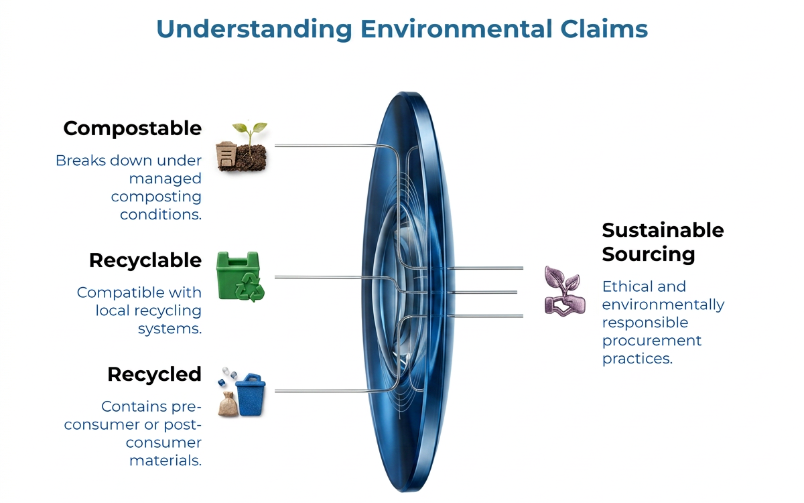
Compostable is an end-of-life claim. It asserts that the bag will break down under managed composting conditions — typically industrial composting — according to a named standard and within a defined timeframe. Compostability claims should identify the standard and composting condition. Without that specificity, the claim cannot be verified or matched to the target market’s disposal system. The Biodegradable Products Institute, for example, distinguishes between commercial compostability and commercial-and-home compostability certification — which illustrates why “compostable” should not be treated as one universal condition. ISO 14021, which addresses self-declared environmental claims, provides a framework for verifying their boundaries.
Recyclable is a recovery-system compatibility claim. It means the bag is designed to enter a paper recycling stream — but it does not guarantee the bag will actually be recycled. Recyclability depends on the bag’s material construction and on whether the local collection and processing system accepts that construction. A bag that qualifies in one market may be rejected in another.
Recycled is a material-input claim. It describes what went into the bag, not what happens to it afterward. Buyers should ask for the percentage of recycled content, whether it is pre-consumer or post-consumer where that distinction matters, and whether the claim is traceable to the specific product and order through supplier documentation.
A bag made from recycled fiber is not automatically recyclable. A recyclable bag is not necessarily compostable. Each claim needs its own evidence trail.
Use a Claim-to-Proof Matrix Before Comparing Suppliers
Before sending an RFQ to multiple suppliers, procurement teams use a documentation matrix to map each sustainability claim to its required proof. If suppliers are using different claim types, the quote comparison is not yet like-for-like — and the matrix should be applied before price comparison begins.
| Claim Type | What the Buyer Should Ask | Documentation to Request | Market-Fit Check | Risky Wording to Avoid |
| Compostable | Under what standard, certification, and composting condition is this claim being made? | Certificate, test report, certification scope, product reference, and component coverage | Is the target market’s composting route compatible with the claim? | “Compostable everywhere” |
| Recyclable | In which collection and recycling systems is this bag designed to be accepted? | Material construction details, recyclability guidance, supplier declaration, and coating/ink/adhesive details | Are coatings, inks, handles, liners, windows, or use conditions accepted in the intended recovery stream? | “Will be recycled” |
| Recycled | What percentage and type of recycled content is claimed for this exact product? | Chain-of-custody records, supplier input declarations, certificates where applicable, and invoice-level claim wording | Is the content claim traceable to this product, order, production site, and shipment? | “Made from recycled paper” without percentage or scope |
Beyond the matrix, buyers should press suppliers on four questions before any comparison begins:
- “Which exact claim are you making: compostable, recyclable, recycled content, certified fiber, or a combination?”
- “Which product, production site, and order does the documentation cover?”
- “Does the evidence apply to the bag as supplied, including coatings, inks, handles, adhesives, and windows?”
- “Can this claim travel through the quote, PO, invoice, and packing documents?”
These questions turn vague sustainability language into verifiable sourcing criteria. For a broader framework on aligning sustainability values with RFQ specifications, buyers can implement consistent verification standards across their paper bag procurement.
Check the Bag Construction Before Accepting the Claim
Paper bags are not just paper. A typical bag may combine base paper or kraft grade, recycled or virgin fiber, coatings or barrier treatments, printing inks, adhesives, various handle types, windows or laminates, and food-contact surfaces where applicable. Any of those components can change whether a sustainability claim holds up.
That does not mean any one component automatically prevents recycling or composting. It means the supplier’s claim must cover the finished bag as supplied. A certificate for a base paper grade may not cover a printed, coated, handled, or windowed bag. A supplier declaration for an unprinted kraft bag may not apply once heavy ink coverage, adhesives, or barrier treatments are added.
Buyers should ask whether each construction feature is included in the claim scope:
| Construction Element | Supplier Question |
| Base paper or kraft grade | Which paper grade is used and is the claim tied to this grade? |
| Recycled or virgin fiber | What recycled-content percentage or fiber claim is being made, and how is it documented? |
| Coating or barrier treatment | Is the coating included in the compostability or recyclability assessment? |
| Printing ink | Does the claim scope account for ink system and coverage level? |
| Adhesive | Is the adhesive included in the certificate, test report, or supplier declaration? |
| Handles | Are handle material and attachment methods included in the claim scope? |
| Window or laminate | Does the claim apply to the finished bag with the window or laminate included? |
| Food-contact surface | Are food-contact requirements handled separately from environmental claims? |
The practical question in each case is the same: “Does your documentation cover the bag as we will receive it — including every coating, adhesive, ink, handle, and insert?” A supplier may have valid documentation, but the documentation may apply to a material, site, or product family rather than the exact bag being sourced. The distinction between scope and product matters.
When weighing the specification trade-offs between kraft, white, and recycled paper bags, this construction-level check matters as much as the material itself.
Ask Market-Fit Questions, Not Just Material Questions
Global buyers must also avoid assuming one market’s recovery pathway applies everywhere. Recycling and composting infrastructure varies by region, municipality, and retail channel. A bag designed for paper recycling in one market may face different collection, sorting, contamination, or labeling conditions elsewhere. A compostability claim may depend on access to a suitable composting route and recognition of the relevant certification scheme.
WRAP’s recyclability guidance emphasizes that packaging design should account for collection, processing, and reincorporation into supply chains — reinforcing the point that material decisions and market infrastructure work together.
Procurement teams can keep the discussion practical by asking:
| Market-Fit Question | Why It Matters |
| Where will the bag be sold, used, or disposed of? | The relevant recovery route may differ by market and use case. |
| Does the claim depend on industrial composting, home composting, paper recycling, or another route? | Each pathway requires distinct evidence and specific transactional wording. |
| Does the destination market recognize the certification or labeling scheme? | A certificate may be valid but not sufficient for every market claim. |
| Who approves final wording? | Supplier, buyer, legal, sustainability, retailer, and local advisors may each own part of the risk. |
| Does the claim apply after printing, coating, filling, and use? | The final bag may differ from the material originally tested or certified. |
An illustrative example: a supplier says a paper bag is recyclable. The buyer should not convert that into “will be recycled.” A safer follow-up is to ask whether the claim applies to the finished construction — including coating, handle, adhesive, ink coverage, window material, and likely use conditions in the target market.
Put Claim Requirements into RFQs, POs, and Invoice Paperwork
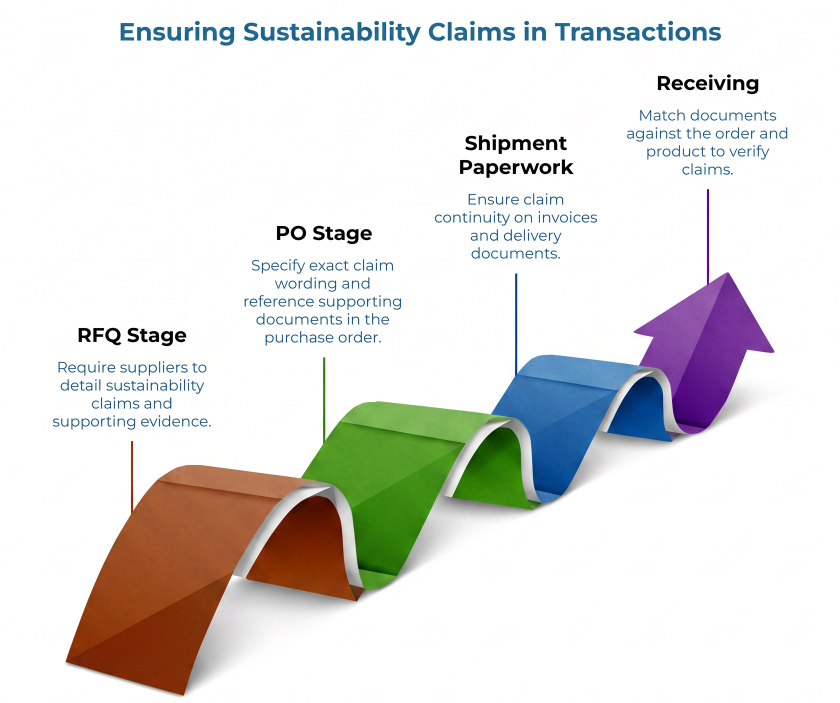
Sustainability claims lose value when they appear in a supplier pitch deck but disappear from the documents that govern the transaction. Documentation can vanish between quote and invoice if not required at each stage.
At the RFQ stage, require the supplier to state the claim, the supporting standard, the certificate holder, the certified site, the scope, and the product reference. The RFQ should ask whether the evidence covers the finished bag, not only the base paper. This prevents vague sustainability language from entering the evaluation without evidence.
At the purchase order stage, require exact claim wording and supporting documents. If the bag is described as containing a stated percentage of recycled content, the PO should name that percentage and reference the documentation behind it. Replace vague terms such as ‘eco-friendly’ and ‘sustainable’ with specific claim language at this stage.
On shipment paperwork, require claim continuity on the invoice or delivery documents where relevant. If the claim cannot appear on the invoice, buyers should document the gap and understand why. If a certified or recycled-content claim appears in the quote but disappears from the invoice, the buyer may not have the paperwork needed for internal reporting or downstream customer review.
At receiving, match documents against the order and the product. A certificate that covers a different product line, production site, or validity period does not support the claim on the shipment being received. If the invoice issuer, certificate holder, production site, product reference, or claim wording does not match the approved file, resolve the difference before using customer-facing claims.
FSC and PEFC chain-of-custody systems provide the clearest model for document continuity. FSC’s chain-of-custody certification verifies forest-based materials along the product path through identification, tracking, and record-keeping. PEFC’s standard similarly supports accurate, verifiable claims for certified, recycled, or controlled-source material. Buyers working with FSC or PEFC claims on paper bags can apply this same logic to compostability, recyclability, and recycled-content claims.
For a step-by-step approach to verifying FSC claims on paper bag orders, buyers can start with the public certificate database.
Safer Wording Buyers Can Use Internally
The language that appears in internal reports, RFQ templates, and packaging artwork matters. Vague or absolute sustainability wording creates exposure when the claim cannot be substantiated at the product, order, or market level. A supplier may provide a narrow claim, but that claim can turn into “eco-friendly packaging” in a presentation, store rollout memo, product page, or sustainability update.
In the US, the FTC Green Guides provide the framework for environmental marketing claim substantiation. While framed as administrative guides (16 CFR Part 260), the FTC actively enforces these standards under Section 5 of the FTC Act (15 U.S.C. part 45), meaning unverified or overly broad claims carry direct legal and financial risk. In the European Union, the Empowering Consumers Directive strictly prohibits generic environmental claims like ‘eco-friendly’ unless backed by recognized environmental performance, establishing binding rules against unverified greenwashing. Both the US and EU frameworks reinforce a core rule: environmental claims must be as specific as the evidence allows, and broad terms carry severe compliance risk.
| Riskier Wording | Safer Alternative |
| “These bags are eco-friendly.” | “The supplier states a sustainability-related claim; procurement is confirming claim type, scope, and supporting documents.” |
| “These bags are compostable.” | “The supplier claims the bags meet the stated compostability standard or certification under the stated composting condition; target-market acceptance still needs confirmation.” |
| “These bags are recyclable.” | “Supplier indicates the bag construction is designed for paper recycling where accepted; destination-market guidance and buyer labeling review are still required.” |
| “These bags are made from recycled paper.” | “The supplier states the bags contain a specified percentage of recycled content; certificate, declaration, and invoice-level confirmation are required.” |
| “FSC or PEFC proves the bag is sustainable.” | “FSC or PEFC documentation may support certified material claims when certificate status, scope, entity match, and transaction documents are confirmed.” |
The safer alternatives are longer, but more defensible. They tell the reader — and any auditor, retailer, or regulator — what the claim rests on and where verification is still needed. The wording should not undermine the supplier. It should make the evidence boundary visible.
For guidance on translating vague sustainability language into specifications suppliers can quote against, procurement teams can standardize this translation approach throughout their specification documents.
Questions to Ask Before Approving a Supplier Claim
Before signing off on any environmental claim for use in buyer-facing documents, packaging artwork, or sustainability reports, procurement teams can run through a short verification checklist.
Ask what exact environmental claim is being made. Then confirm what standard, certification, test method, or supplier declaration supports it. The review should identify the product, production site, and supplier legal entity covered by the document.
The next check is construction scope. Does the evidence cover coatings, inks, handles, adhesives, windows, liners, and other relevant features? If the claim depends on recovery infrastructure, does it match the target market’s likely recycling or composting route?
Finally, confirm document continuity. The quote, PO, invoice, delivery paperwork, and internal file should not tell different claim stories. If customer-facing wording will be used, the final language should be reviewed by the right owner — whether that is sustainability, legal, QA, retailer compliance, or a qualified local advisor.
If any answer is missing, the claim is not ready for external use.
Frequently Asked Questions
Is a recycled paper bag automatically recyclable?
Not automatically. A bag made from recycled fiber may include coatings, adhesives, or other components that affect whether the finished product is accepted in a given recycling system. Recyclability depends on the bag’s full construction and on the collection and processing infrastructure in the destination market. Buyers should verify both claims independently.
Can a paper bag be both compostable and recyclable?
A bag may carry more than one claim, but each must be separately substantiated and appropriate to the target market. A compostability certificate does not prove recyclability, and a recyclability assessment does not confirm compostability. Buyers should request independent documentation for each claim.
What is the safest first question to ask a supplier?
“What exact environmental claim are you making, and what document proves it for this specific product and shipment?” This forces the supplier to name the claim type, identify the evidence, and define the scope — preventing broad sustainability language from entering procurement without verification.
Can suppliers use one certificate for all paper bag products?
Only if the certificate scope supports that use. A certificate may apply to a company, site, material category, or product family, but not necessarily to every finished bag, construction, coating, print format, or shipment. Buyers should verify holder name, validity, scope, product coverage, and transaction continuity.
Conclusion
Buyers do not need to become certification specialists. The shift is simpler: stop treating compostable, recyclable, and recycled as interchangeable labels and start treating each as a separate verification question — with its own documentation, scope limitations, and market-fit checks.
Before comparing suppliers, turn each sustainability claim into a documented RFQ requirement. Global sourcing platforms allow buyers to discover paper bag suppliers and submit RFQs while requesting primary supplier-side documentation directly.
Disclaimer:
This article is for general informational purposes only and does not constitute compliance, sustainability, legal, technical, or professional advice. Requirements, risks, and best practices may vary by market, jurisdiction, disposal system, product construction, supplier documentation, and use case. Confirm important decisions with the appropriate qualified professional, certification body, regulator, supplier, or technical expert.
Our Editorial Process:
Our expert team uses AI tools to help organize and structure our initial drafts. Every piece is then extensively rewritten, fact-checked, and enriched with first-hand insights and experiences by expert humans on our Insights Team to ensure accuracy and clarity.
About the PaperIndex Insights Team:
The PaperIndex Insights Team is our dedicated engine for synthesizing complex topics into clear, helpful guides. While our content is thoroughly reviewed for clarity and accuracy, it is for informational purposes and should not replace professional advice.