

📌 Key Takeaways
Kraft paper doesn’t expire on a set date — shelf life depends on humidity, handling, and wrapping integrity.
- Storage Decides Shelf Life: Humidity, temperature swings, sunlight, and damaged wrapping affect paper quality more than time alone.
- Inspect Before Production: Older stock can show moisture stains, warping, brittleness, or odor that visual checks alone won’t always catch early enough.
- Match Orders to Turnover: Bulk savings disappear if paper degrades before your team uses it, so align order size with real consumption rates.
- Ask Suppliers the Right Questions: Request storage guidance specific to your grade, format, and warehouse conditions — generic answers signal weak product knowledge.
- Treat Each Warehouse Differently: Climate control, dock exposure, and rotation speed vary by site, so one storage plan rarely fits all locations.
Buy smarter by storing smarter — bulk pricing only pays off when the paper still works at production time.
Procurement and warehouse teams managing kraft paper inventory will gain a practical screening and planning framework here, guiding them into the storage and supplier evaluation details that follow.
~ ~ ~ ~ ~ ~ ~ ~ ~ ~ ~ ~ ~ ~ ~ ~ ~ ~
The roll label is fading, the protective wrap has a torn corner, and the warehouse team wants to know whether older kraft paper can still go to production. The material looked acceptable when it arrived. It has since been moved twice, stored near a busy dock, and partly exposed after a rushed pick-and-place shift.
Buying kraft paper in bulk reduces ordering frequency and can improve per-unit pricing. But those savings depend on a critical assumption: that the material will still perform when production needs it. If rolls or sheets sit in a warehouse longer than planned, storage conditions start to influence whether the paper remains fit for use.
The challenge is that kraft paper shelf life is not a single, fixed number. It varies by storage environment, handling practices, supplier packaging, product format, and the requirements of the intended application. A shelf-life estimate that holds in one warehouse may not hold in another with different humidity, turnover speed, or staging practices.
Rather than searching for a universal number, procurement teams benefit more from understanding what shelf life depends on, what deterioration looks like, and what to ask suppliers before committing to volume orders.
The Short Answer: Kraft Paper Shelf Life Depends on Storage, Handling, and Use
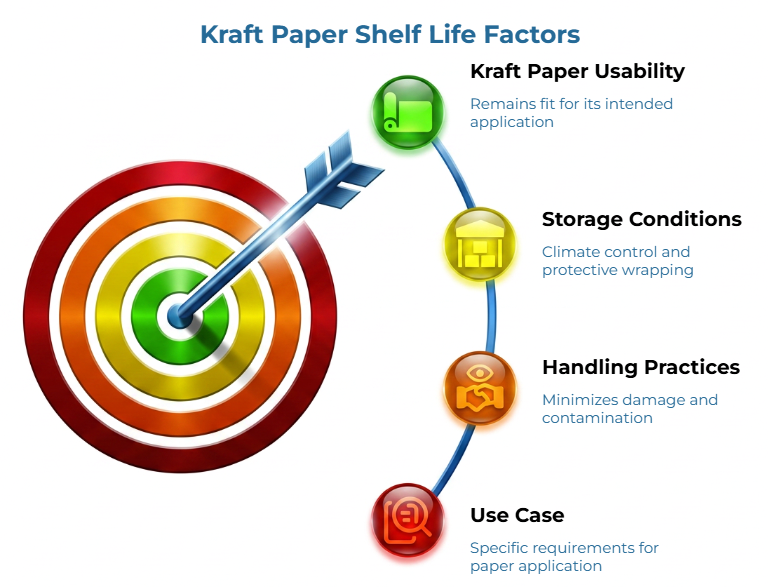
There is no universal expiration date for kraft paper. A roll stored in a climate-controlled warehouse with intact protective wrapping and steady turnover may remain fully usable for an extended period. The same grade stored near a loading dock with fluctuating temperatures and torn wrapping may show problems much sooner.
Shelf life, in practical terms, means how long kraft paper remains fit for its intended packaging, converting, or handling application. A kraft paper mother roll may look acceptable on the outside but still need checks before high-speed converting. A stack of kraft sheets may be usable for basic wrapping but unsuitable for a stricter printed or folded application. Paper that appears physically intact but no longer meets printing, bonding, or structural requirements for a specific job is functionally past its useful life.
This distinction matters for procurement planning. While bulk purchasing can reduce administrative workload and support supply continuity, it also increases storage duration and handling exposure. If the material sits longer than expected, the buying decision becomes a warehouse and production decision too. Buying cadence, storage costs, stock rotation schedules, and supplier conversations all change when shelf life is treated as a condition-dependent variable rather than a calendar date. The question shifts from “how many months does it last?” to “under what conditions will it remain usable for the time you need?”
Why One Shelf-Life Estimate May Not Apply to Every Warehouse
Paper responds to its surrounding atmosphere, and the broader paper-testing world recognizes that temperature, relative humidity, and handling conditions affect paper and related products. The TAPPI T 402 standard defines standard atmospheres for conditioning and testing paper, paperboard, containers, and related products. It also addresses handling so materials can reach equilibrium with the atmosphere. That standard is not a shelf-life guarantee for a specific kraft paper order, but it supports a safer procurement assumption: moisture and environmental conditions matter. If a supplier gives one estimate, procurement still needs to ask what storage conditions that estimate assumes.
The packaging format also changes the discussion. EUROSAC notes that paper sack usability can be affected by exposure to damp, moisture, and UV light, and that correct storage and handling along the supply chain generally influence shelf life. While multiwall sacks often include barrier films to protect their contents from atmospheric gases like oxygen or carbon dioxide, the raw kraft paper material itself degrades primarily due to moisture and temperature fluctuations during typical warehousing. Its guidance is specific to paper sacks rather than every kraft paper format, but it reinforces the same procurement principle: construction, exposure, and handling shape real-world performance.
The table below connects common storage variables to their procurement implications.
| Storage Variable | What Happens | Procurement Implication |
| Moisture and humidity exposure | Paper absorbs ambient moisture, affecting strength, printability, and bonding | Verify warehouse humidity management before increasing order volumes |
| Temperature swings and condensation | Rapid changes cause condensation inside wrapping, creating localized damage | Account for seasonal and geographic differences across storage locations |
| Direct sunlight or heat exposure | Accelerates aging, discoloration, and surface degradation | Confirm storage areas are shielded from direct exposure |
| Damaged or removed wrapping | Exposes paper to dust, moisture, and contaminants | Require warehouse teams to keep protective wrapping intact until use |
| Proximity to dock doors, wet floors, or exterior walls | Increases exposure to moisture and temperature variation | Audit high-risk zones before designating them for kraft paper storage |
| Product format (rolls, sheets, sacks, coated) | Different formats carry different exposure profiles and handling risks | Ask the supplier whether storage guidance changes by format |
A common simplification is, ‘Store it properly, and it will be fine.’ The problem is that “properly” must be defined for the specific material, format, and site. A roll stored in a stable reserve area does not carry the same risk as a roll staged for weeks near an open loading bay.
Procurement teams managing warehouse moisture and temperature risks across multiple facilities should treat each location as a separate storage environment rather than applying a single assumption across all sites.
What Kraft Paper Deterioration Can Look Like Before It Causes Problems
Deterioration does not always announce itself. Kraft paper stored too long or under poor conditions may look passable at a glance but perform poorly on a converting line, during printing, or in final packaging. Sometimes the first warning sign is a musty smell, a softened edge, or a sheet that no longer lies flat. Use inspection as a screening step, not as a full technical test. Visual checks cannot guarantee performance, and they should not replace supplier guidance or quality testing where the application is demanding. They can, however, stop questionable material from reaching production without review.
Signs worth monitoring in older kraft paper stock include:
- Visible moisture damage — water stains, soft spots, damp patches, or wrinkling on outer layers or edges
- Mold or unusual odor — musty smell indicating prolonged moisture exposure
- Discoloration — yellowing, darkened patches, or uneven shade beyond normal appearance
- Warping, curling, or deformation — paper that no longer lies flat or feeds consistently (see also: why kraft paper curls, cracks, or wrinkles during conversion)
- Brittleness or cracking — material that tears or fractures under light handling
- Damaged roll edges or crushed packaging — torn wrap, crushed cores, distorted pallets, or compromised integrity affecting converting
- Print, adhesive, or converting issues — reduced surface performance at the production stage
Consider a scenario where operations teams flag stored rolls showing torn outer wrapping and visible edge damage during a routine rotation. Rather than sending them to the converting line, the team flags them for inspection and compares the material against current production requirements. This kind of pre-use check prevents defective material from causing line stoppages or finished-product failures. Not every mark warrants rejection, but every anomaly requires evaluation.
Visual inspection is a useful first filter, but it does not replace performance testing when the application is critical. A structured receiving controls checklist can standardize how teams evaluate incoming and stored material.
How Shelf Life Should Shape Procurement Planning
When shelf life becomes a purchasing input rather than an afterthought, buying decisions grow more defensible. The goal is not to eliminate bulk purchasing. It is to match order quantities to realistic storage timelines and turnover rates so material reaches production while it is still fit for use.
Match order size to actual consumption. A lower unit price loses its advantage if a portion of the order degrades before production needs it. Review historical usage data before committing to larger volumes. If demand slows, storage space tightens, or the material must be moved repeatedly, the extra stock can become harder to protect and inspect.
Use first-in, first-out rotation. Stock rotation is one of the simplest ways to prevent older material from sitting idle while newer deliveries get consumed. Teams managing kraft paper bulk roll storage and rotation benefit from organizing inventory by receiving date rather than by available floor space.
Account for differences across locations. Multi-site buyers should evaluate each warehouse independently. Storage capacity, environmental controls, and turnover speed may differ significantly between facilities.
For instance, when distributing volume orders across multi-site networks, a procurement team must evaluate localized variables independently rather than relying on a single baseline. For example, if Warehouse A utilizes a strict climate-controlled layout while Warehouse B stores slower-moving inventory near exposed loading dock doors, applying an identical order quantity and rotation schedule to both sites assumes equivalent storage conditions—a flawed premise that introduces localized material degradation risks at Warehouse B. A better plan may split quantities, stagger deliveries, or require an inspection checkpoint before Warehouse B releases older stock.
Include warehouse teams in purchasing decisions. Procurement controls the order; warehouse and operations teams control the storage reality. They know whether protective wrapping gets damaged during internal moves, which zones are exposed to floor moisture or forklift traffic, and where temporary staging pressure builds. Aligning both perspectives before increasing order sizes reduces the chance of material sitting beyond its practical usability window.
Treat slow-moving stock as a quality risk. Inventory not moving at the expected rate deserves attention. Slow consumption combined with inconsistent storage raises the likelihood of deterioration that goes unnoticed until production.
Clarify supplier documentation before increasing order size. Supplier documentation may include shelf-life guidance, storage recommendations, wrapping instructions, handling guidance, technical data sheets, or application-specific notes. If that documentation is vague, procurement should request clarification before committing to a larger volume.
When storage conditions across facilities are inconsistent, smaller and more frequent orders may deliver better quality outcomes than larger, less frequent purchases. If your team is comparing materials such as kraft paper jumbo rolls, connect the comparison to real storage risk as well as specification and price. For broader supplier discovery, cross-referencing an enterprise vendor index such as PaperIndex’s supplier directory can streamline early market mapping, provided all supplier assertions undergo document-level verification before a volume commitment is executed.
A Simple Shelf-Life Planning Checklist for Procurement and Warehouse Teams
Deploy this targeted verification framework during supplier onboarding, volume expansions, or internal inventory audits:
Supplier Documentation
- Confirm shelf-life and storage guidance for the specific grade, format, and packaging
- Request supporting documentation such as technical data sheets or handling guides
- Confirm whether the guidance changes for rolls, sheets, sacks, bags, coated material, or printed material
Warehouse Storage
- Store material according to supplier guidance for temperature, humidity, and exposure
- Keep protective wrapping intact until production use and document damage at receiving
- Position inventory away from high-risk zones such as dock doors, wet floors, and exterior walls
Inventory Rotation
- Use first-in, first-out rotation for all kraft paper stock
- Record receiving dates, batch or lot details, and storage location where available
- Flag slow-moving inventory for inspection before it ages beyond supplier guidance
Pre-Use Inspection
- Inspect older stock for moisture damage, odor, discoloration, warping, brittleness, or wrapping damage
- Escalate questionable material before production-critical use
- Compare material condition against the performance requirements of the intended application
Any specific environmental thresholds included in a facility’s version of this checklist should be verified through supplier documentation or applicable standards. Where verification is unavailable, phrase requirements qualitatively.
Supplier Questions to Ask Before Buying Kraft Paper in Bulk
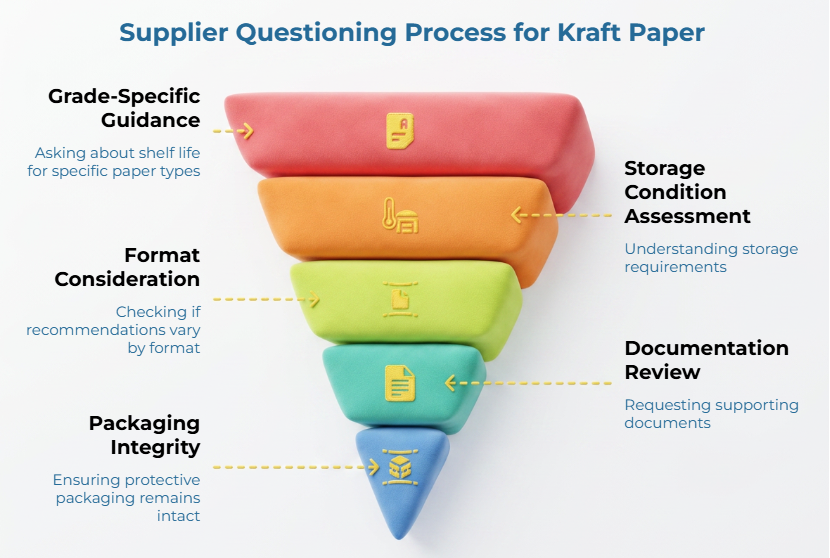
Asking the right questions before placing a bulk order is one of the most practical steps a procurement team can take. The quality of a supplier’s answers reveals whether their guidance is grade-specific or generic — and how well they understand storage behavior for their own products. Supplier questions should be specific, but not adversarial. The purpose is to connect the supplier’s shelf-life guidance with your grade, format, packaging, route, storage conditions, and intended use.
The following questions provide a starting point for supplier conversations:
- What shelf-life guidance applies to this specific grade, format, and packaging?
- What storage conditions does that guidance assume?
- Does the recommendation change for different formats — rolls, sheets, sacks, coated paper, or printed materials?
- What documentation is available to support the shelf-life estimate?
- What wrapping or protective packaging should remain intact during storage?
- What receiving checks should be completed before stock enters inventory?
- What signs of storage damage should be inspected before use?
- What quality checks do you recommend before using older stock?
- Are there different recommendations for high-humidity warehouses, long transport routes, or multi-location storage?
A supplier who provides detailed, grade-specific responses signals stronger product knowledge and technical support. Two suppliers may both discuss shelf life, but one may provide grade-specific handling guidance while another gives only a broad statement. This does not prove one material is superior, but it clarifies the underlying assumptions for the procurement team.
To enforce this accountability, sourcing teams can integrate format-specific environmental tolerances directly into the initial Request for Proposal (RFP). Requiring a comprehensive technical data sheet during bidding ensures the ultimate shelf-life estimate reflects verified material behavior rather than a baseline generic assumption.
Teams evaluating new vendors can use a structured supplier onboarding checklist to formalize this evaluation, and verify kraft paper quality upon arrival using documented inspection protocols.
When to Revisit Your Buying Plan
Not every purchasing cycle requires a full shelf-life review. But certain changes should prompt procurement teams to reassess their approach:
- Storage durations are increasing because demand has slowed or order quantities have grown
- A new warehouse or storage location has different environmental conditions
- Seasonal humidity or temperature changes are affecting storage areas
- Quality complaints or production issues are emerging with older stock
- A supplier change has introduced different materials or handling recommendations
- The kraft paper is now being used for a different packaging application
- Order quantities have increased significantly beyond previous volumes
When any of these conditions apply, request updated storage and shelf-life documentation from the supplier before placing the next bulk order.
If food-contact, medical, or regulated packaging enters the discussion, treat that as a separate verification path. General kraft paper storage advice should not be relied upon for compliance decisions. Confirm the details with supplier declarations, certificates, or applicable regulatory documentation for the exact product and jurisdiction.
Before placing a larger order, review supplier storage guidance and material specifications. If your team is still defining sourcing options, PaperIndex’s supplier discovery tools can help identify potential kraft paper mills and kraft paper raw material suppliers, while the final approval should still rest on your documented requirements and supplier evidence.
Frequently Asked Questions
Does kraft paper have an expiration date?
Kraft paper is not typically assigned a formal expiration date the way perishable goods are. Usability depends on storage conditions, handling, the specific grade and format, and the performance requirements of the intended application. Avoid using a generic month or year estimate unless it comes from documentation for the specific material being purchased. The most reliable approach is to follow the supplier’s storage guidance for the specific material.
Can kraft paper still be used after long storage?
It may be usable if stored under appropriate conditions and if it still meets the application requirements. Inspect older material for moisture damage, discoloration, warping, or brittleness before committing it to production, especially when wrapping is damaged, storage history is uncertain, or the material will be used in a production-critical job. Confirm with the supplier whether the material remains suitable for the end use.
What storage conditions matter most for kraft paper?
Moisture exposure, ambient humidity, temperature swings, direct sunlight, wrapping integrity, and handling quality are the primary variables. Stable, dry conditions with intact packaging and consistent turnover generally support longer usability. Numeric limits should come from supplier guidance or an applicable technical source, not from guesswork. The supplier’s documentation for the specific grade is the most reliable source of guidance.
What should procurement ask suppliers about shelf life?
Ask for grade-specific shelf-life guidance, recommended storage conditions, format-specific considerations, pre-use inspection criteria, and supporting documentation such as technical data sheets or handling guides.
Should buyers compare shelf-life claims across suppliers?
Comparing shelf-life claims is worthwhile, but the comparison should focus on the assumptions behind each claim. Ask what grade, format, wrapping, storage condition, and use case each supplier’s recommendation assumes. A clearer documentation trail is more useful than a broad shelf-life statement with no context.
Kraft paper shelf life is not a single number that applies across every warehouse, climate, and application. It is a planning variable shaped by storage conditions, handling practices, supplier guidance, product format, and end-use demands. Procurement teams that treat shelf life as a purchasing input — through better supplier questions, coordinated warehouse practices, disciplined stock rotation, and pre-use inspection — build more defensible buying plans.
Secure verified material data sheets and format-specific environmental limits from your vendor prior to authorizing subsequent high-volume contracts. Request specifications that reflect the conditions in your warehouse, not just the conditions assumed in a generic estimate. Aligning procurement volumes with verified facility capabilities ensures that bulk inventory remains fully functional up to the exact point of production execution.
Disclaimer:
The information in this article is for general educational and procurement-planning purposes. It does not constitute technical, legal, or regulatory advice. Specific shelf-life, storage, and handling recommendations depend on the kraft paper grade, format, supplier, intended application, and applicable standards. Consult your supplier’s documentation and, where applicable, qualified professionals before making procurement or production decisions based on this content.
Our Editorial Process:
Our expert team uses AI tools to help organize and structure our initial drafts. Every piece is then extensively rewritten, fact-checked, and enriched with first-hand insights and experiences by expert humans on our Insights Team to ensure accuracy and clarity.
About the PaperIndex Insights Team:
The PaperIndex Insights Team is our dedicated engine for synthesizing complex topics into clear, helpful guides. While our content is thoroughly reviewed for clarity and accuracy, it is for informational purposes and should not replace professional advice.