

📌 Key Takeaways
Landed cost—not FOB price—determines which international paper bag supplier actually fits your budget.
- Normalize Before Comparing: Convert all quotes to the same Incoterm and delivery point; FOB Shanghai and CIF Los Angeles aren’t comparable without adding missing freight, insurance, and destination charges.
- Validate HS Codes Early: Supplier classifications often differ from customs authority rules; pre-check with a licensed broker to avoid unexpected duty rates and clearance delays.
- Lock Shipment Assumptions: Freight quotes shift dramatically based on LCL versus FCL, route, and package dimensions; specify these inputs to prevent post-award surprises.
- Itemize Inclusions and Exclusions: Hidden terminal handling fees, delivery order charges, and collect fees flip supplier rankings; require explicit line-item breakdowns in every quote.
- Log and Date-Stamp Assumptions: Freight rates, exchange rates, and duty schedules change; documenting assumptions enables fair revisits when market conditions shift.
Compare to-door totals, not unit prices—clarity eliminates invoice disputes.
Procurement managers sourcing paper bags internationally will gain a repeatable 30-minute normalization method here, preparing them for the detailed cost-component breakdown and copy-paste RFQ templates that follow.
The quote looked perfect. FOB $0.08 per bag—well below the budget. Then the invoice arrived: terminal handling, demurrage charges, a duty rate nobody anticipated, and customs brokerage fees that appeared from nowhere. The “cheapest” supplier became the most expensive one.
This scenario plays out repeatedly in global paper bag sourcing because procurement teams focus on the wrong number.. The FOB price is just one slice of what actually matters: the total landed cost. Understanding how duty, freight, and hidden charges interact is essential for comparing global offers fairly—and for suppliers who want to quote transparently enough to win business without post-award disputes.
This guide provides a practical method for normalizing quotes to a comparable to-door basis, covering the cost components that catch buyers off guard and the documentation discipline that helps suppliers close deals faster.
Landed Cost, in Plain English
Landed cost is the total price of getting goods from a supplier’s location to the buyer’s warehouse, ready for use. It includes everything: the product price, freight charges, insurance, customs duties, taxes, brokerage fees, and any handling or storage costs along the way.
Why does this matter for paper bags specifically? Because packaging materials ship in high volumes with relatively low unit values, freight and duty can represent a disproportionately large share of total cost. A small percentage difference in duty classification or an unexpected destination charge can flip which supplier actually offers the best deal.
The goal is simple: compare all offers on the same basis before making a decision.
The 9 Landed-Cost Components Buyers Miss Most Often
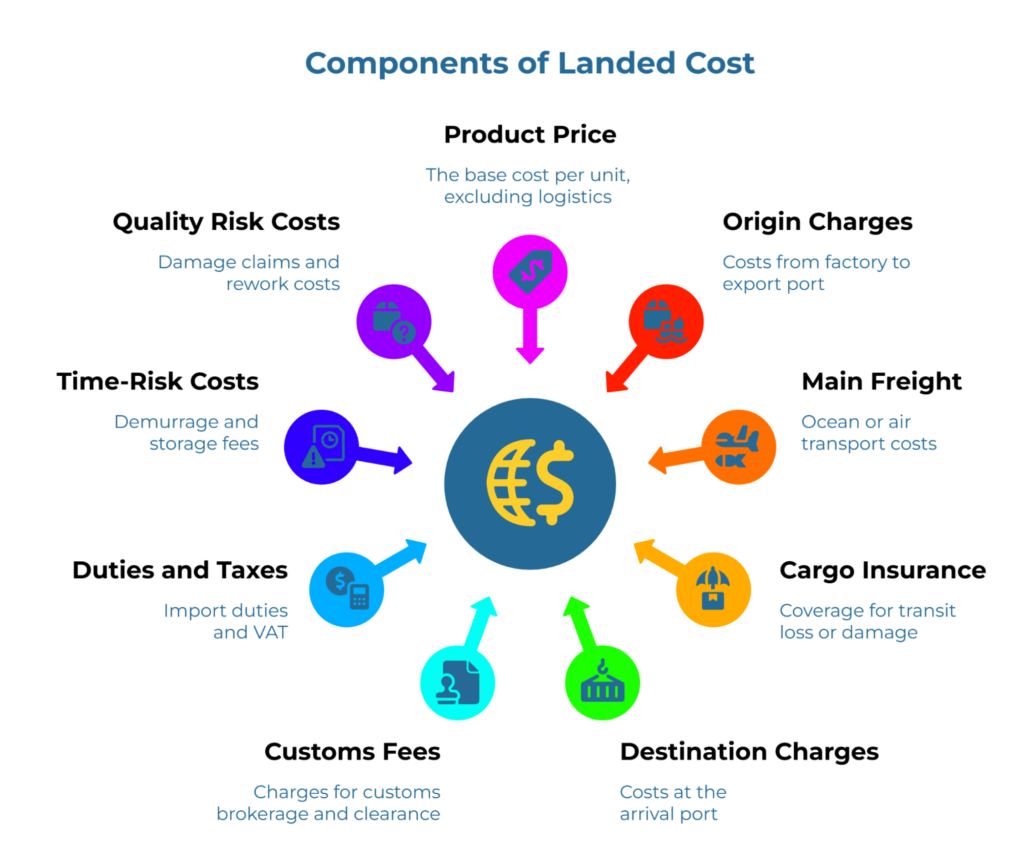
When evaluating international suppliers, procurement teams typically focus on the quoted unit price. But the following nine cost buckets determine what actually hits the budget:
- Product price (unit cost) — The base cost per bag or per metric ton, excluding any logistics or trade costs.
- Origin charges — Inland haulage from factory to port, export customs clearance, and loading fees at the origin terminal.
- Main freight — Ocean or air transport costs, which vary by mode (sea vs. air), shipment type (LCL vs. FCL), and route.
- Cargo insurance — Coverage for loss or damage during transit; responsibility depends on the Incoterm used.
- Destination charges — Terminal handling at the arrival port, documentation fees, and delivery order charges.
- Customs brokerage and clearance fees — Professional services for preparing and submitting customs declarations.
- Duties and taxes — Import duties based on product classification, customs value, and country of origin; plus any applicable VAT or sales taxes.
- Time-risk costs — Demurrage (charges for container use beyond free days), detention (charges for equipment held outside the terminal), and storage fees.
- Quality and packaging risk costs — Damage claims, rework from moisture or handling issues, and the administrative friction of disputes.
“If two quotes use different Incoterms, they are not competing on price. They are competing on assumptions.”
For Buyers: Request quotes that explicitly state which of these nine components are included and which are excluded. Ask for the Incoterm plus the named place (for example, “CIF Los Angeles” or “DAP Chicago warehouse”). Without this clarity, comparison is impossible.
For Suppliers: State inclusions and exclusions clearly in every quote. If you’re looking to connect with global buyers, consider listing your company at PaperIndex to reach active procurement teams. Ambiguity about destination charges or duty responsibility creates disputes—and lost repeat business.
Duty Basics Without the Rabbit Hole: What Procurement Can Control
Import duties are calculated based on three factors: product classification, customs value, and country of origin.
HS code classification drives the duty rate. The Harmonized System (WCO) provides a standardized 6-digit global framework, but individual countries add their own suffix digits (extending codes to 8, 10, or more digits) to determine the specific duty rate.[1] Getting this wrong means unexpected costs—or worse, customs delays and penalties.
Customs value determines what the duty rate applies to. Under the WTO Customs Valuation Agreement, customs authorities typically use “transaction value”—the price actually paid or payable for the goods—as the primary basis for calculating duties.[2] This typically starts with the transaction value, but the dutiable base varies by country: some jurisdictions (like the USA) assess duty on the FOB value, while others (like the EU) assess duty on the CIF value (Cost, Insurance, and Freight).
Country of origin affects whether preferential duty rates apply. Many countries maintain free trade agreements or preference programs that reduce or eliminate duties on goods from specific origins—but only if documentation requirements are met.
Practical step: Before finalizing a supplier from the global paper suppliers network, share the product description, material composition, and intended use with a licensed customs broker. A quick pre-check on the likely HS classification costs far less than discovering a classification error after goods have arrived.
Freight Basics: What Actually Moves the Freight Quote
Several factors determine freight costs, and understanding them helps both buyers and suppliers set realistic expectations.
Mode choice is the first decision. Ocean freight handles the vast majority of global paper bag shipments due to lower costs per unit, but air freight becomes relevant for urgent orders or sample shipments. The cost difference is substantial—often a multiple of ten or more.
Shipment type matters for ocean freight. Full Container Load (FCL) provides a dedicated container, while Less than Container Load (LCL) shares container space with other shippers. FCL generally offers better per-unit rates for larger volumes, but LCL provides flexibility for smaller orders. The break-even point depends on order size and route. For kraft paper suppliers and kraft paper manufacturers, understanding these variables helps both in quoting accurately and in setting realistic buyer expectations.
Chargeable weight versus volume affects pricing. Carriers charge based on whichever is greater: actual weight or volumetric weight (calculated from package dimensions). Bulky but light packaging materials like paper bags often hit the volumetric threshold, making packing efficiency a cost factor.
Surcharges and local charges add variability. Peak season surcharges, bunker adjustment factors, terminal handling charges, and port congestion fees change over time and vary by trade lane. These are generally not locked in advance.
“A freight quote is a model. If the inputs are unclear, the surprise is guaranteed.”
When freight conditions shift—due to capacity constraints, port congestion, or seasonal demand—supplier rankings can change. What looked like the best offer at quote time may not hold. For more on this dynamic, see when freight flips the winner.
Incoterms: Where Cost and Risk Shift (and Where Disputes Start)
Incoterms® 2020, published by the International Chamber of Commerce (ICC), defines which party—buyer or seller—bears responsibility for specific costs and risks at each stage of transport.[3] Choosing the right term, and specifying the named place, determines where handoffs occur.
Common Incoterms for paper bag sourcing:
- EXW (Ex Works) — Buyer assumes all costs and risks from the seller’s premises. Rarely practical for international trade.
- FCA (Free Carrier) — Seller delivers to a named place (often an export terminal). Buyer handles main freight onward.
- FOB (Free on Board) — Risk transfers when goods are placed on board the vessel. Technically restricted to sea and inland waterway transport; for containerized or air shipments where goods are handed to a carrier at a terminal, FCA (Free Carrier) is the correct rule to use.
- CIF (Cost, Insurance, Freight) — Seller pays freight and insurance to the destination port, but risk transfers at origin.
- DAP (Delivered at Place) — Seller delivers to a named destination, uncleared for import. The buyer handles customs.
- DDP (Delivered Duty Paid) — Seller handles everything, including import clearance and duties.
The comparability problem: A quote stated as “FOB Shanghai” and another stated as “CIF Los Angeles” cannot be compared directly. The first excludes main freight and insurance; the second includes them. Mixing Incoterms in a comparison creates the illusion of price differences that are actually responsibility differences.
The DDP complexity: DDP appears simpler because the supplier bears all risk, but if the supplier cannot legally act as the Importer of Record (IOR) in the destination country, the buyer may still be liable for customs formalities and may face significant difficulties reclaiming import VAT or GST. In some jurisdictions, this creates compliance risks.
For a detailed method on normalizing quotes across different Incoterms, see comparing quotes across incoterms.
A 30-Minute Method to Normalize Quotes to a Comparable To-Door View
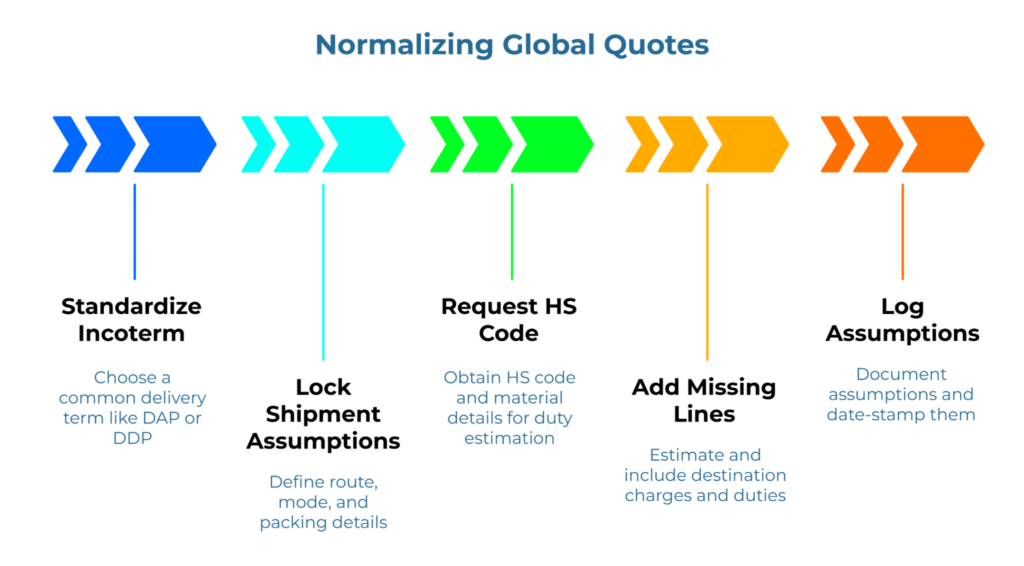
Comparing global quotes fairly requires standardizing the basis. The following steps can be completed in roughly 30 minutes per quote set:
Step 1: Standardize the Incoterm and named place. Pick a single reference point—ideally DAP or DDP to your facility—and ask all suppliers to quote on that basis. If they cannot, request enough detail to add the missing costs.
Step 2: Lock shipment assumptions. Specify the route, mode (ocean or air), shipment type (LCL or FCL), and estimated packing dimensions. Freight quotes vary dramatically based on these inputs.
Step 3: Request HS code, material composition, and intended use. This allows a customs broker to pre-check classification and estimate duties. Do not assume the supplier’s stated HS code is correct.
Step 4: Add missing lines. For quotes that do not extend to your door, estimate and add destination charges, customs brokerage fees, and expected duties. Use conservative assumptions.
Step 5: Log assumptions and date-stamp them. Freight rates, exchange rates, and duty schedules change. Document what assumptions were used and when, so comparisons can be revisited.
This method turns incomparable quotes into a normalized landed-cost view—what actually matters for the budget.
Common Failure Modes and How to Prevent Them
Landed-cost surprises typically stem from a few recurring issues:
Wrong HS code assumption. The supplier provides an HS code that does not match how the destination country classifies the product. Prevention: Validate classification with a local broker before placing orders.
Hidden destination and local charges. Terminal handling fees, delivery order charges, and port storage costs appear on the final invoice but were never quoted. Prevention: Require explicit listing of destination charges, not just “included” or “excluded.”
DDP misunderstanding. The buyer assumes DDP means no further action required, but the supplier cannot act as importer of record, or the buyer loses visibility into the clearance process. Prevention: Clarify who holds importer-of-record status and who controls the customs entry.
Documentation gaps causing delays. Missing certificates, incorrect commercial invoices, or incomplete packing lists trigger customs holds—and demurrage charges accumulate. Prevention: Define required documents in the purchase order and verify completeness before shipment.
Packaging and route mismatch. Packaging sufficient for domestic transport fails under the humidity and handling conditions of a 30-day ocean voyage. Prevention: Specify export-grade packaging and verify the supplier understands the route conditions.
For more on avoiding invoice disputes, see common pitfalls in landed-cost estimates.
Landed-Cost Components Breakdown Chart
| Cost Bucket | What It Includes | Who Typically Pays (by Incoterm) | Questions to Ask |
| Product price | Unit cost (per bag or per MT) | Buyer (always) | What is the minimum order quantity? |
| Origin charges | Factory-to-port haulage, export clearance, loading | Seller (FOB, CIF, DAP, DDP) | Are inland freight and export fees included? |
| Main freight | Ocean or air transport | Seller (CIF, DAP, DDP) or Buyer (FOB, FCA) | What is the shipment type (LCL/FCL)? Route? |
| Insurance | Cargo coverage during transit | Seller (CIF, CIP) or Buyer (others) | What coverage level? Institute Cargo Clauses A, B, or C? |
| Destination charges | Terminal handling, docs, delivery order | Buyer (FOB, CIF) or Seller (DAP, DDP) | Are THC and delivery order fees stated separately? What triggers storage or re-handling? A “CIF” quote may exclude destination local fees; those fees can appear after arrival and overturn the apparent unit-price advantage. |
| Customs brokerage | Professional clearance services | Buyer (most terms) or Seller (DDP) | Is brokerage included or separate? |
| Duties and taxes | Import duty, VAT, other levies | Buyer (most terms) or Seller (DDP) | What HS code is assumed? Is origin verified? |
| Time-risk costs | Demurrage, detention, storage | Party responsible at that stage | How many free days? What are per-diem rates? |
| Quality-risk costs | Damage claims, rework, dispute admin | Risk holder at point of damage | What packaging standard? What claims process? |
Copy-Paste Templates
Buyer RFQ Addendum: Logistics and Duty Fields to Include
When issuing an RFQ for international paper bag sourcing, include the following fields:
- Requested Incoterm and named place (e.g., “DAP [your warehouse address]”)
- Required delivery timeline (production lead time + transit time)
- Shipment type preference (LCL/FCL/either)
- Packing dimensions and weight per unit (if known)
- Material composition and intended use (for HS classification)
- Required documents (commercial invoice, packing list, certificate of origin, others)
- Request: “Please provide itemized inclusions and exclusions from your quoted price, including origin charges, destination charges, collect charges, and estimated duties.”
Supplier Quote Checklist: What to State Clearly
Suppliers can reduce back-and-forth and build buyer confidence by including:
- Incoterm + named place (e.g., “FOB Shanghai Waigaoqiao Port”)
- Validity period (e.g., “Price valid for 30 days”)
- Itemized inclusions (e.g., “Includes inland freight to port, export customs clearance, and loading charges”)
- Itemized exclusions and collect charges (e.g., “Excludes ocean freight, insurance, destination charges, import duties, and customs brokerage”)
- Assumed HS code and material composition
- Estimated transit time and recommended shipping line (if applicable)
- Documentation provided with shipment
- What changes would affect the quoted price (e.g., “Price subject to adjustment if order quantity changes by more than 20%”)
- For DDP-style offers: clarify importer-of-record handling and exceptions process
Frequently Asked Questions
What is the landed cost in global sourcing?
The landed cost is the total cost to deliver goods to the named delivery point, including freight, duties and taxes, clearance services, and local charges. It represents what actually hits your budget, not just the supplier’s quoted unit price.
Do Incoterms include duty?
Most Incoterms do not include duties and taxes by default. DDP (Delivered Duty Paid) can include them, but only when importer-of-record responsibilities and clearance control are explicitly defined. Even under DDP, verify who files the customs entry and who bears liability for classification errors.
How can HS code assumptions be sanity-checked?
Request the supplier’s HS code assumption along with the product’s material composition and intended use. Then validate this classification early with a qualified customs broker in the destination country before comparing landed-cost totals. When sourcing from international paper suppliers, always request their suggested HS code classification as a starting point for broker verification. The supplier’s stated code may not match how your destination customs authority classifies the product.
Next Steps: Turn Clarity into Action
Landed-cost visibility is not a one-time exercise. Market conditions shift, freight rates move, and duty schedules change. Building a repeatable process—standardizing RFQ formats, validating HS codes early, and logging assumptions—turns landed-cost discipline into a competitive advantage.
For further guidance on international sourcing fundamentals, explore PaperIndex Academy. Buyers can submit RFQs free to connect with verified suppliers, while suppliers can join PaperIndex free to access global buyers.
Disclaimer: This article is for educational purposes only and provides general guidance on landed cost, freight, and duty considerations in global sourcing. It is not legal, tax, or customs advice. Duties, taxes, and freight conditions vary by product details, origin, route, Incoterms, and local regulations; consult qualified customs and logistics professionals for order-specific decisions. PaperIndex is a neutral connector and does not sell market intelligence or publish pricing indices.
[1]: World Customs Organization, “What is the Harmonized System (HS)?”, https://www.wcoomd.org/en/topics/nomenclature/overview/what-is-the-harmonized-system.aspx
[2]: World Trade Organization, “Customs Valuation – Technical Information”, https://www.wto.org/english/tratop_e/cusval_e/cusval_info_e.htm
[3]: International Chamber of Commerce, “Incoterms® 2020”, https://iccwbo.org/business-solutions/incoterms-rules/incoterms-2020/
Our Editorial Process:
Our expert team uses AI tools to help organize and structure our initial drafts. Every piece is then extensively rewritten, fact-checked, and enriched with first-hand insights and experiences by expert humans on our Insights Team to ensure accuracy and clarity.
About the PaperIndex Insights Team:
The PaperIndex Insights Team is our dedicated engine for synthesizing complex topics into clear, helpful guides. While our content is thoroughly reviewed for clarity and accuracy, it is for informational purposes and should not replace professional advice.