

📌 Key Takeaways
Before cutting cup sizes across locations, map each size to its actual job — the menu item, lid, dispenser, and workflow it supports.
- Define Scope First: Different teams mean different things by “standardization,” so agree on whether you’re changing capacity, lids, dimensions, or the whole system.
- Demand Data Misleads Easily: Purchase records hide substitutions, shortages, and stock building, so a slow-moving size may look unnecessary when stores simply couldn’t get it.
- Same Size Doesn’t Mean Same Fit: Two cups with matching capacity labels can differ in rim profile, lid seating, and dispenser release — never assume they swap cleanly.
- Low Volume Isn’t a Removal Rule: A seasonal or format-specific cup may sell little overall yet remain essential during its defined operating window.
- “No Change Yet” Is a Valid Outcome: When data, compatibility evidence, or stakeholder agreement is missing, holding is stronger than forcing a decision you can’t defend.
Standardize requirements first — SKU cuts follow.
Operations and procurement teams managing multi-location cup assortments will find a structured review framework in the detailed readiness matrix and decision models below.
~ ~ ~ ~ ~ ~ ~ ~ ~ ~ ~ ~ ~ ~ ~ ~ ~ ~
Reducing several paper cup sizes to a smaller common range may simplify a planning spreadsheet. The change is not simpler, however, if stores then need different lids, work around dispenser problems, or lose a cup tied to a distinct menu use.
The practical question is therefore not, “How many sizes should the network carry?” It is, “Which requirements are genuinely shared, which differences follow repeatable location patterns, and which exceptions remain necessary?” A sound review combines size-level demand with menu, service, accessory, equipment, storage, branding, and governance evidence. Depending on what that evidence shows, full standardization, cluster-based assortments, controlled exceptions, or no change yet may all be reasonable outcomes.
Start by Defining What “Standardizing Cup Sizes” Means
Different functions may use “standardization” to describe different changes. Procurement may mean fewer nominal capacities or suppliers. Operations may mean one lid family or a simpler counter setup. Marketing may focus on printed variants, while packaging or quality teams may be concerned with dimensions, construction, and documented approvals.
Define the scope before comparing volumes. Clarify whether the proposal covers nominal capacity, physical dimensions, rim profile, lid family, wall construction, print, supplier, or the entire cup-and-accessory system. Matching capacity labels do not establish that two products are operationally equivalent.
The team should also define the decision unit. Is it reviewing one SKU, a size family that shares accessories, a location cluster, or the whole network? Assign ownership for demand data, menu requirements, store workflow, technical compatibility, branding, and final approval. Otherwise, each function may approve a different version of the change.
This article focuses on size-assortment decisions. Material selection, coating choice, supplier consolidation, and food-contact review are separate workstreams unless the proposed change alters those requirements.
Do Size-Level Demand Patterns Support a Common Assortment?
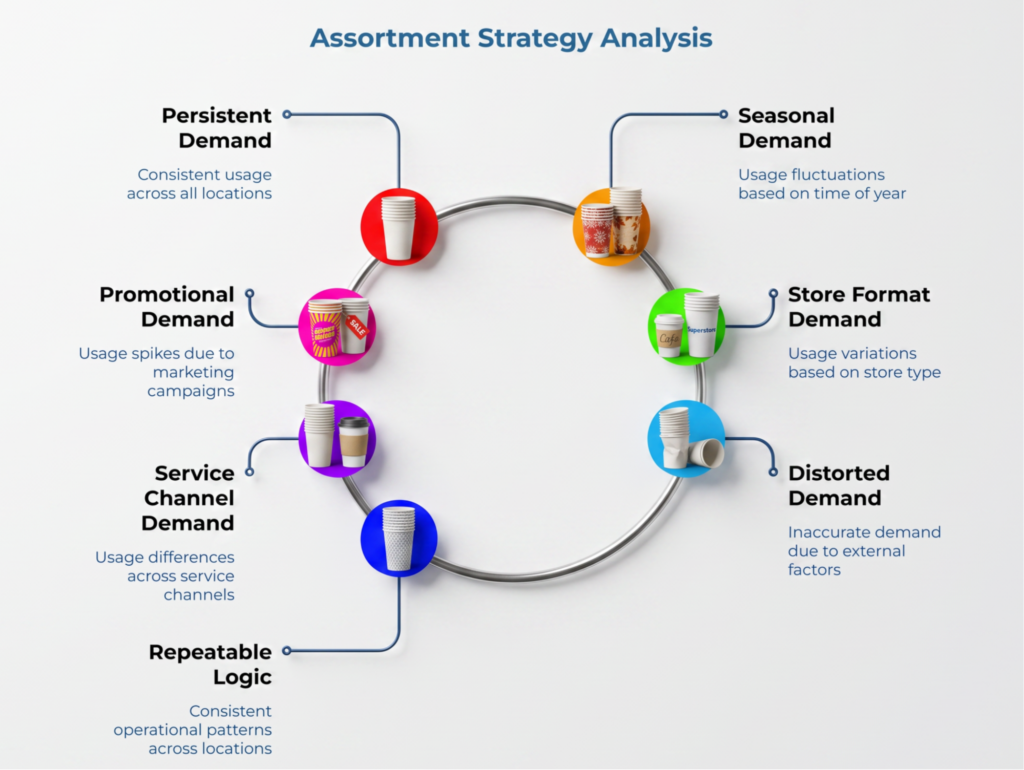
Total network demand can confirm how many cups the organization uses overall, but it cannot show the correct size mix for each location. Compare usage by size and site, then determine whether each pattern is persistent, seasonal, promotional, or associated with a particular store format or service channel.
Purchase history is useful, but it is not a perfect proxy for consumption. Transfers, accumulated stock, waste, shortages, and informal substitutions can distort recorded demand. A slow-moving size may appear unnecessary because stores could not obtain it and used another cup. A frequently purchased size may reflect stock building rather than current service demand.
Group locations only where the operational logic is repeatable. Menu structure, beverage mix, service channel, store format, counter setup, and demand behavior may support meaningful clusters. Avoid forcing every location into a network average when those factors differ.
Illustrative example: A coffee-led location may concentrate demand in a narrow hot-cup range. A mixed-menu location serving fountain beverages and takeaway meals may need a broader hot-and-cold assortment. Combining their data could produce an average size mix that describes the network but fits neither operation particularly well.
For each size, investigate whether it is used consistently, during a defined season, for a specific promotion, or only at certain location types. Check whether substitutions or stock shortages are suppressing recorded usage. The review period should capture current menus, relevant seasonal conditions, and recent specification changes. The appropriate period varies by operating cycle and data quality, so a universal number of months or minimum-volume threshold would create false precision.
Will the Proposed Sizes Fit the Menu and Service System?
Map each cup size to the job it performs. That includes the beverage or portion, service channel, customer presentation, menu description, price point, promotion, and operating instruction connected to it. A size that looks redundant in order data may still support a distinct menu or service requirement.
Cup ecosystem check: cup, lid, sleeve, dispenser, carrier, storage space, counter setup, menu item, and branding.
Review the whole ecosystem before approving a substitute. Verify lid seating, sleeve fit, dispenser release, nesting behavior, carrier fit, storage footprint, and staff handling with the exact components involved. Current technical drawings, official product documentation, equipment manuals, production-equivalent samples, and representative operating trials are appropriate evidence for product-specific conclusions.
Nominal capacity should be treated as a reason to investigate compatibility, not as proof of interchangeability. A substitute may hold the intended beverage yet change fill level, headspace, presentation, grip, or workflow. The review should therefore use real beverages, actual accessories, and normal service conditions.
Printed cups and brand programs also require separation from the size question. The organization may be able to standardize the physical cup while retaining controlled artwork variants. In other cases, artwork timing, presentation requirements, or campaign use may justify a documented exception.
Further reading on connected components includes how automated dispensers and cup sleeves influence paper cup specifications and how paper cup material choices can affect lid fit and spill risk. These resources help structure the review; they do not establish compatibility for a specific product combination.
If a size change also changes material, coating, or a named test method, widen the review beyond operations. Consult the current official authority for the intended market and verify any standard through an official standards portal such as ISO Standards. Jurisdiction-specific portals, including the U.S. FDA’s food-contact substances resources and the European Commission’s food-contact materials resources, apply only within their respective regulatory contexts and are not universal specifications.
Which Differences Are Genuine Requirements and Which Are Legacy Variants?
Trace why each variant was introduced and determine whether that reason still exists. The original driver may have been a menu item, seasonal campaign, supplier change, dispenser, brand program, or local operating constraint that has since disappeared.
A location preference should not automatically become a permanent exception, but it should not be dismissed without review. Ask what operational consequence would follow from removing the size. A documented effect on menu execution, accessory fit, storage, or service provides stronger evidence than historical habit.
Low volume should trigger an investigation rather than automatic removal. A size used only during a seasonal beverage program may be low volume annually, yet necessary during a defined operating window. Another slow-moving SKU may be an obsolete duplicate left behind after a menu or supplier change.
Classify each difference as common, cluster-specific, exception-based, obsolete, or unresolved. “Unresolved” is a controlled status when the organization lacks reliable usage data, current compatibility evidence, or stakeholder agreement. It is better than forcing an unsupported keep-or-remove decision.
Paper Cup Size Standardization Readiness Matrix
| Decision area | Question to answer | Evidence to review | Likely decision outcome |
| Demand | Is the size used consistently, seasonally, or only at certain locations? | Usage, sales, transfer, stock, and substitution records | Standard, cluster-specific, exception, or unresolved |
| Menu | Does it support a distinct beverage, portion, promotion, or price point? | Current menu and service rules | Retain, replace, or test |
| Compatibility | Will current lids, sleeves, dispensers, and carriers work? | Samples, drawings, manuals, and trial observations | Compatible, incompatible, or test required |
| Operations | Does the change affect handling, storage, or counter setup? | Store observations and operator feedback | Standard or location exception |
| Branding | Does artwork or presentation require separation? | Current artwork and brand requirements | Common design or controlled variant |
| Supply | Can suppliers provide a controlled equivalent specification? | Current supplier specifications and samples | Sourceable, conditional, or unresolved |
| Governance | Is there a clear substitution and exception rule? | Approved operating rules, owners, and review dates | Ready or not ready |
The matrix is a classification framework, not a numerical scorecard. Any product-specific answer entered into it should be supported by current internal records, supplier documentation, physical samples, or qualified review.
Define Substitution, Exception, Pilot, and Approval Rules Before Changing the Range
A proposed assortment is not ready until the organization knows what happens when the standard cup is unavailable or unsuitable. Define which substitutions are permitted, under what conditions, and who can approve them.
Document whether a substitution requires a different lid, sleeve, menu description, price point, fill instruction, or operating step. Informal substitutions can conceal true demand and weaken inventory records, so approved alternatives should be visible in the operating rules.
Each exception needs an owner, supporting evidence, and a review date. A permanent exception may be justified by a stable location requirement. A seasonal exception should state its operating window. A temporary exception may remain open until testing, stock depletion, or a supplier change is complete.
Pilot the proposed assortment across representative location types rather than relying on desk samples alone. Test real beverages, actual lids and sleeves, installed dispensers, normal storage areas, counter workflow, and staff handling. Use qualitative decision gates such as pass, revise, hold, or reject; no universal pilot duration or acceptance percentage applies across every operation.
Transition planning should account for cups, lids, sleeves, and printed stock that may deplete at different rates. Approval of a new standard does not require immediate conversion at every location. Future menu launches, equipment replacements, supplier specification changes, artwork programs, or repeated substitutions should trigger a controlled review.
A practical companion resource is the Academy guide to paper cup size, wall strength, and lid pairing checks, adapted to the organization’s own products and operating conditions.
Choose the Right Standardization Model
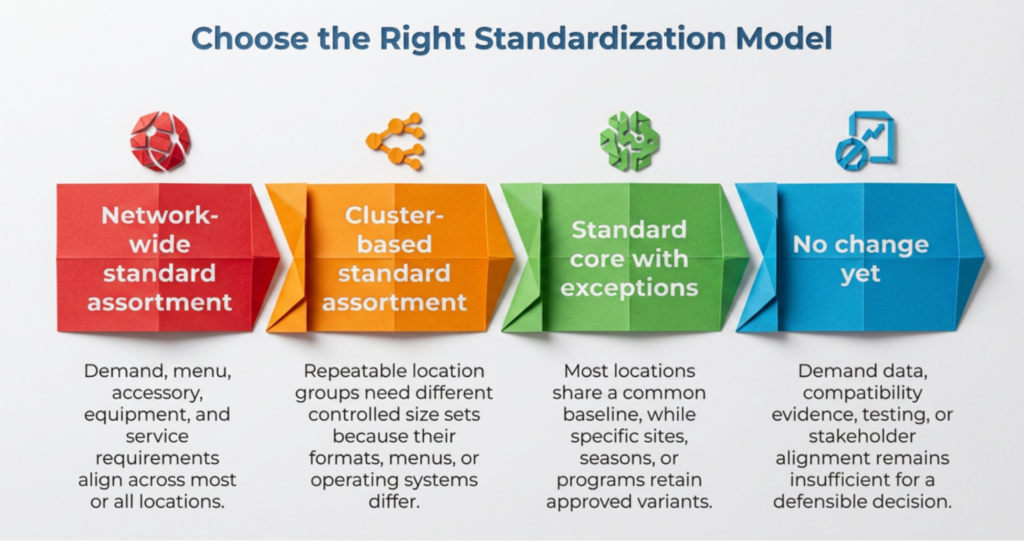
The review should lead to one of four controlled outcomes:
- Network-wide standard assortment: Demand, menu, accessory, equipment, and service requirements align across most or all locations.
- Cluster-based standard assortment: Repeatable location groups need different controlled size sets because their formats, menus, or operating systems differ.
- Standard core with documented exceptions: Most locations share a common baseline, while specific sites, seasons, or programs retain approved variants.
- No change yet: Demand data, compatibility evidence, testing, or stakeholder alignment remains insufficient for a defensible decision.
These models are alternatives, not a ranking. Full network standardization is appropriate only when the evidence supports it. “No change yet” is also a valid decision when unresolved items have owners and a defined path to closure.
Frequently Asked Questions
Should every location use the same paper cup sizes?
Not necessarily. A network-wide assortment is suitable only when demand, menu, compatibility, and service requirements align. Other organizations may need cluster-based assortments or a common core with documented exceptions.
How much historical data should be reviewed?
Review enough representative information to capture current menus, relevant seasonal programs, location differences, substitutions, and recent specification changes. The suitable period depends on the operating cycle and data quality.
Should a low-volume paper cup size always be removed?
No. Determine whether it serves a distinct beverage, season, location, accessory system, or customer-facing role. Low volume is a reason to investigate the SKU, not a complete removal rule.
Can cups with the same nominal size use the same lids?
Do not assume so. Verify rim dimensions, lid specifications, current manufacturer documentation, and physical fit under the intended service conditions before approving a substitution.
Standardize Requirements Before Standardizing SKUs
The strongest decision is not necessarily the one that removes the most sizes. It is the one that establishes a clear common baseline, preserves justified differences, and documents what still requires evidence or testing.
Use the readiness matrix to classify every current size as a network standard, cluster-specific requirement, documented exception, obsolete variant, or test-required item. After those requirements are documented, buyers may compare relevant paper cup manufacturers. Supplier suitability and product compatibility still need to be evaluated against the organization’s own specifications.
Disclaimer:
This article is for general informational purposes only. It is not a substitute for advice from a qualified professional, provider, or official source relevant to your situation. Always verify important decisions with the appropriate expert, authority, or service provider.
Our Editorial Process:
Our expert team uses AI tools to help organize and structure our initial drafts. Every piece is then extensively rewritten, fact-checked, and enriched with first-hand insights and experiences by expert humans on our Insights Team to ensure accuracy and clarity.
About the PaperIndex Insights Team:
The PaperIndex Insights Team is our dedicated engine for synthesizing complex topics into clear, helpful guides. While our content is thoroughly reviewed for clarity and accuracy, it is for informational purposes and should not replace professional advice.