
📌 Key Takeaways
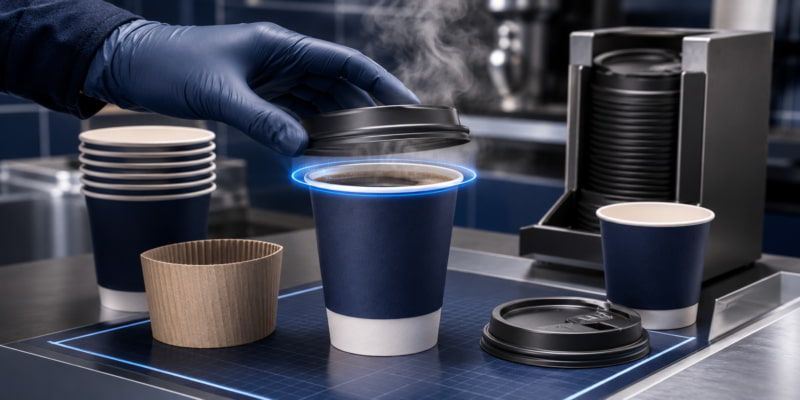
A paper cup lid that fits fine on an empty sample can fail at the counter once hot drinks, rush-hour handling, and real storage conditions enter the picture.
- Test the Exact Pairing: A “12-oz lid” from one supplier may not fit a “12-oz cup” from another, because size labels describe volume, not rim shape.
- Heat Changes Everything: Cups that feel solid at room temperature can soften and shift shape after holding a hot drink for thirty seconds, so always test with hot fills.
- Storage Can Ruin Good Cups: Humidity, stacking weight, and proximity to steam sources can warp rims and soften walls before cups ever reach the counter.
- Watch Staff Workarounds: Repeated re-lidding, double-cupping, or avoiding certain stacks often signals a cup-lid mismatch, not staff error.
- Check Before Bulk Ordering: Run a short compatibility test with production-equivalent samples, real lids, sleeves, and dispensers at actual service pace.
Sample before you sign — a ten-minute counter test prevents months of lid-fit frustration.
Café owners, procurement staff, and small foodservice operators managing cup-and-lid sourcing will find actionable pre-order checks here, preparing them for the detailed compatibility guide that follows.
~ ~ ~ ~ ~ ~ ~ ~ ~ ~ ~ ~ ~ ~ ~ ~ ~ ~
A lid that sits flush on an empty sample cup may behave differently once a barista fills it with hot coffee during a morning rush. Staff pressing down two or three times before a lid catches, wiping drips from a seemingly fine rim, or pulling a second cup because the first felt soft—these are signs of a compatibility problem that started before the drink was poured. For a small café, this kind of mismatch rarely appears as one dramatic failure. It usually shows up as staff slowing down during the busiest part of service, avoiding one cup stack, or double-checking takeaway drinks before handing them across the counter.
The issue is rarely staff error; more often, the cause traces back to the cup rim, board structure, storage conditions, or the fact that cups and lids were sourced separately and never tested as a pair.
Cup-lid fit is a system outcome, not a lid-size issue. Material choice, rim consistency, storage exposure, nesting behavior, sleeve pressure, and dispenser fit all feed into what happens at the point of service. The practical goal is to check the right things before ordering, so paper cups and lids work reliably once they reach the counter.
Why Lid Fit Depends on the Whole Cup-Lid System
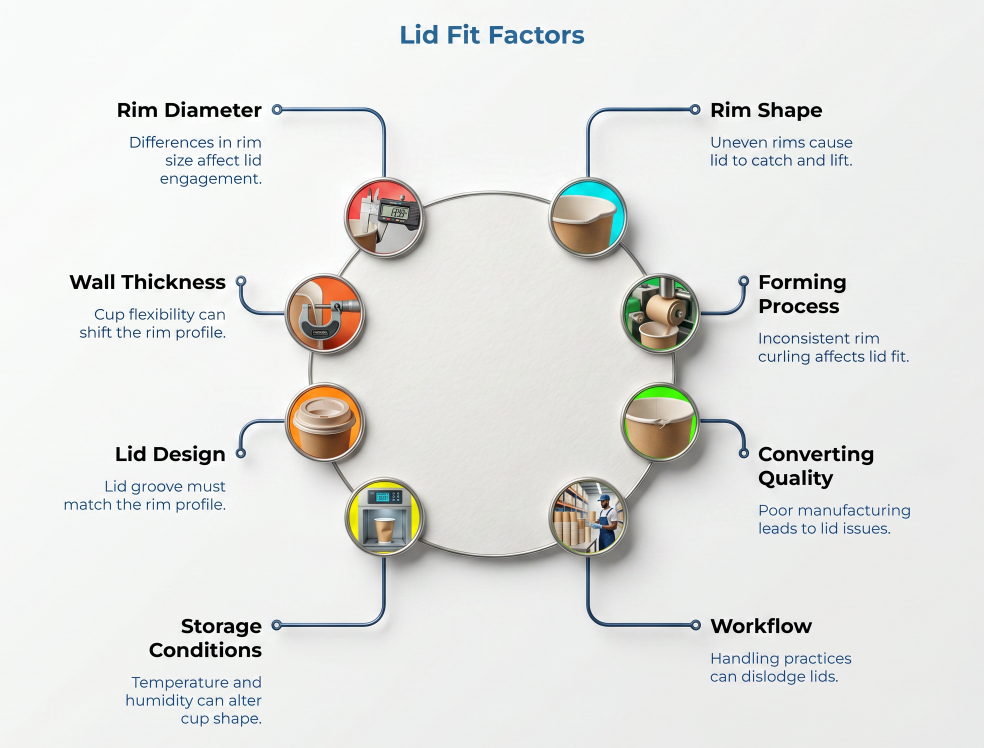
A lid sits against the physical rim of the cup — the rolled edge where the lid groove locks in — not against a product name or nominal size on the packaging. Two cups labeled for the same ounce capacity can differ in rim diameter, rim shape, wall thickness, and how the rim curls during forming. Those differences determine whether a lid clicks into place or pops off under light handling pressure.
The rim-lid interface is the key contact point. The lid groove must engage the rolled rim evenly. If the rim is slightly oval, dented, uneven, or inconsistent across the stack, the lid may catch on one side and lift on another. Staff may respond by pressing harder, rotating the lid, or replacing it with another lid from the same sleeve.
Wall stiffness matters more than many buyers expect. A cup that flexes when gripped can shift the rim profile just enough to unseat a nominally compatible lid. A stiffer cup is not automatically better, however. Lid fit still depends on the finished rim, the lid design, converting quality, storage condition, and normal counter workflow.
Generic size labels can be misleading. A “12-oz lid” from one supplier may not seat properly on a “12-oz cup” from another. Whenever cups and lids come from different suppliers, the need for sample testing increases, because neither supplier controls the other’s rim profile or forming tolerances. The practical question is narrower: has this exact cup SKU been tested with this exact lid SKU under the conditions in which the operation will use it?
How Material Choices Can Affect Rim Consistency and Handling
The board used for a cup stock blank influences how the finished cup feels, flexes, and holds its shape. Heavier, stiffer boards may resist deformation during handling, but stiffness alone does not guarantee a consistent rim. Forming process quality, converting line precision, and board uniformity all contribute to whether rims come out round and even — or slightly oval from cup to cup.
Coating type and application quality can also affect behavior at the counter, depending on supplier specification and converting quality. The coating needs to bond properly during forming so the rim edge stays smooth and sealed. Uneven adhesion may produce a rough rim surface, unpredictable curl, or a less reliable lid seat — variables that depend on cupstock producers and converters, not just the material specification on paper. Coating labels should not be used as shortcuts, either. Terms such as “hot cup grade,” “food grade,” “eco-friendly,” or “compostable” do not prove lid compatibility, leak resistance, or suitability for a specific counter workflow. The PaperIndex Academy’s resource on hot beverage cupstock coating questions covers what to ask before approving a new barrier board.
Hot-fill conditions can reveal problems invisible in an empty, room-temperature sample. Heat softens the cup wall and can shift the rim profile enough to affect lid seating. A cup that felt solid during a desk evaluation may flex or oval slightly after holding a hot beverage for thirty seconds — testing under actual service temperatures matters more than inspecting dry samples. Since standard espresso-based beverages and drip coffees are typically served between 150°F and 170°F, testing should occur within this precise temperature band to accurately replicate the thermal stress placed on the cupstock during a live service rush. For more on these variables, see the article on how cupstock moisture, curl, and dimensional stability can affect paper cup production planning.
A useful buyer question is not “which material prevents spills?” A better question is: does this material, once converted into this cup, support the rim consistency, handling feel, and lid seating needed for this beverage program?
Counter Symptoms and What They May Indicate
The following table is a practical troubleshooting guide, not a certified test method.
| Counter Symptom | What to Check First | What It May Indicate |
| Lid pops off or sits unevenly after filling | Rim shape, lid groove engagement, or cup wall flexing under hot-fill conditions | Rim-lid pairing may not be seating evenly |
| Staff press lids repeatedly | Cup stiffness, lid design, or rim consistency | Fit may be too tight, uneven, or sensitive to handling |
| Cups stick together in the stack | Nesting, board compression, humidity exposure, or storage under heavy weight | Staff may apply extra force before filling, stressing the rim |
| Sleeve crushes the cup wall | Sleeve inner diameter too tight for the cup, or cup wall stiffness too low for the sleeve | Sleeve pressure may affect handling during lidding |
| Fit changes after hot fill | Hot-fill behavior and workflow sequence | Empty-sample checks may not reflect service conditions |
| Issue appears only in some stacks | Storage, carton handling, or batch variation | The problem may not affect the whole order |
This kind of observation helps small teams avoid overcorrecting. A lid-fit complaint should not automatically trigger a switch to a heavier cup, a new lid supplier, or a different coating. First, identify where the issue appears and whether it repeats under normal service conditions.
Storage, Nesting, Sleeves, and Dispensers Can Change What Happens at the Counter
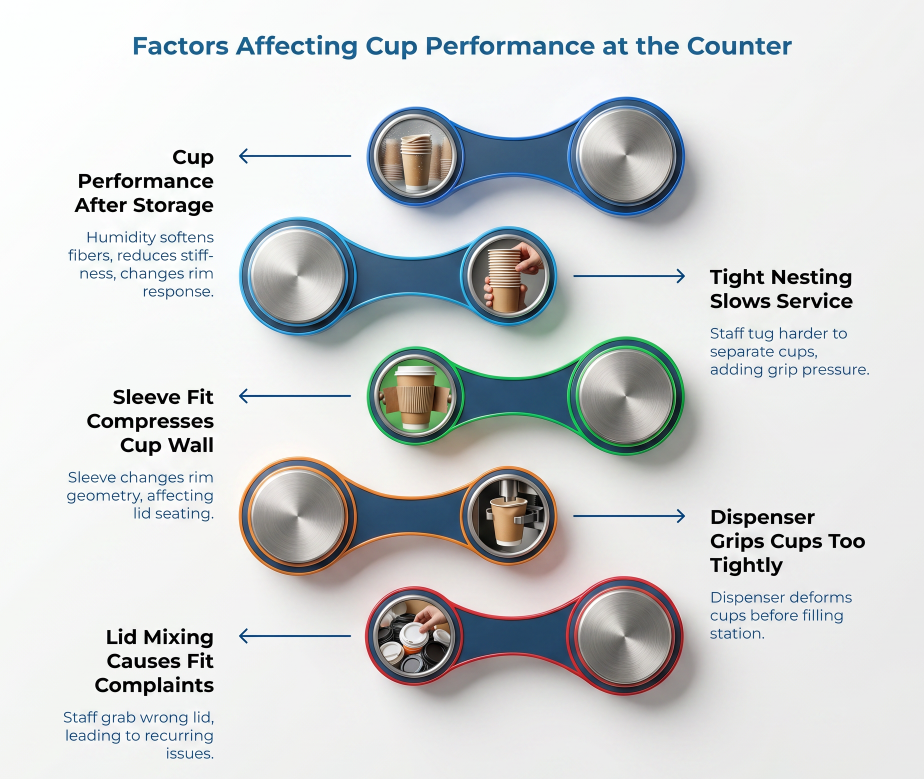
A cup that performed well on delivery day may behave differently after two weeks in back-of-house storage. Humidity can soften board fibers, reduce wall stiffness, and change how the rim responds to lid pressure. Cups stored near a dishwashing station, steam source, or unventilated corner may absorb enough ambient moisture to affect handling before reaching the counter. Without supplier-specific storage guidance, avoid relying on exact humidity thresholds. Look instead for visible signs: softening, sticking, oval cups, crushed rims, or stacks that separate poorly.
Compression matters too. Cups stacked under heavy inventory or stored with uneven weight can develop subtle deformation — enough to make rims sit unevenly or lids catch inconsistently.
Tight nesting creates its own friction. Cups that lock together too firmly slow service because staff tug harder to separate them, adding grip pressure that can flex the rim before the cup is even filled. While this does not indicate defective material, it reduces the margin for clean lid seating. On small counters with limited space for multiple lid sizes, mixed lid SKUs compound the problem.
Sleeve and dispenser fit deserve the same scrutiny. If a sleeve is too tight, it compresses the cup wall and changes rim geometry. A sleeve that slides too easily may cause staff to hold the rim area more firmly during lidding. A dispenser that grips cups too tightly or releases them unevenly can deform cups before they reach the filling station. A cup taken gently from a clean stack may behave differently from a cup pulled repeatedly from a dispenser during peak service.
Lid mixing is another practical risk worth addressing. When several cup and lid SKUs sit close together on a small counter, staff may reach for a lid that appears close enough but was not intended for that cup. Clear SKU separation and simple storage labels can prevent recurring fit complaints that have nothing to do with the cup or lid themselves.
A Pre-Order Cup-Lid Compatibility Checklist
Before committing to a bulk order, run these checks with production-equivalent samples — not display samples. Display or sample-run cups may perform differently from bulk production due to differences in board batches, forming runs, or storage history. To ensure a reliable evaluation, test a minimum of 10 to 20 cups drawn from the top, middle, and bottom of different sleeves. A single cup cannot represent the mechanical variance found across a full production batch. This checklist is an operational review framework, not a formal laboratory method. For formal physical, mechanical, or packaging test methods, teams may refer to standards organizations such as TAPPI and ASTM, whose standards cover paper, paperboard, packaging, and related testing contexts.
| Check | What to Test | Why It Matters | Signal |
| Actual cup-lid pair | Use the exact cup and lid SKUs | Size labels can hide fit differences | Lid seats evenly without forcing |
| Hot-fill behavior | Fill at the temperature the operation typically serves | Some issues appear only after filling | Lid stays seated during handling |
| Rim inspection | Check cups from different positions in the stack | Rim inconsistency creates uneven seating | No dents, ovaling, or rolled-rim irregularity |
| Stack separation | Pull cups at a simulated rush pace | Sticking slows service and stresses rims | Cups separate cleanly |
| Sleeve fit | Test sleeve before and after lidding | Sleeve pressure can shift rim alignment | Sleeve fits without crushing the cup |
| Dispenser fit | Use the actual counter dispenser | Dispensing can deform cups before filling | Cups release without damage |
| Storage check | Store samples under back-of-house conditions for several days | Storage may reveal moisture or compression issues | No deformation or sticking after storage |
| Staff feedback | Ask counter staff to lid samples under realistic conditions | Operators catch friction procurement may miss | No repeated re-lidding or workarounds |
A simple pass, hold, or reject decision keeps the review manageable. “Pass” means the cup-lid combination works under normal handling. “Hold” means more samples, supplier clarification, or a short counter trial is needed. “Reject” means the combination creates repeated seating issues, visible rim problems, damaged cups, or staff workarounds that are likely to continue.
For teams reviewing cupstock more formally, the guides on cupstock sample review for procurement, quality, and production teams and heat-seal, curling, and leak checks cover additional procurement and quality review steps.
Supplier Questions to Ask Before Ordering Cups and Lids Separately
When cups and lids come from different suppliers, neither party may have tested the other’s product. Supplier questions should focus on actual compatibility evidence, not broad claims such as “suitable for hot drinks.” These questions help close that gap before the order ships.
| Supplier Question | Why It Matters |
| Which specific lid SKUs have been tested and confirmed compatible with this cup SKU? | Confirms whether the supplier is discussing the exact pairing |
| Are production-equivalent samples available for testing, or only display-grade samples? | Display samples may not reflect bulk production behavior |
| What storage conditions does the supplier recommend for maintaining cup performance? | Storage guidance helps avoid back-of-house damage |
| Are there known compatibility notes for specific sleeves, dispensers, or lid types? | Counter equipment can affect handling |
| Will the supplier notify the buyer if the cup rim profile, board grade, coating, or converter changes between production runs? | Specification changes can affect fit between batches |
| Can the supplier provide food-contact documentation for the intended market and use case, if required by the buyer’s QA process? | Compliance review depends on market and application |
| What should the buyer document if lid-fit issues appear between batches? | Better records support faster supplier conversations |
Food-contact documentation should be treated separately from lid-fit testing. Official regulatory resources, such as the FDA’s food-contact packaging pages and EFSA’s food-contact material information, can help buyers understand why market-specific review may be needed, but they do not prove that a specific lid will fit a specific cup.
Answers do not guarantee compatibility or compliance, but they surface whether the supplier has tested the pairing and whether the buyer will be notified of changes that could affect fit. Refer to the articles on supplier qualification questions for coated cupstock and how to translate paper cup performance requirements into supplier-ready cupstock specifications covering qualification and specification alignment in more detail.
What to Document if Lid-Fit or Spill Complaints Appear After Ordering
When fit problems surface after cups are already in use, a more productive first step than switching suppliers is documenting what is happening so the conversation starts with evidence.
Record the cup SKU, lid SKU, supplier name, delivery reference, and any batch or lot numbers available. Note storage duration and location, proximity to heat or moisture sources, drink type, fill level, and whether the issue appeared before or after hot filling. Photos of the rim and lid seating capture details verbal descriptions miss. Track whether the problem affects all cups in a delivery or only isolated stacks. Staff feedback should be specific: “lid lifts on one side,” “cups stick together,” “sleeve feels too tight,” or “issue happens only with large lids.”
The purpose is not to blame the cup supplier, lid supplier, or staff too quickly. A clear evidence pack helps distinguish a systemic supplier issue from a storage or handling variable the buyer can address internally.
Frequently Asked Questions
Can the same lid fit one paper cup but not another cup of the same size?
It can. Nominal capacity describes volume, not rim geometry. Cups rated for the same capacity may differ in rim diameter, rim curl, or forming tolerance, all of which affect lid seating. Test the exact cup and lid SKUs together.
Should cafés buy cups and lids from the same supplier?
Buying from the same supplier can reduce compatibility risk, but it is not always necessary. Separate sourcing may be practical for availability, continuity, or commercial reasons. What matters is whether the specific cup-lid pair has been tested together under real service conditions, and whether both suppliers have been asked about compatibility notes.
Can storage conditions affect paper cup lid fit?
Storage can affect paper-based packaging behavior. Cups exposed to humidity, compression, or rough handling may develop softness or warping that changes how the rim seats a lid. Avoid relying on unsupported numeric thresholds unless the supplier provides them — look for visible signs such as sticking, softening, crushed rims, or deformation.
Does a heavier paper cup always improve lid fit?
Not necessarily. Heavier boards may increase stiffness, but lid fit depends on rim profile, forming quality, coating adhesion, lid design, sleeve pressure, dispenser handling, and hot-fill testing.
What is the simplest test before ordering in bulk?
Test production-equivalent samples with the actual lid, sleeve, and dispenser under hot-fill conditions, and ask counter staff to lid and handle them at a realistic service pace. Document any repeated re-lidding, uneven seating, sticking, or visible rim issues.
Turning Lid-Fit Checks Into a Standard Part of Ordering
Lid fit is a small detail that creates outsized friction when it fails. Staff workarounds, double-cupping, and reorders cost more than a structured sample check before the purchase order goes out.
The variables are manageable once visible: rim consistency, board behavior under heat, storage conditions, nesting and sleeve fit, and whether the actual cup-lid pair has been tested rather than assumed compatible. Building a short pre-order check into the procurement process turns a recurring frustration into a solvable problem.
Before placing a larger order, compare paper cup makers and cupstock supplier options, and ask for production-equivalent samples of the exact cup-lid combination. Explore paper cups for hot beverages to build a more complete supplier shortlist.
Disclaimer:
This article is for general informational purposes only. It is not a substitute for advice from a qualified supplier, packaging professional, foodservice safety advisor, or official source relevant to your situation. Always verify important purchasing and safety decisions with the appropriate expert, authority, or service provider.
Our Editorial Process:
Our expert team uses AI tools to help organize and structure our initial drafts. Every piece is then extensively rewritten, fact-checked, and enriched with first-hand insights and experiences by expert humans on our Insights Team to ensure accuracy and clarity.
About the PaperIndex Insights Team:
The PaperIndex Insights Team is our dedicated engine for synthesizing complex topics into clear, helpful guides. While our content is thoroughly reviewed for clarity and accuracy, it is for informational purposes and should not replace professional advice.