

📌 Key Takeaways
Paper cups that hold drinks just fine can still fail at the counter if their dimensions don’t match your dispenser, sleeves, lids, and storage setup.
- Map Your Setup First: List your dispenser, sleeve, lid, storage spot, and peak-hour speed before comparing cup samples — material is only one piece of the puzzle.
- Test Dispenser Fit Closely: Cups that nest too tightly stick together, and even a rim variance beyond ±0.5mm can cause lid failures during fast service.
- Sleeves Change the Rules: A sleeve that works on one cup shape may slip or squeeze on another, so test the actual sleeve-and-cup combination before committing to volume.
- Test Everything Together at Speed: A desk review of five cups won’t reveal problems that show up at the fiftieth cup during a morning rush — test lids, sleeves, and cups together under real conditions.
- Track Staff Workarounds: When workers start double-cupping or forcing sleeves, those habits point to specification gaps, not bad technique.
Specify for the counter, not just the cup.
Foodservice buyers and café operators sourcing paper cups will find a ready-to-use fit matrix and supplier question checklist in the detailed guide below.
~ ~ ~ ~ ~ ~ ~ ~ ~ ~ ~ ~ ~ ~ ~ ~ ~ ~
A paper cup can hold a hot latte without leaking and still cause problems at the counter. Cups that nest too tightly may stick inside a dispenser. A sleeve that gripped one cup shape may slide on another with a slightly different taper. A lid that seated cleanly during a sample review may wobble when pressed onto a sleeved cup during a rush.
These are not quality defects—they are specification gaps. They appear when a cup’s material properties, dimensions, and tolerances do not match the equipment, sleeves, lids, storage environment, and service speed that make up the actual counter workflow. A “hot cup suitable” label addresses beverage containment, not whether the cup will move smoothly through every step between the dispenser and the customer’s hand. The checks below focus on how automated dispensers and cup sleeves create material requirements that generic cup descriptions often miss, and how buyers can translate everyday counter friction into supplier-ready requirements before committing to volume.
Start with the Service Setup, Not Only the Cup Material

Cup material is one variable inside a larger system. Before comparing samples, map the system those samples need to survive: beverage type, cup size, lid family, sleeve style, dispenser format, storage location, staff handling speed, and peak-volume conditions.
Material demands shift drastically depending on the setup. A single-wall hot cup paired with a corrugated sleeve, snap-on lid, spring-loaded dispenser, and humid storage shelf creates a different set of requirements than the same cup size used without a sleeve in a dry, front-counter caddy. Even the dispenser format and sleeve staging area affect counter space requirements, which can narrow the range of suitable cup shapes before material enters the conversation.
To organize the buying discussion, separate material-related fields from fit-related fields. Material fields cover wall construction, cupstock grade, coating type, and intended beverage use. Fit fields cover rim consistency, cup taper, nesting behavior, sleeve compatibility, lid pairing, and storage guidance. Keeping both categories visible helps prevent overcorrection — a heavier or more complex cup may not be necessary if the real issue is tight nesting, poor sleeve fit, cramped storage, or a lid family that was never tested with the cup.
Service setup first, material specification second. List the dispenser type, sleeve format, lid family, storage environment, and expected throughput before requesting samples. That list becomes both the test protocol and the supplier-ready specification.
How Automated Dispensers Expose Nesting, Rim, and Wall-Stiffness Issues
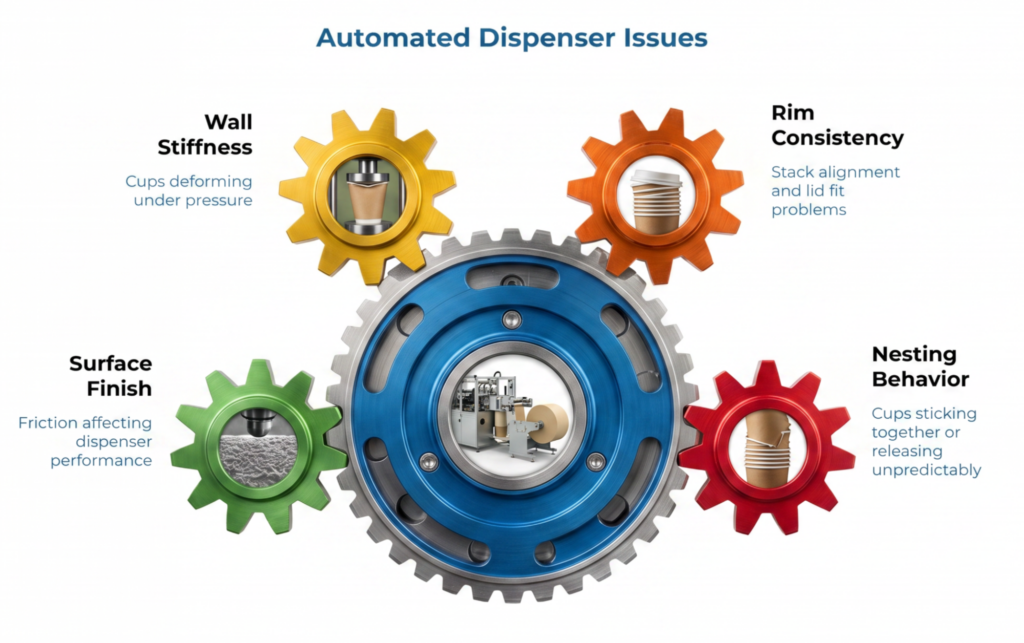
An automated dispenser applies mechanical force to separate one cup from a nested stack, and that interaction depends on more than nominal cup size.
Nesting and separation behavior determine whether cups release one at a time. Cups that nest too tightly may stick together; cups that sit too loosely may release unpredictably. Nesting depends on taper angle, wall thickness, and consistency of those dimensions across a production run. A cup that looks fine on a desk may double-release or jam when a full stack is loaded into a dispenser.
Rim consistency affects stacking alignment inside the dispenser tube and lid fit downstream. A rim that varies in diameter or roll profile from cup to cup can shift the stack or create lid-seating problems. As TAPPI standards work reflects, dimensional consistency in converted paper products depends on both base paperboard properties and converting process controls — worth keeping in mind when comparing production samples to pilot-run samples.
Wall stiffness and caliper influence whether the cup holds its shape under dispenser spring pressure or during staff handling. A cup that deforms slightly under load may not release cleanly.
Surface finish and friction also matter. Coatings and textures affect friction between nested cups. A surface change between production batches may alter dispenser performance even when nominal dimensions remain the same.
When discussing samples with a supplier, ask what dimensions and tolerances are controlled for rim diameter, height, and taper. For example, a rim diameter variance of more than ±0.5mm can often be the threshold where lid-seating failures begin to multiply during rapid service. Ask whether production samples are available from the same line intended for supply, whether the cup has been tested in dispenser-style stacked storage rather than only as loose samples, and whether there are loading, stacking, or storage recommendations specific to dispenser use. Exact tolerances should come from supplier technical data, equipment manufacturer documentation, or an applicable packaging standard before they are written into a formal specification.
How Sleeves Change Cup Specification Priorities
A sleeve introduces fit and handling requirements that may change which cup construction works best for a given operation.
Sleeve fit depends on the cup’s outer diameter, taper, wall firmness, and surface characteristics. A sleeve that is slightly too loose may slide during service. A sleeve that is too tight may deform a thinner-walled cup or slow staff during high-volume periods. When a café switches to a slightly different cup shape and staff notice sleeves take longer to apply, that is a practical signal that taper or surface interaction has shifted enough to warrant re-evaluation.
Sleeve use also changes how buyers evaluate wall construction. A single-wall cup with a well-fitting sleeve may provide adequate hand comfort, while a double-wall or textured cup may reduce the need for a separate sleeve. Whether that holds depends on cup design, beverage temperature, and hold time — category labels alone do not capture enough detail to compare options.
Ask which sleeve size or range is recommended, whether the cup has been tested with the specific sleeve format in use (flat-packed, pre-opened, or branded), whether the wall deforms when sleeved quickly during rush service, and whether sleeve fit should be retested if the cupstock, wall construction, or surface finish changes between orders. Buyers evaluating the cupstock behind their cups may find it useful to review coating weight and board structure requirements.
Lid Fit, Rim Consistency, and Sleeve Fit Should Be Tested Together
A cup that performs well on its own may behave differently once a lid and sleeve are both in play.
Rim rolling quality and dimensional consistency affect how firmly a lid seats. If the rim diameter varies between cups in the same batch, some lids may feel secure while others feel loose. Sleeve placement adds another variable: a sleeve positioned too high may interfere with the lid’s seating zone, while one positioned too low may leave exposed hot surface above the grip point. Since cups, lids, and sleeves may come from different suppliers, combined fit testing becomes essential.
These inconsistencies compound during fast service. When staff begin double-cupping, forcing sleeves, or manually separating stuck cups, those workarounds are signals that the specification needs review — not just the technique. Document the specific workarounds observed before assigning the issue to the cup, the sleeve, the lid, the supplier, or the storage process. The pattern of workarounds often points more accurately to the specification gap than any single complaint does.
Have counter staff fit lids and sleeves on sample cups at service speed and volume, with the actual dispenser included. A desk-side review of five cups does not reveal problems that appear at the fiftieth during a morning peak. Related guidance on heat-seal, curling, and leak checks may also be relevant when evaluating cupstock changes alongside fit testing.
Storage and Counter Workflow Can Change How Cups Perform After Delivery
Samples tested on arrival may not represent how cups perform after days or weeks in storage. Cups stored near steam sources, hot equipment, or in humid areas may absorb moisture that softens the wall, changes the surface feel, or alters nesting behavior. For instance, if cups are stored next to an espresso machine’s steam wand or an under-counter dishwasher, the localized humidity can soften the paperboard within hours. Compressed stacks on cramped shelves can deform rims or shift nesting depth enough to affect dispenser release.
Standards bodies such as ISO and ASTM International publish testing methods for moisture sensitivity and dimensional stability in paper and board. While specific humidity or temperature thresholds require supplier documentation, the general principle is well established: paper-based products can change dimensionally when exposed to moisture, heat, or sustained compression.
Counter layout matters as much as storage conditions. If sleeves sit far from cups, staff may rush the sleeving step and apply them carelessly. If lids are stored in a tight space, staff may grip the cup harder while fitting the lid. If the dispenser is difficult to access, small release problems become more disruptive during peak periods. These layout-driven behaviors can make a cup appear to underperform when the real issue is the workspace around it.
Small foodservice operations should consider whether order quantity, storage space, and rotation practices match the cup’s handling requirements. A heavier cup may not be necessary if the real problem is storage conditions rather than the material itself.
Ask the supplier: What storage conditions are recommended? How should cartons be handled before loading dispensers? Are there warnings about humidity, heat, or stacking limits? Should sample testing include cups stored in the buyer’s actual storage area rather than only freshly opened cartons?
Build a Simple Dispenser–Sleeve–Cup Fit Matrix Before Approving the Order
Before signing off on a volume purchase, translate observed service issues into a structured review. The matrix below connects workflow symptoms to specification areas and supplier questions.
| Workflow Check | What to Observe | Specification Area to Review | Supplier Question |
| Dispenser release | Cups stick, double-release, or deform during dispensing | Nesting depth, rim consistency, wall stiffness, surface friction | What dimensional tolerances are controlled for rim, height, and taper? |
| Sleeve fit | Sleeve slips, bunches, or is difficult to apply quickly | Cup taper, outer diameter, surface texture, wall firmness | Which sleeve size is recommended, and has the cup been tested with that sleeve? |
| Lid application | Lid feels loose, requires excessive force, or does not seat consistently | Rim roll profile, top diameter consistency | Which lid family has been tested with this cup? |
| Storage after delivery | Cups warp, soften, stick together, or nest differently after storage | Carton protection, moisture sensitivity, storage guidance | What storage conditions are recommended? |
| Rush-period handling | Staff double-cup, force sleeves, or manually separate stuck cups | Overall workflow fit across all touchpoints | Can production-equivalent samples be tested under real service conditions? |
Use the checklist to prepare supplier questions before comparing quotes. Buyers examining upstream cupstock coating specifications can align coating and board questions with the fit observations documented here.
What to Include in a Supplier-Ready Specification or RFQ
Once the fit matrix is complete, convert it into a specification suppliers can respond to precisely. An RFQ for paper cups used in dispenser and sleeve service should cover cup size and beverage use, dispenser type or dimensions, sleeve format and size, lid family and pairing requirements, storage environment and order frequency, sample-testing requirements, and food-contact documentation needs relevant to the target market.
Vague terms like “standard hot cup” or “fits common lids” leave too much room for mismatch. If food-contact documentation is relevant, request documentation for the intended market and use case rather than assuming broad compliance. The FDA’s Packaging & Food Contact Substances page and the European Commission’s Food Contact Materials legislation page are examples of high-authority starting points for regulatory review where those jurisdictions apply. For technical terminology or standards-based requirements, buyers may also refer to ISO/TC 6 for paper, board, and pulps and TAPPI standards, methods, and technical information papers as appropriate.
Since procurement, operations, and counter staff evaluate samples differently, sharing the fit matrix across those groups before finalizing helps surface mismatches that any single reviewer would miss. Buyers working through hot beverage cupstock coating questions can align material-level questions with fit requirements for a more complete specification.
Specify for the Counter, Not Just the Cup
Dispenser release, sleeve fit, lid application, storage resilience, and rush-period handling are specification requirements. Documenting them before ordering and testing production-equivalent samples against the fit matrix reduces the risk of cups that meet a broad product description but create daily counter friction.
Before contacting suppliers, document your dispenser, sleeve, lid, and storage requirements. Then use PaperIndex to find paper cup manufacturers that can review those requirements. If your requirements are ready, submit an RFQ with the cup size, lid, sleeve, dispenser, and storage details included.
Frequently Asked Questions
Do paper cup sleeves affect the cup material specification?
They can. Sleeve fit depends on cup taper, outer diameter, wall firmness, and surface characteristics. A cup that performs well without a sleeve may deform or create grip problems when sleeved. Testing with the actual sleeve before committing to volume helps surface these issues early.
Why do paper cups stick in dispensers?
Possible causes include tight nesting, rim inconsistency, surface friction between stacked cups, storage-related moisture absorption, or compression from overstacked cartons. The specific cause varies by cup design and storage setup, so isolating the issue typically requires testing under the conditions where the problem occurs.
Should buyers test lids, sleeves, and cups together?
Yes. A cup may appear acceptable on its own but behave differently once a lid is pressed on and a sleeve applied at service speed. Testing the full combination under realistic counter conditions is more revealing than evaluating each component separately.
What should a small café ask suppliers before ordering paper cups?
Ask about dimensional consistency (rim, height, taper), recommended sleeve compatibility, tested lid pairings, storage guidance, availability of production-equivalent samples, and food-contact documentation relevant to the intended market.
What should be checked before placing a repeat paper cup order?
Check dispenser release, sleeve fit, lid seating, stacking and nesting behavior, storage condition effects, wall feel, rim consistency, and rush-period handling. Staff workarounds that have developed since the last order should be documented before the reorder is approved.
Disclaimer:
This article is for general informational purposes only and does not constitute compliance, safety, technical, or professional advice. Paper cup material requirements, dispenser fit, sleeve compatibility, food-contact documentation, and storage needs may vary by supplier, product design, equipment, market, and use case. Confirm important decisions with the appropriate supplier, equipment manufacturer, qualified professional, or regulatory authority.
Our Editorial Process:
Our expert team uses AI tools to help organize and structure our initial drafts. Every piece is then extensively rewritten, fact-checked, and enriched with first-hand insights and experiences by expert humans on our Insights Team to ensure accuracy and clarity.
About the PaperIndex Insights Team:
The PaperIndex Insights Team is our dedicated engine for synthesizing complex topics into clear, helpful guides. While our content is thoroughly reviewed for clarity and accuracy, it is for informational purposes and should not replace professional advice.