

📌 Key Takeaways
Specific questions requiring verifiable proof disqualify fraudulent suppliers in minutes while legitimate partners answer confidently.
- Evidence Over Persuasion: Real suppliers provide documentation—registration certificates, time-stamped facility proof, test reports—while scammers evade with vague promises and urgency tactics.
- Legal Entity Consistency Matters: Invoice names, bank accounts, and shipping documents must match exactly across all paperwork to confirm supplier identity and prevent payment fraud.
- Facility Proof-of-Life Required: Live videos, dated photos with prompts, or recent audits verify production capability this week, eliminating stock footage and borrowed factory claims.
- Test Methods Reveal Capability: Suppliers stating “ISO 2758 burst strength at 350 kPa ±5%” demonstrate measurable quality control; “premium quality” without specs signals risk.
- Staged Payments Reduce Exposure: Legitimate first-time supplier relationships accommodate sample approval gates and documented milestones rather than demanding irreversible full payment upfront.
Proof-first supplier vetting protects working capital and prevents costly restarts.
Procurement managers qualifying international packaging suppliers will gain a ready-to-send verification script here, preparing them for the risk-mitigation frameworks that follow.
You need boxes by next month. Three suppliers have quoted. One price looks too good. How do you tell who’s real efficiently?
The inbox fills fast when you’re sourcing packaging—attractive prices, professional emails, promises of quick delivery. But somewhere between that polished PDF and the wire transfer request sits a question that keeps procurement managers awake: Is this supplier actually real?
Here’s what scammers count on: vagueness, urgency, and claims you can’t verify. They move fast because friction is their enemy. The moment you ask for something specific, something provable, something that requires actual documentation—they stumble.
Why These Questions Work (in 60 Seconds)
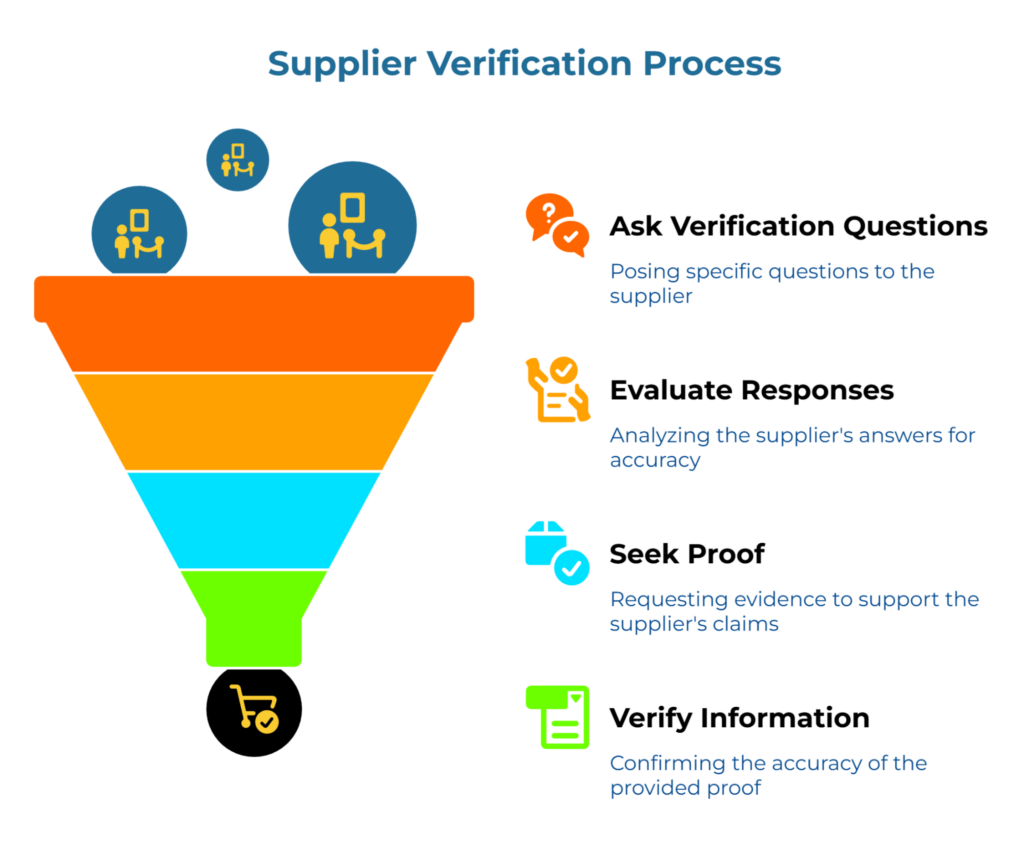
The objective isn’t to investigate forever. It’s to disqualify quickly.
A scammer can talk. A real supplier can answer specifically and prove it. These seven questions force proof and verifiability—two elements that fraudulent operators typically struggle to maintain without discrepancies.
Send these as a single email or run them as a 20-minute introductory call.. Either way, the responses will tell you everything you need to know about whether to proceed or walk away.
For a deeper framework on building systematic supplier trust, consult a comprehensive supplier verification protocol, see The Trust Protocol: a system for supplier verification and risk mitigation.
Implementation Strategy:
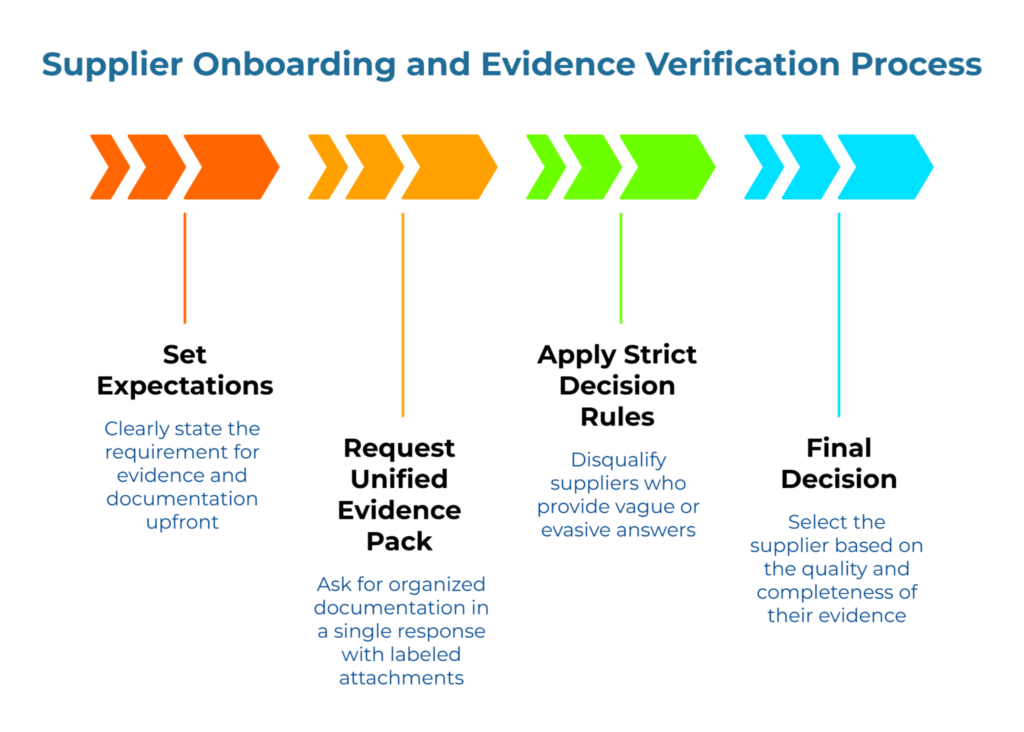
Prioritize evidence during onboarding. Set the expectation upfront: “We require answers plus supporting documentation attached.” This signals professionalism and immediately filters out anyone unwilling to provide proof.
Require unified evidence packs. Scattered WhatsApp photos and verbal assurances don’t count. When sourcing kraft paper or corrugated boxes, establishing what constitutes acceptable documentation prevents misunderstandings before orders are placed. Ask for organized documentation in a single response with attachments labeled Q1–Q7. Redaction is fine for pricing and customer names; entity details, dates, and document structure must stay visible. Legitimate suppliers maintain this readily. Fraudulent entities generally find it difficult to fabricate this level of detail consistently.
Apply strict decision rules. Don’t negotiate with evasiveness. Vague answers aren’t a starting point for discussion—they’re disqualifying signals. Move on.
A note for suppliers reading this: these questions should be welcome. They prevent wasted cycles, misquotes, and mismatched expectations. Preparing clear answers and organized proof actually accelerates the path to real business relationships.
Supplier Vetting Interview Script
Copy and send as a single email, or use as a 12-minute call guide.
| Question | What a Real Answer Includes |
| 1. What is the legal entity that will invoice me—and what registry can I verify it in? | Legal name, registration number, registered address; link to official registry |
| 2. Which facility will actually make/fulfill this order—and can you prove it’s real this week? | Facility name + address; time-stamped proof-of-life (live video, dated photos, recent audit) |
| 3. What exact product specs can you hold repeatedly—and how do you test them? For kraft paper buyers, this means asking suppliers to specify test methods like ISO 536 and ISO 2758 with defined tolerances. | Measurable parameters, test methods, tolerances in specific units |
| 4. Can you share 2–3 recent shipment proofs (redacted) showing international delivery? | Redacted commercial documents with consistent entity details and recent dates |
| 5. Who are two current customers that can confirm performance—with verifiable contact info? | References with permission; verifiable company domains or third-party platform reviews |
| 6. Which payment terms do you accept for first orders—and what risk controls will you use? | Reasonable first-order options; willingness to stage payments after sample approval |
| 7. If something goes wrong, what is the dispute path—and who is accountable for the documents? | Named accountable person, defined escalation process, documented acceptance criteria |
Red Flag Triggers:
- Inconsistent legal entity names across documents
- Refusal of time-stamped facility proof
- Only marketing language for specs (no test methods or tolerances)
- Urgency pressure combined with irreversible payment demands
- “No problems ever” with no named accountable person
Decision Rule:
- Pass: Specific answers + verifiable proof + consistent entity details → proceed to trial order
- Caution: Mostly specific but weak proof → small sample order first
- Fail: Evasive, inconsistent, or urgent pressure → stop engagement
Download: [Supplier Vetting Interview Script (PDF)] — Same content in a formatted, shareable document for your team.
The 7 Questions
Q1: Legal Entity Verification
Ask: “What is the legal entity that will invoice me—and what registry can I verify it in?”
A real answer includes: The exact legal name, company registration number, and registered address. The invoice entity must match exactly. The supplier provides a link or clear instructions for verification through an official government or business registry. For entities with a Legal Entity Identifier (LEI), verification can be performed through the Global LEI system. When sourcing internationally, understanding how to verify international suppliers without travel becomes crucial for establishing supplier legitimacy.
Scammer patterns: “We have many branches” without specifying which one invoices. Inconsistent names across communications. Reluctance to share registration documents.
Follow-up: “Please confirm the bank account name will match the invoice entity exactly.”
Q2: Facility Proof
Ask: “Which facility will actually make or fulfill this order—and can you prove it’s real this week?”
A real answer includes: The facility name and physical address. Time-stamped proof-of-life: a live video walk-through, dated photos with specific prompts you request (like today’s newspaper or a sign with your company name), or a recent third-party audit summary.
Scammer patterns: Stock factory footage from image libraries. Refusal to provide live or current proof. Generic claims like “big factory” or “modern equipment” without specifics.
Follow-up: “Can you send a 30-second video of the production floor with today’s date visible?”
Q3: Product Specs and Testing
Ask: “What exact product specs can you hold repeatedly—and how do you test them?”
Tailor this question to the specific category—corrugated boxes, kraft paper, packaging materials—whatever applies to your order.
A real answer includes: Measurable parameters with specific values. Named test methods from standards bodies like ISO, TAPPI, or equivalent. Defined tolerances with units. For example: “We test burst strength per ISO 2758 and report in kPa with ±5% tolerance.” Understanding specific kraft paper technical specs helps buyers set measurable acceptance criteria that prevent post-delivery disputes.
Scammer patterns: Only marketing language (“high quality,” “premium grade”) with no technical specifics. No mention of test methods. No tolerances or acceptance criteria.
Follow-up: “Can you share a recent test certificate or quality report for this product?” When evaluating paper bag suppliers, requesting lab reports with GSM and burst factor specifications ensures suppliers can deliver consistent quality.
For more on setting clear acceptance thresholds, see containerboard quality acceptance criteria that prevent disputes.
Q4: Recent Shipment Proofs
Ask: “Can you share 2–3 recent shipment proofs (redacted) that show you’ve delivered this product internationally?”
A real answer includes: Redacted commercial documents—invoices, packing lists, or bill of lading references—showing consistent entity details and recent activity. Understanding export documentation requirements helps buyers identify what legitimate shipping documents should contain and what red flags to watch for. Keep dates and entity names visible; redact only prices and customer names. Document structure and timeline consistency cannot be faked.
Scammer patterns: Excuses about “privacy” with no willingness to provide redacted alternatives. Only screenshots without document context. Documents with inconsistent formatting or entity names.
Follow-up: “Can you confirm the exporting entity on these documents matches the invoice entity you provided?”
Q5: Customer References
Ask: “Who are two current customers that can confirm performance—using contact info I can independently verify?”
A real answer includes: References who have given permission, with contact information at verifiable company domains (not personal email addresses). When vetting international paper bag suppliers, cross-referencing provided references against third-party platforms adds another verification layer. Alternatively, third-party platform reviews combined with company websites you can cross-reference.
Scammer patterns: Only personal email addresses (gmail, yahoo) for “references.” Unwillingness to allow any verification. LinkedIn profiles that don’t connect to real company websites.
Follow-up: “May I contact them directly, or can you provide a reference letter on their company letterhead?”
Q6: Payment Terms and Risk Controls
Ask: “Which payment terms do you accept for first orders—and what risk controls are you willing to use?”
Keep this educational—the goal is understanding their flexibility, not providing legal or financial advice.
A real answer includes: Reasonable first-order options that acknowledge the trust-building nature of new relationships. Many legitimate suppliers understand that negotiating payment terms beyond 100% advance demonstrates mutual commitment to building a working partnership. Willingness to discuss staged payments after sample approval. Openness to standard risk controls common in B2B international trade. Terms should reference clear Incoterms® rules so responsibilities are understood by both parties.
Scammer patterns: Pressure for urgency combined with demands for full payment through irreversible channels. Refusal to discuss any staged approach. “Special discount” that expires immediately.
Follow-up: “What is your standard process for first-time buyers who want to start with a sample order?”
Q7: Dispute Path and Accountability
Ask: “If something goes wrong, what is the dispute path—and who is accountable for the documents?”
A real answer includes: A named person responsible for quality and delivery issues. Documented acceptance criteria. A clear escalation process with contact information. Willingness to define terms before problems occur.
Scammer patterns: “No problem ever happens.” No named accountable person. Vague assurances instead of documented processes. Resistance to discussing what happens if specs aren’t met.
Follow-up: “Can you include the accountable contact and escalation process in our purchase agreement?”
Scoring and Next Steps
Apply a simple decision framework based on the responses you receive:
Pass: The supplier provides specific answers with verifiable proof and consistent entity details across all documents. Proceed with a trial order.
Caution: Answers are mostly specific, but proof is weak in one or two areas. Move forward with a small sample order before committing to volume. Request missing documentation before scaling.
Fail: Responses are evasive, entity details are inconsistent, or you sense urgency pressure. Stop engagement immediately. The risk isn’t worth the potential savings.
For a complete framework on verifying overseas suppliers through sequential gates—identity → capability → compliance → comparability → trial—see the Zero-Trust Sourcing Model: how to verify overseas suppliers without travel.
If Sustainability Claims Are Involved
When a supplier claims FSC certification, recycled content percentages, or other sustainability credentials, documentation continuity becomes critical. A certificate alone isn’t enough—the claim must travel correctly through invoices and shipping documents to maintain chain-of-custody integrity.
Certificate validity can be checked through public registries likethe FSC Public Certificate Search, but verification goes beyond confirming active status. Buyers should learn how to run a quick registry check for FSC/PEFC certificates to match holder legal names with invoice entities and confirm scope coverage. You must ensure the certificate scope covers your specific product and that claim wording transfers correctly onto commercial documents.
This adds complexity beyond the seven core questions. For guidance on verifying that certified claims survive the full supply chain, see The Relay Baton Test for chain-of-custody proof continuity.
Make Proof the Default
“A scammer hates a specific question. A real supplier loves it.”
The suppliers worth working with will appreciate these questions. They demonstrate that you’re serious, organized, and building toward a real business relationship—not just chasing the lowest quote.
When you make evidence the baseline expectation rather than the exception, you stop wasting time on suppliers who can’t deliver and start building relationships with those who can.
For more frameworks on safe international trading and supplier qualification, explore the resources available in PaperIndex Academy. Buyers can also submit RFQs to pre-qualified suppliers or browse verified paper suppliers to begin building relationships with evidence-backed partners.
Disclaimer: This article provides educational guidance on supplier qualification practices.
Our Editorial Process:
Our expert team uses AI tools to help organize and structure our initial drafts. Every piece is then extensively rewritten, fact-checked, and enriched with first-hand insights and experiences by expert humans on our Insights Team to ensure accuracy and clarity.
About the PaperIndex Insights Team:
The PaperIndex Insights Team is our dedicated engine for synthesizing complex topics into clear, helpful guides. While our content is thoroughly reviewed for clarity and accuracy, it is for informational purposes and should not replace professional advice.