

📌 Key Takeaways
Skipping folding carton specification reviews doesn’t save time—it transfers risk to QA, regulatory, and brand teams who’ll pay for it later.
- Certificates Don’t Equal Compliance: A supplier’s quality certification proves their system works, not that your specific folding carton run meets your food-contact needs.
- Gaps Surface Late, Hurt Early: Vague specifications let problems hide until audits, complaints, or recalls force expensive scrambles.
- Speed Creates Fragility: Rushing approvals without proof doesn’t eliminate work—it moves the work to moments when stakes are higher and options are fewer.
- Define Before You Compare: Name material requirements, food-contact use cases, and proof expectations before sending RFQs so supplier quotes are actually comparable.
- Frame Risk, Not Paperwork: Leadership responds better to “this creates recall exposure” than to “we need more documentation.”
Specification discipline isn’t friction—it’s the checkpoint that keeps preventable failures out of your supply chain.
QA managers, packaging engineers, and procurement leads at food and beverage companies will find a practical framework here, preparing them for the detailed compliance checklist that follows.
~ ~ ~ ~ ~ ~ ~ ~ ~ ~ ~ ~ ~ ~ ~ ~ ~ ~
The RFQ deadline is tomorrow. Three suppliers have responded. Leadership wants a decision by the end of week.
Somewhere in the rush, a familiar shortcut appears: skip the detailed folding carton specification review because the supplier already has ISO certification. We can verify the details later.
That assumption is how preventable recalls begin.
Ignoring folding carton specifications is not a speed advantage. It is a risk transfer—shifting exposure from the procurement timeline onto QA, regulatory affairs, and ultimately the brand itself. When a folding carton enters a food-contact application without verified specification alignment, every shipment carries exposure that no certificate can retroactively fix.
Speed is irrelevant if the destination is a product recall.
This article explains how skipped folding carton specifications become recall triggers, what consequences follow, and how to build the internal case for specification discipline before supplier comparison begins.
Why Teams Skip Folding Carton Specifications In The First Place
Teams usually skip folding carton-specification discipline because the first delay is visible and the downstream risk is not. If you are trying to move an RFQ faster, a detailed specification sheet can feel like friction. Strict specification discipline transforms a standard RFQ from a price-tallying exercise into a rigorous risk-assessment protocol.
The organizational tension is real: growth-stage food and beverage operations face competing demands from new product launches, seasonal volume spikes, supplier transitions, and cost targets. In this environment, specification reviews can look like optional administrative work.
Pressure-tested workflows typically degrade via three specific failure pathways.
First, the supplier already holds a general quality certificate, so the team assumes run-specific compliance follows automatically. It does not. A supplier’s ISO 9001 or FSSC 22000 certification confirms their management system meets a standard. However, these high-level audits do not validate that a specific production run aligns with your unique barrier requirements, migration thresholds, or moisture-resistance tolerances. This distinction matters because certificates alone do not qualify a folding carton supplier for your particular application.
Second, the previous folding carton worked, so the replacement should too. But “worked” often means “no visible failure yet.” Subtle specification drift—changes in board grade, coating formulation, or substrate source—can shift performance without triggering an obvious problem until an audit, customer complaint, or regulatory inquiry surfaces the gap. This pattern of gradual erosion is why cross-SKU material standardization matters before portfolio expansion.
Third, the approval process lacks a defined checkpoint for specification alignment. Without a gate requiring explicit sign-off on material parameters before supplier comparison, the specification review becomes optional. Optional steps disappear under deadline pressure.
None of these patterns reflect bad intent. They reflect workflow gaps that become risk pathways when no one is assigned to close them.
How Ignored Folding Carton Specifications Become Recall Conditions
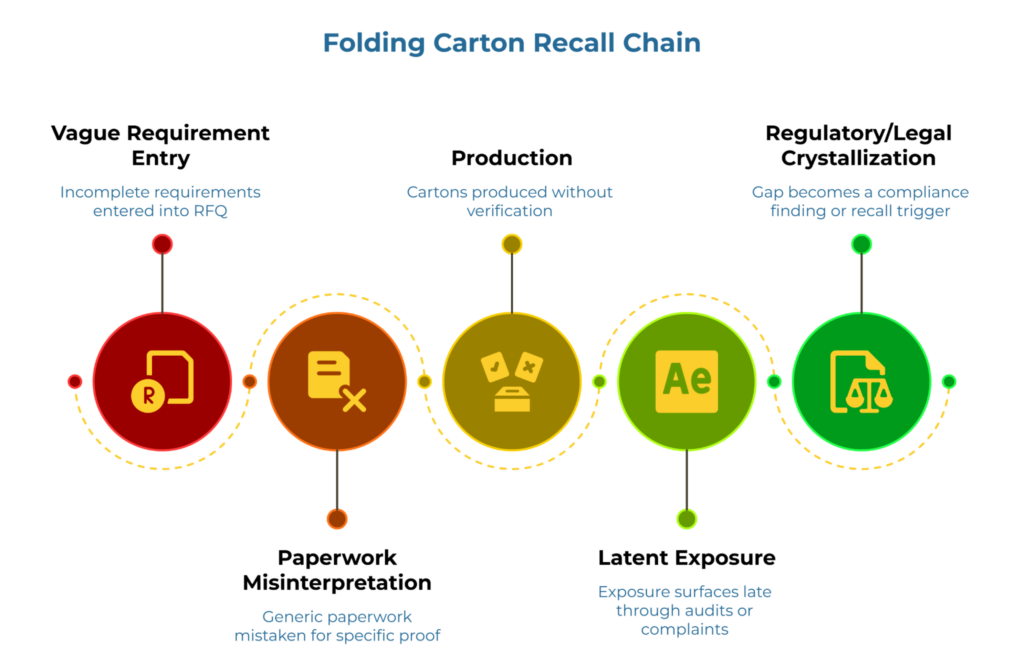
A recall rarely traces back to a single dramatic failure. More often, it follows a chain of small assumptions that compound until a regulator, auditor, or customer finds the gap.
The chain typically unfolds through five stages.
1. Vague Requirement Entry: Vague or incomplete folding carton requirements enter the RFQ—the request asks for “food-grade folding cartons” without specifying barrier performance, migration testing expectations, or direct food-contact suitability for the actual application. Building quote-ready folding carton fields prevents this ambiguity. Suppliers quote against their own interpretation of what that means.
2. Paperwork Misinterpretation: Generic paperwork then gets mistaken for product-specific proof. The winning supplier submits a certificate of conformity, a general food-contact declaration, or an ISO registration. The team files it as compliance evidence without verifying whether the certificate scope covers the specific board grade, coating type, and intended use case.
3. Production: Unverified suitability reaches production. Folding cartons arrive, look correct, and run through the filling line without mechanical issues. No one flags a problem because the specification was never defined tightly enough to create a clear pass/fail boundary.
4. Latent Exposure: Exposure surfaces late. A routine audit requests migration test data for the specific folding carton-product combination. A customer in a regulated market asks for documentation the file does not contain. A complaint triggers an investigation revealing the folding carton coating was never tested against the product’s fat content or temperature profile.
5. Regulatory/Legal Crystallization: At that point, the gap is no longer theoretical. It becomes a compliance finding, a shipment hold, or a recall trigger—depending on how far the product has traveled and how regulators in destination markets respond.
The U.S. FDA regulates food-contact substances (FCS) under 21 CFR, while the European Commission’s Framework Regulation (EC) No 1935/2004 mandates safety. In the absence of specific EU-wide measures for paper, compliance defaults to the German BfR Recommendation XXXVI or similar national standards—or general safety clauses to govern acceptable migration limits. Neither framework accepts “the supplier said it was food-grade” as sufficient evidence when an investigation opens.
Generic certificates confirm supplier systems. They do not confirm that your folding carton run—with its specific substrate, barrier coating, and application conditions—meets the regulatory threshold for your product in your market.
Operational and Financial Cascades Following a Packaging Failure
A packaging-related recall does not stay contained in the compliance function. The impact extends to operations, supplier relationships, and brand perception.
QA escalation consumes capacity. The team that should be preventing the next issue spends weeks reconstructing documentation, responding to regulator questions, and coordinating with legal. Routine quality work pauses.
Shipments hold or reverse. Product in transit may be stopped. Product on shelves may be pulled. Products in customer warehouses may require retrieval. Each step adds logistical complexity and customer-facing friction that compounds over time.
Supplier relationships strain. The supplier who provided the folding carton may dispute responsibility, especially if the original RFQ did not specify the requirements now under scrutiny. Finger-pointing replaces partnership.
Health-risk scrutiny intensifies. Depending on the product and the gap, regulators may require expanded testing, additional documentation for future shipments, or facility inspections. The FDA’s recall and safety alert process creates public visibility that compounds reputational exposure.
Brand perception shifts. Customers, retailers, and distribution partners notice. A recall tied to packaging—even if no consumer harm occurred—raises questions about quality systems. Rebuilding confidence takes longer than resolving the immediate compliance finding.
When the approval trail is weak, every downstream question gets harder. Which material parameters were actually required? Which food-grade barriers were assumed? Which migration testing conditions were relevant? Who signed off? If those answers are slow or unclear, the organization is no longer managing a packaging detail. It is managing a governance failure.
Why Speed-Focused Leadership Often Misreads The Risk
When leadership prioritizes procurement speed, they optimize for real business constraints: time-to-market, cash flow, capacity utilization. The error is not in valuing speed. The error is treating specification discipline as friction rather than as a condition for sustainable speed.
Validating material parameters is a proactive safeguard, not a logistical bottleneck. It is a control preventing a category of failure—packaging-related compliance gaps—from entering the supply chain in the first place. Skipping it does not eliminate the work. It defers the work to a moment when the stakes are higher and the options fewer.
Executives respond to risk language when framed in terms they already track: operational continuity, brand protection, regulatory standing. The key message is not “this costs more later.” The key message is “this creates a preventable, organization-wide risk event that no team can delegate away once it surfaces.”
A QA manager who says “we need more documentation” sounds like friction. A QA manager who says “we are approving folding cartons without evidence that they meet our direct food-contact requirements, and that creates recall exposure” describes a business risk that leadership can weigh against timeline pressure.
Consider a packaging engineer in a fast-moving snacks business. The team has one week to approve a new folding carton source before an export shipment is booked. Procurement has three supplier files, but none ties barrier performance or direct food-contact suitability to the actual SKU family. The result is predictable: the decision looks fast in the meeting, then slows to a crawl when QA asks for proof that should have been defined before the quote request went out.
That is the hidden cost of speed-first thinking. Not higher spend. Greater fragility.
The Minimum Folding Carton-Specification Controls That Prevent Preventable Recalls
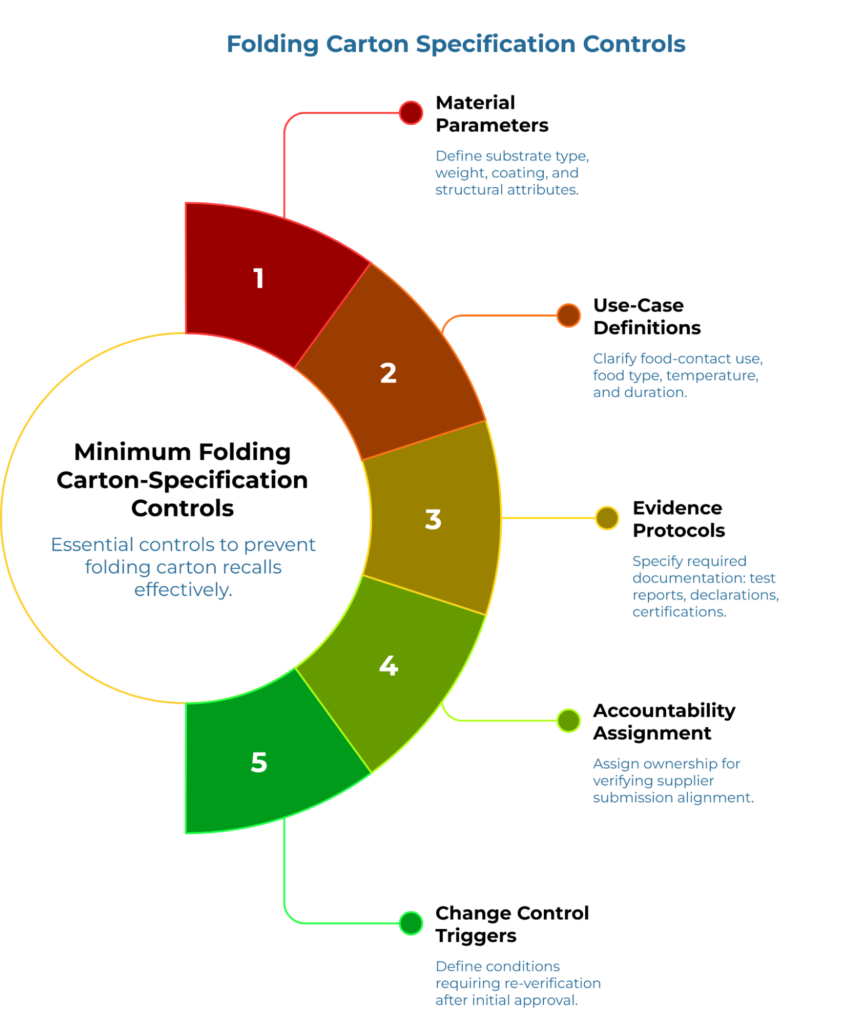
Specification discipline does not require a six-month qualification program. It requires a defined checkpoint with clear ownership before supplier quotes are compared. The folding carton specification alignment checklist provides this checkpoint in a structured format. For teams ready to operationalize this approach, a proof ladder helps match evidence depth to qualification stage.
The minimum viable controls include five elements.
1. Material Parameters: The parameters must be defined before the RFQ. Specify the substrate type, basis weight range, barrier coating requirements, and any structural attributes—caliper, stiffness—affecting performance. For substrate specifications, understanding board grade tolerances prevents suppliers from interpreting requirements differently. If the folding carton contacts food directly, specify whether migration testing is required and under what conditions.
2. Use-Case Definitions: The intended food-contact use case must be stated clearly. Will the folding carton contact food directly? What type of food—dry, fatty, acidic, frozen? What temperature and duration conditions apply? A folding carton suitable for dry bakery goods may not be suitable for chilled dairy products.
3. Evidence Protocols: Explicit proof expectations tell suppliers what documentation you require: test reports referencing specific test methods, declarations of compliance against named regulations, or third-party certifications with defined scope. Vague requests produce vague responses. Guidance on what proof to request at RFQ stage for folding cartons can help structure these requests.
4. Accountability Assignment: Review ownership assigns someone—QA, packaging engineering, or a cross-functional designee—to verify that supplier submissions align with stated requirements before the supplier is approved. Without ownership, the checkpoint becomes optional.
5. Change Control Triggers: Defined conditions must specify when re-verification is required after initial approval. Substrate source changes, coating reformulations, manufacturing site relocations, and regulatory scope updates all represent triggers that invalidate prior qualification evidence. Understanding how compliance decay happens helps teams design appropriate monitoring cadences. Without explicit triggers, suppliers may substitute materials or shift production without notification, and the original compliance basis erodes silently. Change control clauses belong in supplier agreements, not just internal SOPs.
These controls fit within an existing procurement workflow. They do not require new systems. They require agreement that specification alignment happens before comparison, not after approval.
Quantifying the Cost of Inaction
If your organization treats folding carton specification review as optional, changing that requires an internal case. Compliance gaps do not produce visible costs until they surface as incidents. Speed, by contrast, produces visible benefits immediately. The Cost of Inaction sheet reframes this asymmetry.
Critical Inclusion Metrics:
The categories of disruption a packaging-related recall creates—QA escalation, shipment holds, supplier disputes, regulatory scrutiny, customer confidence erosion. The departments affected and duration of impact, which typically spans weeks to months rather than days. The fact that these consequences follow from a preventable gap, not from market conditions or competitor actions. The minimum checkpoint that prevents the category of failure: specification alignment before supplier comparison.
Implementation Strategy:
Bring the summary to the meeting where procurement timelines are set. When leadership asks why the specification review cannot be compressed, the sheet provides the answer: skipping it does not remove the work—it transfers the work to a moment when the consequences are larger and the response options narrower.
The goal is not to slow procurement. The goal is making specification alignment a visible, non-negotiable step that runs in parallel with other timeline activities rather than being deferred or dropped.
To see how this concept fits into the broader compliance strategy, explore the complete guide to stop relying on generic certificates: a practical guide to food-safe folding carton compliance. For broader learning and adjacent tools, the PaperIndex Academy provides additional resources on packaging, sourcing, and compliance workflows. When you are ready to connect with verified folding carton suppliers, the PaperIndex marketplace offers a curated directory.
Disclaimer
This article is for educational purposes only and does not replace legal, regulatory, or product-specific compliance review. Food-contact packaging obligations vary by market, material, formulation, and end-use conditions. Validate all specifications and compliance evidence against your actual product, destination market, and applicable rules before approval.
Our Editorial Process:
Our expert team uses AI tools to help organize and structure our initial drafts. Every piece is then extensively rewritten, fact-checked, and enriched with first-hand insights and experiences by expert humans on our Insights Team to ensure accuracy and clarity.
About the PaperIndex Insights Team:
The PaperIndex Insights Team is our dedicated engine for synthesizing complex topics into clear, helpful guides. While our content is thoroughly reviewed for clarity and accuracy, it is for informational purposes and should not replace professional advice.