

📌 Key Takeaways
Visual samples prove how a folding carton looks—not how it will hold up when humidity spikes, pallets stack high, or trucks bounce for three days.
- Appearance and Performance Are Different Tests: A crisp-looking sample confirms print quality, but it cannot reveal moisture limits, weight tolerances, or stacking strength.
- Lock Specifications Before Comparing Suppliers: Define exact targets for board weight, water absorption, and moisture content—with tolerance bands—so every quote measures the same thing.
- Name the Test Methods: Specifications without ISO or TAPPI references let suppliers interpret standards differently, which fuels disputes after delivery.
- Separate Visual and Structural Sign-Offs: Assign one reviewer to approve appearance and another to verify measurable specifications—combining both into one “looks good” decision invites failures.
- Request Evidence Up Front: Ask for technical sheets alongside samples; if data is missing, the sample is incomplete no matter how polished it appears.
Specifications you can measure prevent the finger-pointing that visual approvals invite.
Packaging, procurement, and quality managers sourcing folding cartons will find a ready-to-use approval workflow here, preparing them for the detailed specification-normalization guides that follow.
~ ~ ~ ~ ~ ~ ~ ~ ~ ~ ~ ~ ~ ~ ~ ~ ~ ~
That folding carton in your hands right now—the one that looks production-ready—cannot tell you how it will behave when humidity spikes inside a warehouse truck in July. The print is crisp. The die cuts are clean. The board feels solid. And none of that matters if the structural specifications were never locked.
A visual sample is a print-and-finish checkpoint, not a durability guarantee. Only normalized, testable folding carton specifications make supplier approvals defensible when folding cartons face real transit conditions. This is the core problem: Technical teams often conflate aesthetic fidelity with mechanical reliability.
The Myth: If the Sample Looks Good, the Folding Carton Is Good
Visual proofs feel persuasive because they are tangible. You can hold them, flex them, and inspect the corners. They make supplier reviews feel fast and decisive. Initial visual alignment frequently triggers premature procurement cycles.
But this confidence is misplaced. What teams assume a visual sample is proving—that the folding carton will perform reliably in distribution—is not what the sample actually proves. A sample confirms that the supplier can produce something that looks correct. It says nothing about whether the next 50,000 units will hold up under stacking pressure in a 3PL facility or survive three days in a humid cross-country shipment.
The approval habit of trusting a good-looking sample persists because it feels efficient. It is not. It is the beginning of a dispute you have not yet had.
Reality: A Visual Sample Cannot Validate Structural Reliability
A sample can confirm print quality, finish consistency, dieline accuracy, and basic form factor. These matter. But they represent only half of the approval decision.
This is not a contradiction; it is a failure of objective scope. Aesthetic sign-off and mechanical validation address disparate risk profiles.
Appearance questions ask: Does the artwork register correctly? Does the board look clean? Does the folding carton fold as expected? Does the finish match the brand standard? A sample can answer these.
Specification questions ask: Is the grammage consistently within range? Is water absorptiveness controlled? Is the moisture window stable? Will the board behave the same after humidity exposure, stacking pressure, and route variation? Will two suppliers who use the same board-grade name actually deliver comparable performance? A sample cannot answer these. You cannot see moisture content. You cannot feel tolerance drift. You cannot know from appearance alone whether the board will soften, warp, or collapse.
The line between visual validation and performance validation is the line between what you can see and what you need to measure. Relying on supplier specifications alone without independent verification is where specification-induced failures begin—this is why working with verified packaging paper suppliers who provide documented test data matters.
The Numbers That Matter More Than the Sample
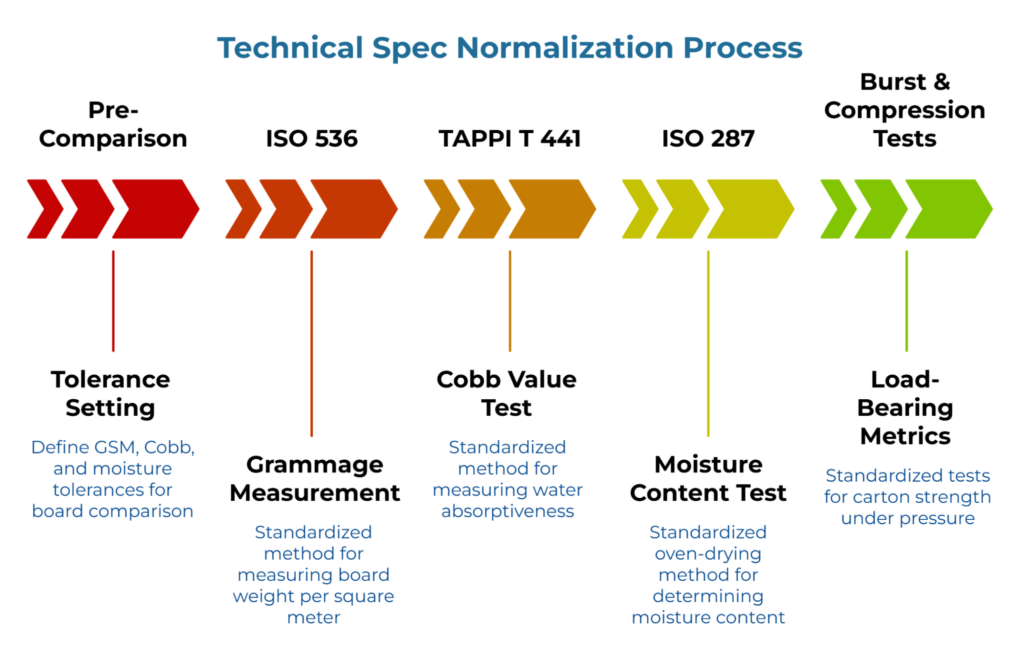
Technical Specification Normalization is the methodology of locking tolerances for GSM, Cobb, and moisture before supplier comparison begins. It replaces subjective feel with objective, testable data.
GSM (grammage) is the weight of the board in grams per square meter. But a nominal GSM target is not enough. Without a tolerance band—say, 300 GSM ±3%—the same “board grade” can vary meaningfully between suppliers or even between production runs from the same paper manufacturer. ISO 536 defines the standardized test method for grammage measurement.
Cobb value measures water absorptiveness, typically tested using TAPPI T 441 methodology. Why does this matter? Because moisture exposure changes performance. A folding carton that feels solid in a climate-controlled showroom may soften and fail when it sits in a non-climate-controlled truck for 72 hours. If your supplier is not holding a Cobb value with a defined tolerance, you have no basis for complaint when water exposure degrades the board.
Moisture content at the time of production affects how the board behaves in transit. ISO 287 covers the oven-drying method for determining moisture content. The same board grade can behave differently if moisture varies at release—warping in automated folding lines, jamming in high-speed packing equipment, or losing compression strength before reaching the customer.
Burst strength and compression are the load-bearing metrics that visible appearance cannot predict. A folding carton can look identical to a passing sample and still crush under stacking weight because the structural integrity was never tested or specified.
These are the numbers that matter more than the sample.
Myth vs. Reality: What a Nice Sample Shows vs. What a Technical Specification Sheet Guarantees
| Dimension | What a Visual Sample Shows | What a Technical Specification Sheet Guarantees |
| Print / finish appearance | Yes — confirms visual quality | Yes — but adds repeatability standards |
| Board grade naming | Label only — no verification | Verified grade with source documentation |
| GSM target and tolerance | Not visible | Defined target ± tolerance band |
| Cobb target and tolerance | Not visible | Defined value with test method citation |
| Moisture target and tolerance | Not visible | Defined range at time of testing |
| Burst strength or compression basis | Not measurable by inspection | Specified minimum with test protocol |
| Named test method | Not applicable | TAPPI, ISO, or ISTA reference |
| Lot-to-lot consistency | Unknown from one sample | Documented process controls |
| Transit-readiness signal | Assumed, not proven | Tested against distribution conditions |
| Approval evidence retained | Photo of sample at best | Comparative laboratory validation report |
This table is the difference between approving what you see and approving what you need.
How Transit Failures Start After Approval
The failure sequence is systemic: visual acceptance precedes structural definition. The production runs ship with unnormalized board variance—slightly different moisture content, slightly different Cobb value, slightly outside the GSM tolerance that was never actually specified. The folding cartons enter distribution.
Then the environment and logistics do what they do. As omnichannel shipping gets rougher and 3PL handling gets less predictable, these exposures multiply. Humidity in the trailer rises. Pallets stack higher than expected in a 3PL facility. Handling is rougher than the controlled conditions of the sample review. The folding cartons that looked perfect begin to fail—crushed corners, collapsed stacks, damaged products inside.
And then the dispute. The supplier says the board met specification. But which spec? This ambiguity is why vetting potential partners through a B2B marketplace with verification processes matters before contracts are signed. The one that was written down, or the one that was assumed? When the approval basis was subjective—”the sample looked fine”—there is no defensible standard to enforce. ISTA 3A procedures exist precisely because e-commerce parcel distribution exposes folding cartons to vibration, shock, compression, temperature, and humidity that showroom samples never face.
Supplier finger-pointing thrives when the proof standard is subjective. For teams working through why folding carton clarity matters before supplier review starts, this is precisely why Technical Specification Normalization removes the ambiguity.
A Practical Review Workflow Before You Approve the Next Supplier Proof
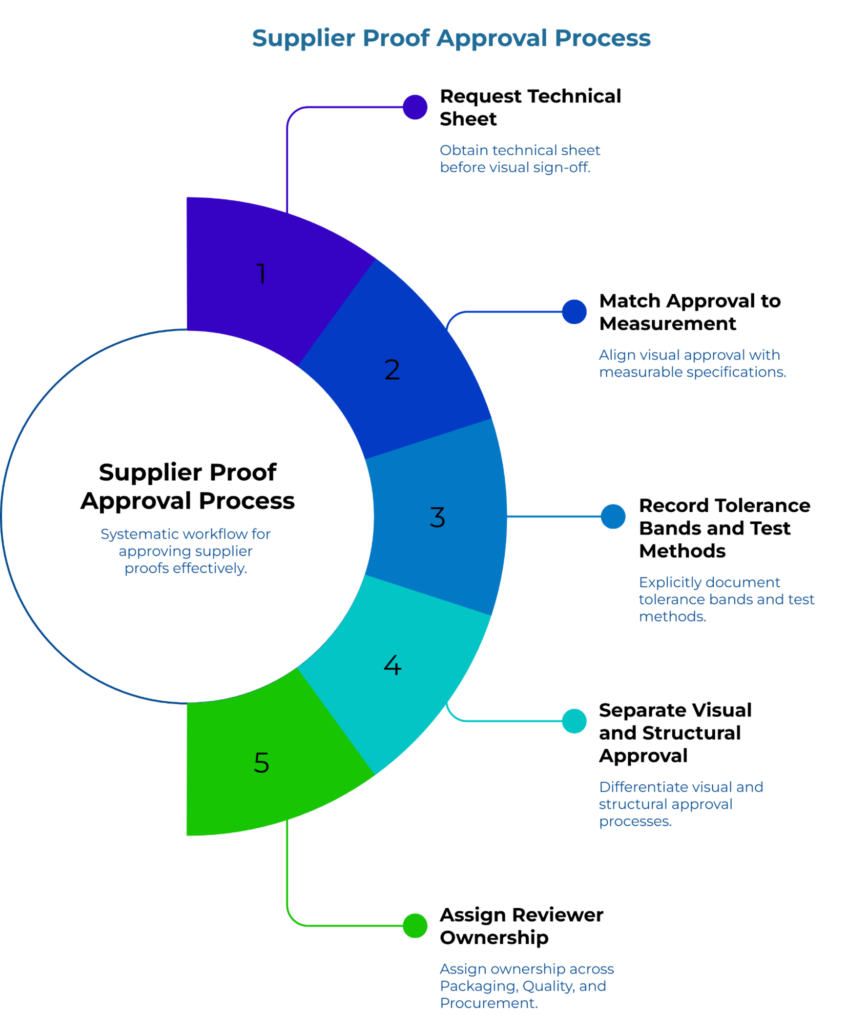
Before final sign-off on any supplier proof, use a five-part gate:
- Request the technical sheet before final visual sign-off. The technical sheet should accompany the sample, not follow it as an afterthought.
- Match each visible approval to a measurable field. If you are approving the board grade, confirm the GSM target and tolerance in writing. If you are approving the finish, confirm the Cobb value and the test method used. Do not assume. Document.
- Record tolerance bands and named test methods explicitly. A specification that says “300 GSM board” is incomplete. A specification that says “300 GSM ±3% per ISO 536” is defensible.
- Separate visual approval from structural approval. These are two different sign-offs, ideally by two different reviewers. Visual approval confirms print and finish. Structural approval confirms measurable performance parameters. Combining them into one “looks good” decision is the mistake this entire process is designed to prevent.
- Assign reviewer ownership across Packaging, Quality, and Procurement. When everyone assumes someone else checked the specifications, no one checks the specifications. Creating standardized RFQ parameters stops supplier finger-pointing before it starts—buyers can submit RFQs & receive quotes for free once specifications are properly defined.
What to Ask for When the Sample Looks Fine but the Data Is Thin
When a supplier sends a sample that looks production-ready but the technical documentation is vague or missing, these are the questions that matter:
What GSM range is being guaranteed, not just targeted? What is the tolerance, and how is it verified?
What Cobb value and tolerance are being held? Which test method—TAPPI T 441 or equivalent—was used to determine it?
What moisture range applies at time of testing and release? How is this controlled across production lots?
Which named test methods were used for burst strength or compression? Is there a minimum threshold being guaranteed?
What evidence is retained if the delivered lot behaves differently than the approved sample? Will test reports be available for dispute resolution?
For internal alignment, Packaging, Quality, and Procurement should agree on which fields require specification before any supplier proof is approved. Once alignment is achieved, teams can find suppliers who can meet these documented requirements. If those fields are not populated, the sample is incomplete—regardless of how good it looks.
For readers new to this process,normalizing your first folding carton quote provides a beginner-friendly framework, and the PaperIndex Academy offers additional educational resources on procurement best practices. For those ready to build a formal evidence discipline,supplier evidence packs offer a structured approach.
Approve Appearance Last, Approve Specifications First
Visual samples still matter. Print quality, finish, and dieline accuracy are real requirements that deserve real approval. But they belong later in the logic stack—after the structural specifications are locked.
The better standard is specification-first, appearance-second. Lock the GSM, Cobb, moisture, and compression tolerances. Confirm the test methods. Document the evidence trail. Then—and only then—approve the visual proof.
This is how Technical Specification Normalization prevents transit failures. Not by rejecting visual samples, but by putting them in their proper place: as confirmation of aesthetics, not proof of performance.
Durability is not a pricing negotiation. It is a technical specification baseline that prevents supplier finger-pointing before the first folding carton ships. The sample that looks perfect today is only as reliable as the specifications that define what “perfect” actually means.
Disclaimer:
This article is for educational purposes only. All specifications, tolerances, and test methods discussed are illustrative examples. Consult qualified packaging engineers and verify all technical parameters with certified testing laboratories before making sourcing decisions.
Our Editorial Process:
Our expert team uses AI tools to help organize and structure our initial drafts. Every piece is then extensively rewritten, fact-checked, and enriched with first-hand insights and experiences by expert humans on our Insights Team to ensure accuracy and clarity.
About the PaperIndex Insights Team:
The PaperIndex Insights Team is our dedicated engine for synthesizing complex topics into clear, helpful guides. While our content is thoroughly reviewed for clarity and accuracy, it is for informational purposes and should not replace professional advice.