
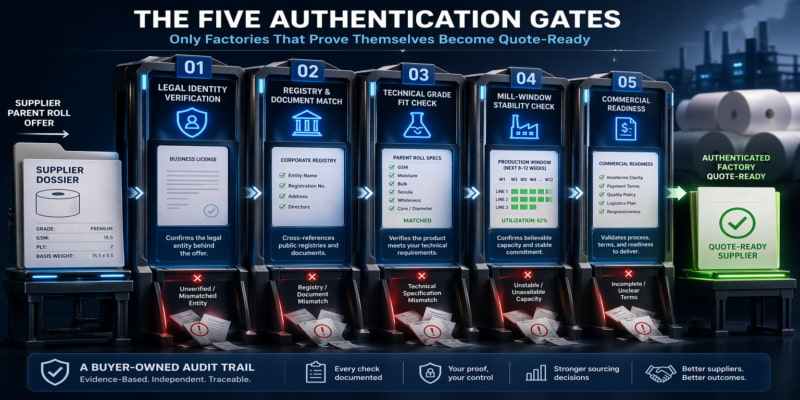
📌 Key Takeaways
Premium bath tissue sourcing works only when supplier checks prove the mill is real before price comparisons begin.
- Quotes Prove Very Little: A polished quote or clean sample does not prove real mill control or factory-direct status.
- Verification Must Go Deeper: Strong supplier checks confirm legal identity, manufacturing reality, technical fit, and production stability together.
- Documents Need Cross-Checks: Certificates and registry records help only when they match the quoted entity and the operating mill.
- Technical Answers Reveal Truth: Suppliers who understand premium grades clearly are more credible than those relying on polished sales language.
- Compare Prices Only After Proof: Commercial comparison makes sense only after a supplier earns a clear proceed, hold, or escalate decision.
Clear proof before quotes leads to cleaner supplier decisions and fewer sourcing mistakes.
Procurement teams and toilet tissue converters screening premium-grade suppliers will gain a clearer qualification mindset here, preparing them for the detailed overview that follows.
~ ~ ~ ~ ~ ~ ~ ~ ~ ~ ~ ~ ~ ~ ~ ~ ~ ~
Premium sourcing changes the stakes.
Factory-direct verification for premium bath tissue grades is not a badge check. It is a Multi-Layer Authentication process that tests legal identity, manufacturing reality, technical fit, and production stability before a supplier is treated as quote-ready.
That distinction matters the moment a converter moves upmarket. A supplier can send polished quotes, acceptable documents, and even a clean sample for bulk parent rolls, yet still fail the deeper test of mill-level credibility. The documents look clean, and the answers sound polished. But is this really the mill? That tension sits at the center of premium bathroom tissue sourcing. The primary risk is not an uncompetitive offer, but a credible one issued by a disconnected legal entity.
A quote is not proof of a toilet tissue mill. In premium sourcing, that is the starting rule.
Why High-End Tissue Procurement Demand a Higher Verification Standard
Premium bulk converting programs increase the cost of weak Supplier Vetting. The buyer is no longer screening only for availability. The buyer is screening for stable mill reality, tighter technical credibility, and a believable Mill Window that can support repeat orders without drift.
That is why website checks and basic certificates stop being enough in higher-risk cross-border sourcing. While useful for preliminary vetting, these signals fail to confirm the nexus between the quoting party and the physical mill operations, managing the production slot, and speaking credibly about the grade being offered. In a growth-stage sourcing program, shallow verification becomes a future operational problem: continuity slips, credibility erodes, and premium-grade consistency gets harder to defend.
As a general sourcing principle, verification depth should rise before commercial complexity does. Premium grades make that rule harder to ignore.
What a Factory-Direct Authentication Protocol Actually Verifies
A strong Factory-Direct Authentication process verifies four separate realities.
It verifies the legal identity behind the quote. It confirms the manufacturing reality behind the mill claim, technical compatibility with premium requirements, and the operational stability of the promised Mill Window.
Those checks are related, but they are not interchangeable. A certificate can support a claim without proving the plant relationship. A sample can support product review without proving factory control. Technical fluency can support credibility without proving registry alignment. The buyer-owned audit trail works only when those signals converge.
That is where Neutral Authentication becomes useful. It keeps the buyer focused on traceable proof rather than persuasion, directory presence, or quote speed.
The Five Layers of Premium Toilet Tissue Mill Authentication
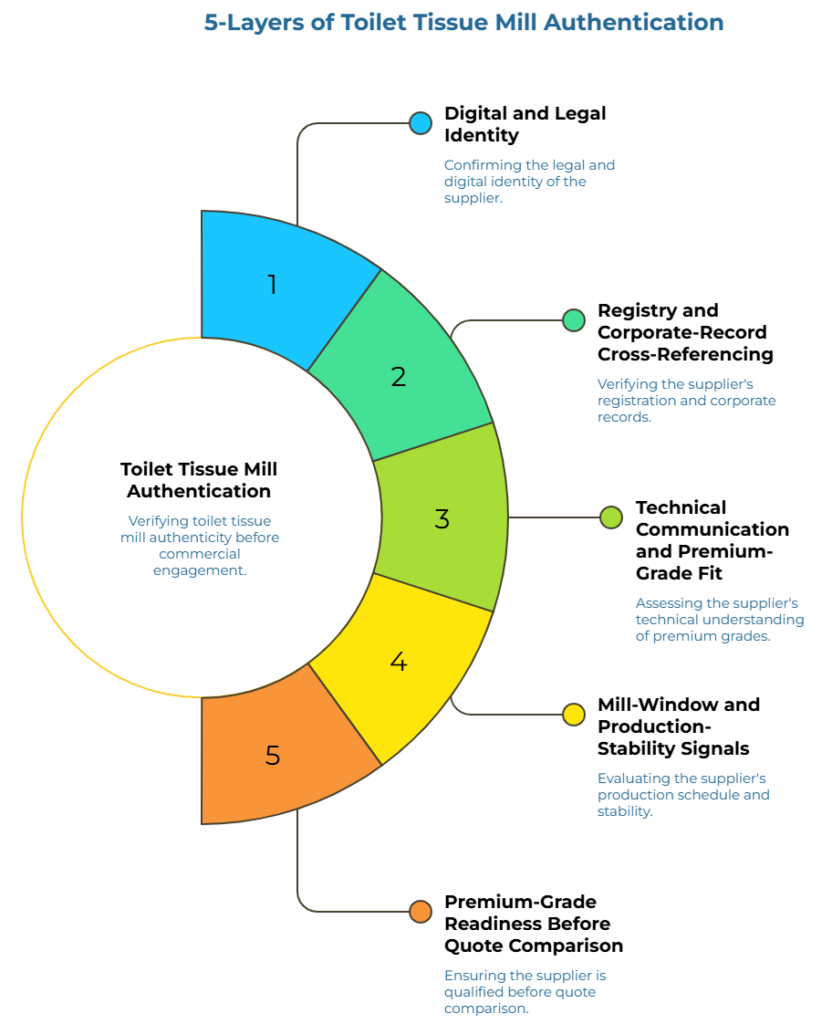
Use the audit trail before sample trust, before RFQs, and before quote comparison.
- Digital and legal identity
Who is actually making the offer?
Proof to check: Quoted entity name, domain ownership signals, company address, phone details, certificate holder name, export document identity.
Failure mode prevented: Treating a polished digital profile as proof of a legitimate manufacturing facility. (For a strong supporting reference, see: “beyond the digital profile: a 5-layer shield for bath tissue parent roll supplier verification“).
Decision: Proceed only if the identity trail is consistent.
- Registry and corporate-record cross-referencing
Does the quoted entity map cleanly to a real operating business?
Proof to check: Registry entries and company records through tools such as the Dun & Bradstreet D-U-N-S lookup and OpenCorporates, generally reinforced by direct queries to the specific national or provincial enterprise registries operating in the supplier’s home jurisdiction.
Failure mode prevented: Buying from an intermediary or borrowed corporate identity—a risk addressed directly in bath tissue parent roll sourcing: how to distinguish factory-direct suppliers from intermediaries and improve vetting accuracy.
Decision: Hold or escalate if quoted, registered, and certificate entities do not align.
- Technical communication and premium-grade fit
Can the supplier discuss the grade like a mill, not just a trader?
Proof to check: Clear answers on premium bathroom tissue characteristics, specification logic, machine capability, and how the quoted grade fits converting needs. For useful internal references on this discussion, consult “toilet tissue raw materials technical specifications: the essential baselines for high-yield converting“ and “from quote to delivery: standardizing toilet tissue jumbo roll specifications.
Failure mode prevented: Mistaking smooth sales language for technical control.
Decision: Proceed only if the answers are specific, consistent, and grade-aware.
- Mill-window and production-stability signals
Is the promised production slot operationally believable?
Proof to check: Coherent answers on lead times, production sequencing, shipment basis, and how timing changes under CIF vs EXW terms, Transshipment exposure, or order-size changes. The first 72 hours: how to map your current toilet tissue raw material lead-time windows is a useful companion resource for structuring that review.
Failure mode prevented: Accepting generic availability claims that collapse under real scheduling pressure.
Decision: Escalate if the Mill Window sounds vague, evasive, or detached from operations.
- Premium-grade readiness before quote comparison
Has the supplier earned the right to be compared commercially?
Proof to check: Alignment across identity, registry, technical depth, and production evidence.
Failure mode prevented: Normalizing quotes before the supplier is actually qualified.
Decision: Mark the supplier as proceed, hold, or escalate. Nothing in between.
How to Cross-Reference Registries with Mill Capability Without Getting Lost in Documents
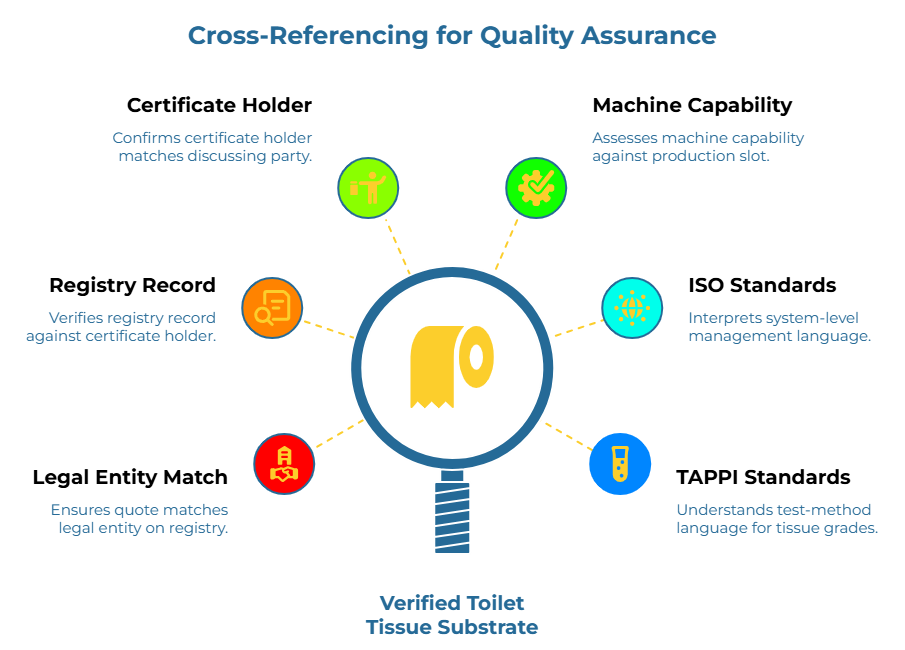
Keep the sequence simple. Match the legal entity on the quote to the registry record. Match that record to the certificate holder. Then match both to the party discussing the grade, the machine capability, and the production slot for toilet tissue bulk substrate.
Audit for structural misalignments, specifically discrepancies between the quoting entity and the certificate holder, or a lack of technical depth regarding parent roll specifications. Clear documents paired with weak answers about operating evidence. In a real converter workflow, those inconsistencies matter more than presentation quality.
As a general supporting practice, official references such as the ISO 9001:2015 standard overview, ISO 9001 explained can help you interpret system-level management language, while TAPPI standards resources and specific grade-level testing frameworks (such as ISO 12625 for tissue) are essential to interpret test-method language. They should support your standards-and-registry framing, not replace mill-specific verification.
Red Flags That Suggest You Are Still Dealing with an Intermediary
Several warning signs deserve immediate attention:
- The claimed mill name, quoted entity, and registry record do not line up.
- Technical answers stay thin when the discussion shifts to specific premium grade requirements .
- The supplier leans heavily on polished documents, samples, or website presentation.
- Production-window answers sound generic, especially when shipment basis or Transshipment risk is raised.
- The supplier speaks confidently about commercial terms but weakly about manufacturing reality.
A recurring pattern in cross-border sourcing is that technical communication quality reveals more than the website does. Clean documents can still sit on top of a misaligned operating structure.
How to Operationalize the Process Before RFQs, Samples, and Quote Comparison
Put the audit trail upstream. That is the practical shift.
Create one buyer-owned record per shortlisted supplier. Log the legal entity, registry match, technical-fit notes, Mill Window answers, and current decision status. Then keep commercial comparison separate until the proof sequence is strong enough to justify it. At that stage, resources like “the first 72 hours: how to audit your current cross-border bath tissue parent rolls supplier vetting process“ and “beyond the broker: three steps to direct toilet tissue raw materials supplier authentication“ fit naturally, because both extend the same educational logic.
If the record is incomplete, hold. If the entities conflict, escalate. If the proof aligns across all five layers, proceed to the next commercial step. That is the future-proofing discipline.
Frequently Asked Questions
Can a supplier sample prove factory-direct status?
No. A sample can support product review, but it does not prove mill ownership, legal identity, or production control. The article “the bath tissue parent roll sample trap: why good quote quality does not always mean a reliable supplier“ explains this distinction in more detail.
What should be verified before comparing high-tier tissue quotes?
Verify legal identity, manufacturing reality, technical fit, and production-window stability first. Quote comparison should follow authentication, not substitute for it.
How deep should verification go before an RFQ is issued?
Deep enough to produce a clear proceed, hold, or escalate decision. If the supplier cannot pass that threshold, the RFQ is early.
The next useful step is educational, not transactional. We recommend reading “the multi-layer verification blueprint: advanced risk mitigation for toilet tissue parent roll procurement“ for a related five-layer model, then use PaperIndex Academy to extend the broader sourcing workflow. Browse bath tissue mills after you define your verification criteria.
Disclaimer:
This content is for educational purposes only and should not be relied on as legal, procurement, technical, quality, trade-compliance, or financial advice. Results vary by supplier, jurisdiction, documents, and operating conditions. Independent due diligence is essential. Unless stated otherwise, no affiliate links, sponsorships, or paid partnerships apply.
Our Editorial Process:
Our expert team uses AI tools to help organize and structure our initial drafts. Every piece is then extensively rewritten, fact-checked, and enriched with first-hand insights and experiences by expert humans on our Insights Team to ensure accuracy and clarity.
About the PaperIndex Insights Team:
The PaperIndex Insights Team is our dedicated engine for synthesizing complex topics into clear, helpful guides. While our content is thoroughly reviewed for clarity and accuracy, it is for informational purposes and should not replace professional advice.