

📌 Key Takeaways
A 72-hour audit reveals the gaps between what your toilet tissue supplier promises and what your converting line actually needs to run smoothly.
- Collect Everything First: Gather supplier data sheets, QA logs, and operator knowledge into one place before judging what’s missing or mismatched.
- Check for Real Specifications: A number without a tolerance range or named test method isn’t a true specification—it’s just a target with unknown wiggle room.
- Test Methods Must Match: Two suppliers quoting the same moisture percentage may be measuring differently, making their numbers impossible to compare fairly.
- Build Your Own Baseline: Create a shared internal document that lists what your machines actually need, not just what suppliers happen to provide.
- Clarity Comes Before Price: Comparing costs before aligning specifications creates false savings—a cheaper roll that jams constantly costs more in the end.
Documentation gaps, not dishonest suppliers, cause most converting-line problems.
Procurement managers, QA leads, and operations teams at toilet tissue converting facilities will gain a clear starting point for specification alignment, preparing them for the detailed normalization guides that follow.
~ ~ ~ ~ ~ ~ ~ ~ ~ ~ ~ ~ ~ ~ ~ ~ ~ ~
A toilet tissue parent roll can pass every line on a supplier’s data sheet and still jam your converting line before lunch. The label looks familiar. The mill sounds confident. The numbers match. But three hours into the shift, the machine stops, reject bins fill, and your team scrambles to find the cause.
This scenario plays out in toilet tissue converting operations worldwide—not because suppliers are dishonest, but because the specifications on paper rarely tell the whole story. The gap between what a supplier promises and what your converting line actually needs is where runnability problems begin.
This 72-hour audit provides a structured way to surface those gaps. It is not a supplier-replacement exercise. It is not a pricing negotiation. It is a transparency tool that gives Procurement, QA, and Operations a shared view of what your toilet tissue parent roll specifications actually say—and what they fail to say.
The True Purpose of the 72-Hour Supplier-Specification Audit
The audit exists to answer three questions. What toilet tissue parent roll specifications are we actually relying on today? Where do supplier promises fail to match converting-line requirements? And which of our current “specifications” are documented versus simply assumed?
For a Procurement manager, that means exposing quote gaps before the next RFQ. For QA, it means checking whether GSM, moisture content, Cobb values, and test methods are defined clearly enough to compare. For Operations, it means tracing downtime and out-of-specification behavior back to fields that should have been locked earlier.
Many converting operations discover that their specification baseline is not a single document. It is a patchwork: supplier data sheets in one folder, purchase orders with different numbers in another, QA intake notes that reference yet another set of values, and tribal knowledge that lives in the heads of experienced operators or is trapped in email threads. The audit pulls these fragments into one view.
This is not a full specification normalization project. That work comes later. The 72-hour audit is the first step—a manageable process that creates clarity without overwhelming your team or destabilizing supplier relationships.
The governing principle throughout: comparability comes before price. Quote gaps often reflect assumption gaps, not true pricing advantages. Until specifications are aligned, supplier comparisons remain unreliable.
0–24 Hours: Gather Every Current Toilet Tissue Parent Roll Input You Already Rely On
The first phase is collection, not judgment.
Gather every document and data point your team uses to evaluate, receive, or approve toilet tissue parent rolls. Do not filter at this stage.
From suppliers: Collect technical data sheets, product specification sheets, and Certificates of Analysis from recent shipments. Include any quoted specifications from the last procurement cycle and any email clarifications where a supplier explained what a number meant.
From internal teams: Pull purchase specifications currently on file, QA intake logs, incoming inspection records, converting-line complaint notes, and reject logs. Include any documentation where someone recorded why a roll failed or why a batch ran well.
From operations: Capture the tribal knowledge that experienced operators carry. Which rolls run smoothly? Which ones cause tension adjustments mid-shift? Are there unwritten rules about which supplier’s rolls to load first thing in the morning versus end of day?
A practical way to organize this collection is to sort material into three buckets:
- Supplier states: technical data sheets, COAs, sales emails, quality claims
- Internal team checks: QA intake checks, receiving notes, internal purchase requirements
- Line behavior: downtime reports, machine jams, waste notes, yield loss patterns
That sorting step does two things quickly. It shows whether the current toilet tissue supplier specifications are complete, and it shows whether Procurement, QA, and Operations are even looking at the same version of the material. Often they are not.
The point of this phase is visibility. Most toilet tissue converting operations find that their actual specification baseline is scattered across departments. GSM targets might appear on supplier sheets. Moisture tolerances might live in QA forms. And the knowledge of which rolls actually run well often lives only in the memories of operators who have been on the line for years.
A missing document is not a failure at this stage. It is already a finding.
Pulling these inputs together is the first step toward a buyer-owned baseline—a specification set that reflects your machine’s requirements rather than whatever toilet tissue raw materials suppliers happen to provide.
24–48 Hours: Map the Gaps Between Supplier Promises and Machine Reality
With documents collected, the next phase focuses on comparison. The goal is to identify quote gaps: places where supplier language does not match what your converting line needs to run smoothly.
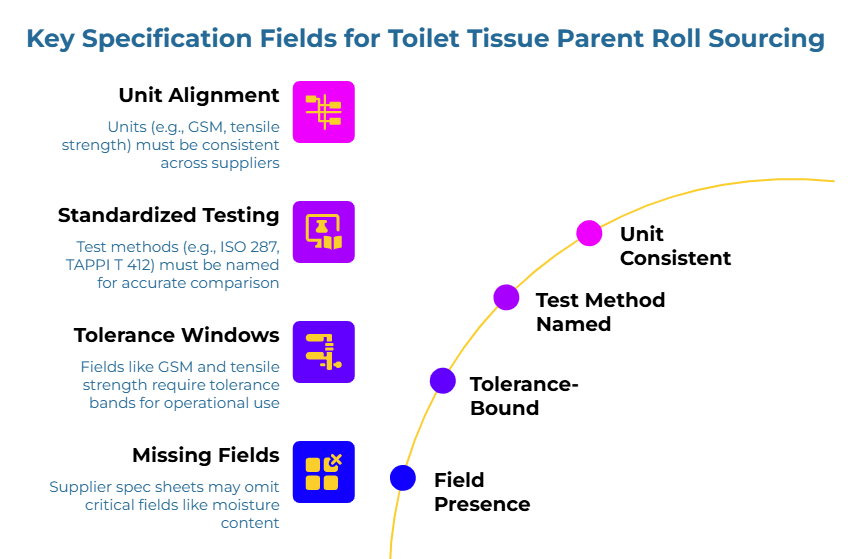
Work through each core specification field and ask four questions.
Is the field present? Some supplier specification sheets omit fields that matter to your line. Moisture content, for example, may not appear on a data sheet even though your converting equipment is sensitive to moisture variation. If a field is missing entirely, you cannot evaluate it—and you cannot compare suppliers on it.
Is the field tolerance-bound? A supplier may state a GSM value of 18.5 without specifying an acceptable range. A nominal value without a tolerance band is not a specification. It is a target with unknown variance. Fields like grammage, bulk, and tensile strength require tolerance windows to be operationally useful. Without them, you have no basis to accept or reject a shipment.
Is the test method named? Two suppliers quoting the same moisture percentage may be using different testing methods. ISO 287 and TAPPI T 412 both measure moisture, but their results are not directly interchangeable. If the test method is unnamed, apparent comparability is false. For tensile strength in tissue products, ISO 12625-4 provides the tissue-specific methodology that general paper standards do not address.
Is the unit consistent? GSM measured in grams per square meter is standard, but tensile strength can appear in different units across suppliers. If your internal QA team uses one unit and the supplier uses another, reconciliation errors follow.
The fields most likely to create quote gaps in toilet tissue parent roll sourcing include grammage (commonly expressed as GSM; check for tolerance bands and test method references such as TAPPI T 410), moisture content (percentage range and named test method), bulk and caliper (measurable ranges consistent with GSM targets), and tensile strength (test method alignment with machine-direction and cross-direction values specified).
As you map these fields, note which values are documented, which are assumed, and which are missing entirely. This mapping becomes the foundation for the next phase.
For a deeper examination of GSM and bulk interdependencies, see how to set baseline gsm and bulk specifications for toilet tissue paper contracts.
48–72 Hours: Turn Findings Into a Buyer-Owned Toilet Tissue House Baseline
The final phase translates audit findings into a shared internal baseline. This is not yet a full normalization project. It is the groundwork that makes normalization possible.
Separate must-have fields from secondary fields. Identify which specification fields directly affect runnability on your toilet tissue converting line. GSM and moisture content are almost always critical—these two variables interact with machine tension, winding behavior, and downstream converting performance. Other fields may be secondary depending on your specific equipment configuration and product mix.
Write down named test methods where possible. If your QA team tests moisture using a specific test method, record it. If a supplier uses a different test method, note the gap. Test method alignment is a prerequisite for true specification comparability. A moisture reading of 6.5% means different things depending on how it was measured—and whether it is calculated on a wet-basis or an oven-dry basis.
Record gaps without escalation. The purpose of this phase is documentation, not confrontation. Note where supplier specifications are missing, vague, or incompatible with internal requirements. These gaps become the basis for future conversations—conversations that seek clarification rather than demand immediate change.
Prepare clarifying questions for suppliers. Frame questions to seek transparency rather than create conflict. “Can you confirm the test method used for the moisture percentage on your specification sheet?” opens dialogue. “Your specifications are wrong” closes it.
Create a shared worksheet. Build a simple Procurement-QA-Operations audit worksheet that lists each critical field, the supplier’s stated value, your internal requirement, and any identified gap. This shared document ensures all three functions work from the same information.
For a structured approach to building this internal alignment, see the blueprint for runnability: standardizing your toilet tissue parent roll specifications.
Common Mistakes That Ruin a Toilet Tissue Supplier-Specification Audit
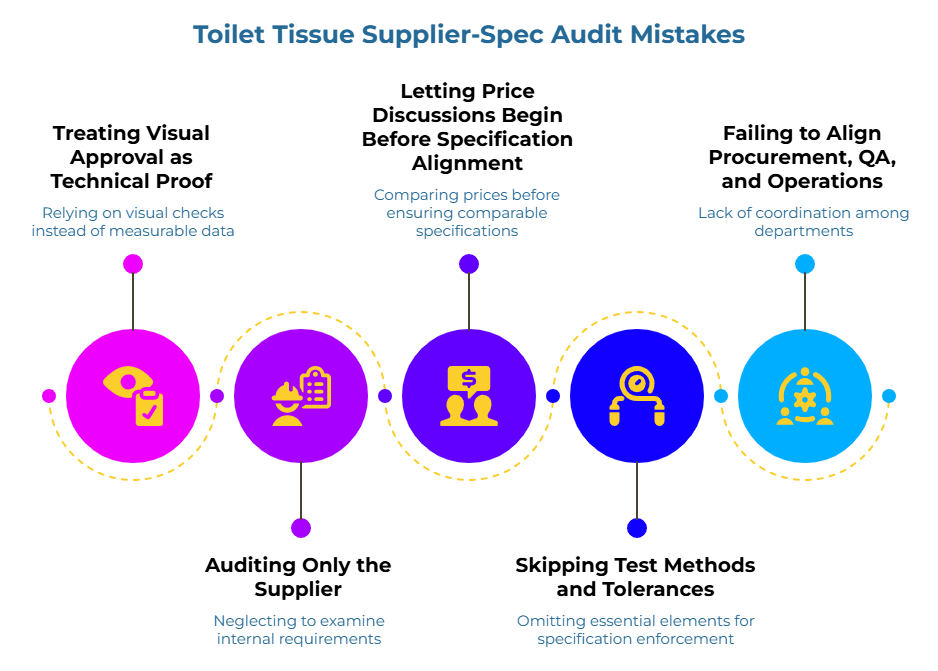
Even well-intentioned audits fail when teams fall into predictable traps.
Treating visual approval as technical proof. A sample roll that looks and feels acceptable may still fail at converting-line speeds. Visual checks cannot detect GSM variance within a roll, moisture instability across a shipment, or tensile weakness that only appears under machine tension. Specifications must be measurable and measured.
Auditing only the supplier, not your own assumptions. Many teams focus exclusively on what suppliers provide while ignoring what their own internal requirements actually demand. If your house baseline is undefined, you cannot audit supplier alignment to it. The audit must examine both sides of the gap.
Letting price discussions begin before specification alignment. Comparing prices before comparing specifications creates false savings. A lower unit cost means nothing if the roll jams more frequently, produces more waste, or requires constant machine adjustments. Price comparisons only make sense when specifications are comparable. This is where the “comparability before price” principle becomes operational.
Skipping test methods and tolerances. A specification without a named test method is not fully comparable across suppliers. A specification without a tolerance band cannot be enforced at receiving. Both elements must be present for a specification to function as intended.
Failing to align Procurement, QA, and Operations. If Procurement evaluates suppliers on price, QA evaluates on test results, and Operations evaluates on runnability—and none of these groups shares definitions—audit findings will conflict. A shared baseline requires shared definitions established before the audit begins.
For guidance on aligning moisture and absorbency tolerances across these functions, see 4 steps to normalize absorbency and moisture tolerances before evaluating toilet tissue paper parent roll suppliers.
What To Do After the First 72 Hours
The audit is a starting point. The next steps are not “find a new supplier” or “renegotiate prices immediately.” The next steps are internal.
Tighten your buyer-owned toilet tissue house baseline. Standardize the fields that matter most to runnability. Align internal test methods with supplier specifications—or identify where alignment conversations are needed. Improve quote comparability so future RFQs yield responses that can actually be compared. When your baseline is defined, you can submit your buying requirements with the precision needed for comparable supplier responses.
Once your baseline is clear, supplier conversations become more productive. Quote gaps become visible and discussable. Assumption gaps become negotiable. And when you do compare prices, you compare prices for the same thing.
For a checklist-based approach to the normalization work that follows this audit, see understanding the toilet tissue paper specification-to-normalization checklist.
Frequently Asked Questions
What toilet tissue parent roll specifications should be checked first?
Start with GSM, moisture content, and bulk. These three fields interact closely and are common sources of machine jams, tension inconsistencies, and yield loss. If these are uncontrolled or unmeasured, downstream problems are likely regardless of how other specifications perform.
Does auditing current supplier specifications mean changing suppliers?
No. The audit is a transparency exercise that documents what is currently assumed and what is actually specified. It creates the foundation for informed decisions. Supplier changes are a separate decision that may or may not follow, depending on what the audit reveals and how suppliers respond to clarification requests.
What if the supplier uses a different test method than our internal team?
Document the difference as a gap. Some variation between test methods can be managed through conversion factors or by requesting results in both formats. Other gaps may require the supplier to adjust their reporting or may require your team to adapt internal processes. The first step is knowing the gap exists.
Which gaps are most likely to cause toilet tissue converting machine jams?
Moisture variation outside tolerance is one of the most common causes of runnability problems in toilet tissue converting. Moisture affects how paper behaves under tension, how it responds to winding and unwinding, and how it performs in downstream converting steps. GSM instability and bulk inconsistency also contribute to jams, tension problems, and yield loss.
Explore more toilet tissue specification guides in the PaperIndex Academy.
When your house baseline is ready and you want to explore supplier options, review toilet tissue parent roll suppliers or toilet tissue mills.
Disclaimer:
This article is educational and methodology-first. It does not provide price guidance, market-intelligence products, or supplier endorsements.
Our Editorial Process:
Our expert team uses AI tools to help organize and structure our initial drafts. Every piece is then extensively rewritten, fact-checked, and enriched with first-hand insights and experiences by expert humans on our Insights Team to ensure accuracy and clarity.
About the PaperIndex Insights Team:
The PaperIndex Insights Team is our dedicated engine for synthesizing complex topics into clear, helpful guides. While our content is thoroughly reviewed for clarity and accuracy, it is for informational purposes and should not replace professional advice.