

📌 Key Takeaways
A cheap folding carton quote usually means a different folding carton—not a better price—because vague specifications let suppliers fill in the blanks differently.
- Price Gaps Signal Specification Gaps: A quote 15% below others often reflects looser tolerances or lighter materials, not smarter pricing.
- Certificates Prove Systems, Not Suitability: A supplier’s ISO badge confirms they have quality processes—it doesn’t prove this specific folding carton matches your production needs.
- Small Savings Vanish Fast: A $0.05 unit discount disappears the moment downtime costs thousands per hour in jams, rejects, or rework.
- Normalize Before You Compare: Define board grade, moisture limits, and test methods in your RFQ so every supplier quotes the same folding carton.
- Specification Discipline Is Risk Control: Clear specifications don’t raise costs—they make hidden costs visible before the purchase order goes out.
The lowest invoice total and the lowest total cost are rarely the same number.
Procurement managers and packaging engineers sourcing folding cartons will gain a practical framework for avoiding spec-driven failures, preparing them for the detailed workflow that follows.
~ ~ ~ ~ ~ ~ ~ ~ ~ ~ ~ ~ ~ ~ ~ ~ ~ ~
When the Cheapest Folding Cartons Shut Down the Line
It is 2:00 PM on a Tuesday. A major shipment of folding cartons arrives at the dock, and within minutes, the production line grinds to a halt. The folding cartons look fine. The paperwork checks out. But the COBB values are wrong, and the filling equipment cannot run material that absorbs moisture at this rate.
This is the lowest bidder myth in action.
The assumption that the lowest unit price equates to procurement efficiency is a common byproduct of budget pressure. While the mandate for savings is constant, a quote sitting 15% below the median often masks misaligned material baselines. And there sits a quote, sometimes 15% below the others, promising both. But here is what that number often conceals: the supplier is not quoting the same folding carton. They are quoting their interpretation of a vague specification, with different material assumptions, looser tolerances, or performance characteristics that will only reveal themselves when production begins.
Think of it like hiring builders to construct a house. If five contractors receive the same architectural blueprint with exact specifications, their quotes become comparable. But if each builder is left to assume their own foundation depth, material grade, and finishing standards, the lowest bid is not a bargain. It is a different house.
The “cheapest quote wins” mentality does not save money. It transfers cost from the procurement budget into operations, where it surfaces as downtime, rejected folding cartons, rework, and supplier disputes that nobody budgeted for.
Myth: The Lowest Unit Price Means the Lowest Total Cost
The appeal of this belief is understandable. Procurement teams face constant pressure to reduce costs, and a lower unit price appears to deliver exactly that. When budgets are tight and leadership is watching, choosing the cheapest option feels like responsible stewardship.
The problem is that unit price only tells part of the story. A folding carton quote reflects the supplier’s assumptions about material grade, barrier coatings, dimensional tolerances, and performance requirements. When those assumptions differ from what production actually needs, the “savings” become imaginary. The real cost simply shifts downstream, where it becomes harder to measure and easier to blame on other factors.
Reality: A Cheap Quote Usually Means a Different Folding Carton Than You Think or Need
The failure mechanism matters. Buyers send vague or incomplete RFQs, and when folding carton specifications lack defined tolerances, suppliers fill in the blanks differently. One supplier assumes a lighter board. Another assumes wider tolerance bands. A third assumes lower barriers or performance requirements because the RFQ never defined them. One quote then looks dramatically cheaper because it is effectively quoting a different folding carton.
When that folding carton reaches the line, the mismatch appears through moisture behaviour, fit problems, repeatability failures, or all three at once. Operations absorb the cost through downtime, rejects, rework, or urgent replacement activity.
This happens because quote variance is not a market mystery. It is a sign that suppliers are pricing different versions of the same job. Without explicit tolerances, test methods, or performance thresholds, suppliers fill gaps based on their own capabilities and inventory. The quotes arrive looking comparable, but they describe fundamentally different products.
Where Cheap Folding Cartons Fail First on the Production Floor
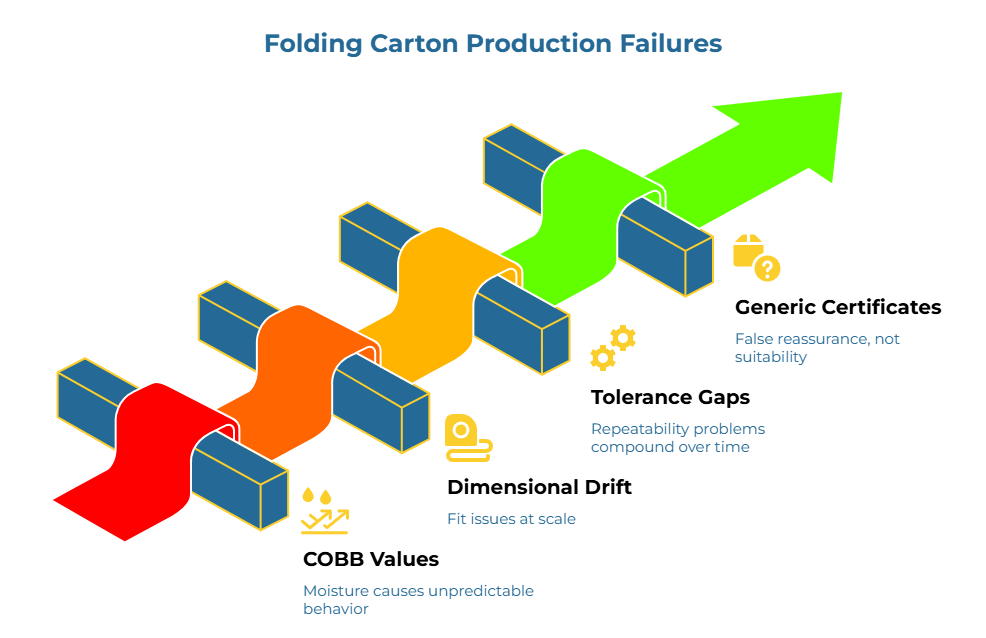
Production failures from specification mismatches tend to cluster around a few predictable failure points.
COBB values and moisture behaviour represent a common source of disruption. COBB values measure water absorptiveness under the Cobb method, as standardized in ISO 535:2023 and TAPPI T 441. Folding Cartons with incorrect COBB values behave unpredictably when they encounter moisture during filling, storage, or transit. A value that looks acceptable on paper can cause warping, softening, or coating failure under real conditions.
Dimensional drift and fit issues create problems at scale. A folding carton that measures correctly on a sample might drift outside tolerance across a production run, particularly when vendor-led data sheets substitute for buyer-owned specifications. When the caliper varies by even small amounts, automated filling lines jam, closures fail to seat properly, and rejection rates climb. Small dimensional gaps can erase a visible unit saving very quickly.
Tolerance gaps and repeatability problems compound over time. A single acceptable batch does not prove control. Suppliers operating without tight process controls may deliver acceptable folding cartons on one shipment and out-of-specification folding cartons on the next. Without defined acceptance criteria, these variations go undetected until they disrupt production. The problem is not that one party is acting in bad faith. The problem is that the sourcing process allowed different interpretations of the requirement.
Generic certificates offer false reassurance. A supplier’s ISO certification or general quality documentation confirms that systems exist. It does not confirm that this specific carton, produced on this specific run, meets your specific requirements. Certificates verify capability; only specification-aligned evidence verifies suitability. For more on this distinction, see why certificates alone do not qualify a folding carton supplier.
Why a Small Unit Saving Disappears the Moment Downtime Starts
The economics of cheap folding cartons become clear when production stops.
Consider a simplified illustration: a folding carton that costs $0.05 less per unit sounds attractive across a large order. But a single hour of production downtime—caused by folding cartons that jam equipment, fail inspections, or require rework—can cost several thousand dollars depending on the operation. The unit savings evaporate in minutes.
| Scenario | Visible Impact | Hidden Impact |
| Folding carton moisture behaviour causes line jam | $0.05/unit “saving” | Downtime, emergency supplier calls, overtime labour |
| Dimensional drift triggers rejection spike | Lower invoice total | Rework, delayed shipments, customer complaints |
| Generic certificate accepted without run-specific proof | Faster supplier approval | Audit findings, compliance exposure, repeat failures |
Table: Illustrative comparison of visible savings versus hidden operational costs
This is not an argument against cost control. It is an argument for understanding where cost actually lives. The lowest invoice total and the lowest total cost are rarely the same number.
The Specification-True Mindset: What Smart Buyers Compare Before They Compare Price
The correction is not to ignore price. It is to ensure that every quote describes the same folding carton before price enters the conversation.
Material baseline comes first. Board grade, weight, and fibre composition determine the folding carton’s structural foundation. Without explicit requirements here, suppliers assume what their mills produce most efficiently.
Barrier and performance requirements must be named, not implied. COBB thresholds, grease resistance, and coating specifications need to appear in the RFQ with measurable targets. “Food-safe” or “moisture-resistant” are not specifications—they are categories that invite interpretation.
Caliper and tolerance clarity prevents dimensional drift from becoming a production problem. Defining not just the target thickness but the acceptable variance ensures that suppliers understand the precision required. The board grade tolerances that separate reliable folding cartons from problem folding cartons often amount to fractions of a millimetre.
Test methods and acceptance criteria remove ambiguity about how compliance will be measured. Referencing specific standards (ISO, TAPPI, or equivalent) ensures that suppliers and buyers are evaluating performance the same way, a principle explored in depth in building a proof ladder for folding carton suppliers.
Supplier evidence tied to named specification fields closes the loop. Rather than accepting generic documentation, buyers can request proof that maps directly to the requirements in the RFQ. This shifts the conversation from “trust us” to “here is the evidence.”
For a structured approach to defining these fields, the folding carton specification alignment checklist provides a practical starting framework.
A Simple 5-Step Prevention Workflow Before Your Next Folding Carton RFQ
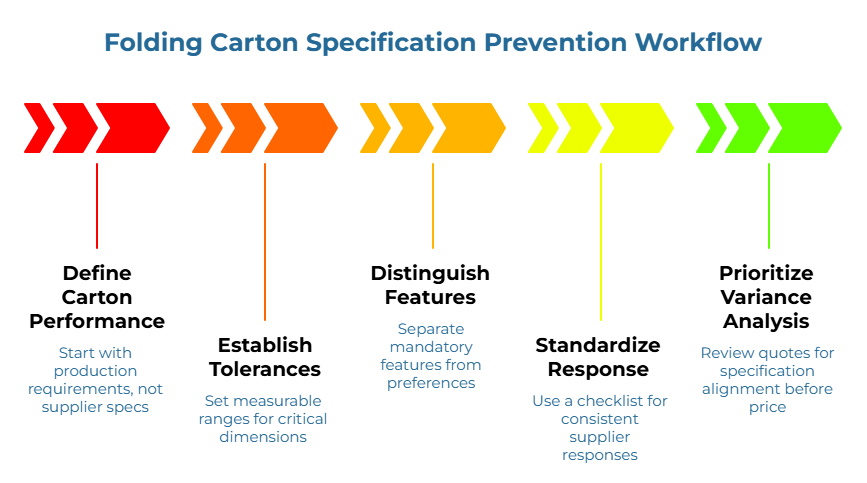
Preventing specification-driven failures does not require a complete procurement overhaul. A few disciplined steps before releasing an RFQ can eliminate most of the variance that causes downstream problems.
1. Define the folding carton based on real-world performance. Start with production requirements, not the last supplier’s specification sheet. What does the filling line require? What conditions will the folding carton face in storage and transit? Build the specification around real-world performance, not inherited assumptions.
2. Establish measurable tolerances for every critical dimension. Every critical dimension needs a target value and an acceptable range. “Approximately 300 gsm” invites interpretation. “300 gsm ± 3%” creates a measurable standard.
3. Distinguish between mandatory features and preferences. Not every specification carries equal weight. Distinguish between must-have requirements (where non-compliance is disqualifying) and nice-to-have preferences (where trade-offs are acceptable). This prevents suppliers from cutting corners on critical elements to hit a price target.
4. Standardize the response framework. Issue a baseline packaging parameter checklist that defines exactly what the quote must address. When every supplier responds to the same fields, comparison becomes meaningful.
5. Prioritize variance analysis over price. Before evaluating cost, review how each quote interprets the specification. Flag any assumptions that differ from requirements. Only after specification alignment is confirmed does price comparison make sense. Clarity before supplier review prevents false comparisons.
How to Explain This to Leadership Without Sounding Anti-Cost-Control
Advocating for specification discipline can feel awkward when leadership is focused on reducing spend. The key is framing: this is not an argument against cost control. It is an argument for accurate cost control.
The language that tends to resonate positions specification alignment as risk management and budget predictability. Vague specifications create variance. Variance creates surprises. Surprises disrupt budgets. A disciplined RFQ process does not increase costs—it makes costs visible earlier, when they can still be managed.
When a lower-priced supplier can demonstrate that their folding carton meets every specification field with documented evidence, that is a genuine saving worth capturing. When a lower price reflects undisclosed material substitutions or looser tolerances, that is a risk transfer disguised as a discount.
A low quote is not automatically a bargain. It may simply be a different folding carton hiding behind weaker assumptions. The goal is not to pay more. The goal is to know what the organisation is actually buying before the purchase order goes out.
Cheap Folding Cartons Are Only Cheap Until the Line Stops
The lowest unit price is not the same as the lowest total cost. A quote that arrives 15% below the median is usually not a bargain—it is a different folding carton, with different assumptions, heading toward a different outcome on the production floor.
The correction is straightforward: define specifications before requesting quotes, align every supplier to the same framework, and verify that the documentation matches the requirements. When this discipline is in place, cost comparisons become meaningful, supplier relationships become more productive, and production disruptions become preventable. Buyers who make that shift move from reactive price shopping to defensible, specification-led cost control.
Next Steps:
- Read the folding carton specification alignment checklist for a practical framework to structure your next RFQ.
- Review what proof to request at RFQ stage for folding cartons to understand how specification-aligned evidence replaces generic documentation.
- Explore folding cartons on PaperIndex to connect with verified suppliers.
- Visit the PaperIndex Academy for additional resources on procurement methodology.
Disclaimer: This article is educational. PaperIndex does not sell market intelligence or publish pricing indices.
Our Editorial Process:
Our expert team uses AI tools to help organize and structure our initial drafts. Every piece is then extensively rewritten, fact-checked, and enriched with first-hand insights and experiences by expert humans on our Insights Team to ensure accuracy and clarity.
About the PaperIndex Insights Team:
The PaperIndex Insights Team is our dedicated engine for synthesizing complex topics into clear, helpful guides. While our content is thoroughly reviewed for clarity and accuracy, it is for informational purposes and should not replace professional advice.