

📌 Key Takeaways
Price swings hurt more when you lack leverage, and weak leverage makes volatility more dangerous. Treating them as separate problems guarantees reactive firefighting instead of strategic control.
- Budget Bands Replace Panic with Prepared Responses: Simple low/base/high price ranges transform unpredictable kraft paper costs into manageable scenarios with pre-agreed actions for each threshold.
- Small Buyers Need Different Levers, Not Bigger Muscles: Modest volume commitments, forecast sharing, reliability signals, and spec flexibility build leverage gradually without requiring container-level orders.
- Integration Patterns Match Reality to Strategy: Whether facing high volatility with low power, moderate swings, or improving leverage, each situation demands a coherent mix of bands, supplier tactics, and customer pricing rules.
- Internal Alignment Scripts Turn Systems into Credibility: Giving sales, finance, and leadership clear, consistent language about bands and triggers replaces blame cycles with productive discussions about risk corridors.
- Preparation Beats Negotiation Theater: SMB converters can’t out-muscle mills, but they can out-prepare them by designing budgets and contracts that absorb volatility within chosen margins instead of fighting structural power gaps.
The playbook shifts procurement from explaining margin collapses to presenting options grounded in data and deliberate design.
Procurement and sourcing managers at small and mid-sized packaging converters will gain a practical integration framework here, preparing them for the detailed patterns and implementation guidance that follows.
The email arrived Tuesday morning. Subject line: “Kraft Paper Price Adjustment – Effective Next Month.” Your stomach drops before you even open it. Another 8% increase. You have 48 hours to explain this to your owner, update customer quotes, and somehow keep the plant running without blowing the quarterly budget.
This scenario plays out across small and mid-sized packaging converters every few months. The problem isn’t just that kraft paper prices move—it’s that they move while you’re negotiating from a position of structural weakness. You buy smaller volumes than the big players. You have fewer backup suppliers. When allocation gets tight, you’re not first in line.
Two challenges are squeezing you simultaneously: kraft paper price volatility and budget management (the unpredictable swings in pulp, energy, freight, and currency that hit your costs) and limited negotiating power of packaging paper converters with kraft paper suppliers (the structural disadvantage that comes from buying moderate volumes in a market where scale matters). Kraft paper is a commodity-grade substrate made from wood pulp via the kraft process, with prices influenced by pulp markets, energy costs, freight rates, and currency movements no individual SMB converter can control. Most converters treat these as separate headaches. They’re not. They amplify each other, and the solution requires integrating your response to both.
This playbook shows how budget bands, volatility scenarios, and realistic negotiation levers fit together into one coherent sourcing strategy you can execute with spreadsheets, structured conversations, and the relationships you already have.
Two Intertwined Problems: Price Swings and Weak Leverage
Think of kraft paper sourcing as a tug-of-war. On one side, large buyers with container-level orders and multi-year contracts pull hard. On the other side, small converters buying a few pallets per month struggle to get the same attention or terms. The rope is kraft paper pricing and allocation priority.
Now add a complication: the rope itself keeps moving. Pulp indices shift. Ocean freight rates spike during peak season. Currency fluctuations change landed costs overnight. Energy surcharges appear on invoices without warning. For a large buyer with dedicated procurement teams and hedge strategies, these moves are manageable bumps. For a small converter running lean, each swing feels like the ground shifting beneath you.
Limited negotiating power of packaging paper converters with kraft paper suppliers is a component of overall kraft paper sourcing risk for SMB converters. Your small order size isn’t a personal failing. It’s a structural reality. Mills and traders prioritize customers who commit to steady volumes, accept standard grades, and pay reliably. When you order sporadically, request custom specs, or stretch payment terms, you become a higher-cost account to service. Most SMB converters represent a very small fraction of any single mill’s total output, which creates predictable power asymmetries in supplier negotiations. The result: less favorable pricing, lower allocation priority during shortages, and fewer alternatives when you need to switch suppliers.
Unmanaged kraft paper price volatility causes budget shocks and tense internal conversations. When your base kraft paper cost jumps 12% in a quarter and you haven’t prepared your owner or updated customer contracts, the conversation turns defensive. You’re explaining why margins compressed instead of presenting options. Operations worries about supply disruptions. Finance questions why procurement didn’t see it coming.
The stress compounds because the math is unforgiving. Many converters operate on thin net margins, which can often fall into the single digits, making them exceptionally vulnerable to cost shocks. To illustrate the impact, for a business in that position, a 5-7% kraft price increase could plausibly compress net margin by several percentage points—in some scenarios, cutting profit in half for that period. Consider the mechanics: if revenue from boxes and bags stays flat while your average kraft cost per kilogram jumps 6%, that entire increase flows directly into your gross margin calculation. Without a deliberate plan to absorb or pass through that shock, one supplier email can erase a quarter’s worth of operational improvements.
These problems reinforce each other. Volatility makes you reactive, which weakens your negotiating position. Weak leverage means you absorb more volatility because you can’t lock favorable structures or diversify easily. Breaking this cycle requires treating budget management and leverage-building as one integrated strategy, not separate projects.
Budget Shock Absorbers: Low/Base/High Bands and Simple Scenarios
Imagine trying to manage your household budget if your biggest expense—say, transportation—could swing 20% up or down each month with no warning. You’d either overspend constantly or keep such a large cash cushion that you’d waste opportunity. Kraft or brown paper buyers face the same challenge at a business scale.
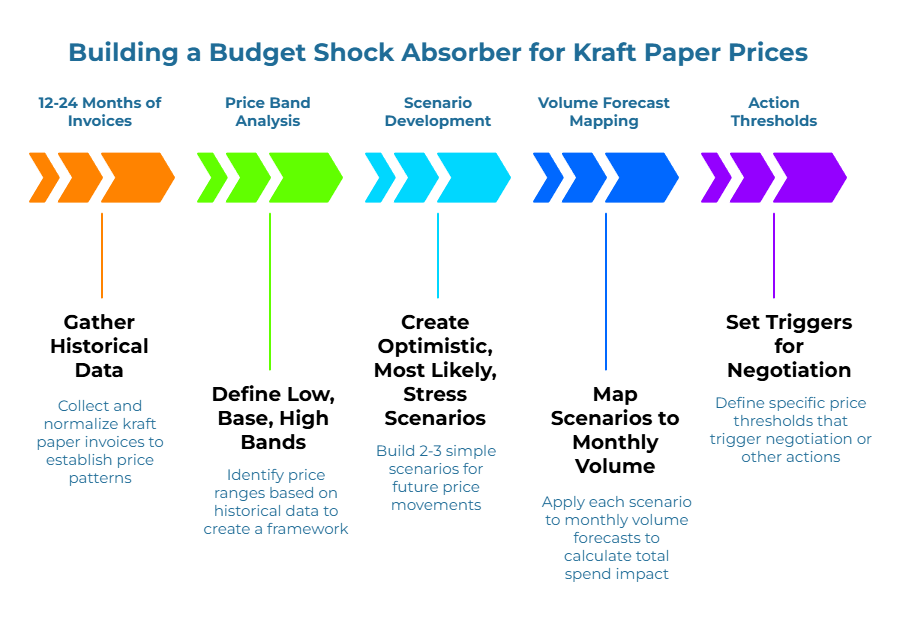
The solution isn’t perfect price forecasting. It’s building a budget shock absorber that turns unpredictable swings into manageable ranges. Start by collecting your last 12 to 24 months of kraft paper invoices. Strip out one-time surcharges and normalize quotes to the same delivery basis. Plot the prices. You’ll typically see a pattern: most months cluster around a middle range (your base band), with occasional dips to a low band and spikes into a high band.
These three bands become your framework:
Low Band: The favorable price level you see during periods of surplus, weak demand, or favorable freight conditions. This might represent your lowest 15-20% of historical observations.
Base Band: The most common range where prices settle during normal market conditions. This is where you’ll spend most months, and it’s the foundation for your budget planning.
High Band: The stress zone triggered by supply constraints, energy shocks, freight surges, or currency moves. This might represent your highest 15-20% of observations.
Once you have bands, build 2-3 simple scenarios for the next 6-12 months:
- Scenario A (Optimistic): Prices drift toward or stay in the low band. What’s your total spend? What margin improvement does this enable?
- Scenario B (Most Likely): Prices fluctuate within the base band. This becomes your working budget.
- Scenario C (Stress Case): Prices push into or stay in the high band for an extended period. What’s the margin impact? When do you need to act?
Map each scenario to your monthly volume forecast and calculate total spend impact. Now you have a range instead of a single fragile number. When your owner asks, “What happens if kraft paper goes up again?” you show three paths with concrete numbers. When a supplier proposes an increase, you know immediately whether it keeps you in the base band or pushes you into high-band territory where different actions are required.
This framework isn’t about predicting the future. It’s about replacing panic with prepared responses. The bands give you a shared language with owners and operations. The scenarios give you thresholds that trigger specific actions—including which negotiation levers to pull.
For a detailed walkthrough of building these bands in a spreadsheet, see our guide on kraft paper price volatility and budget management.
Realistic Levers When Your Negotiating Power is Limited
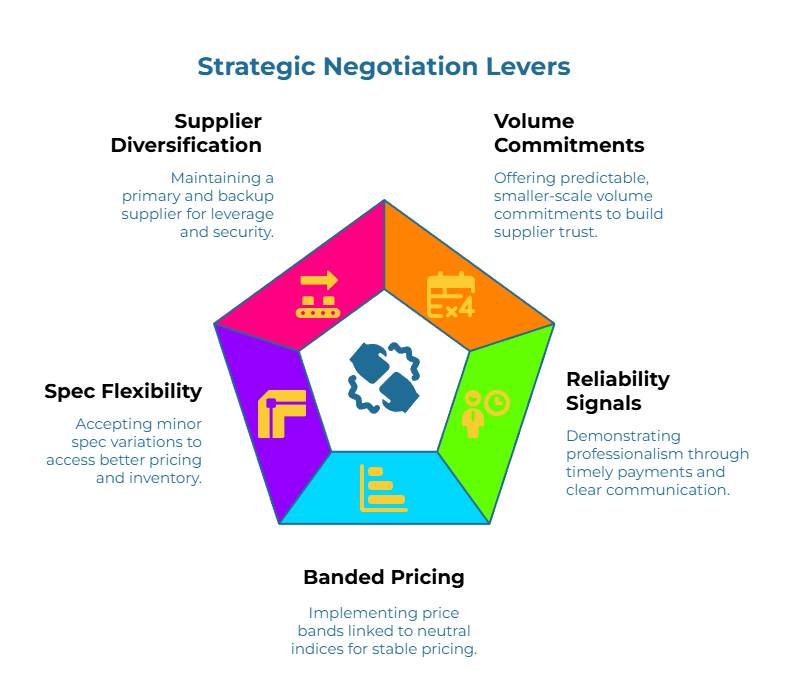
You can’t negotiate like a buyer who orders 500 tons per month when you’re buying 15 tons. Trying to strong-arm suppliers with volume threats you can’t back up damages relationships without improving terms. The key is using levers that work at a smaller scale.
Modest Volume Commitments and Forecast Sharing: You may not be able to commit to container loads, but you can offer a 3-6 month rolling forecast with reasonable accuracy. Suppliers value predictability. If you historically order once every 6 weeks in erratic quantities, shifting to a monthly cadence with advance notice reduces their working capital risk and can justify modestly better pricing or more reliable allocation.
Reliability and Communication Signals: Pay on agreed terms. Respond to quotes promptly. Provide clear specs upfront. Document quality acceptance criteria before orders, not during disputes. These behaviors cost you nothing but signal you’re a professional account worth serving. Over 12-24 months, this builds goodwill that translates into better treatment during allocation squeezes.
Banded Price Structures and Limited Index-Linked Portions: You don’t need huge volumes to propose a banded pricing agreement. The band might be wider than what a large buyer gets, but the principle works: if the supplier’s cost drivers stay within a defined range, your price holds. If drivers breach the threshold, both parties revisit terms using documented data, not arbitrary increases. Start small—propose linking 20-30% of your volume to a neutral index while keeping the rest on negotiated fixed pricing. This shows sophistication and reduces confrontational renegotiations.
Spec and Grade Flexibility: Can you run 70gsm instead of 75gsm for certain applications without compromising performance? Can you accept a slightly different shade or moisture spec if it means accessing mill overflow inventory at a discount? Small converters often over-specify. Giving suppliers flexibility on non-critical parameters can unlock better pricing or priority access during shortages.
Gradual Supplier Diversification: You don’t need five suppliers. You need two: a primary relationship for 60-70% of volume and a qualified backup for 30-40%. This isn’t about playing suppliers against each other with every order. It’s about demonstrating credible alternatives when discussing multi-month commitments or annual contracts. The backup supplier knows they’re secondary but values the steady business. Your primary supplier knows they can’t take your account for granted.
None of these levers deliver immediate 15% discounts. They’re not meant to. They gradually improve your risk position, stabilize terms, and give you options when volatility forces a decision. For a deeper exploration of building leverage despite limited volume, see our practical playbook for SMB packaging converters.
Three Integration Patterns: Matching Your Situation to a Coherent Strategy
Budget bands and negotiation levers mean little if they sit in separate spreadsheets. The power comes from connecting them based on your specific situation. Most SMB converters will recognize themselves in one of three patterns, each requiring a different integration approach.
Pattern A: Low Power, High Volatility
This is the most stressful position. You depend on one or two mills or dealers, have limited alternative supply options, and operate in a market where kraft prices move sharply and frequently.
Paper Strategy: Treat core grades as lifeline materials. Focus on building reasonably stable relationships with your 1-2 key kraft paper suppliers, even if that means accepting prices that aren’t always the absolute lowest. Explore partial index-linked contracts or transparent formula-based pricing for a portion of volume, so at least some price movements are predictable and explainable to customers.
Budget and Bands: Use relatively wide low/base/high bands for kraft, reflecting the historical volatility. Set the base closer to the conservative side rather than the recent low. Run simple quarterly scenarios—test what happens at +5% and +8% kraft increases—to understand margin impact and prepare response options before they’re needed.
Customer Pricing: Define clear, written rules for when kraft moves must trigger a customer review, especially for key accounts. Train the sales team on a simple narrative: the business isn’t chasing every short-term dip but staying disciplined around agreed pass-through triggers.
The goal here isn’t to beat the market. It’s to avoid uncontrolled margin collapses when big moves happen. The integration is visible: the reality of weak power and choppy prices drives more conservative bands, more structured communication, and less exposure to pure spot buying.
Pattern B: Low Power, Moderate Volatility
In some markets, kraft prices still move but within a more predictable corridor. You’re still a small buyer, but the price environment is calmer.
Paper Strategy: Continue working primarily with current suppliers, but deliberately stagger contract and price review dates to avoid all changes clustering in the same month. Negotiate for smaller, more frequent adjustments rather than rare, sharp jumps wherever possible.
Budget and Bands: Use narrower bands than Pattern A because the market itself is less volatile. Align band reviews with supplier price review cycles, so planning assumptions don’t drift too far from reality.
Customer Pricing: Offer customers more stable pricing with clearly defined review windows tied to kraft bands rather than ad hoc requests. Emphasize this stability as a differentiator, backed by a clearly described method rather than vague reassurances.
This pattern still respects limited negotiating power but treats it as compatible with a calmer market. Power is weak, but volatility isn’t extreme, so the budget system can aim for stability rather than constant defense.
Pattern C: Improving Power, Still Volatile
Some SMB converters grow into better positions over time through increased volume, improved credit strength, or access to additional mills and traders. Kraft volatility, however, remains part of the landscape.
Paper Strategy: Divide volume into “must secure” base volume and “flexible” volume. Use longer-term or structured arrangements for the former and keep some capacity for opportunistic purchases on the latter. Use the expanded supplier set to create at least limited optionality on price and lead time without fragmenting volume excessively.
Budget and Bands: Set separate bands for base and flexible volumes. The base can use narrower bands with stronger pass-through rules. The flexible volume can be modeled with more aggressive scenarios, both up and down. Tie internal performance discussions less to “did we buy at the absolute low?” and more to “did actual kraft outcomes stay within the planned risk corridor?”
Customer Pricing: For key accounts, formalize more explicit pass-through formulas or clauses linked to kraft bands or indexes. For the rest of the portfolio, standardize surcharges or adjustment tables so sales isn’t improvising from scratch during every move.
Here, improved power allows you to design a more nuanced mix of contracts, bands, and customer rules. Power isn’t an end in itself—it’s fuel for better risk shaping.
For detailed scenario planning tools that support all three patterns, see our guides on kraft paper price volatility and budget management and spot buying vs index-linked pricing.
Bringing Owners and Operations Into the Plan: The Alignment Scripts
Even a well-designed integration playbook fails if each internal function tells a different story. The goal isn’t to turn everyone into procurement experts—it’s to give each team clear, consistent language that connects limited power, volatility, and budget design.
For Sales
Sales needs a simple, honest way to explain changes to customers without sounding defensive or reactive.
The Script: “Our biggest raw material is kraft paper. Prices are influenced by global pulp markets, energy costs, freight rates, and currency movements—factors none of us can control. Instead of reacting randomly to each move, we work with defined kraft price bands and review points. When kraft moves beyond those bands, we come back with transparent, data-driven adjustments rather than surprises. This approach keeps our pricing fair and our supply chain stable.”
Show the sales team, on one page, how the kraft bands relate to customer pricing tiers, typical surcharges, and expected review frequency. That keeps them out of the “blame procurement” loop and positions them as partners in a disciplined system.
For Finance
Finance cares about predictability, cash flow, and margin protection. They need to understand the system’s logic, not just accept its outputs.
The Script: “Given our structural negotiating limits, we cannot fully prevent kraft increases. What we can do is decide how conservative our kraft budget bands should be, define clear triggers for passing through increases, and use scenarios to understand how different band choices affect margin and working capital. You’ll see this in monthly reports as variance against planned bands, not as unexplained margin shocks.”
This reframes the question from “why didn’t you negotiate better?” to “which risk corridor did the business choose, and are actual results staying inside it?” That’s more productive and keeps discussion anchored to deliberate design choices.
For Leadership
Converting plant owners, managing directors, and CEOs often feel kraft spikes as direct hits to perceived performance. They need a concise explanation of what’s controllable and what’s being managed systematically.
The Script: “We accept that, as an SMB converter, our kraft negotiating power is limited right now. Instead of fighting that reality, we’re designing for it. We use clear kraft budget bands that reflect our true risk, link customer pricing rules to those bands, and choose contract patterns that balance stability and flexibility. You’ll see this in our reports as variance against planned bands, not as firefighting and excuses.”
Once leadership recognizes there’s a system in place—rather than ad hoc reactions—trust in procurement and budgeting improves. Discussions can focus on refining the system over time instead of relitigating every price increase.
For a comprehensive checklist to facilitate these internal alignment conversations, see our short checklist for aligning procurement and quality.
Frequently Asked Questions
Is it realistic for a small converter to negotiate index-linked or formula-based kraft pricing?
In many markets, it is possible, especially when a converter has stable volume and a good payment record. The goal isn’t perfect indexing. It’s creating transparent, explainable links between kraft movements and price changes that can be shared with customers. Start by proposing to index just 20-30% of your volume to a neutral benchmark like a regional pulp price index. This demonstrates sophistication without requiring mills to restructure their entire pricing model for your account.
Do wider kraft budget bands always mean lower risk?
Not necessarily. Wider bands can prevent frequent, noisy adjustments, but they also delay action when moves are large. The right width depends on your market’s volatility, your margin strength, and how quickly your customers accept price changes. Pattern A situations (high volatility, low power) typically need wider bands. Pattern B situations (moderate volatility) can use narrower bands for tighter control.
What if customers refuse to accept any price increase?
That situation usually signals a deeper commercial issue. The integration mindset still helps by making the trade-off explicit: if certain accounts cannot absorb increases even when bands are breached, leadership must decide whether to accept structurally lower margins on those accounts or to reshape the customer portfolio. The playbook doesn’t solve every problem—it surfaces choices that were previously hidden in reactive chaos.
How often should kraft budget bands be reviewed?
Most converters find quarterly reviews reasonable, with ad hoc reviews if kraft breaches the top or bottom of a band sooner. The crucial point is having explicit review points instead of waiting for crises. Pattern A converters in highly volatile markets might review monthly. Pattern B converters in stable markets might extend to semi-annual reviews.
Can integration work without complex software or detailed forecasting models?
Yes. The core elements—simple bands, basic scenarios, written pass-through rules, and alignment scripts—can all be handled with spreadsheets and disciplined communication. Forecasting tools and analytics help, but integration is mainly a design and governance discipline, not a technology feature. Most successful SMB implementations start with Excel and graduate to more sophisticated tools only after the process proves valuable.
From Reacting to Leading: Your Path to a Modern Kraft Paper Sourcing Strategy
Kraft paper price volatility and budget management and limited negotiating power of packaging paper converters with kraft paper suppliers are not separate problems you solve independently. They’re intertwined challenges that require an integrated response. Budget bands and scenarios give you clarity on where you stand and what’s at stake. Negotiation levers give you realistic options to improve terms and reduce risk despite smaller volumes. The three integration patterns—matched to your specific power and volatility position—connect them into a playbook you can use in real supplier conversations and internal planning meetings.
This playbook won’t eliminate volatility or turn you into a Fortune 500 procurement department overnight. It will do something more valuable: it gives you control and credibility. Control comes from knowing your bands, understanding your scenarios, and having pre-agreed actions ready when prices move. Credibility comes from walking into owner meetings and supplier negotiations with a structured plan instead of scattered notes and apologies.
Negotiating power and cost visibility symbolize professional security and business continuity. When you master this integration, you’re no longer the person who gets blamed for price shocks. You become the strategist who saw it coming, prepared options, and protected the business within realistic constraints.
Mills will stay powerful. Kraft paper will remain volatile. Those structural realities aren’t changing. What can change is how deliberately your business links those realities to budgeting, band design, and customer pricing rules. SMB converters may not be able to out-muscle kraft suppliers, but they can out-prepare them—by integrating power realities directly into budget and pricing design instead of fighting them on separate fronts.
This playbook is your entry point to a modern kraft paper sourcing strategy. From here, you can go deeper: build more sophisticated scenario models, explore advanced cost driver frameworks, or develop a formal supplier diversification roadmap. Each step builds on the foundation you establish when you map your first bands, identify your pattern, and align your internal teams.
Start with your invoices, identify which pattern fits your situation, and draft your alignment scripts. The rest follows.
Disclaimer: This article provides general information on kraft paper sourcing, budgeting, and contracts. It is not financial, legal, or tax advice. Always consult qualified advisors and consider your specific context before making commercial or contractual decisions.
Our Editorial Process
Our expert team uses AI tools to help organize and structure our initial drafts. Every piece is then extensively rewritten, fact-checked, and enriched with first-hand insights and experiences by expert humans on our Insights Team to ensure accuracy and clarity.
About the PaperIndex Insights Team
The PaperIndex Insights Team is our dedicated engine for synthesizing complex topics into clear, helpful guides. While our content is thoroughly reviewed for clarity and accuracy, it is for informational purposes and should not replace professional advice.