
📌 Key Takeaways
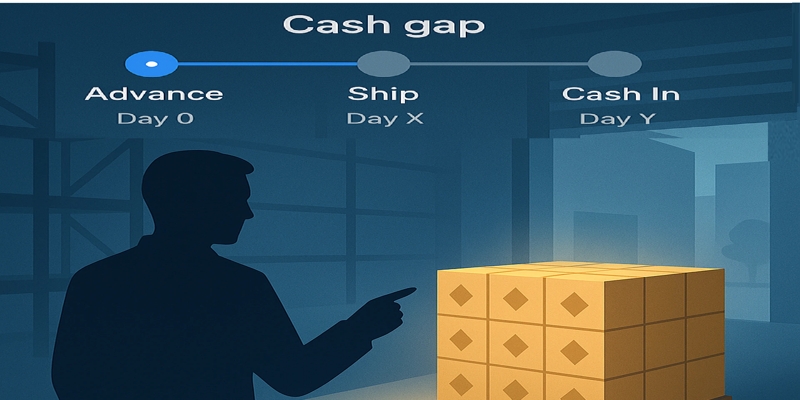
Paper bag procurement creates a cash gap—the time between paying suppliers and recovering money through customer sales—that could stretch 90 to 175 days.
- Five Inputs Define Your Gap: Lead time, MOQ, payment terms, usage rate, and customer payment timing determine how long capital stays locked in bag inventory.
- Peak Value Hits at Arrival: The moment bags reach your warehouse before any consumption, the full order value sits frozen as working capital.
- Shorter Lead Times Shrink Gaps: Suppliers delivering in three weeks instead of eight enable smaller, more frequent orders that reduce peak capital requirements.
- MOQ Flexibility Matters More Than Price: Lower minimums, split shipments, and rolling releases can outweigh modest per-unit savings by freeing trapped cash.
- Quality Failures Create Double Commitments: Rejected batches force emergency reorders while unusable inventory occupies warehouse space, widening the gap through overlapping payments.
Calculate before you commit—rough numbers reveal hidden capital traps.
E-commerce procurement managers, retail operations teams, and brand managers overseeing packaging decisions will gain a practical framework for quantifying working capital impact, preparing them for the supplier evaluation strategies that follow.
Cash leaves before bags arrive.
Picture a procurement manager at a growing e-commerce company with 51–250 employees. A major sales campaign launches next quarter, and the marketing team wants 50,000 custom-printed paper bags with the new brand design. The supplier requires a 30% advance on order confirmation. Six weeks later, the remaining 70% is due when bags ship. Another two weeks pass before inventory reaches the warehouse. Meanwhile, those bags won’t generate a single dollar until customers receive their orders and payments clear.
You’ve likely faced something similar. That uncomfortable stretch when money flows out to suppliers while revenue trickles back slowly from customers. Most procurement professionals recognise this tension intuitively, yet few have a clear method for measuring it or managing it strategically.
This guide introduces a simple “Cash Gap” framework designed specifically for wholesale paper bag sourcing. By the end, you’ll understand exactly where your working capital gets trapped in the procurement cycle and what sourcing decisions can help release it.
Why Paper Bag Procurement Quietly Strains Working Capital
Seasonal campaigns, product launches, and rebranding efforts create sudden spikes in paper bag demand. A food delivery platform preparing for a holiday rush might need to triple its usual order quantity. Whether sourcing kraft paper bags for retail packaging or paper bags for order fulfillment, the working capital challenge remains consistent.A retail brand refreshing its store packaging commits to large volumes of custom-printed bags months before they’re needed.
These situations share a common pattern. Suppliers typically request payment well before bags reach your warehouse. Custom printing adds lead time. Minimum order quantities force larger commitments than immediate demand requires.
The result is a gap that forms between two moments: when cash leaves your business to pay suppliers and when that cash returns through customer sales.
This gap exists in most procurement cycles. But paper bag sourcing has characteristics that can make it particularly pronounced. Printed bags require longer production lead times than plain stock. Design approvals, plate creation, and colour matching extend timelines. And because custom bags serve specific campaigns or branding requirements, they often sit in inventory until those initiatives launch.
For operations teams juggling warehouse space and inventory turnover, this creates planning challenges. For brand managers excited about premium packaging upgrades, the working capital implications remain invisible until finance raises concerns. In many SMEs, the total value of bags sitting in stores and warehouses across the network can easily equal several weeks of margin on core products. Understanding whether inventory overload is silently killing working capital helps quantify this often-invisible strain.
What Is the “Cash Gap” in Wholesale Paper Bag Sourcing?
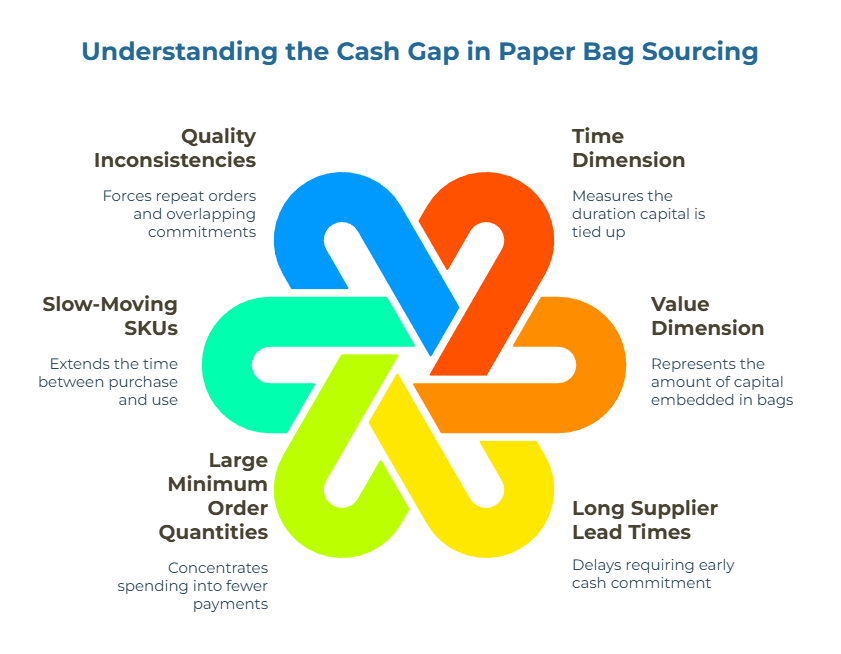
The cash gap represents the difference between paying for paper bags and recovering that money through customer transactions. Think of it as measuring how long your money stays locked inside your packaging inventory.
This concept is a practical subset of what finance teams call the cash conversion cycle—the time between paying suppliers and collecting cash from customers. Here, the focus narrows specifically to paper bag procurement and its effect on cash flow.
The gap has two dimensions worth understanding.
The time dimension measures days. From the moment you transfer funds to a supplier until customer payments hit your account, your capital is unavailable for other uses. A gap of 60 days means two months of tied-up resources. A gap of 90 days means three months.
The value dimension measures money. At any given point, a certain amount of capital sits embedded in bags that haven’t yet contributed to revenue. For a company spending significant amounts monthly on packaging, this can represent substantial working capital held static.
Several factors commonly widen this gap in paper bag procurement:
Long supplier lead times push orders earlier, requiring you to commit cash weeks or months before bags are needed. Large minimum order quantities concentrate spending into bigger, less frequent payments rather than spreading it across smaller, regular purchases. Slow-moving SKUs, particularly seasonal designs or campaign-specific prints, extend the time between purchase and use. And quality inconsistencies can force repeat orders before existing stock is depleted, creating overlapping cash commitments.
Understanding these drivers is the first step toward managing them deliberately rather than accepting them as unavoidable costs of doing business.
The “Cash Gap” Calculator: The 5 Inputs Every Buyer Needs
Calculating your cash gap doesn’t require complex financial modelling. A practical estimate needs just five inputs that most procurement teams can identify from existing records and supplier agreements.
Lead Time and Reorder Frequency
Start with how long it takes from placing an order to receiving bags in your warehouse. This includes production time, any approval cycles for custom printing, and shipping duration.
For standard unprinted bags, lead times might run two to four weeks from established suppliers. Custom-printed bags typically require longer, often six to twelve weeks depending on complexity and supplier location.
Equally important is how often you place orders. Monthly ordering means cash leaves your business twelve times per year. Quarterly ordering concentrates those outflows into four larger amounts. The combination of lead time and order frequency determines how far in advance cash must leave your account relative to when bags are actually used.
Minimum Order Quantity and Batch Size
Custom-printed paper bags commonly carry minimum order requirements. Suppliers need sufficient volume to justify plate setup, colour mixing, and production line changes.
These minimums directly affect your cash gap. A requirement of 20,000 bags when you use 5,000 monthly means each order covers four months of supply. That’s four months of cash committed in a single payment, sitting in warehouse inventory until gradually consumed.
Larger MOQs aren’t inherently problematic. They often come with better per-unit pricing. But the working capital implications deserve consideration alongside the cost savings. A 10% discount loses value if it requires financing inventory for an extra quarter. Many buyers face the MOQ barrier when cash flow is already tight, requiring strategic approaches to volume constraints.
Payment Terms and Actual Payment Behavior
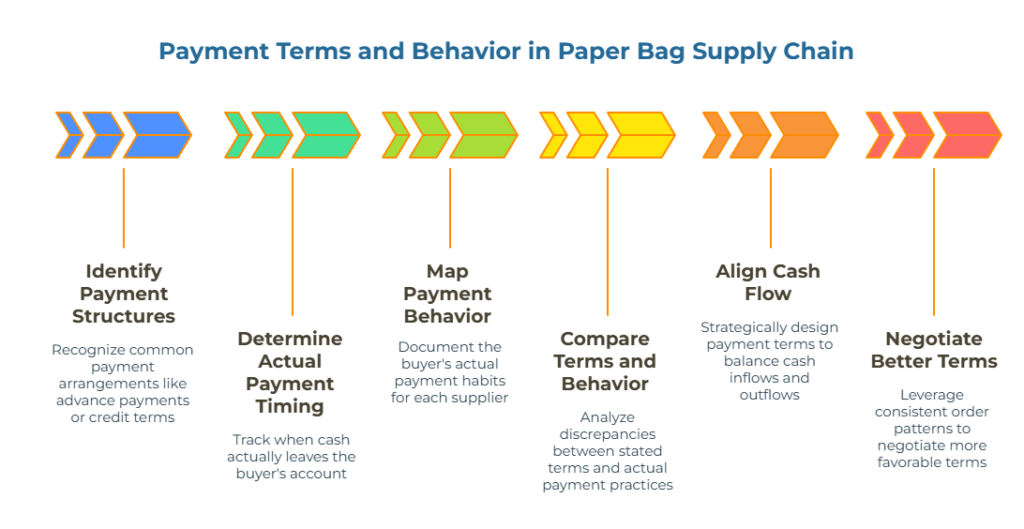
Payment structures vary considerably across the paper bag supply chain. Common arrangements include full payment against proforma invoice before production begins, split payments with 30% advance and 70% on shipment, and credit terms of 30, 60, or occasionally 90 days for established relationships.
The critical factor is when cash actually leaves your account, not what the contract states. An invoice dated upon shipment but paid within seven days of receipt behaves differently than one paid at 45 days.
Map your actual payment timing for each bag supplier. Some buyers discover their real payment behaviour differs significantly from their stated terms, either through early payment habits or processing delays that inadvertently extend credit.
Payment structure is a practical form of risk sharing between buyer and supplier. A strategic approach to payment terms design can align cash in and cash out more effectively than simply accepting supplier defaults.
Reliable buyers with clear demand visibility often negotiate better-aligned terms over time, particularly when they can demonstrate consistent order patterns.
Usage Rate
How quickly do bags move from warehouse to customer? This consumption rate determines how long purchased inventory sits before generating revenue.
A steady-demand business using 10,000 bags monthly has predictable usage. An e-commerce company with seasonal peaks might consume 5,000 bags in slow months and 25,000 during holiday periods.
Usage rate matters because it determines how long each bag, and the cash spent to acquire it, remains locked in inventory. Slow-moving designs for specific campaigns or outdated branding can trap capital for extended periods even while overall business activity looks healthy. Calculating inventory days and understanding how much cash is stuck in slow-moving stock reveals the true cost of these design decisions.
Customer Cash-In Timing
The final input acknowledges that your cash gap extends beyond your warehouse. Revenue from sales doesn’t instantly become available cash.
E-commerce platforms typically operate with payment processing delays. Retail operations may extend credit to business customers. The time between a customer receiving their order in your paper bag and your business having access to those funds adds to the overall gap.
While this timing isn’t strictly a packaging procurement issue, understanding it provides context for interpreting your total cash cycle. A procurement gap of 45 days combined with customer payment delays of 30 days creates 75 days of total cash commitment.
A Simple Worked Example: From PO Date to Cash Back in the Bank
Consider a mid-sized online retailer sourcing custom-printed paper bags for order fulfilment. They use approximately 15,000 bags monthly at a cost of roughly $0.40 per bag, representing $6,000 in monthly packaging spend.
Their supplier requires a minimum order of 45,000 bags (three months’ supply) with payment terms of 30% advance upon order confirmation and 70% upon shipment. Production and shipping take eight weeks from order to delivery.
Here’s how the cash gap develops:
Step 1: Map the Cash Outflow
Day 0 – Purchase order and advance payment: The retailer issues a PO for 45,000 bags totalling $18,000. Advance payment of $5,400 (30%) transfers to the supplier.
Day 45 – Production nearing completion: No further payments yet, but $5,400 has been locked up for 45 days.
Day 56 – Production complete, bags ship: Remaining payment of $12,600 (70%) transfers to the supplier. At this point, the full $18,000 has left the company.
Step 2: Map Bag Arrival and Usage
Day 70 – Bags arrive: All 45,000 bags are now in the warehouse and available for use. At this moment, the full $18,000 sits locked in packaging inventory before any bags have been consumed.
Days 70–160 – Bags consumed: With usage at 15,000 bags per month, the retailer takes approximately 90 days to work through the batch. The last bags from this order are used around Day 160.
Step 3: Map Customer Cash-In
The retailer ships orders steadily, and payments typically clear within 15 days after shipment.
The first orders using these bags ship near Day 71–75, with related cash arriving around Day 86–90. The last orders using the final bags ship near Day 160, with related cash arriving around Day 175.
Step 4: Calculate the Cash Gap
Time gap: First cash out occurs on Day 0. Last related cash in arrives around Day 175. The cash gap spans approximately 175 days.
Value gap (peak): At Day 70 when all bags have arrived but none yet consumed, the full $18,000 sits locked in packaging inventory. As bags are consumed and orders ship, this amount gradually converts back to available capital.
The precision of these numbers matters less than what they reveal. Even rough calculations expose the magnitude of capital committed to packaging and the timeline for its release.
How Sourcing Choices Change Your “Cash Gap”
The cash gap isn’t fixed. Sourcing decisions directly influence its size and duration. Understanding these levers helps procurement teams make choices that balance cost, quality, and working capital efficiency.
Supplier Lead Times and Location
Shorter lead times enable smaller, more frequent orders. Instead of ordering three months’ supply because production takes eight weeks, a supplier delivering in three weeks might allow monthly ordering.
This shift doesn’t necessarily reduce total annual spending on bags. But it transforms the cash flow pattern from large periodic outflows to smaller regular ones, reducing peak capital requirements.
Geographic proximity often correlates with lead time. Exploring paper bag suppliers across different regions reveals alternatives that might offer better lead time profiles for your situation.. A domestic converter may deliver faster than an overseas mill, even if unit costs differ. The working capital benefit of shorter lead times can offset modest price premiums, depending on your cost of capital.
MOQ and Flexibility on Order Cadence
Some suppliers accommodate flexibility that others don’t. Possibilities include lower minimum quantities for repeat customers, split shipments from a single production run, rolling release schedules that spread deliveries across weeks, and consignment arrangements where payment follows usage.
Not every supplier offers these options. Not every buyer qualifies. But exploring alternatives expands your choices beyond accepting whatever terms a current supplier proposes.
Comparing offers from multiple kraft paper bag suppliers often surfaces variations in flexibility that aren’t apparent when working with a single source.
Payment Terms and Risk Sharing
Payment terms reflect supplier perceptions of buyer reliability and competitive dynamics in the market. They’re often more negotiable than buyers assume, particularly for consistent, predictable orders.
Established relationships sometimes unlock extended terms unavailable to new customers. Volume commitments may justify better structures. And suppliers themselves benefit from predictable demand even if payment arrives somewhat later.
The goal isn’t necessarily to stretch payment as long as possible. Aggressive payment delays can damage supplier relationships or exclude you from preferred customer treatment during supply shortages. Rather, the aim is ensuring terms align with your cash cycle rather than working against it.
Quality Consistency and Reprint Risk
Poor quality creates hidden cash gap expansion. Bags rejected during incoming inspection require replacement orders. Campaign bags that arrive with printing defects force emergency reorders while flawed inventory occupies warehouse space.
Each quality failure potentially creates overlapping cash commitments: money tied up in unusable inventory plus new money committed to replacement orders. The gap widens not through planning but through recovery from problems.
Supplier qualification processes exist to prevent these situations. Verification of production capabilities, review of quality control systems, and careful evaluation of supplier track records all reduce the likelihood of quality-driven cash gap expansion.
Understanding how quality variance in paper bags creates hidden costs helps frame quality not just as a product specification issue but as a financial risk management concern.
Using the “Cash Gap” Framework to Plan Your Next Paper Bag Purchase
Transform this framework into a practical tool by capturing specific numbers before your next significant paper bag order.
Before issuing a purchase order, note:
- The total order value and your payment timing (advances, balance, actual transfer dates)
- Expected arrival date at your warehouse
- Projected usage period (how many weeks or months until this inventory is consumed)
- Typical customer payment collection timing
Calculate your approximate gap:
- Days from first payment to last bag consumed, plus customer payment delay
- Peak cash tied up (total order value when fully delivered, before usage begins)
Compare across scenarios:
- Run the same calculation for your highest-volume standard bag
- Run it again for a seasonal or campaign-specific design
- Note which situations create the longest gaps or largest peak commitments
Even rough estimates illuminate patterns. You might discover that campaign bags trap three times more capital per unit than standard packaging. Or that one supplier’s terms create gaps 40% longer than others for similar products. For buyers managing multiple payment streams, a simple guide to seeing and fixing your cash flow gap provides a step-by-step mapping process.
These insights support better conversations. With finance teams, you can quantify the working capital cost of marketing’s packaging requests. With suppliers, you can discuss terms with specific reference to your cash cycle needs. And when evaluating new supplier options, you can factor working capital impact alongside unit price.
Where PaperIndex Fits in Your Working Capital Strategy
PaperIndex operates as a supplier discovery platform that offers direct access to a broader supplier base than most buyers encounter through traditional sourcing channels. With over 6,900+ suppliers across continents, the platform enables comparison shopping for lead times, minimum quantities, and terms alongside price and quality.
For procurement teams working to shrink their cash gap, this expanded visibility matters. Discovering a supplier with four-week lead times instead of eight weeks directly affects how far in advance you commit capital. Finding a converter willing to accept smaller minimums changes the rhythm of your cash outflows. Identifying suppliers whose terms better align with your customer payment patterns reduces the total gap duration.
The PaperIndex Academy provides additional resources for buyers navigating moving from volume constraints to agility and related sourcing decisions.
From Invisible Strain to Intentional Management
The cash gap in paper bag procurement exists whether you measure it or not. Working capital silently flows out to suppliers and slowly returns through customer transactions. The only question is whether you manage this gap intentionally or accept whatever pattern your current sourcing arrangements create.
Most buyers underestimate the cash impact of their packaging procurement. Now you have a framework for seeing it clearly.
Start with your largest paper bag SKU. Sketch out the timeline from payment to revenue recovery. Note the peak capital commitment. Then ask whether your current sourcing approach represents the best available balance of cost, quality, and working capital efficiency.
The numbers don’t need to be precise. Rough calculations expose the pattern. And patterns, once visible, become manageable.
Explore. Calculate. Optimise.
Disclaimer:
This article provides general educational information about working capital management in paper bag procurement. It is not intended as financial, accounting, or business advice specific to your company’s circumstances. The content does not create any advisory, consulting, or professional services relationship between the reader and PaperIndex or the article authors. Readers should consult qualified financial advisors, accountants, or business consultants before making procurement or working capital decisions.
Our Editorial Process:
Our expert team uses AI tools to help organize and structure our initial drafts. Every piece is then extensively rewritten, fact-checked, and enriched with first-hand insights and experiences by expert humans on our Insights Team to ensure accuracy and clarity.
About the PaperIndex Insights Team
The PaperIndex Insights Team is our dedicated engine for synthesizing complex topics into clear, helpful guides. While our content is thoroughly reviewed for clarity and accuracy, it is for informational purposes and should not replace professional advice.